for a special flag-raising
pp. 47-49 · Read in the full issue

Travel
To Solomons’ Vilu Village for a special flag-raising
Taylor describes a trip to Vilu Village, near Honiara, Solomon Islands, and a nemorable meeting with Fred Kona, keeper of the village’s noted museum. She discovers hat there’s much more to Mr Kona than the successful entrepreneur, and that his concern or the future of his recently independent homeland is deep and genuine.
)ne can’t but be impressed nth Fred Kona’s vitality and is constant endeavour to remote Vilu Village, his out oor cultural centre and war luseum near Honiara, lolomon Islands. Although red’s unique promotion cam aigns are successful draw ards, he does have another lessage for his visitors: in the resentation of his museum he as given serious thought to the estiny of newly independent olomon Islands, and the bas irdisation of its culture. This 'as evident on New Year’s )ay, 1980 when one year and ve months after independence, e had his own flag-raising eremony.
It was an extra hot day and ie 250-odd guests, both danders and expatriates, ar ved coughing and spluttering fter the arduous journey from ie capital, Honiara, along the Ikm pothole-ridden, dirt Dad. The perfect host, a smil ig, gesticulating Fred was ailing to greet his guests. ‘lu o insaed bi bi me kam :atem kwick taem.’ (You go iside. I’m coming to start Don.) So, leaving the swirling dust ehind, we entered the Dacious, pleasantly green rounds of Vilu Village, where red’s assistants presented us ith cans of chilled lemonade.
As we sat and sipped our life saver drink, under the shade of the numerous hibiscus trees, the main topic of conversation was: What was the meaning of this ceremony, and why had Fred allowed so much time to elapse before raising the inde pendent Solomons’ flag.
Before anyone could arrive at an answer, Fred had ushered in the last of his guests and. Pied Piper fashion, led us to a cleared area in front of his prize possessions, two Japanese 150 mm howitzers.
Here, at the pavilion of flags, the central Solomons flag pole had been joined by red string to eight other national flags from Britain, USA, Japan, Australia, New Zealand, Canada, France and Korea.
Fred later fervently ex plained that this symbolised his wish for unity and co-operation between all nations. Fred is quite serious on this question and has been extremely honoured when an ambassador or official from these countries has presented him with a national flag.
Although Fred is a ‘custom’ man, believing in his ancestors’ traditions and culture, he is also a devout Christian, so he began the ceremony with a Bible reading, and in the following sermon endeavoured to give an insight into the purpose of the
gathering. In his sophisticated Pidgin he stressed that the people of this newly indepen dent country need to be united in their cause to build the country up, rather than destroy it. And here he gave the example of productive coconut trees that had been cut down by wild revellers on New Year’s Eve. ‘Mi sore bikos gavman in han of netiv. Taem olketa katem daon tri, hem bad saen,’ and, with a lowered head, he ended, ‘makem me sem’. (Em sorry because the government is in the hands of Solomon Islanders. When the people cut down trees it was a bad sign. It makes me ashamed.) So on the note that ‘united we stand, divided we fall,’ a Malaitan elder officially raised the Solomon Islands flag for the first time at Vilu Village a little late, but with significance.
With the official ceremony over, Fred gathered everyone together, including several par ties of lingering tourists, and insisted that we all help him rejoice on this special occasion by remaining for the feast.
Immediately on entering the outdoor entertainment area pretty dancers from Kiribati, wearing multi-coloured nylon string skirts, arrived to enter tain us. The presence of these dancers, instead of Guadal canal girls, at a special Solomon Islands ceremony seemed to be just another way that Fred showed his concern for a har monious co-existence of people in the Solomons.
Before long Fred’s efficient assistants reappeared with tubs of fresh pineapple and watermelon, all produce off Fred’s land.
Fred Kona is a Solomon Islander proud of his traditions and culture. This became more obvious as he explained to us all that the feast ‘buma cow’ (beef), ‘kumara’ (sweet potato) and cassava pudding (a gift
from the village guests), had been cooked in the true Melanesian fashion, that is, in a ‘biti’ or stone oven. For plates, he continued in his expansive manner, we were to use large, green leaves from the bush.
Still, Fred is a practical man, realising the benefits of con trolled modernisation, so soon an old truck arrived overflowing with the contents of the ‘biti’.
Being ravenously hungry, we queued up with our leaf-plates to be given a generous helping of ‘kai’ (food) by a beaming Mrs Fred.
And so, after the presen tation of two gospel songs by Fred and his children, the day’s feasting and entertainment was over, and we were free at last to tour Fred’s Vilu Village! Firstly his reconstructed custom house, where a collection of genuine old fighting weapons, talking drums and a stone mirror, in which water is placed for reflection (sorry women’s libbers, this ancient beautifying device was for ‘men’ only) takes the visitor back to pre-colonial days.
On days when large parties of tourists, especially from cruise ships, visit the museum, Fred dons his ‘custom’ calico and acts the fierce warrior or enacts a wedding ceremony, wearing the traditional bridal shell money worth at least $2OO.
And, if you ask him about his ancestral mark, he will most certainly show you the black spot on the palm of his hand, where as a week-old baby one of his grandfather’s hairs was em bedded in his flesh, thus giving him all the knowledge of his ancestors.
But without a doubt the greatest attraction is Fred’s vast collection of war relics.
There are an abundance of war remains in the Solomons. How ever, they are scattered along beaches and in the jungle, just as they were abandoned by the Americans and Japanese. The uniqueness of Vilu Village is
Guadalcanal dancers with Grumman Wildcat fighter at Vilu
that Fred is the only person in the Solomons who has made a serious attempt to assemble and preserve these rusting and de fying relics.
Fred got his initiative in the late 50s, when as the first free holder of land, the chief sec retary of the time advised him :>n the set-up of an outdoor war
museum. The potentiality of
such a venture could not be averlooked, so by the late 60s he had started to collect an assort ment of relics.
Even for those blase about war relics and such, the collec tion at Vilu, ranging from small war pieces such as helmets,
water bottles, rifles, bomb shells, to larger items such as fighter-bombers and a variety of cannon from both Japanese and American forces, is im
pressive.
Before the jungle takes over, Fred plans to salvage one of numerous US amphibious craft from their graveyard at Tetere, where they were abandoned during the war. Here these ageing craft have remained to act as silent reminders of the extent of US involvement in the Guadalcanal campaign, and its importance to the final outcome of the Pacific War.
If you are fortunate enough
to have Fred as your guide, he will happily give you a history of each individual item. And his facts are probably accurate since many of his guests are visiting US and Japanese war veterans, who are only too willing to recall in detail the history, for instance, of the American Grumman F4F-4 Wildcat fighter-bomber, used in the Battle of the Coral Sea, or the 150 mm howitzers, which Lieutenant-General Masao Maruyama of the disastrous Japanese Bloody Ridge assault remembers well.
Finally, with the departure of the last guests, the grand host was free to relax and explain more to me about the significance of this special Solomon Islands day at Vilu Village. It appears that his gathering was not an original idea, but rather one borrowed from colonial days.
Apparently, as Fred remem bers, before the war the British on Malaita gave a feast to celebrate New Year’s Day. The government provided the meat, while the villagers supplied the
vegetables, following the tra dition in the Solomons that everyone should contribute something on such an occasion.
Not only was this a festive gathering, but it also had serious undertones since it was an opportune time for the government to speak to the ‘big men’, heads of villages, and for the people from antagonistic language groups to be united on a friendly basis.
Yes, undeniably, Fred’s unique application of an old colonial idea proved to be a successful promotion for Vilu Village, but he is not merely an opportunist as one US war veteran suggested; ‘Fred Kona raises the Stars and Stripes for us Americans and the Rising Sun for the Japanese.’
No, as Fred indicated on New Year’s Day at his special flag-raising ceremony, one year and five months after the Solomons’ independence, he is just as concerned about the destiny of his country and the co-operation of nations as he is in the promotion of Vilu Vil lage.
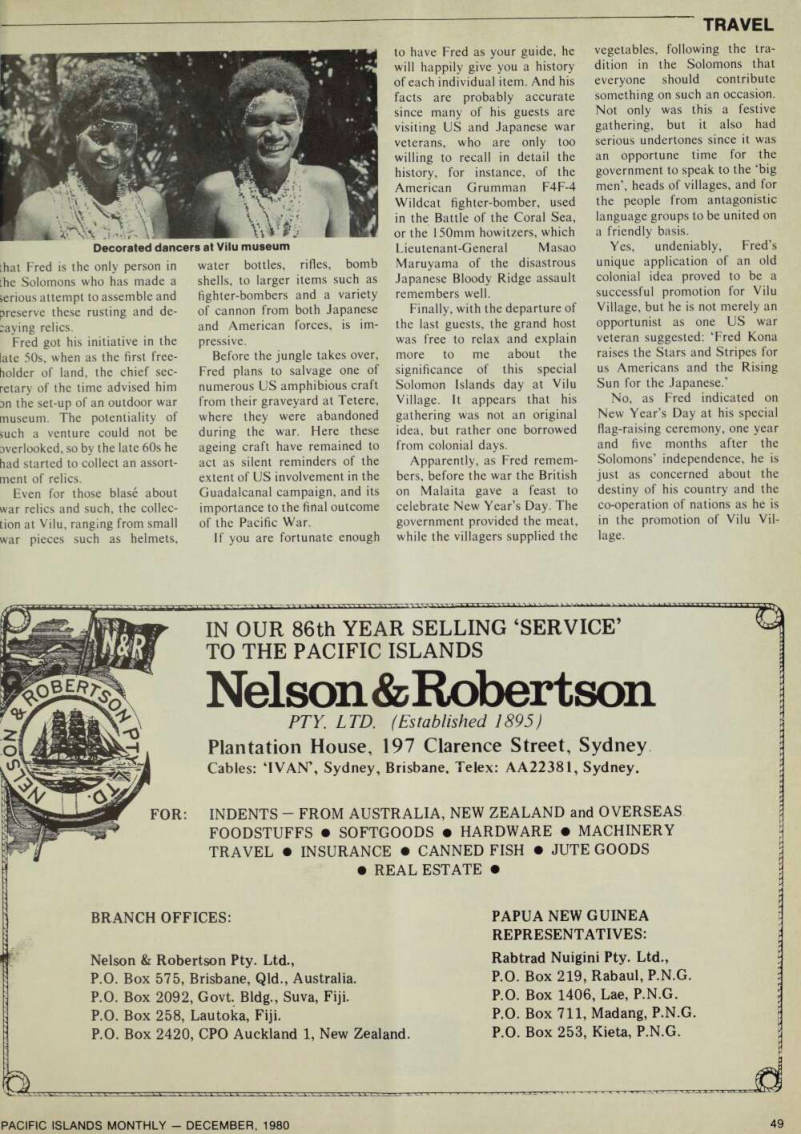
Decorated dancers at Vilu museum