Pitcairnese as
pp. 27-33 · Read in the full issue
Tropicalities
she is spoke
Vilh the help of the Pitcairn slanders, a study has recently ►cen made of their dialect.
Vhal is this dialect like? Well, me could say it is English cut horl. For example, the slanders say ‘Bout you gwen?' nslead of saying ‘Whereabouts re you going?’ ‘V’ is always (renounced ‘w’ and ‘th’ is (renounced ‘s’ or ‘d’.
But this short description is lot very satisfactory, the fitcairnese language is much nore interesting than that. In act, its vocabulary reflects very veil the history of Pitcairn and he present situation on the sland.
A study of the words used on filcairn confirms that: • Some of the settlers in 1790 vere Polynesians many finds of fish have Polynesian James for example ‘nanwe’ hooe-fish’, and other Polynesian words have also urvived (example, ‘umma >ola’ means ‘clumsy’). • The Pitcairners are, and tave always been seamen :onsequenlly they say ‘flog’ nslead of ‘spank’, ‘heave’ in ;tead of ‘throw’. • The island has been quite solaled for a long time as a ■esult words that have died out n modern English, or have been •eplaced by others, are still ised on Pitcairn. Examples: musket' means any kind of gun Dr rifle, and ‘paunch’ means stomach’. • Not many people live on [he island every individual is important, and names of the islanders appear in many ex pressions. Example: ‘Da’s only William’ means ‘That’s nothing important’, because William used to pul bandages on small wounds. ‘Allen’ means ‘poor food’ since the day when Allen questioned the customary grace, because there were only boiled kumaras and raisins for
dinner. One kind of fish is called ‘Elwyn’s trousers’ simply be cause they looked like Elwyn’s trousers. • There has been an American influence many of the ships that called during the 19th century were American whalers, and Americans have settled on the island (Warren, Brown, Coffin, Clark) and the Seventh-day Adventist Church has increased contacts with the USA. So the islanders say ‘candy’ instead of ‘sweets’ and ‘corn’ for ‘maize’. • Reflecting the importance of the Seventh-day Adventist Church, Friday is usually called ‘preparation’ and Saturday is ‘Sabbath’.
Like many other small languages and dialects in the world, the ‘Pitcairnese’ is slowly dying. This is particularly true when it comes to Pitcairn words. Many of these, recorded in the late A. W. Moverley’s book produced in the early 19505, have already totally dis appeared. Others like the word ‘mamoo’ (meaning ‘silence’, used like ‘shut up‘) are remem bered only by the older inhabi tants. The reason for this, of course, is the influence of mod ern English.
Every day the children speak English in school, while Pitcairnese is not taught at all.
As long as it isn’t taught, it is probably impossible to save Pitcairnese as a second language on the island. There fore we will have to accept that it is gradually dying out, and becoming more and more simi lar to modern English.
Anders Kallgard, in Pitcairn Miscellany.
NZ sees launch
of Tongan paper
Tired of being shunned by New Zealand’s daily newspapers, and searching for a voice of their own, an Auckland-based Tongan publishing co-operative has launched a new paper (PI M Nov p 6).
The pan-Pacific venture is aimed at about 25 OQO expatri ate Tongans living in various places from Australia to Hawaii, as well as the 100 000 Tongans in their own kingdom.
But its initial circulation of 2000 is firmly anchored within the 7000-strong Tongan com munity living in New Zealand.
Called Talanga (‘Speaking out frankly’), the fortnightly paper is bilingual, while main taining a strong emphasis on the Tongan language. It is published by Polinisia Com munications, the publishing arm of the Fangufangu O Tonga Cultural Society, and printed by the Northern Advo cate.
Papiloa Foliaki, the only woman member of the Tongan Parliament (PIM Feb p 24).
New Zealand’s Immigration Under-Secretary Aussie Mal colm and deputy Labour Party leader David Lange gave their blessing to the paper at a Sep tember launching hulohula.
Early issues have been well supported by advertisers such as Air Pacific, and the paper joins other ethnic publications in New Zealand like Samoana (circ. 9000) and Te Maori which have succeeded the ill fated newspaper Mana.
An ambitious pan-Polynesian concept, Mana was launched in Auckland in 1978 as a multilingual paper with pages printed in English, Fijian, Maori, Niuean, Rarotongan, Samoan and Tongan. But the paper didn’t survive because of financial difficulties. ‘Our slogan Jakatonga ma'a e Tonga ’e he Tonga (in Ton gan, for Tongans, by Tongans) is an indication of our wish not only to communicate effectively but to strive for self-reliance and self-determination,’ says Sefita Haouli, one of the paper’s five joint editors.
The 31-year-old Haouli, also a Consumers’ Institute advisory officer, says Talanga will play a vital role in keeping Tonga’s language and culture alive,
particularly among Tongan ex patriates.
He says New Zealand’s dail ies have largely ignored the Tongan community, except in a negative way, and the only Tongan access to the media was through the limited Polynesian programmes of Radio Pacific and Radio New Zealand.
Haouli* adds; ‘The main stream media in this country are not equipped to deal with Polynesian news. We will en deavour to set up our own network of Polynesian news.’
Gathered around him is a talented team of young editors; New Zealand-born social worker Will ’llolahia, sociology scholar Lita Foliaki, anthro pology scholar 'Okusi Mahina, and court translator Ika Tameifuna.
The paper is certain.to pro vide a fresh, competitive voice to challenge the Tongan govern ment newspaper Kalonikali (Chronicle) in Nukualofa which has enjoyed a monopoly until now. ‘You can hardly call the Kalonikali a real newspaper it’s more like a royal diary,’ says one Tongan, a long-time Auck land resident. ‘Bringing out this new paper is one of the best things to have happened in our community.’
However, Talanga’s editors reject any suggestion that their newspaper could be a threat to the Chronicle. And they will
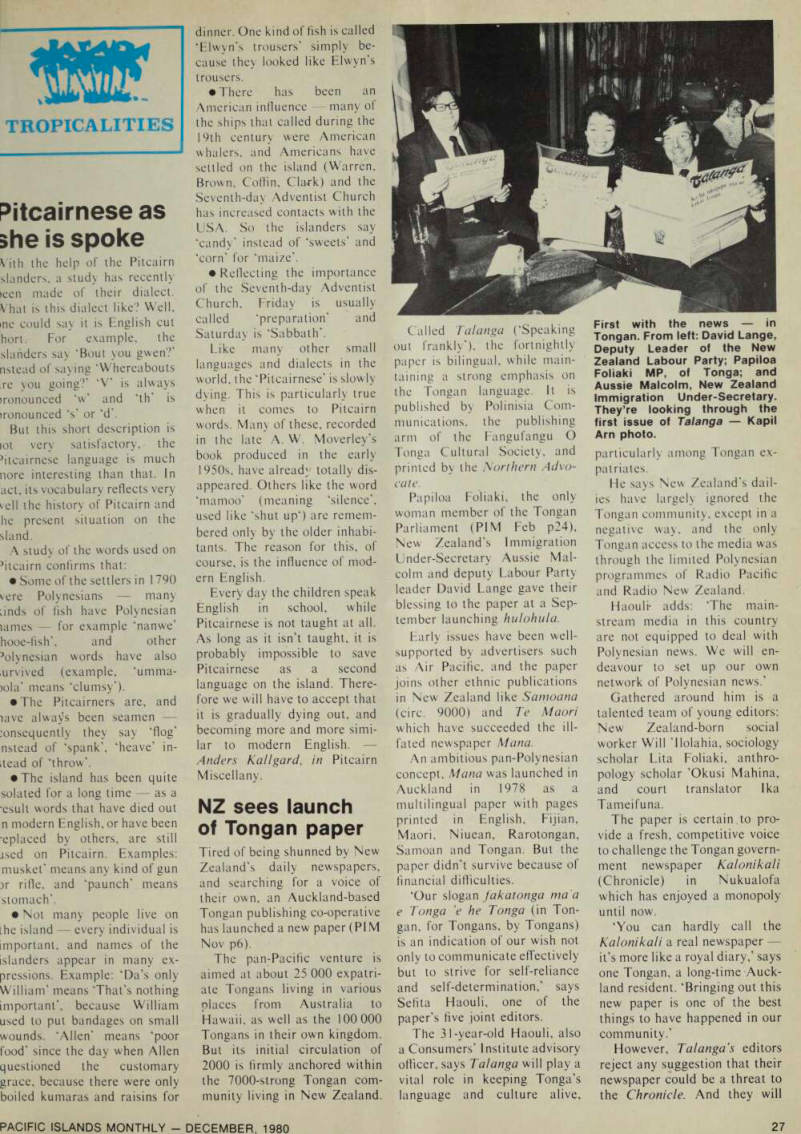
First with the news - in Tongan. From left: David Lange, Deputy Leader of the New Zealand Labour Party; Papiloa Foliaki MP, of Tonga; and Aussie Malcolm, New Zealand Immigration Under-Secretary.
They’re looking through the first issue of Talanga - Kapil Arn photo.
:ertainly be wary about tread ng on political corns.
As Haouli puts it: ‘Of course, a newspaper is always a politi cal tool. But Talanga is inde pendent and we will not become
politically partisan.’ David
Robie in Auckland.
Michoutouchkine,
Pilioko in Moscow
What could be more exotic for the Muscovite than the intric ately painted ritual skulls, or the colourful Polynesian tapa, displayed at the ‘Art of the Peoples of Oceania’ exhibition at Moscow’s Friendship House?
On the invitation of the Academy of Art of the USSR, the exhibition, which contained over 200 items, made a tour of the country. Besides Moscow it was played in Khabarovsk (Soviet Far East), Novosibirsk (Siberia), Tbilisi (Georgia) and Yerevan (Armenia).
The exhibition from Oceania was accompanied on its tour by its compilers and the authors of several works, the Polynesian artist Aloi Pilioko and the European Nicolai Michout ouchkine, who settled in Polynesia about 20 years ago.
Both artists put in a great deal of effort to find and preserve rare household uten sils that have all but disap peared, articles used for re ligious rites, weapons and art objects of the peoples of Oceania.
Their collections have been displayed in France, Japan and Sweden. A number of canvases by Pilioko and Michoutouch kine are in private collections in the USA, Australia and New Zealand.
Aloi Pilioko, a resident of Port-Vila, capital of the newly independent Republic of Vanuatu (formerly New Heb rides), has been awarded the gold medal of the ministry of education of France. So far, he is probably the only Polynesian artist to win world recognition.
The Soviet press compared his colourful drawings and em broidery with the original works of the well-known Georgian artist of the past century, Pirosmani. The specialists have also noted Pilioko’s creative interpretation of Polynesian
subjects, and his innovatory techniques.
Dr Semyon Tyulyaev, art critic and Nehru Prize winner, pointed out that despite a certain conventionality, the works of the Polynesian artist attract viewers with ‘their re markable expressiveness and vitality’. Tyulyaev said that only the art of some African tribes still retained similar fea tures. ‘The exhibition acquaints Soviet people with the little known way of life of Oceania.
This is the first exhibition of its kind which, I hope, will mark the beginning of a fruitful cultural and scientific exchange between the USSR and the in dependent states of Oceania,’ said the Soviet art critic.
In the opinion of Correspond ing Member of the Academy of Sciences of the USSR, Alexei Kapitsa, one of the sponsors of the exhibition, the collection from Oceania has proved to be most valuable for Soviet schol ars both in the artistic and scholarly sense.
Similar ethnographic ma terial collected by the Russian scientist Nikolai Miklukho- Maklai in the 19th century constitutes the gold reserves of the Museum of Anthropology and Ethnography in Feningrad which, together with the Insti tute of Ethnography in Mos cow, are the chief Soviet centres doing research on Oceania. ‘Our collection was received with great enthusiasm and in terest in the Soviet Union, with several thousand visitors com
ing to see it,’ said Nikolai Michoutouchkine.
Aloi Pilioko added that the warm reception and hospitality of the people of Siberia helped him bear the severe Siberian frosts, to which he was com pletely unaccustomed, while he was in Novosibirsk.
Speaking at the opening of the exhibition in Moscow, Pro fessor Grigory Bondarevsky, first vice-president of the Soviet Association for Friendship with the Peoples of South and South east Asia, stressed the fact that while the exhibition was touring the USSR, the country where Aloi Piloiko has made his home, the former New Hebrides, gained independence, and that the new state of Vanuatu had already been recognised by the Soviet Union.
Sergei Buranov, Novosti Press Agency.
Transculturar
study for nurses
Nurses from the US Trust Territory participated in a re cent Transcultural Nursing Workshop’ sponsored by the nursing division of the Univer sity of Guam.
The workshop, run by Dr Madclaine Leininger, was funded by the Continuing Edu cation For Nurses Grant of the University. This grant will also provide some limited nursing assistance for the Northern Marianas, Palau, the Marshalls, and the Federated Slates of Micronesia for the next two years.
Dr Fcininger has been in Papua New Guinea for two years doing research work on nursing as it applies to local cultures. ‘Culture, in the nursing con text, refers to particular lifestyles, values, and practices of a certain group of people which a nurse must learn to identify and apply in her or his nursing work. Dr Feininger said.
She said unless a nurse learns this, she may not be able to give complete and realistic care to the people she serves. Trust Territory Chief Nurse Mary O.
Regan said the workshop came at a critical period because it is now apparent that there is a ‘definite’ need for Micronesian nurses to understand and utilise their culture when giving care to patients, or when they con front grieving family members. From the Micronesian News Service.
Pros, cons of
marrying young
‘Marry young and keep yourself out of trouble’ is the advice of Fiji’s Minister for Tourism, Transport and Civil Aviation Tomasi Vakatora.
Mr Vakatora was speaking in a debate in the House of Representatives based on an opposition motion of concern at the law and order situation in Fiji. He said that young mar riages were an aspect of Indian culture and they could well be adopted generally in the Fiji community as a contribution to social stability.
Mr Vakatora told the house that in Fiji society ‘not many Indian lads get into trouble because they marry early, and that is a good thing’. By marry ing early they established a stable life pattern and settled down as members of the com munity.
Other members heckled Mr
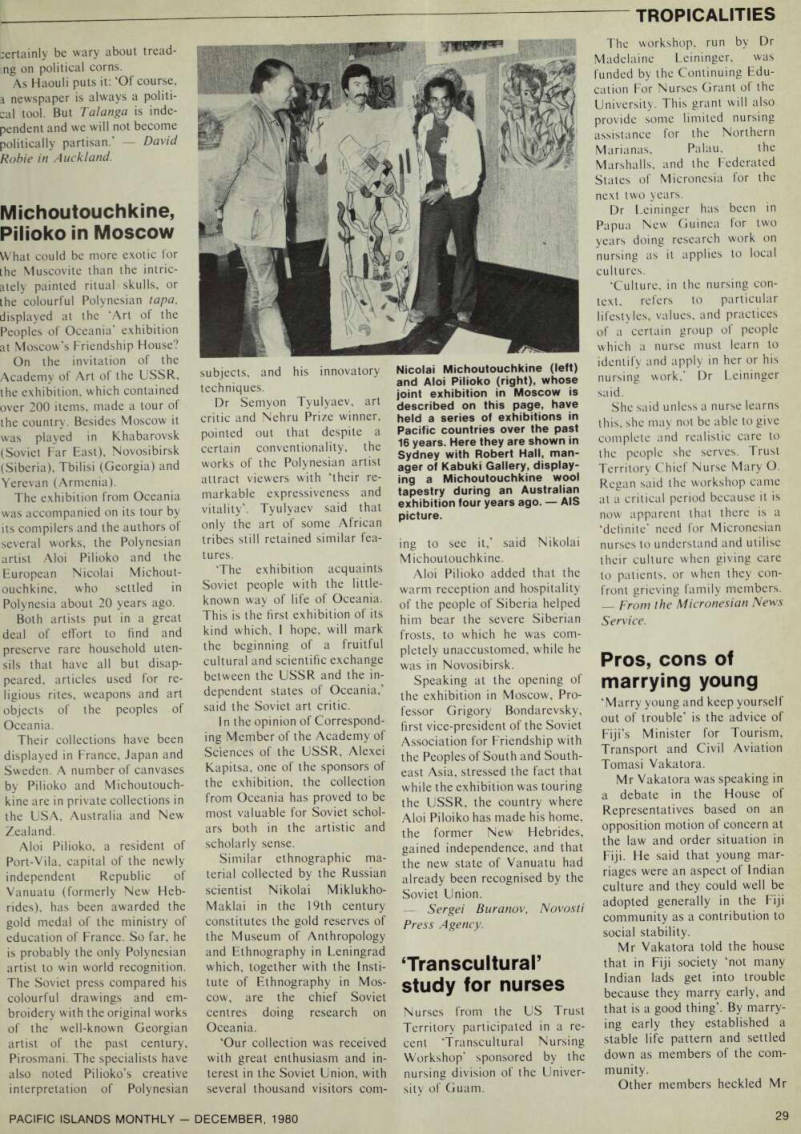
Nicolai Michoutouchkine (left) and Aloi Pilioko (right), whose joint exhibition in Moscow is described on this page, have held a series of exhibitions in Pacific countries over the past 16 years. Here they are shown in Sydney with Robert Hall, man ager of Kabuki Gallery, display ing a Michoutouchkine wool tapestry during an Australian
exhibition four years ago. - AIS
picture.
Vakatora as he spoke, claiming that early marriage would con tribute to population problems. ‘That may be so, but there are ways of overcoming it,’ Mr Vakatora retorted. He claimed that the stability of Indian family groups spoke for itself.
Earlier, at a party political meeting, Prime Minister Ratu Sir Kamisese Mara urged Fijian families to take note of the disciplined way in which Indian families raised their children.
Subsequently Mr Vakatora was criticised by sections of the Indian community for basing his argument on what they claimed was a false foundation.
In a letter to The Fiji Times, Dr T. U. Bavadra said that the trend in the past 15 years had been for Indians to defer mar riage. He saw a priority for all people to establish a sound education and income-earning base before marriage.
Dr Bavadra wrote: ‘1 feel that the emphasis should be on advising Fijians to go back to the village and work the land if they have nothing useful to do in urban centres. Those Fijians with a regular income in towns should be advised and encour aged to save enough money for a house, and to plan the size of their families.’
Kokoda: Cadets
meet Vets
Ten members of Sydney’s Scots College Army Cadet Unit, wearing their Black Watch tartan kilts and the Papua New Guinea Defence Force badges presented to them after they had successfully completed a patrol over the Kokoda Trail in 1979, took part in a ceremony in October at which they met veterans who fought in PNG in World War 11.
The occasion was the handover to the college by the Sixth Division (Second AIF) Association of the emblem of PNG mounted on PNG timber.
The emblem had previously been presented to the associ ation by a representative of the PNG Government as a mem ento of the Auslralia-Papua New Guinea Friendship Trust.
The trust was set up by the Sixth Division Association,
along with other veterans’ or ganisations, to present school books to primary schoolchild ren in PNG. The books bear the message ‘Australia remembers the help given by the people of PNG in World War ll’.
The association selected Scots College to receive the emblem because cadets from the college have been over the Kokoda Trail four times in recent years, thus forming a close association with the
Pngdf.
PIM vindicated
28 years on
‘Come January 1981 the Palauans will join other Micronesian political entities in sporting locally ratified consti tutional government,’ writes a commentator in the Micronesian News Service. ‘When Palau ceases to be a “district" somebody in Washington will have to come up with a new official definition
for the term “Trust Territory of the Pacific Islands".' The commentator went on: ‘Twenty-eight years ago. in 1952, the Pacific Islands Monthly, the news magazine of the South Pacific, which is published in Australia, saw the problem with the title “Trust Territory of the Pacific Islands" and chastised the United Slates for using it.
'The PIM editorialised at the lime: “The Americans, with unusual lack of imagination, have named their Micronesian administration The United Slates Trust Territory of the Pacific Islands."
It went on to say: “The Territory comprises the well known Micronesian groups of Palau, the Carolines, Marshalls and Marianas. The groups were held originally by the Spaniards, sold or lost by war by Spain, and became part of the German colonial empire; were handed over to the Americans as a Trust Territory after World War II.” ‘The PIM was not in the least impressed with the new desig nation the Americans gave to their new Pacific wards. It said in its brave editorial: “The total area of the lot is only 715 square miles (they were called Micronesia because they com prised a lot of very small islands), and their total popu lation is only 50 000. (Micronesia today has a popu lation of about 130 000. MNS.) Vet they arc called ‘The Trust Territory of the Pacific Islands', irrespective of the fact that, apart from Philippines and Hawaii, all the Pacific Islands
worth talking about lie south of the Equator, and are all British and Irendi.”
'The PIM advised the United Stales: "In order to keep the description within focus and understanding, the four groups should be called the United Stales Trust Territory of Micronesi The MNS writer concludes: 'By next \ear, there will be four Micronesian political entities, all with certain political ties with the United Stales, and the Pacific Islands Monthly may have been closer to the truth than many people realised in 1952.'
Dogs dogging
Rarotongans
While experts in demography see a bleak future in world population statistics, Rarotonga, Cook Islands, is plagued with an over population problem of a dilTcrent kind: there are 100 many dogs on the island. Be cause the public is fed up with dogs knocking over rubbish tins, and wandering across the roads constituting a real hazard for motor cyclists. the Rarotonga Police Department has mounted a campaign that might lower Rarotonga's canine population. The public has been warned that all dogs over the age of six months must be registered ($5 a year for a female and S 3 for a male) or they will be destroyed.
Unfortunately, there are sev eral problems with this measure. Inspector Tiki Malapo of the Police Depart ment points out that as Rarotonga has no pound or other facilities for destroying animals out of the public eye, the police will shoot the dogs where they find them. The impression created by rifle toting police, shooting animals in full public view, is not a favourable one. The bigger problem is that if all the dogs are registered. Rarotonga’s dog problem will still not be solved.
It is small consolation to know that the dog that runs out in front of your motor cycle is likely to be registered, rather than not. Paul Rysavy in Rarotonga.
Major General Alan Murchison, a former Inspector General of the Australian Army Reserve, and Senior Cadet Under Officer Cameron Marks hold the newly presented emblem following the ceremony described on this page. Others in the picture, left to right, are Major M. Frank, OC Cadets; CUO T. Hardwig; Mr G.
Renney, Scots College princi pal; Captain Rev. Dr J. Croft; CUO T. McMullen; CUO T.
Fisher; first-former Tangil Okuk, son of the Papua New Guinea deputy prime minister; Mr B. Oberleuter, PNG Consul; Dr T. Selby, convenor of the Australian-PNG Friendship Trust.
10 countries get
culture grants
Australia provided $A 100 000 to 10 South Pacific countries in the year ended 30 June, from its Fund for the Preservation and Development of South Pacific Cultures. Recipients of funds for specific projects were Vanuatu, Tuvalu, Niue, Tokelau, Cook Islands, Solomon islands, Fiji, Tonga, Western Samoa and Kiribati.
For Pacific-wide activities grants of $5OOO each were made to the Institute of Pacific Studies and the South Pacific Creative Arts Association. The South Pacific Social Science Association received $4OOO, and the University of the South Pacific $6OOO. University of South Pacific Extension Centres in Solomon Islands, Fiji, Tonga, Western Samoa and Kiribati each received grants of $lOOO to sponsor cultural activities in the area served by each centre. The extension centre in the Cook Islands received $BOO and the centre in Niue $4OO.
In Solomon Islands $2500 was for the National Site Sur vey to finance archaeological studies and $lOOO to the National Library to buy books.
The Solomon Islands Cultural Association will use its grant of $4OO to publish museum journals and custom story books. The largest single amount to the Solomons,ssooo, is being administered by the ministry of education to sponsor school cultural festivities and functions. A further $l5O was for school equipment in Malaila.
Kiribati’s grants included $3OOO for district festivals, $2OOO for recording oral tra ditions, $2500 for books in schools and libraries. Vanuatu received grants of $5650 for its cultural centre, $3OOO to buy artifacts and $2OOO to support the country’s First National Cultural Festival.
Tuvalu and Niue each re ceived grants of $lOOO and Tokelau $5OO for general cul tural activities.
In Western Samoa a grant of $2OOO was made to the Nelson Library to buy books and $2500 was provided to Tonga to help
in the school advisory, project.
The largest amount, $2O 000, went to Fiji for the Fijian Dictionary Project. A sum of $ 1 1 000 is to assist a project for the documentation of Fijian ceremonial procedure, dance and music.
Marianas act
on youth crime
The Northern Marianas House of Representatives has ap proved the creation of an office within the government whose sole job is to help the young people of the Commonwealth.
According to a report by the House Committee on Health, Education, and Welfare, juven ile delinquency and crime caused by the breakdown of traditional institutions and pressures and complexity of the changing Marianas society are becoming a serious problem.
The report cites the following statistics 28% of all charges filed with the police are against juveniles; 63% of all burglaries are committed by juveniles; 39% of larceny charges are against youth and 60% of car thefts are committed by juven iles.
The House report also said that when compared with the rest of the Pacific, the Northern Marianas reports ‘among the highest rates in juvenile bur glary and larceny’. From the Marianas Variety A r ews & Views.
A witch doctor’s
bad advice
Witchcraft was the reason why a 58-year-old man and his young woman companion re moved some of the ashes of a newly-cremated body from a cemetery, a court at Lautoka, Fiji, heard in September.
The woman had seen a witchdoctor for an illness and was told to bring some ashes from a crematorium to be used to cure her.
Mun Sarny, taxi driver, of Natabua, and Premila Devi, 26, salesgirl, of Namoli Avenue, admitted trespassing on burial grounds.
Magistrate John Tomlinson fined them $6O each in default three months in prison.