Windsurfing
p. 25 · Read in the full issue
baron was ‘an honest cheat’
; is most fitting that RIM correspondent in Papeete BENGT )ANIELSSON should have what looks like being ‘the last vord’ on the affair of the windsurfing ‘Terrible Baron’ and lis controversial ocean-crossing in French Polynesia (PIM vlov p 18). Dr Danielsson is one of six men who made up he crew on the 1947 Kon Tiki raft expedition (which first jrought him to Tahiti). He is therefore no stranger to >cean-crossing by unorthodox means. In an October irticle in the Papeete daily La Depeche he seems to have julled the whole story together at last. The article, leadlined ‘Was the Baron an Honest Cheat?’ is translated i full below.
r or some time now we have >een witnessing a rather curi >us war of words. On the one land that astounding figure, 3aron Arnaud de Rosnay, like ,ome Cassius Clay of the high ;eas, has been loudly proclaim ng that he is the greatest and landsomesl windsurfer of them ill. On the other, a number of :hampion French exponents of his new sport have been disput ng with somewhat more :alm and dignity, it is true .he accuracy of the baron’s iccount of his feat. Among :hem is the record-holding Stephane Peyron, who has windsurfed 136 miles in 24 hours! He says quite categori cally that what Arnaud de Rosnay claims to have done is far beyond the limits of human endurance. The metropolitan windsurfers seem united in con cluding that the baron cheated, and are more or less convinced that he had a support vessel on hand throughout the trip.
Who’s right? Several friends of the baron have at once leapt to his defence, showering his detractors with the crudest insults, but failing to offer the necessary kinds of clarifications on the dubious aspects of the matter of what precisely for this reason has become known as The Rosnay Affair’.
Luckily for all, Jean-Pierre Marquant has just published an article in La Depeche which abounds in valuable infor mation and perceptive com ments. The only thing wanting in this latest addition to the ‘Rosnier file’ is a conclusion.
But a conclusion is nevertheless forced upon us with a logic that is quite irresistible. It could be put this way: Yes, the baron did cheat, but in a quite honourable way . . .
The key to the mystery is in the impressive list of things that Arnaud de Rosnay took with him on his journey a list recorded by Marquant. We should lake special note of the two ‘wishbones’ he had with him. ‘Wishbone’ is an English word describing a forked bone found in poultry, which is still today used in simple family wish-fulfilment riles, especially with children. But the baron had ‘wishbones’ made of metal, and this is the main point they enabled him effectively to transform his surfboard into a catamaran. How? Quite simply by first furling his sail around the mast and then using the mast as a kind of boom (iato in the language of those who invented this type of craft).
With his two metal ‘wishbones’ (in Tahitian tiatia ), the baron could then attach his two floats (ama), to the ends of the boom, which extended for equal dis tances to port and starboard.
Obviously the floats were made not of wood, but of inflatable plastic. So Arnaud really left Taiohae a bit before midnight on August 31 on a zodiac outrigger, rather than an ordi nary windsurfer.
According to his own state ments, he could lie down every night on his board, but this did not stop him from making progress at reduced speed
thanks to an ingenious arrange ment by which a kite pulled the craft along. He has never him self quite claimed it, but the public seems to have gathered the idea from what he’s said that he spent the daylight hours standing on his board, travel ling flat out in the usual windsurfing way (apart from a few hours when the solar still was operating to keep him in fresh water).
But how can it be explained that it took him more than 10 days to cover 9000 km (500 nautical miles) between Nukuhiva and Ahe? (This amounts only to an average speed of two knots, about the same as the Kon Tiki raft,
which was very large and weighed 20 tonnes!) This slow ness is all the more surprising and interesting if we recall that the baron had to give up his earlier attempt to get to Hawaii because he was travelling too fast (at about 10 knots) for the yacht Zeus to keep him com pany, as arranged. It’s also a fact that the weather office has assured us that when he was on his way to the Tuamotu group in the first fortnight of September there was no lack of wind. So the baron ought to have been able to reach Ahe, after two good nights’ rest, in three days.
The most likely explanation that comes to mind, now we have the information brought out by Marquant, is the follow ing: Supposing that the terrible baron used the mast as a crosspiece for most of the time, the fact of his very low speed which simply cannot be denied would be accounted for by the small sail surface provided by the kite, and by the consider able braking effect of the floats, being dragged constantly through the water as they were.
This hypothesis has the ad ditional advantage of explain ing the excellent physical state of our baron on his arrival at Ahe. 1 would hasten to add that I can see nothing at all reprehen sible in using this Polynesian derived technique of propul sion. 1 have myself made use of a similar technique, but on land, in my homeland of Sweden. To conserve my strength during winter trips in the northern mountains, instead of travelling upright on my skis, with a huge knapsack on my back, I would follow the old custom of simply joining the skis together, using a sapling branch as a crosspiece on which 1 would place my knapsack.
Sitting comfortably on this improvised toboggan of mine, 1 was able to slide along for considerable distances.
If Arnaud de Rosnay adopted similar means to ‘slide’ off towards the Tuamotus, it could be very well described as a form of ‘honest cheating’.
What’s more, he should come clean and say so. This would be in his own interest because otherwise lots of people are going to continue calling him a cheat full slop.
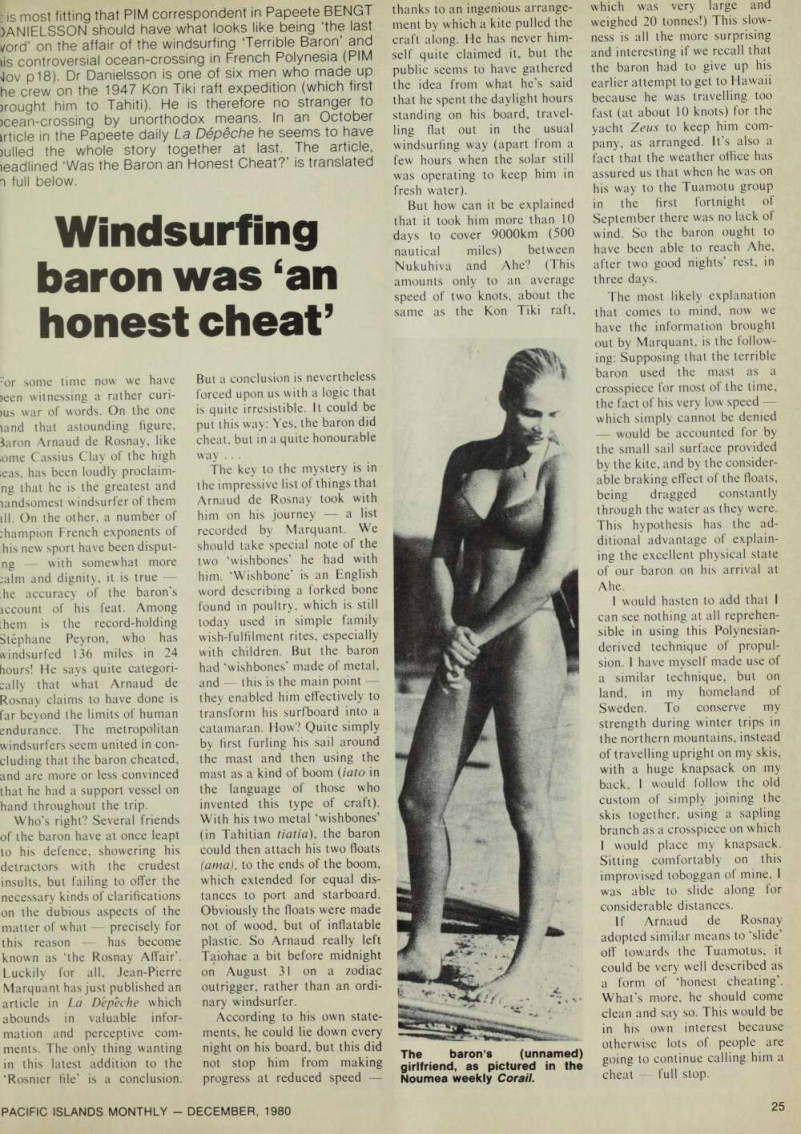
The baron’s (unnamed) girlfriend, as pictured in the Noumea weekly Corail.