independent nationhood
pp. 51-53 · Read in the full issue
Fiji faces its second decade of independent nationhood
Fiji on October 10 celebrated the 10th anniversary of its independence. A star-studded cast of international celebrities headed by Princess Anne zeroed in for the occasion. Australian, BBC and Japanese television teams covered the event.
Here Kingsley Wood, a frequent visitor to Fiji, gives a profile of the nation as it enters its second decade of independence.
Fiji straddles the international dateline which has been con veniently curved east to go around the group of islands, meaning that it is 12 hours east of Greenwich and so the first nation on which the sun rises each day.
Take off for Hawaii from Nadi airport and by the time the No Smoking sign goes out you’re flying back into yester day. The Fiji Times proudly proclaims on its masthead: ‘The first newspaper published in the world today.’
The nation gained indepen dence on October 10, 1970, the first of the British South Pacific islands to break away from its mentors. While much has been accomplished in the decade, few government officials play down the fact that at times the going has been tough.
Fiji comprises 332 islands with a land area of 18 3335 q km, but only one-third of the islands are inhabited. The largest Viti Levu ,(10 4295 q km), holds the biggest part of the population of just over 600 000 and is the location of the capital, Suva.
It claims to be the hub of the Southwest Pacific for shipping and air services between Australia-New Zealand and North America. However, a decreasing number of trans pacific aircraft are now refuel ling at Nadi international air port, and a realised lack of port facilities is creating a headache for shipowners.
But certainly Suva and Lautoka do big business with the rust-streaked fleet of inter island traders, and are used by the modern units of the Union Steam Ship Company of New Zealand and some 16 other international shipping lines.
Fiji has en route and direct cargo liner services from UK/ Europe, Australia and New Zealand, Japan and the Far East, South-east Asia and most
points of the Pacific a frequency of calls and services far in excess of what the nation warrants as an importer or exporter.
Lautoka and Suva are favourite ports for Australian cruise ships but the high cost of fuel has sharply reduced the number of operators in the business so that there are now fewer calls on which bare chested Australians swarm ashore.
The numerous cargo ships, which include the vessels of such majors as Nedlloyd, Columbus Line, Karlander, China Navigation, Blue Star and the troubled Pacific Forum Line (of which Fiji is a part owner) provide a blanket ser vice for a nation which gener ates total cargo throughput of less than 1.5 million tonnes, or less than most of the Australian outports.
In the latest year the seven main ports of Fiji handled 1 364 796 tonnes of cargo
(811052 tonnes imports/ 553 744 tonnes exports) with Suva accounting for 570 167 tonnes and Lautoka 442 091 tonnes.
Major exports are mineral oil (re-exports to other islands); sugar, molasses, coconut oil, copra and fish, with the 287 281 tonnes of sugar easily taking the top spot. Main imports are mineral oil and general cargo, which together totalled 735 000 tonnes.
That the islands have a shipping problem is well recog nised by the Ports Authority of Fiji. Transport Minister Tomasi Vakatora has acknowledged growing demands for special ised shore facilities for an increasing number of container and roll-on roll-off ships calling at various ports. Some 1000 container movements a month are now being serviced in Suva, yet the port has no container terminal or shore cranes. ‘The acute shortage of back up space is a major obstacle
threatening the efficiency and safety of port operations,’ Mr Vakatora said.
The land shortage for con tainer storage is compounded by the poor condition of exist ing wharf structures, particu larly in Suva and Lautoka.
Engineering studies have re vealed fractures in piles and beams at Suva. Sections of road have subsided under the con tinued weight of container traffic causing floods at high tides.
Essential improvements in this port alone are going to cost around $FlOm. But gradually work is being done. Recently a $6OO 000 concrete wharf was brought into use at Levuka, the sleepy port of Fiji’s old capital, replacing a rickety wooden structure dating from the 19205. Recently, too, a team of
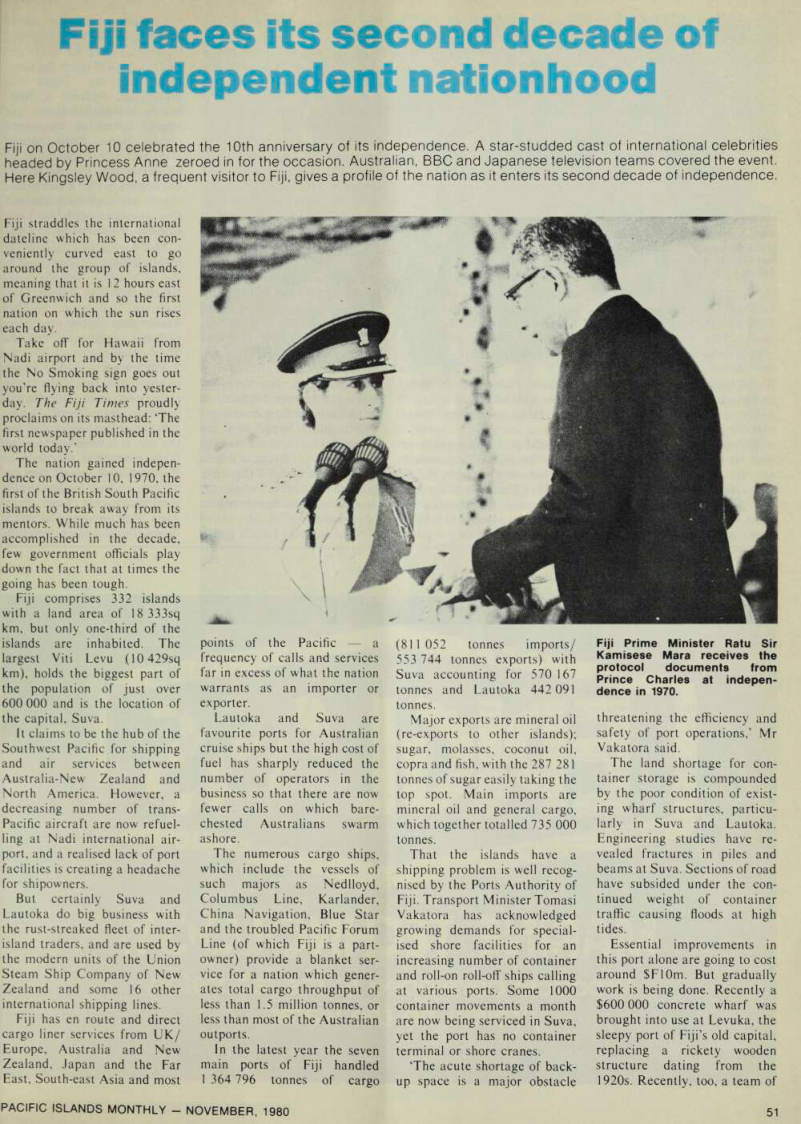
Fiji Prime Minister Ratu Sir Kamisese Mara receives the protocol documents from Prince Charles at indepen dence in 1970.
runs very much on oil fuel, it is going to be hard to hold in check.
Electricity is generated in diesel power stations assisted by some Hydro, but the World Bank in June provided a loan to help the country develop its hydro-electric capacity. By 1983 Fiji hopes to have virtually eliminated its diesel plants with an annual saving of some SUS4.S million at 1979 oil prices.
Racial problems simmer not far below the surface. Indians (50.1%) outnumber Fijians (44.5%). The Indians are the traders and the businessmen and in most places one is to be found close to the cash register.
Japanese consultants reached Suva to look at the port situ ation. From these studies an application could be made to the Asian Development or World Bank for funds to begin an updating programme.
There are other worries in paradise, however. Unemploy ment has reached around 9000 with no government handouts, and with rising wages jobs are becoming increasingly hard to find. The inflation rate is now some 11.1% compared with the previous 7.7% and, because Fiji
The Fijian tends to be the labourer road worker, farmer, canecutter, fisherman and so on and while officials insist that the two races are learning to live together it is obvious that barriers have still to be broken down.
In round figures, Fiji has total exports worth sl7sm, imports of s3lom and a trade deficit of slsom. The Govern ment of Ratu Sir Kamisese Mara is heavily dependent on overseas investment and is mak ing conditions as attractive as possible for new industries.
Tourism remains the big money-spinner but the number of visitors has been gradually tapering off. Worried officials put this down to the fact that cheap air fares have made the longer hauls more attractive to holiday-makers, but they are making determined efforts to bring back the customers.
It is to be hoped they are successful for these are smiling, friendly people living in a land where it is doubtful if they have yet found names for all the flowers that bloom everywhere in profusion.
Suva is busy, full of colour
and noise, and a town that is rapidly changing its face as new buildings replace old. There are modern shops of much the same style as are found in Wellington, Sydney or Mel bourne. Supermarkets are largely controlled by island traders Burns Philp, Morris Hedstrom and its parent, W R Carpenter (it’s hard to escape Carpenters in Fiji) where prices are on par with Australia and the checkout girls no less efficient or impersonal.
The big tourist hotels are mainly along the Coral Coast or out of town the luxurious Beachcomber at Pacific Har bour or, not quite so far, Tradewinds, known to every cruising yachtsman in the South Pacific.
Tradewinds is said to be the only hotel in the world where a crew can moor the biggest yacht to the verandah, jump over the rail and order a beer at the bar. It is built on the brink of deep water at the postcard Bay of Islands, about Bkm out of town, and is a rendezvous for cruising yachts from most parts. Tied up when this writer booked in yet again were the
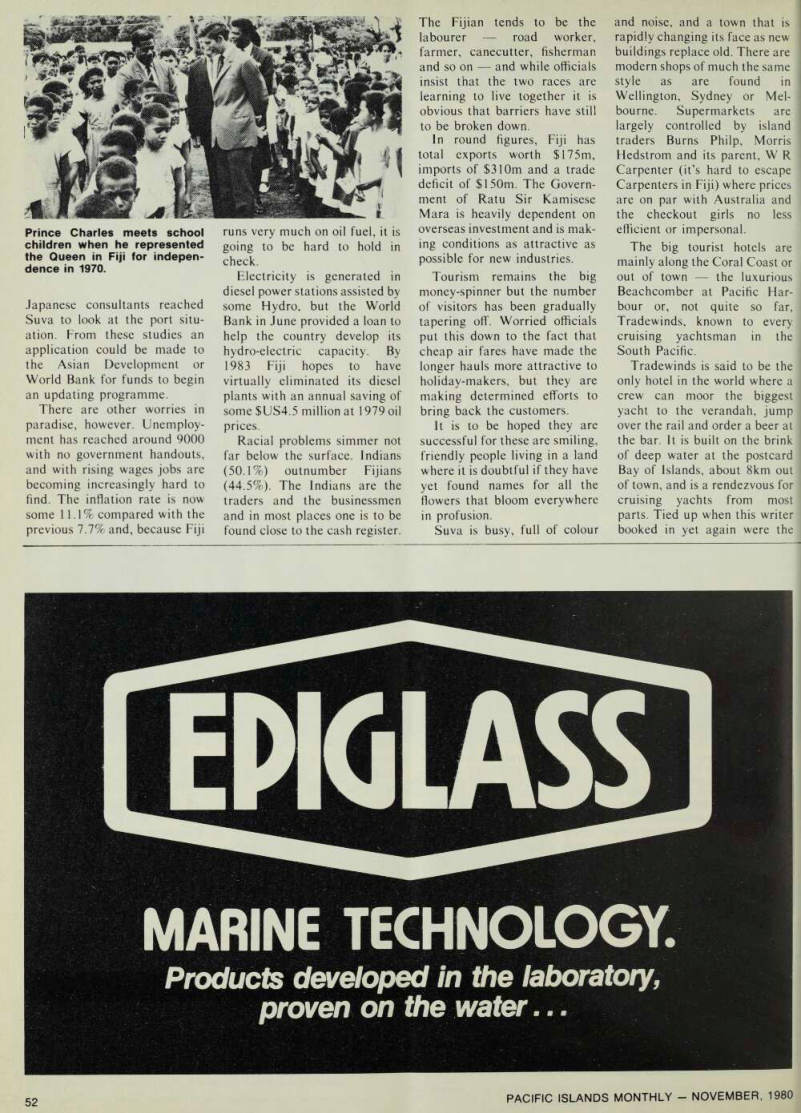
Prince Charles meets school children when he represented the Queen in Fiji for indepen dence in 1970.
big steel-hulled Sunchaser, ex- Melbourne and bound for the Mediterranean, the sleek, custom-built Energy from Jer sey, Channel Islands; Tuffie and Marie Chantel, from New Zealand, friendly Solar Drift wood, out of Vancouver, and half a dozen others registered in Hong Kong, Greece, the US and Britain. There was also Black Magic, San Francisco Yacht Club, captain Peggy Larkin.
Peggy is a big happy blonde who handles a dinghy superbly and who is quick to laugh while doing chores aboard Black Magic or visiting other boats to talk about. In one year she lost a husband (divorce), mother and father (deaths), then had a bout of meningitis. ‘So 1 said, “What the hell’’ and had my son help me bring Black Magic over to Trade winds. Yeah, that would be a couple of years ago now . ..’
Every so often Peggy has to
put to sea for two weeks to maintain her visitor status. The son is back in the States now so for these regulation departures Peggy becomes Black Magic’s all-girl crew.
All it means, however, is provisions, a few days’ good weather to get over to Tonga or Samoa, dropping the hook and letting the 14 days drift by.
The yachties like Fiji. They claim it is by far the cheapest of the well-known islands, which is important when many of them are trying to get by on a budget of around $2OO a month. They like the people and the friendli ness, and while there has to be red tape, in Fiji there seems to be less for them to get tangled in.
One striking point: Fiji is intensely loyal to its British ties.
It is a member of the British Commonwealth, with the Queen as Head of State. But it would be perhaps the only member country which not only has a public holiday for the Queen’s official birthday but another in November for the birthday of Prince Charles.
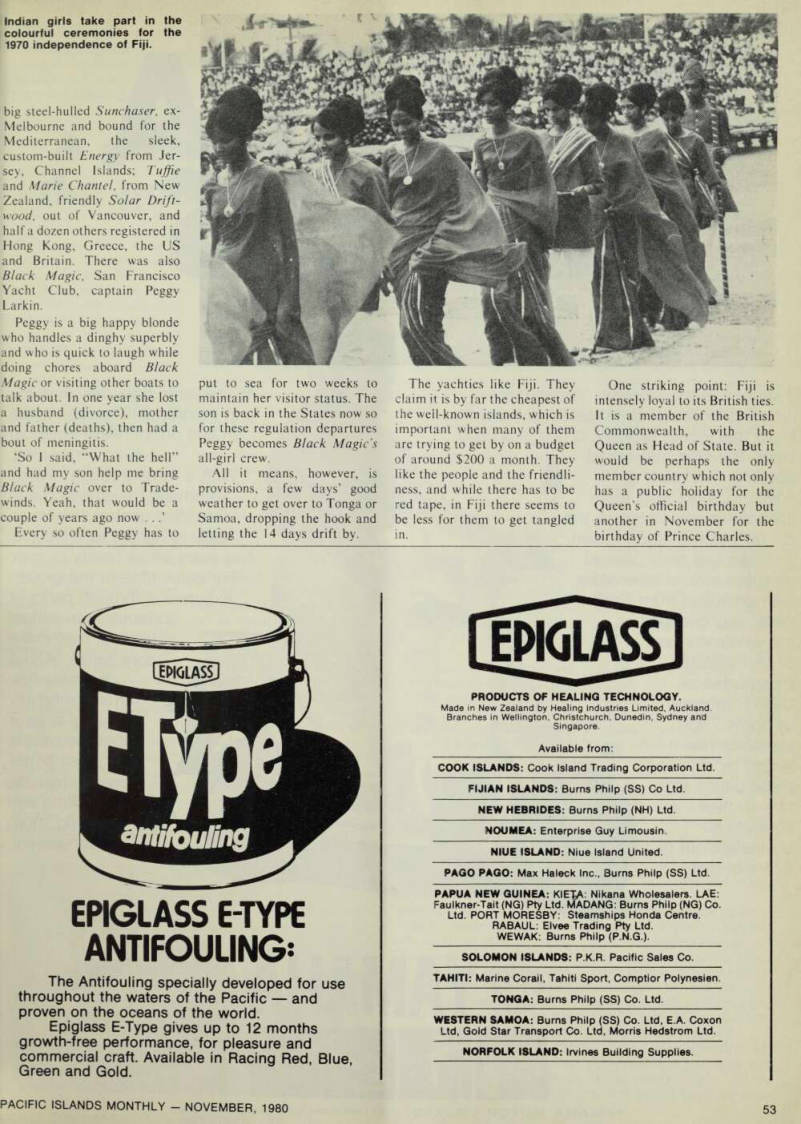
Indian girls take part in the colourful ceremonies for the 1970 independence of Fiji.