great Fiji cycling craze
pp. 47-49 · Read in the full issue
1898-1900: Years of the great Fiji cycling craze
Can you guess what was almost the national sport of Fiji in 1900 cricket, hockey, rugby, soccer? ... It was none of the sports that are popular in Fiji today, but bicycle touring and racing. If the recent South Pacific Games had been held at the turn of the century, then bicycle racing would have been one of the main sports, a velodrome being part of the Buckhurst Park sporting complex.
Races were held frequently at the bicycle race track belonging to the Fiji Bicycle League or
on other grounds, and in report ing on a meeting in August 1900, The Fiji Times com mented: ‘With an increasing number of wheels, this class of racing is becoming highly popular in Fiji, and promises in the near future, to become the “national sport” of the country.’
The Fiji Bicycle League, formed in 1898, organised race meetings, including some foot races, the cycle races being over several distances, notably half mile, one and two miles, with respectable prizes being offered
for winners. The Easter Monday programme for 1900 offered a ‘monster prize’ of 40 pounds. At the February 3, 1900, meeting of the league, prizes were offered by the Dunlop Tyre Company of Syd ney, Mr John Abrahams of Rewa, and Messrs Hoffnung and Company of Sydney. The Fiji Times was able to report before the meeting of the great enthusiasm of prospective com petitors: ‘The cricket ground at Albert Park and the bicycle track at the League ground sees every evening numbers of intending riders all eager to win and should fine weather favour the day some very fine riding will be witnessed.’ In fact because of wet weather the meeting was postponed to the following Saturday.
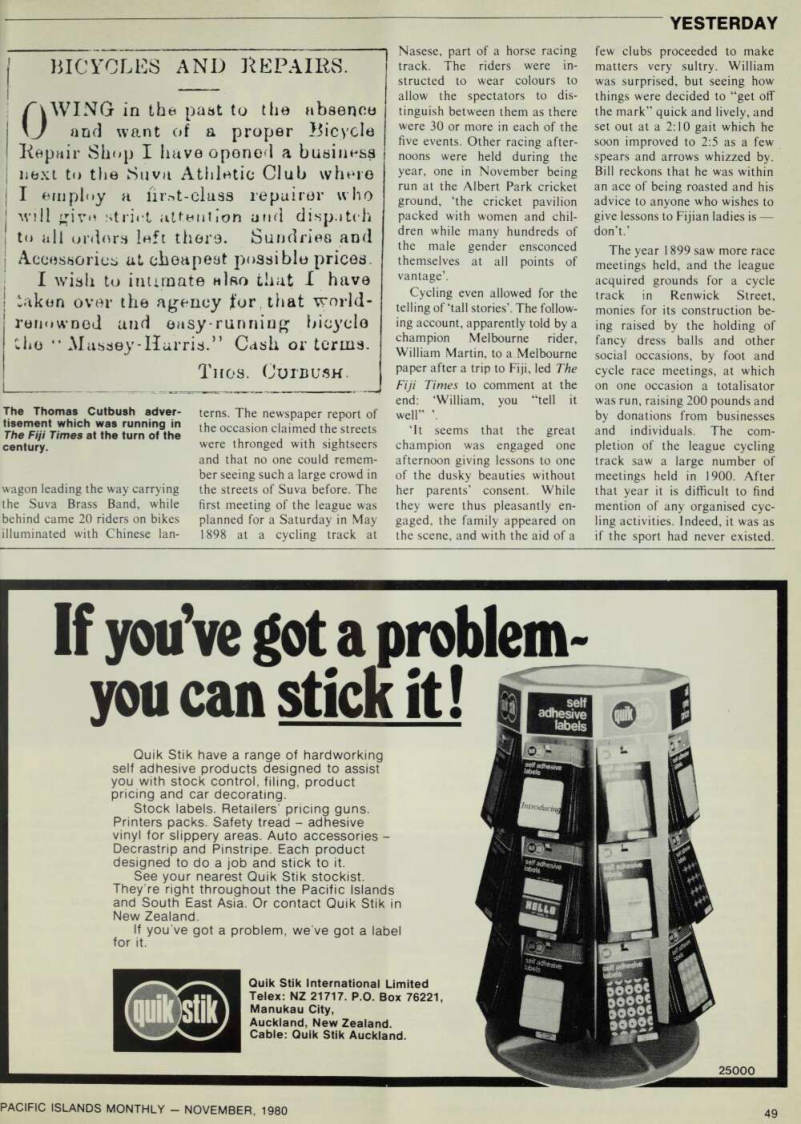
Long lours were undertaken, but few were reported. How ever, in terms of the South Pacific Games and the empha sis on the breaking of records, it is of interest to note a record claimed for a bicycle ride from Suva to Nausori in May 1900: ‘From time to time we hear of a very fast trip to Nausori, Rewa, and we now have another one to record which takes some beating. On Saturday afternoon last, Mr Thomas Cutbush, well mounted on his Massey-Harris bicycle, left Suva for Rewa and was across the river at Nausori under two hours. Mr. Cutbush says he made many stoppages on the road and when it is considered that ferrymen are not plentiful on the river the journey can be considered a record one. The road taken was the new lower one via Koronivia which was in very bad state but when completed and in good condition, an hour on a bicycle to Nausori should not be im possible.’
This trip by Thomas Cutbush was probably undertaken for
the publicity it gained him as he had recently set up a bicycle business in Suva, being the distributor of Massey-Harris bicycles. Later in 1900 an announcement appeared in The Fiji Times noting the arrival of ‘a well known racing cyclist’, Mr Joseph Cliff of Sydney, to take charge of the repairing and sales department in Cutbush’s store.
The Saturday meetings were serious events, well patronised by competitors. At one meet ing, there were so many com petitors that heats were run for each event. It was reported that during the fourth heat of the half-mile race, two riders were ‘justly disqualified' from taking part in the races for two meetings, for not trying. It was pointed out in the report that although the riders had only meant it as a joke, ‘it was a serious offence and such non sense deserves severely punish ing’.
It is difficult to trace the origins of the bicycle craze in Fiji, but certainly in early 1898 there were privately organised events being held. Then in March 1898, a meeting was called to form a cycling club.
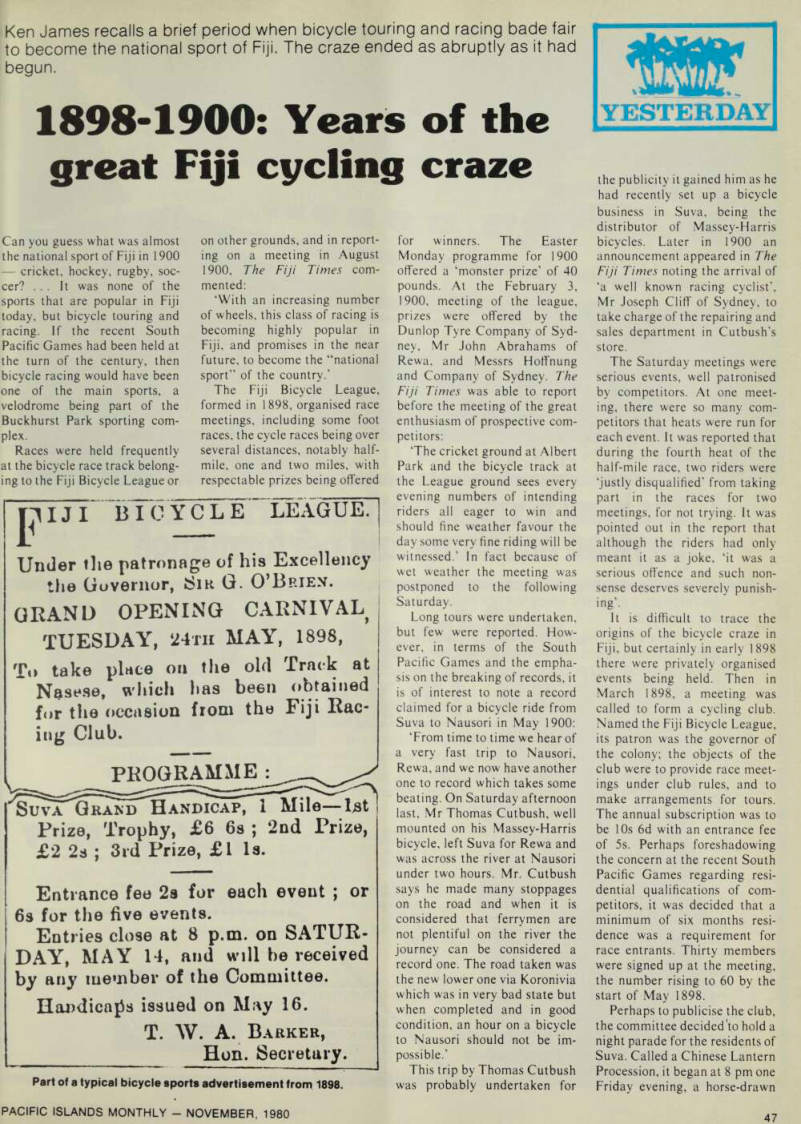
Named the Fiji Bicycle League, its patron was the governor of the colony; the objects of the club were to provide race meet ings under club rules, and to make arrangements for tours.
The annual subscription was to be 10s 6d with an entrance fee of ss. Perhaps foreshadowing the concern at the recent South Pacific Games regarding resi dential qualifications of com petitors, it was decided that a minimum of six months resi dence was a requirement for race entrants. Thirty members were signed up at the meeting, the number rising to 60 by the start of May 1898.
Perhaps to publicise the club, the committee decided to hold a night parade for the residents of Suva. Called a Chinese Lantern Procession, it began at 8 pm one Friday evening, a horse-drawn
Part of a typical bicycle sports advertisement from 1898.
wagon leading the way carrying the Suva Brass Band, while behind came 20 riders on bikes illuminated with Chinese lan
terns. The newspaper report of the occasion claimed the streets were thronged with sightseers and that no one could remem ber seeing such a large crowd in the streets of Suva before. The first meeting of the league was planned for a Saturday in May 1898 at a cycling track at
Nasese, part of a horse racing track. The riders were in structed to wear colours to allow the spectators to dis tinguish between them as there were 30 or more in each of the five events. Other racing after noons were held during the year, one in November being run at the Albert Park cricket ground, ‘the cricket pavilion packed with women and chil dren while many hundreds of the male gender ensconced themselves at all points of vantage’.
Cycling even allowed for the telling of ‘tall stories’. The follow ing account, apparently told by a champion Melbourne rider, William Martin, to a Melbourne paper after a trip to Fiji, led The Fiji Times to comment at the end; ‘William, you “tell it well” ’. ‘lt seems that the great champion was engaged one afternoon giving lessons to one of the dusky beauties without her parents’ consent. While they were thus pleasantly en gaged, the family appeared on the scene, and with the aid of a
few clubs proceeded to make matters very sultry. William was surprised, but seeing how things were decided to “get off the mark” quick and lively, and set out at a 2:10 gait which he soon improved to 2:5 as a few spears and arrows whizzed by.
Bill reckons that he was within an ace of being roasted and his advice to anyone who wishes to give lessons to Fijian ladies is don’t.’
The year 1899 saw more race meetings held, and the league acquired grounds for a cycle track in Renwick Street, monies for its construction be ing raised by the holding of fancy dress balls and other social occasions, by foot and cycle race meetings, at which on one occasion a totalisator was run, raising 200 pounds and by donations from businesses and individuals. The com pletion of the league cycling track saw a large number of meetings held in 1900. After that year it is difficult to find mention of any organised cyc ling activities. Indeed, it was as if the sport had never existed.
The Thomas Cutbush adver tisement which was running in The Fiji Times at the turn of the century.