Symbolism defeats economics
p. 71 · Read in the full issue
Ships
Symbolism defeats economics in debate on Forum Line
The future of the Pacific Forum Line was the subject of sharp debate at a special ‘mini-forum’ held on the sidelines of the September Commonwealth Heads of Government Regional Meeting in New Delhi.
Upshot of the gathering whose atmosphere was de scribed by Australian officials as ‘cool’ was that Australia will put up $4.5 million of the $9 million necessary to keep the line going until the end of 1981, but only out of aid money already promised, and not as a special grant in direct aid to the line.
New Zealand had pledged to provide the other half. Reflect ing the sharp exchanges which had taken place between Aust ralian Prime Minister Fraser and himself. New Zealand PM Robert Muldoon said after the meeting: ‘I cannot be very complimentary towards the Australians over this matter.’
He predicted ‘some bitterness’ towards Australia among Island countries as a result of its stand.
In a long meeting with PFL Chairman Naroni Slade Mr Fraser argued that the essential proposition the meeting was being asked to adopt was that member countries should con tribute to New Zealand freight :osts from their aid budgets.
Australian figures tabled at the meeting showed that 45% of the total freight tonnage car ried by the line originates from New Zealand, 23% from Aust ralia and 17% from Fiji.
Australia appears to believe :hat New Zealand wants the ine to continue, even though it s losing large amounts, to boost ts position in the Pacific region ind particularly in its links with Papua New Guinea.
Mr Fraser referred several imes to the line’s NZ-PNG service, saying it was losing more than $1.5 million a year, hat its rates were below con /enlional levels, and that such inefficient cost-cutting’ was 'orcing other Pacific regional :argo services out of business.
The alternative proposed by
him was a system of subsidies, funded by Australia, to com mercial shipping lines to service Pacific ports not on regular commercial routes.
Such subsidies would be quite independent of the funds already allocated for aid pro grammes, and should on the face of it have appeared attract ive. But Mr Fraser and his officials evidently seriously under-estimated the value placed on the line by the Island countries.
Mr Fraser made it quite clear that Australia does not believe the line is viable in the long term. He told the Pacific countries’ leaders he thought they had made ‘a bad invest ment’.
But while few disputed the logic of his case, there was a consensus that the line should continue. As one Australian commentator wrote, ‘member countries of the PFL rejected economics in favour of conspicu ous symbolism,’ adding: ‘The line has come to represent a concrete instance of Pacific co-operation, even if at great cost, and the Island States are clearly reluctant to let it go.’
At the height of the debate Mr Muldoon said he rejected the analysis and conclusions drawn by Mr Fraser, although he conceded that his facts were ‘probably right’.
Mr Muldoon said later that he had found the debate ‘mov ing’, because each one of the Pacific leaders made a speech about how important the line was to them.
Among Island nations rep resented at the meeting were Tuvalu, Kiribati, Vanuatu, Western Samoa, Tonga, Solomon Islands and PNG.
Suva
Register
Ships registered in Suva last year totalled 206 with an over all 9385 nett tonnes. This com pares with 200 registered in 1978 with a nett tonnage of 8690.
The largest ships were in the 150 tonnes and over bracket, and altogether 12 were regis tered last year. Fourteen barges with no means of propulsion were also among the different categories registered.
Palau Paid
For Spill
Palau District Attorney Kevin Kirk recently collected a cheque for SUSIOS 000 from the Bowoon Sanga Co of South Korea in compensation for a coconut oil spill from one of the company’s ships in Palau early this year.
A tanker from the Sangsa
company carrying processed
coconut oil for the Micronesian Industrial Corporation, Koror, went aground on Palau Reef.
In the process of freeing itself it dumped about 1 500 tonnes of coconut oil in the ocean. The spill spread throughout southern Palau, including the famous rock islands Peleliu and Angaur.
Fortunately, the damage was
not as extensive as originally feared and now little or no trace of the oil can be found, according to Mr Kirk. ‘The incident was settled out of court and we collected $lO5 000 which we have turned over to the Palau Legislature for appropriation as it sees fit,’ he said.
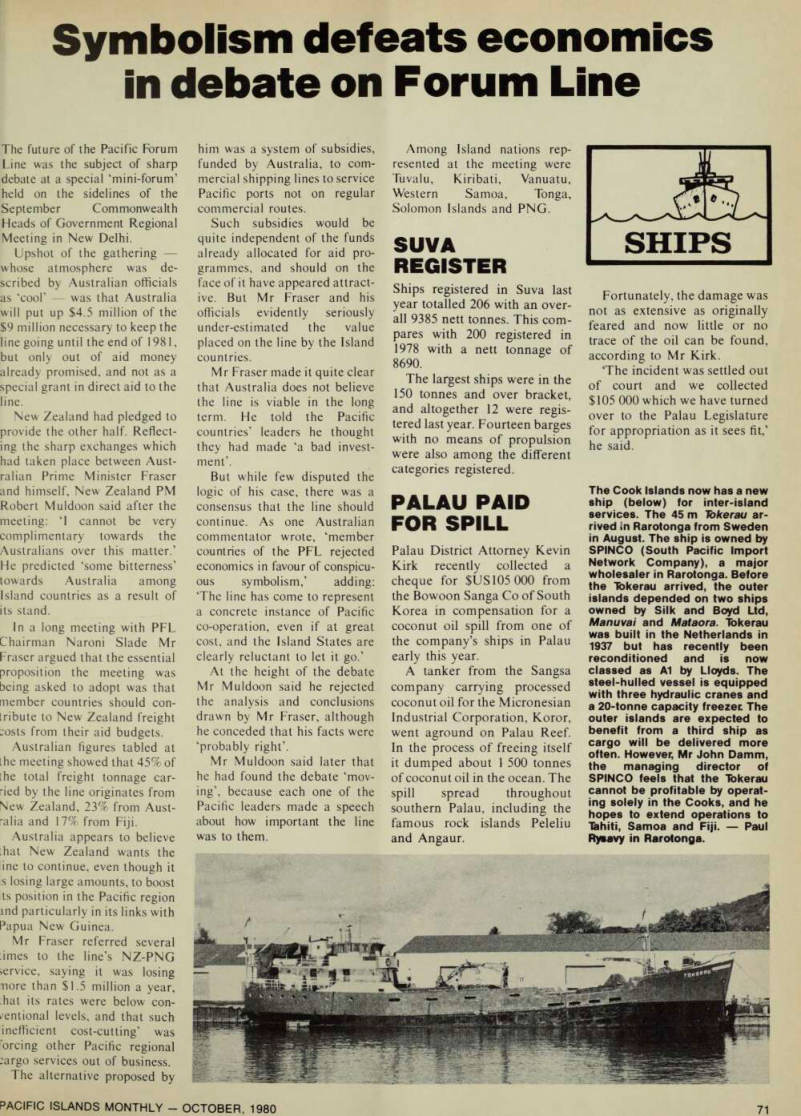
The Cook Islands now has a new ship (below) for inter-island services. The 45 m Tokerau ar rived in Rarotonga from Sweden in August. The ship is owned by SPINCO (South Pacific Import Network Company), a major wholesaler in Rarotonga. Before the Tokerau arrived, the outer islands depended on two ships owned by Silk and Boyd Ltd, Manuvai and Mataora. Tokerau was built in the Netherlands in 1937 but has recently been reconditioned and is now classed as A1 by Lloyds. The steel-hulled vessel is equipped with three hydraulic cranes and a 20-tonne capacity freezes. The outer islands are expected to benefit from a third ship as cargo will be delivered more often. However, Mr John Damm, the managing director of SPINCO feels that the Tokerau cannot be profitable by operat ing solely in the Cooks, and he hopes to extend operations to
Tahiti, Samoa and Fiji. - Paul
Rysavy in Rarotonga.