export plantings
p. 69 · Read in the full issue
Recovery in banana export plantings
The tiny atoll of Aitutaki in the Cook Islands expects to pro duce up to 80 000 cases of bananas this year for export from its 18 square kilometres of reef-ringed land.
In the past 18 months there has been a spectacular recovery in the Aitutaki banana indus try, which peaked in 1971 with the production of 90 000 cases, fell away in intervening years because of punishment from hurricanes, disease and other depressing factors, and is now back in a boom phase. Last year Aitutaki shipped 49 233 cases io New Zealand, confirming its ■epulation as the banana capi ;al of the Cooks. Rarotonga was he only other exporter of Dananas among the group 1100 cases.
In little more than 12 months \itutaki banana plantings have ncreased by 50 percent to 125 ha, hence the optimism ibout stretching the production arget this year.
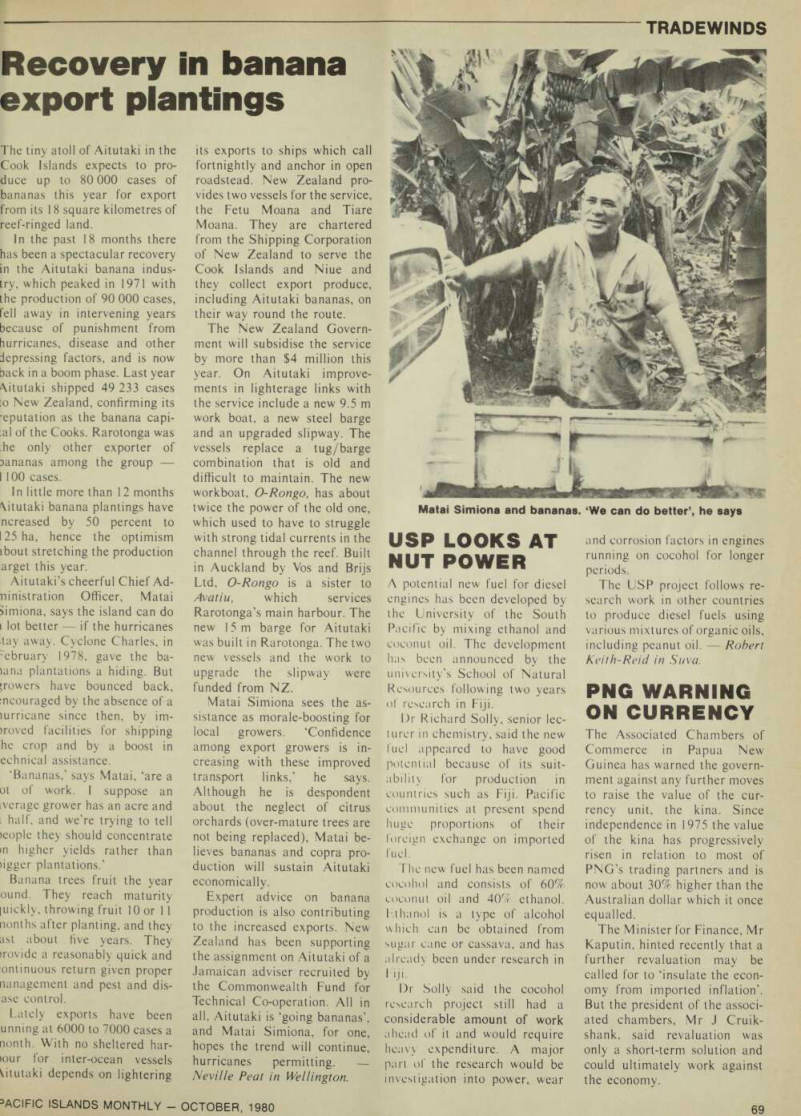
Aitutaki’s cheerful Chief Ad ninistration Officer, Matai Simiona, says the island can do i lot better if the hurricanes lay away. Cyclone Charles, in -ebruary 1978, gave the ba lana plantations a hiding. But ►rowers have bounced back, mcouraged by the absence of a mrricane since then, by im >rovcd facilities for shipping he crop and by a boost in echnical assistance. ‘Bananas,’ says Matai, ‘are a ot of work. I suppose an iverage grower has an acre and . half, and we’re trying to tell >eople they should concentrate m higher yields rather than »igger plantations.’
Banana trees fruit the year ound. They reach maturity [uickly, throwing fruit 10 or 11 nonths after planting, and they ast about five years. They ►rovidc a reasonably quick and onlinuous return given proper nanagement and pest and dis asc control.
Lately exports have been unning at 6000 to 7000 cases a nonlh. With no sheltered har (our for inter-ocean vessels
Aitutaki depends on lightering
its exports to ships which call fortnightly and anchor in open roadstead. New Zealand pro vides two vessels for the service, the Fetu Moana and Tiare Moana. They are chartered from the Shipping Corporation of New Zealand to serve the Cook Islands and Niue and they collect export produce, including Aitutaki bananas, on their way round the route.
The New Zealand Govern ment will subsidise the service by more than $4 million this year. On Aitutaki improve ments in lighterage links with the service include a new 9.5 m work boat, a new steel barge and an upgraded slipway. The vessels replace a tug/barge combination that is old and difficult to maintain. The new workboal, O-Rongo, has about twice the power of the old one, which used to have to struggle with strong tidal currents in the channel through the reef. Built in Auckland by Vos and Brijs Ltd, O-Rongo is a sister to Avatiu, which services Rarotonga’s main harbour. The new 15 m barge for Aitutaki was built in Rarotonga. The two new vessels and the work to upgrade the slipway were funded from NZ.
Matai Simiona sees the as sistance as morale-boosting for local growers. ‘Confidence among export growers is in creasing with these improved transport links,’ he says.
Although he is despondent about the neglect of citrus orchards (over-mature trees are not being replaced), Matai be lieves bananas and copra pro duction will sustain Aitutaki economically.
Expert advice on banana production is also contributing to the increased exports. New Zealand has been supporting the assignment on Aitutaki of a Jamaican adviser recruited by the Commonwealth Fund for Technical Co-operation. All in all, Aitutaki is ‘going bananas’, and Matai Simiona, for one, hopes the trend will continue,
hurricanes permitting.
Neville Peat in Wellington.
Usp Looks At
Nut Power
A potential new fuel for diesel engines has been developed by the University of the South Pacific by mixing ethanol and coconut oil. The development has been announced by the university’s School of Natural Resources following two years of research in Fiji.
Dr Richard Solly, senior lec turer in chemistry, said the new fuel appeared to have good potential because of its suit ability for production in Countries such as Fiji. Pacific communities at present spend huge proportions of their foreign exchange on imported fuel.
The new fuel has been named cocohol and consists of 60% coconut oil and 40% ethanol.
Flhanol is a type of alcohol which can be obtained from sugar cane or cassava, and has already been under research in Fiji.
Dr Solly said the cocohol research project still had a considerable amount of work ahead of it and would require heavy expenditure. A major part of the research would be investigation into power, wear
and corrosion factors in engines running on cocohol for longer periods.
The USP project follows re search work in other countries to produce diesel fuels using various mixtures of organic oils, including peanut oil. Robert Keith-Re id in Suva.
Png Warning
On Currency
The Associated Chambers of Commerce in Papua New Guinea has warned the govern ment against any further moves to raise the value of the cur rency unit, the kina. Since independence in 1975 the value of the kina has progressively risen in relation to most of PNG’s trading partners and is now about 30% higher than the Australian dollar which it once equalled.
The Minister for Finance, Mr Kaputin, hinted recently that a further revaluation may be called for to ‘insulate the econ omy from imported inflation'.
But the president of the associ ated chambers, Mr J Cruik shank, said revaluation was only a short-term solution and could ultimately work against the economy.
Matai Simiona and bananas. ‘We can do better’, he says