Promise, and problems, of the
pp. 53-55 · Read in the full issue
Trade
Winds
Promise, and problems, of the South Pacific Trade Commission
RON HEGERHORST, Trade Commissioner for the South Pacific, sums up the work of the Sydney-based South Pacific Trade Commission after its first year of operation. At the time of the birth of the SPTC, which is under the auspices of the South Pacific Bureau of Economic Co-operation, Mr Hegerhorst summed up its prospects for PIM (Oct 1979 p 31).
In the article below he recalls that he was optimistic then, and is even more so today.
The South Pacific Trade Commission after one year: Even though a year is an arbitrary period in the life of any organisation, it is an appro priate moment to reflect on what has been done by the SPTC in its first year, and on whether our experience in that time has established a sense of direction for the future.
What we have done so far: Since its birth the SPTC has built up quite an impressive dossier of trade and investment inquiries, and has begun work on specific publicity or promotional ventures. The SPTC is at present working on nearly 80 inquiries concerning products and industries, it has completed plans to participate in the Melbourne International Centenary Exhibition in Seplember/October this year, and has agreed to give help to and take part in a small trade fair organised in Tarawa by the Kiribati Department of Trade, Industry and Labour for November 1980.
The SPTC’s promotional ef forts in its first year of existence have centred on what is best described as a ‘getting to know you’ exercise.
Within Australia, contact has been made with business 3rganisations and companies with a history of trade with the Pacific, or known to be inter ested in developing such trade, n most capital cities. Similarly, visits have been made to mem ber countries of the South Pacific Bureau of Economic Zo-operation (SPEC) in order o become acquainted with business people and govern nent officials there.
This exercise has been ex remely useful in that it has not >nly established a large number )f useful contacts, but established in the minds of elevant Australian business nen the idea that some of the iroducts in which they are
interested can be supplied from the Pacific, and let Pacific businessmen know that selling to a market like Australia is not beyond their capabilities.
An example of the value of getting out and establishing contacts was my tour of eight Pacific countries in May of this year. During 26 days of almost incessant travelling and dis cussions in Tonga, Western Samoa, Niue, Kiribati, the Fed erated States of Micronesia, Nauru, Solomon Islands and Papua New Guinea, several pre-set purposes appear to have been well-served. • Very often new lines of thought and new inquiries only come to light through personal contact with the manufacturer or exporter during this trip several new inquiries surfaced e.g., dried bananas, tropical clothes, fruit preserves, cut tropical flowers, sawn timber and timber-derived products, passionfruit in its various forms, dried sharks’ fins, coco nut cream, leather products, fruit products such as puree and glacee, appliance assembly, confectionery, charcoal, honey, furniture items, printing work, spices. • Further progress was made with earlier inquiries which for some reason had not seen much progress through correspon dence. • The visit included three countries not previously included in trips by me or by my staff (Niue, Micronesia and Nauru), at last enabling me to make new contacts and become better acquainted with the nature of the business world in those countries. • In many places the ground work was laid for establishing a more or less regular flow of information needed by SPTC in servicing its customers. • I was able to establish the availability or otherwise of products or services which had
come to the attention of the SPTC from Australian sources.
We should understand clearly that it is unfortunately not possible for all activities and all inquiries to achieve the desired results. Existing trading pat terns for Australian importers, limitations in the supply and range of products made in the Pacific, pricing, packaging and presentation problems, are all factors which tend to influence the outcome of our work. In this context one is heartened that after several rounds of negotiations over the last 12 months, the South Pacific Regional Trade and Economic
Co-operation Agreement
(SPARTECA) has been con cluded. Its coming into force in the near future will, I trust, materially assist efforts by Pa cific businessmen and by my office to find markets for their products in Australia.
This is not to say that SPARTECA won’t have its share of problems, particularly in its early stages. But the importance of SPARTECA is that it establishes in practice an extremely important concept, i.e., greater and freer access for Pacific countries to the Aust ralian market, and, at the same time, it has built into it suf ficient flexibility for enlarging its scope should this become desirable.
Where do we go from here?: It is obvious that our bread and butter line of work, i.e., to receive, handle, dig out, re search and facilitate trade and investment inquiries, must con tinue to claim most of our attention and this even if only a small proportion of all those handled come off.
The expansion of exports in existing products, the creation of trade in products already produced but not previously traded, and the investment and industry-creation type of in quiry, all fall within this
category and are, in principle, all capable of positive results, given our ability to pay them the required attention.
Our basic range of contacts both in Australia and the Pa cific must be maintained and expanded. This will be done through a solid programme of travel within Australia and, as a direct consequence of that, a limited amount of travel to member countries. The empha sis here will change from con stant direct contact with government officials to much closer relationships with the business world itself. Our aim is to bring together buyer and seller, investor and project proposer, through personal con tact.
After the initial publicity and image-creation phase of ‘get ting to know you’, we are planning to change emphasis to one of product promotion. One way in which we will do this is by bringing out selected Pacific businessmen and subjecting them to an intensive Australian business visit to two or more capital cities. We plan to ar range specific product pro motions in Sydney to which Pacific businessmen will be invited to make their own presentations to prospective Australian buyers. This activity is likely to include a seminar type of day, a working lunch eon, product displays and visits to buyers’ establishments. In addition, to the extent that adequate funding is available, participation in a trade fair
within Australia will be con sidered.
I have concentrated so far on a series of activities which could all basically be looked upon as part of ‘trade pro motion’. There are, of course, other activities with which my staff and 1 will undoubtedly become or remain involved.
The provision of adequate shipping services is one such matter. It can safely be said that shipping services from Australia to most Pacific Island countries are reasonable and serve the Australian exporter well. Regrettably it is not poss ible at present to make the same claim for Pacific ex porters dealing with the Aust ralian market. Immediately after the SPTC was established we saw a period of very good services with short transit times from Pacific ports to Australia.
This has been followed by a worsening of the situation. Ob viously, this tendency, if con tinued, will knock much of the SPTC’s efforts. We, and no doubt all others affected by this change, made our views known, and there is ground for hope that before very long we shall return to a situation where regular fast shipping from the najor Pacific ports to Australia kvill again be available.
Another topic which has seen of some concern and vhich we hope will soon be a hing of the past is the speed, )r rather the lack thereof, with vhich inquiries or queries are seing attended to. This is not a complaint. I merely take this )pportunity to state the obvi )us: if one wants business one nust not simply be interested in )btaining this business, one nust be seen to be interested.
Conclusion: A year ago the iPTC started in an optimistic rame of mind. This optimism las only been strengthened by he early successes with such )roducts as fresh coconuts, vooden toys, shirts, taro, yam, andalwood, and desiccated :oconut, as well as by what to ome people will be the urprisingly large range of •roduct inquiries now in the •ipeline. Thus the SPTC is in he happy position of experienc ng a heavy while •lanning intensified activity for he coming year.
Australia’s generous and most gratefully accepted annual contribution of $l5O 000 has been solely re sponsible for the trade com mission doing what it has done to date.
The amount was set, offered and accepted two years ago and, since then, inflation has put such serious pressure on the
effectiveness of the amount that it is no longer capable of doing what it could originally. It is therefore incumbent upon us and on all concerned to begin considering additional sources of funds. The SPTC has begun doing this with a sense of urgency.
Essentially there are three possible sources from which funds can be drawn. First, Australia, which is already do ing what it can; second, ben eficiary members of the organ isation; and, third, international trade promotion organisations.
The latter two possible sources call for our close attention.
A year ago 1 expressed in this journal confidence in our ability to bring about significant ex pansion of most members’ ex ports to Australia.
I should like to repeat that view: the operation will con tinue to spread its benefits further and more widely among member countries. It will con tinue to pay close attention to all inquiries coming its way and will initiate its own activities whenever opportunities arise. A good start has been made. Let’s maintain momentum.
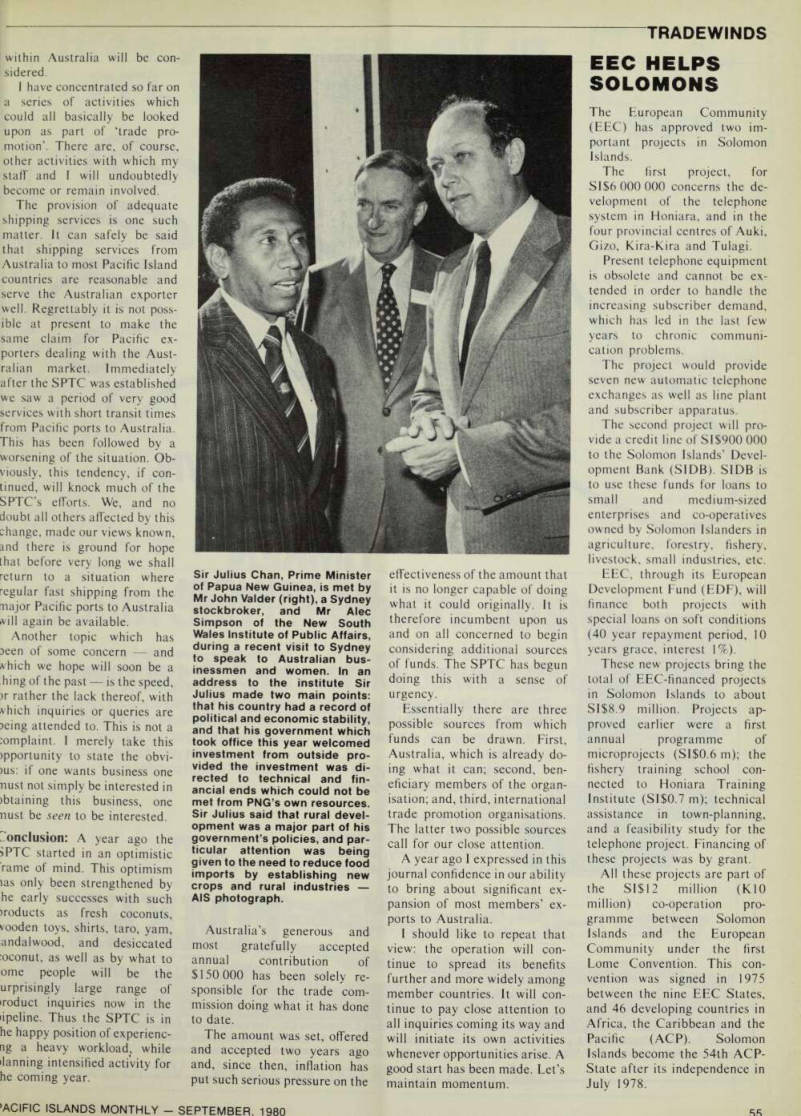
Sir Julius Chan, Prime Minister of Papua New Guinea, is met by Mr John Valder (right), a Sydney stockbroker, and Mr Alec Simpson of the New South Wales Institute of Public Affairs, during a recent visit to Sydney to speak to Australian bus inessmen and women. In an address to the institute Sir Julius made two main points: that his country had a record of political and economic stability, and that his government which took office this year welcomed investment from outside pro vided the investment was di rected to technical and fin ancial ends which could not be met from PNG’s own resources.
Sir Julius said that rural devel opment was a major part of his government’s policies, and par ticular attention was being given to the need to reduce food imports by establishing new crops and rural industries
AIS photograph.