A brief, memorable love
pp. 47-50 · Read in the full issue



affair with Abemama
After spending the 1978/79 cyclone season together in New Zealand, the crews of three yachts decided to sail all the way to Tarawa for the Kiribati independence celebrations, a distance of over 5000 km; Aventura , from London, with Jimmy, Gwenda, Doina and Ivan Cornell on board; and two Australian yachts, Tar rawarra, from Melbourne crewed by Tony Robinson and Kim Prowd, and the Sydney
registered Hdgar, skippered by
Gunter Gross. They were the
only yachts in Tarawa during
the July 1979 celebrations.
Returning south, the three vessels called in at several islands, their first stop being in Abemama.
After the lowering of the Bri tish flag and the end of the cel ebrations in Tarawa, there was little to keep us in Betio’s oily and overcrowded harbour.
Recrossing the equator into the South Pacific we made our way into the placid waters of
Abemama lagoon, lying about
200 km south-east of the
country’s capital.
Unlike Tarawa, where the government seemed keen to put an end to the festive mood even before the last guests had
departed, the people of
Abemama were still busy celebrating the birth of their nationhood. Significantly, it was here that Captain Davis of HMS Royalist had planted the Union Jack in 1892, thus adding yet another territory to Queen Victoria’s mighty realm.
After World War 11, Abemama seemed poised to become the capital of the Gilbert and Ellice Islands Colony, but Tarawa won on account of its deeper lagoon. It was a decision which no one on Abemama seems to regret.
In Abemama’s main village,
Tabontebike, we met the dis trict officer, who made us exceedingly welcome and assigned his assistant, Kuria Teitia, as our personal guide.
Meanwhile he was busy super vising the return to the villages spread out among the islands that encompass the lagoon of the numerous people who had come to celebrate in the main maneaba. This was far from
being a simple operation, as
many families had come to the
week-long festivities bringing
along most, if not all, of their
worldly possessions.
With the determination and knack of a professional tour conductor, Kuria somehow squeezed us on the trailer of a
tractor already brimming with
grannies, children, chickens, cats, guitars and cooking uten sils, with people perched even on the tractor’s mudguards.
Thus we left Tabontebike in a hail of farewell greetings, as if our fellow passengers were set ting off for the end of the world and not for the next village, all of five km away.
After shedding its motley
cargo along the road, the driver took us as far as our first objec
tive, a bunker where a group of Japanese soldiers made their last suicidal stand when the island was stormed by a detachment of US para troopers during World War 11.
In a nearby coconut grove stood a fine house, the resi dence of the customary chief of Abemama, who unfortunately was away on an official visit to the nearby islands of Kuria and Aranuka. Traditionally these islands were ruled by the chief tain of Abemama, an arrange ment which appears to have been kept, although it has lost its pre-colonial significance.
We set off on foot along a narrow causeway and crossed on a rickety bridge to the next island, Manaku. In the scorch ing midday sun it felt like crossing the Styx and we must have looked like a party of Noel Coward’s ‘mad Englishmen’, accompanied as we were by a mongrel dog, who fortunately wasn’t mad himself. As he had been to school there, our guide wanted us to visit the Mission of the Sacred Heart at Manaku, an old-established convent which runs, among other things, a primary school, a small dis-
pensary and a course for nov ices.
We were invited inside the cool building by the Gilbertese Mother Superior who served us cold drinks and snacks, while Sister Raphael, an Australian who had spent more than 40 years in the Gilberts, recalled the war years when she and some of her companions had
miraculously escaped the
Japanese. Many others were
less fortunate. Before leaving we were taken around the mission grounds, to the tidy gardens and the sisters’ small
chapel, beautifully made from
local materials in the tra ditional way, with all joints tied and not a nail in sight.
A whale had been stranded on a beach facing the ocean a couple of weeks earlier, and Kuria finally gave in to our re quests to go and see it, while assuring us that there wasn’t much left to see. By the time we had reached the edge of the beach we could have found the whale guideless and blind folded, as the stench emanating from the blackened carcass, lying more than a km away, was so strong that one could virtually touch it. Such an odorous reception should have been enough to put any visitors to flight, but not us, inveterate globetrotters, who were har bouring the secret hope that at least some of the whale’s teeth might still be present. After all.
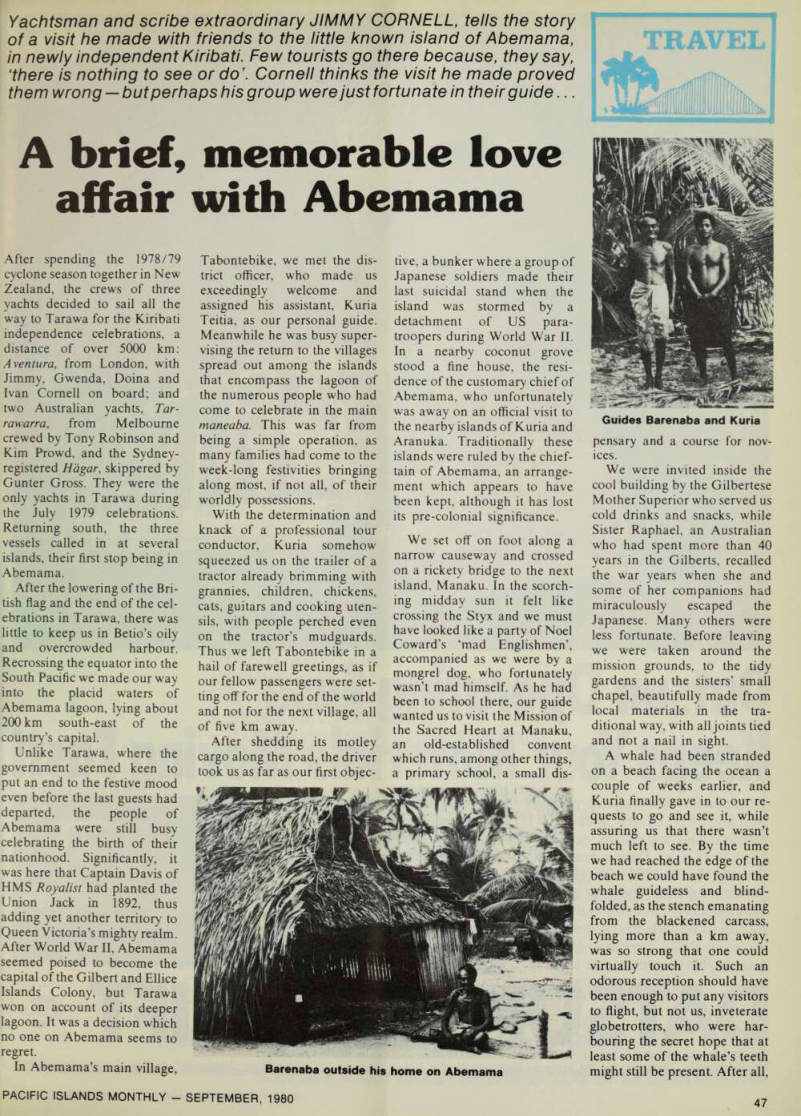
Barenaba outside his home on Abemama
Guides Barenaba and Kuria
we were on our way back to Fiji, where such a rare gift would have been greatly ap-
predated by any village
chief.
Sniffing the wind, of which there was more than enough to sniff, we made our way upwind of the smelly monster and approached it with nostrils firmly pinched. A few ribs were sticking out from the gooey, slimy mass, crawling with fat maggots. Some of the blubber had found its way into the cooking pots and lamps of the nearest village, while as we were to find out later, the main trophy, the whale’s teeth, had been appropriated by none other than the great-grandson of Abemama’s infamous tyrant, Tem Binoka. But even if the teeth had still been there, I doubt that any of us would have had a hand available to extract them, as by now we were flailing madly at the swarms of fat green flies that fer some odd reason seemed to prefer us to the tasty corpse.
We hitched a ride back into
Tabontebike with the mission truck, briefly stopping en route to dissect the heart of a coconut tree fallen across the road after the owner had generously given us permission to do so. I just hope we didn’t give any destructive ideas to the islanders, who were watching us curiously, thus introducing them to this gourmet delight, also known as millionaire’s cabbage, which makes a tasty salad tossed in French dress
ing.
A welcome stop was finally made at Abemama’s sole hotel, sadly closed for lack of visitors.
Having been advised that the standard way to get a cold beer was to leave a few cans in the island’s only freezer, we had placed our orders with the
storekeeper before setting off
on our trip. Returning much later than anticipated we were presented with a few Foster’s whose contents were frozen solid. A detour was quickly de vised by Kuria to allow the beer to regain a more palatable state.
Not far from Tabontebike stands Tern Binoka’s grave, surmounted by a tomb of mass ive solidity. It was as if the ty rant’s subjects had tried to prevent even his ghost from escaping his last abode. In a nearby house lives Barenaba Tabaeko, whose grandfather was one of Binoka’s servants.
In pursuance of the family tra dition, old Barenaba is now the
self-appointed caretaker of the
former royal compound, of
which little is left except a
small muddy pool, pointed out
with wide grins by our two
guides.
According to these, Binoka’s harem used to bathe here, the only outsider ever allowed to watch the young maidens frolicking in the water being Robert Louis Stevenson, who
Tem Binoka’s tomb near Tabontebike
later made his despotic host famous in his story In the South Seas. During his Pacific travels, the Scottish author had spent some time on Abemama, Barenaba pointing out a few stones left from the foundation of his house and a well, sup
posedly used by Stevenson.
Back at the hotel we were joined by a tall man, Sorem Paulo, a true giant by local standards, who greeted us like long-lost friends and proceeded to ply us with stories as tall as himself. However, we enjoyed his tales even if he refused to tell us what he had done with the dead whale’s teeth. After all, he was Binoka’s great-grandson and as the ty rant’s heir and successor, no body could deny him certain
privileges. Only the store
keeper seemed unimpressed by
his ancestry and firmly refused to sell him beer before the official six o’clock deadline, a rule which didn’t seem to apply to us outsiders.
The following day we went outside the reef for a diving
expedition. The underwater scenery was among the best we had encountered anywhere in the Pacific, even if the pleasure of swimming among the multi coloured coral formations was somewhat spoilt by the pres ence of several white-tipped sharks. For a while, these appeared unconcerned with our activities until a large groper, which I had speared, took refuge under a coral head whence it refused to budge.
Trying frantically to retrieve, if not my quarry, at least the
spear, I was suddenly joined by
the white-tips, who had shed their nonchalant role and were now actively interested in what was going on. So actively, in fact, that I decided to quickly leave the stage before they be came too dangerous. The blood streaming from the wounded fish was already sending the sharks into a frenzy, the situ ation made worse by their in ability to reach the fish which was, firmly jammed under the coral head. From the surface,
feeling myself in relative
safety, I watched the frenzied struggle going on 15 m below me, as the six sharks, none of which was under two m long, were trying to get their flat heads under the coral to take a bite out of the helpless victim.
At long last it was all over and I could dive down and retrieve the spear and the gun attached to it. But of my fish there were no remains.
To crown our visit to his island, Kuria arranged that
evening a concert given by a
local string band in one of the maneabas. The mixed choir sang with great feeling both older and newer songs, one of the best among the latter being a ballad composed by the local musician lentoia, about a girl returning home from her schooling overseas. Kuria then translated for us the sad lyrics of a song dedicated to the memory of the missionaries killed by the Japanese. Later, sitting crosslegged on the fine mats laid on the coral floor for us, we swapped yams with the musicians who were greatly
interested in our voyage and the ouside world, particularly in the music of other Pacific Islands. It was my turn to enter tain our hosts and I played sev eral tapes that I had recorded in Wallis, Tonga, Fiji and Eas ter Island. It was nearly mid night when the hissing sound of the bright Coleman lamps was extinguished in the maneaba and we slowly rowed back to the yachts moored in the la goon.
While sailing out of the la goon next morning bound for our next destination, Onotoa, I kept thinking of what Kuria had told me when I had asked him why the hotel was void of visitors, in spite of the regular airlink with Tarawa. ‘Oh,’ he replied with a sad smile, ‘the tourists complain that there is nothing to see or do in Abemama, so they simply don’t come.’
Well, we seem to have proved them wrong but then perhaps they never had the luck to come across Kuria Tei tia.