The Cornell story: Three years
pp. 169-173 · Read in the full issue
Yachts
The Cornell story: Three years at home in the Pacific
When Jimmy and Gwenda Cornell entered the Pacific through the Panama Canal they intended to spend a year cruising in it. They finished up spending three. Here GWENDA CORNELL tells the story of this experience of sailing the great ocean in their yacht Aventura with their children Doina and Ivan. As they head for Europe and home, she writes of their many regrets at leaving the Pacific, ‘for above all it has been for us a peaceful ocean, one full of friendly welcoming people, where we have rarely needed to lock up our boat’.
Our entry into the Pacific was quite dramatic. Poised high in the Miraflores Lock of the Panama Canal, we caught our first glimpse of that great ocean stretching out to the horizon. Then the water rushed out at great and turbulent speed, we fell with it behind the lock gates, and as they opened we were spat out with the strong current and swift eddies into the Pacific Ocean.
Little did we guess that the Pacific would cast such a spell on us that instead of the planned one year, we would spend three years criss-crossing it.
Sailing in a small boat across the vast ocean, I felt so much closer to the countries and peoples than if I had flown in by air. This is Oceania, whose countries are all islands, tra ditionally linked only by the sea. Often I have thought of the Polynesian legends, and when we have been at sea for many days, I put myself into the minds of those early navi gators in their canoes. I imagined how they must have felt, exactly as we did, when the first coconut palms spiked up on the horizon, or a tiny speck of island emerged where we had expected it would be.
Three weeks out from South America, we felt this way when we sighted Rapa Nui, our first Pacific island, also known as Easter Island, and the feeling hasn’t changed since. Some islands are still not charted correctly, such as Wallis
Island. Some islands have no air links and rare sea links, and sailing into such places, where other visitors are few, has a special significance. Since con tacts with the outside world are so rare, the islanders are as interested in us, our way of life, how the boat sails and how we navigate, as we are in their way of life, their music and tra ditions.
Being a family has undoubt edly made an enormous differ ence to our travels. We are a social unit that the Pacific Islanders well understand, for children have a special place in their affections. In many places the only visitors are officials or adults, and the local children especially have rarely seen white children, so playing together becomes a valuable experience for both sides.
In choosing to sail the un usual route across the South Pacific from Peru to Easter Island, Pitcairn, Gambier Islands to Tahiti, we were rewarded by seeing some rarely visited islands and in several months we didn’t come across
another yacht. In fact, the only way to get to Pitcairn is to sail there yourself, as there are no regular sailings nor an airstrip.
Descended from the Bounty mutineers, only 65 people live on that tiny island, and the Pitcairners welcomed us by immediately taking us into their family life. Doina, 12, and Ivan 10, quickly made friends with the few children and needed no persuading to sleep ashore in the Christian household and go to school the next morning. There were eight children in the school from the ages of five to 14. Two of these were the children of the New Zealand schoolteacher Mr Cox. With the addition of two more pupils, Mr Cox took advantage of them to perform some drama, normally so diffi cult with the same few voices.
Later Doina, and Ivan, de scribed their voyage, while the Pitcairn children talked about life on their remote island. This was typical of the exchange between my children and those they have met throughout the Pacific. The experience has
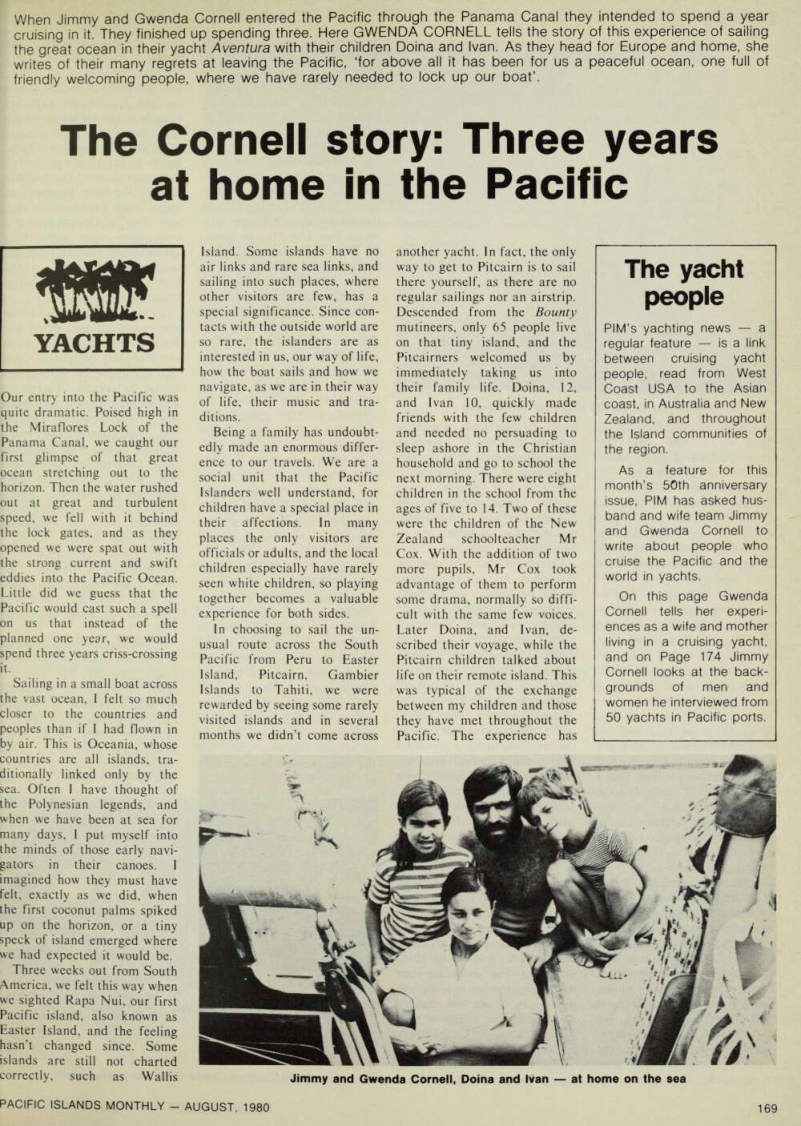
Jimmy and Gwenda Cornell, Doina and Ivan - at home on the sea
helped them to understand the island way of life, and the island children to learn some thing of our lifestyle.
Pitcairn has no safe anchor age and we were not able to give in to pleas to stay longer, setting sail for Mangareva in the Gambier group. Here, the mayor, Lucas Paeamara, must have read my mind, when shortly after offering to take us around the island to deliver some mail we had brought from Pitcairn, he turned to me and said; ‘Wouldn’t the chil dren like to go to school here?’
We stayed a month, becoming almost part of the island life.
Every morning the children rowed off to be at school by seven and returned to Aventura only when they had to. By the end of the month they spoke French with a definite Polynesian accent.
The French system of edu cation is much more rigid than the British, and as French is a foreign language for the Mangarevan children too, Doina and Ivan weren’t at too much of a disadvantage. Lucas was very concerned about the younger members of his com munity, for whom there was little prospect of employment on an island where the adults had lost all interest even in cultivating their gardens. We spent many interesting even ings discussing with him the problems and results of edu cation, and the relevance of
some of the more academic subjects to island life. He was especially interested in my de scriptions of the progressive school I had taught at in London. Lucas was young to be mayor, but full of idealistic notions, most of which would be difficult to achieve.
Our social life on Mangareva flourished. The gendarmes, nurse, postmaster and school teachers, recruited from other islands in French Polynesia, readily accepted us into their midst. They all had children and it was here that Doina first learnt to plait a crown of frangipani, juggle lemons and dance the tamure. They had no boats capable of going outside the reef, so Jimmy organised a fishing expedition on Aventura for some of the men, returning with a bumper catch of king fish, dolphinfish and tuna, that filled various deep freezers.
Our month passed so quickly and all too soon we were at our first Polynesian farewell, with presents of shells in sets of seven for each day of the week, and goodbyes amidst a festoon of shell necklaces laced with the odd teardrop. Our aft cabin looked like a floating fruit shop, with not one but four stems of bananas hanging up, plus sacks of oranges, lemons and grapefruit. Everyone had brought us something for the journey to Tahiti.
The well-sailed track among Tahiti and the Society Islands
made it less easy to establish any friends ashore, while we had guests ourselves and a social life among the yachts.
Still, Ivan had the pleasure of hearing a young boy yell his name from the pillion seat of a motorbike in Raiatea one of his Mangarevan schoolfriends spending the long holidays on the schoolteacher’s home island. That is how the children discovered that Tahitian tele vision has The Muppet Show in French the same plea sures enjoyed worldwide.
The official languages may be French or English here or there, but we soon learnt that the similarities between the Polynesian islands were often greater than their differences.
The dancing for the 14th July Fete in Bora Bora was no different from that in Rarotonga for Constitution Day. The legends of their an cestors acted out by the chil dren had the same flavour. As at Mangareva, in Aitutaki in the Cooks our friends brought down drinking nuts and fruit in plenty for the short passage to Rarotonga. As well as joining the band of children that ac companied the legendary Father George on all his er rands, my children had been welcomed in the primary school here too, and even the headmaster came down to the quay with drinking nuts and to say farewell. I could imagine how it must have felt to set off on a voyage in a canoe in the old days. Canoes could be and were blown off course on even the shorter journeys, and I felt this thought was in the minds of the landlubbers of today as
they farewelled those of us travelling in small vessels.
From the Cooks to Tonga bad weather did indeed strike us, and for several days we were buffeted by strong winds and huge seas. Fortunately Aventura is a well-built boat, and dropping all sail we let her look after us until the weather abated. We were hundreds of miles from anywhere in that vast Pacific Ocean and the only vague worry were those unconfirmed reports that one reads occasionally on the charts ‘breaking water reported 1893’.
Originally planning more or less to sail straight across the Pacific, it was in fact right at the beginning on Easter Island that events started shaping our course differently. There’s an Englishman at my guesthouse who’s interested in meeting you,’ said a friend. So we came to Tom Laing, who had spent many years in the Pacific and was then Britain’s Com missioner for Tuvalu. It was a country 1 hadn’t even heard of, although when he mentioned Gilbert and Ellice, it rang a bell. ‘We’re due to become independent in October,’ he said. There aren’t many colon ies left now, so these cel ebrations are something to be seen.’
It sounded exciting and that is how we came to be sailing north from Fiji that year in stead of westward. Our first morning at anchor in Tuvalu’s Funafuti lagoon was a taste of things to come, as we were woken up at dawn by the sound of harmonious singing. A boat load of people from one of the
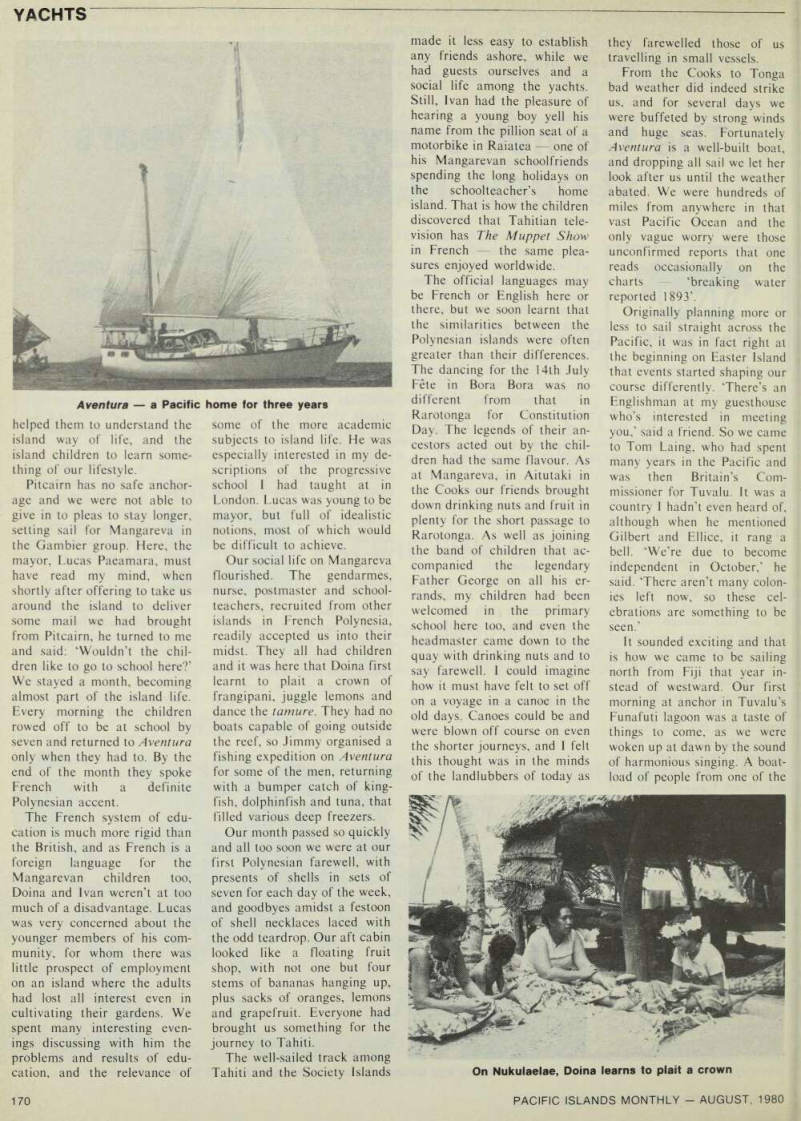
Aventura - a Pacific home for three years
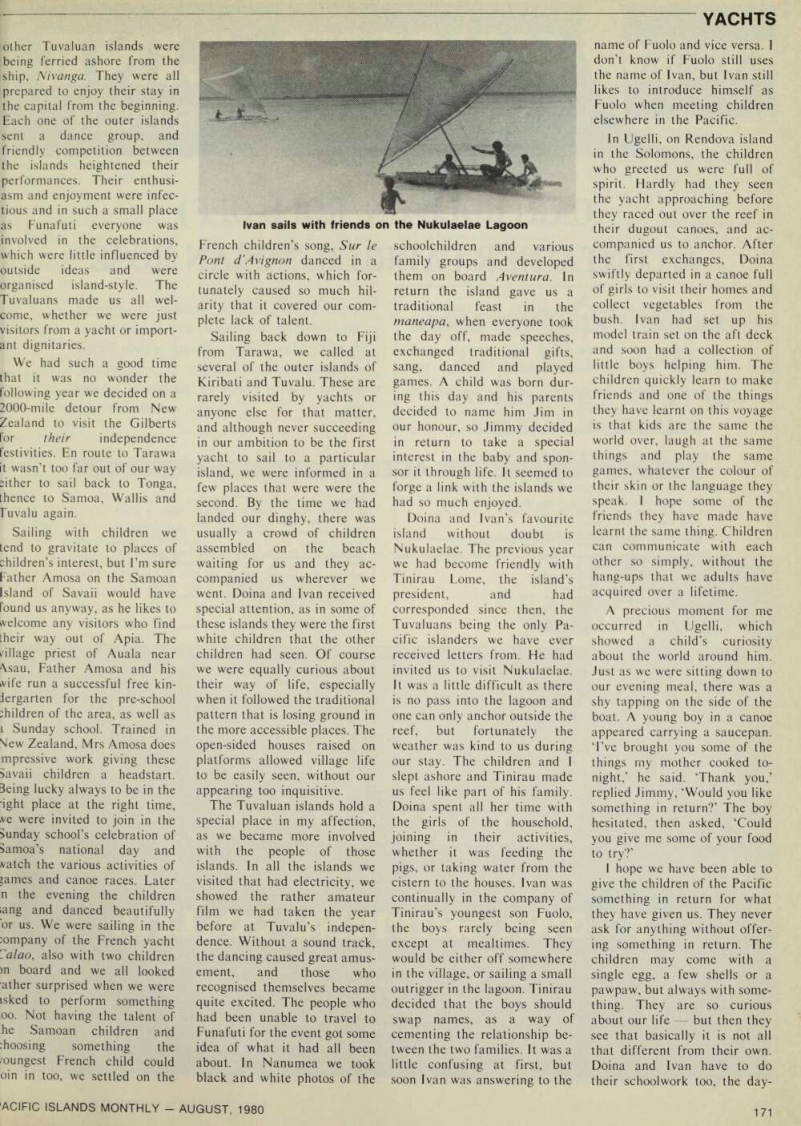
On Nukulaelae, Doina learns to plait a crown
other Tuvaluan islands were being ferried ashore from the ship, Nivanga. They were all prepared to enjoy their stay in the capital from the beginning.
Each one of the outer islands sent a dance group, and friendly competition between the islands heightened their performances. Their enthusi asm and enjoyment were infec tious and in such a small place as Funafuti everyone was involved in the celebrations, which were little influenced by outside ideas and were organised island-style. The Tuvaluans made us all wel come, whether we were just visitors from a yacht or import ant dignitaries.
We had such a good time that it was no wonder the following year we decided on a 2000-mile detour from New Zealand to visit the Gilberts for their independence festivities. En route to Tarawa it wasn’t too far out of our way either to sail back to Tonga, thence to Samoa, Wallis and Fuvalu again.
Sailing with children we tend to gravitate to places of children’s interest, but I’m sure Father Amosa on the Samoan Island of Savaii would have found us anyway, as he likes to welcome any visitors who find their way out of Apia. The tillage priest of Auala near \sau. Father Amosa and his wife run a successful free kin dergarten for the pre-school :hildren of the area, as well as i Sunday school. Trained in New Zealand, Mrs Amosa does mpressive work giving these Savaii children a headstart.
Being lucky always to be in the ■ight place at the right time, ve were invited to join in the Sunday school’s celebration of Samoa’s national day and watch the various activities of »ames and canoe races. Later n the evening the children
iang and danced beautifully
or us. We were sailing in the company of the French yacht ~alao, also with two children m board and we all looked ather surprised when we were isked to perform something 00. Not having the talent of he Samoan children and choosing something the youngest French child could oin in too, we settled on the
French children’s song, Sur le Pont d’Avignon danced in a circle with actions, which for tunately caused so much hil arity that it covered our com plete lack of talent.
Sailing back down to Fiji from Tarawa, we called at several of the outer islands of Kiribati and Tuvalu. These are rarely visited by yachts or anyone else for that matter, and although never succeeding in our ambition to be the first yacht to sail to a particular island, we were informed in a few places that were were the second. By the time we had landed our dinghy, there was usually a crowd of children assembled on the beach waiting for us and they ac companied us wherever we went. Doina and Ivan received special attention, as in some of these islands they were the first white children that the other children had seen. Of course we were equally curious about their way of life, especially when it followed the traditional pattern that is losing ground in the more accessible places. The open-sided houses raised on platforms allowed village life to be easily seen, without our appearing too inquisitive.
The Tuvaluan islands hold a special place in my affection, as we became more involved with the people of those islands. In all the islands we visited that had electricity, we showed the rather amateur film we had taken the year before at Tuvalu’s indepen dence. Without a sound track, the dancing caused great amus ement, and those who recognised themselves became quite excited. The people who had been unable to travel to Funafuti for the event got some idea of what it had all been about. In Nanumea we took black and white photos of the
schoolchildren and various family groups and developed them on board Aventura. In return the island gave us a traditional feast in the maneapa , when everyone took the day off, made speeches, exchanged traditional gifts, sang, danced and played games. A child was born dur ing this day and his parents decided to name him Jim in our honour, so Jimmy decided in return to lake a special interest in the baby and spon sor it through life. It seemed to forge a link with the islands we had so much enjoyed.
Doina and Ivan’s favourite island without doubt is Nukulaelae. The previous year we had become friendly with Tinirau Lome, the island’s president, and had corresponded since then, the Tuvaluans being the only Pa cific islanders we have ever received letters from. He had invited us to visit Nukulaelae.
It was a little difficult as there is no pass into the lagoon and one can only anchor outside the reef, but fortunately the weather was kind to us during our stay. The children and 1 slept ashore and Tinirau made us feel like part of his family.
Doina spent all her time with the girls of the household, joining in their activities, whether it was feeding the pigs, or taking water from the cistern to the houses. Ivan was continually in the company of Tinirau’s youngest son Fuolo, the boys rarely being seen except at mealtimes. They would be either off somewhere in the village, or sailing a small outrigger in the lagoon. Tinirau decided that the boys should swap names, as a way of cementing the relationship be tween the two families. It was a little confusing at first, but soon Ivan was answering to the
name of Fuolo and vice versa. 1 don’t know if Fuolo still uses the name of Ivan, but Ivan still likes to introduce himself as Fuolo when meeting children elsewhere in the Pacific.
In Ugelli, on Rendova island in the Solomons, the children who greeted us were full of spirit. Hardly had they seen the yacht approaching before they raced out over the reef in their dugout canoes, and ac companied us to anchor. After the first exchanges, Doina swiftly departed in a canoe full of girls to visit their homes and collect vegetables from the bush. Ivan had set up his model train set on the aft deck and soon had a collection of little boys helping him. The children quickly learn to make friends and one of the things they have learnt on this voyage is that kids are the same the world over, laugh at the same things and play the same games, whatever the colour of their skin or the language they speak. I hope some of the friends they have made have learnt the same thing. Children can communicate with each other so simply, without the hang-ups that we adults have acquired over a lifetime.
A precious moment for me occurred in Ugelli, which showed a child’s curiosity about the world around him.
Just as we were sitting down to our evening meal, there was a shy tapping on the side of the boat. A young boy in a canoe appeared carrying a saucepan, d've brought you some of the things my mother cooked to night,’ he said. ‘Thank you,’ replied Jimmy, ‘Would you like something in return?’ The boy hesitated, then asked, ‘Could you give me some of your food to try?’
I hope we have been able to give the children of the Pacific something in return for what they have given us. They never ask for anything without offer ing something in return. The children may come with a single egg, a few shells or a pawpaw, but always with some thing. They are so curious about our life but then they see that basically it is not all that different from their own.
Doina and Ivan have to do their schoolwork too, the day
Ivan sails with friends on the Nukulaelae Lagoon
to-day life of cooking, washing and housework goes on just the same.
Whether in Polynesia, Micronesia or Melanesia, many things remain the same. On the coast of New Guinea, anchored in the small bay of Dregerhafen, surrounded by the grounds of the high school, both staff and pupils made us feel welcome, just as we have felt in other schools throughout the Pacific. Once again Doina and Ivan joined a class, Ivan being thrilled to have science lessons in a laboratory, although he found the three periods of agriculture in the school a bit tiring. The schoolchildren grew a lot of their own food for the canteen and kept the school impeccably tidy. The school had a happy atmosphere with children smil ing everywhere. I was impressed by their initiative in raising money by various means, even collecting empty beer bottles from surrounding villages. The children were using this money to build a new mess hall. They intended to construct it themselves. They had also collected enough money for a video TV.
Dregerhafen was an impress ive school. But while these children were receiving an ex cellent education, in contrast »ome of the children in the next places we visited in the Frobiands and Amphletts had no schools at all. In the remoter islands, especially in the \mphlett group, life was going 3n little touched by any :hanges in the world outside.
Contacts with outsiders are few ind as soon as we arrived :anoes came out to greet us, to ;alk, to sell, buy or trade hings. With no stores on the slands, it is a long sail or saddle for them to do any ihopping and their needs were )asic. Did we have rice, sugar, ioap to spare? They offered us Vesh fruit and vegetables in eturn. We found some batter es for the only radio in one dllage and a bulb for a torch.
With no medical care avail ible I treated a child’s infected jye and provided some ;h!oroquine tablets from my nedical chest. I was distressed )y the state of health of some )f the people. We hadn’t seen
people in such condition before in the Pacific. One woman wanted to make us a gift of one of their clay pots, but such a large fragile object was too difficult to stow on a boat. We were fascinated by the tra ditional life in the villages, especially the beautiful sailing canoes, carved, tied together with sennit and sporting woven pandanus sails. Ivan was in trigued by the fire they carried with them and the glowing stick they used instead of matches. They in turn admired our ropes and rigging and we managed to find some old rope for them. Our friend Maiviena from Yabwaia killed a wild pig with spears and dogs and brought us the roasted shoulder in the evening. He was sailing the next morning to Fergusson Island, 20 miles away, and so we planned our departure so we could sail in company with him part of the way.
Leaving Papua New Guinea, we will be leaving the Pacific Ocean and sailing back home to England via the Indian
Ocean, Red Sea and Middle East.
Looking at that troubled part of the world, we have many regrets in leaving the Pacific, for above all it has been for us a peaceful ocean, one full of friendly, welcoming people, where we have rarely needed to lock up our boat.
It has left its mark on the children in many of the ways they think, and on us too. We feel at home sitting crosslegged on a fine mat. We have learnt to enter a house or meeting
place from the lagoon side when we can and not from the sea, so as to be regarded as friends, not enemies.
The saddest part of our travels is always the leaving, and nowhere is this experience more poignant than in Polynesia. So often we have taken the lingering scent of the islands back to Aventura in our frangipani crowns, but we are incurably superstitious sailors and always throw them into the ocean on leaving, hoping this will bring us back one day.