take the passengers ashore exploring
pp. 164-167 · Read in the full issue
When there was time for the captain to take the passengers ashore exploring
Ships
• Captain Brett Milder, the South Pacific’s best-known master mariner, one-time commodore of the Burns Philp Line, navigator, artist, author, academic, here recalls some of the changes and the highlights of a half century among the Pacific Islands. The illustrations are by the author, from his book, ‘Navigator in the South Seas’, now available in paperback.
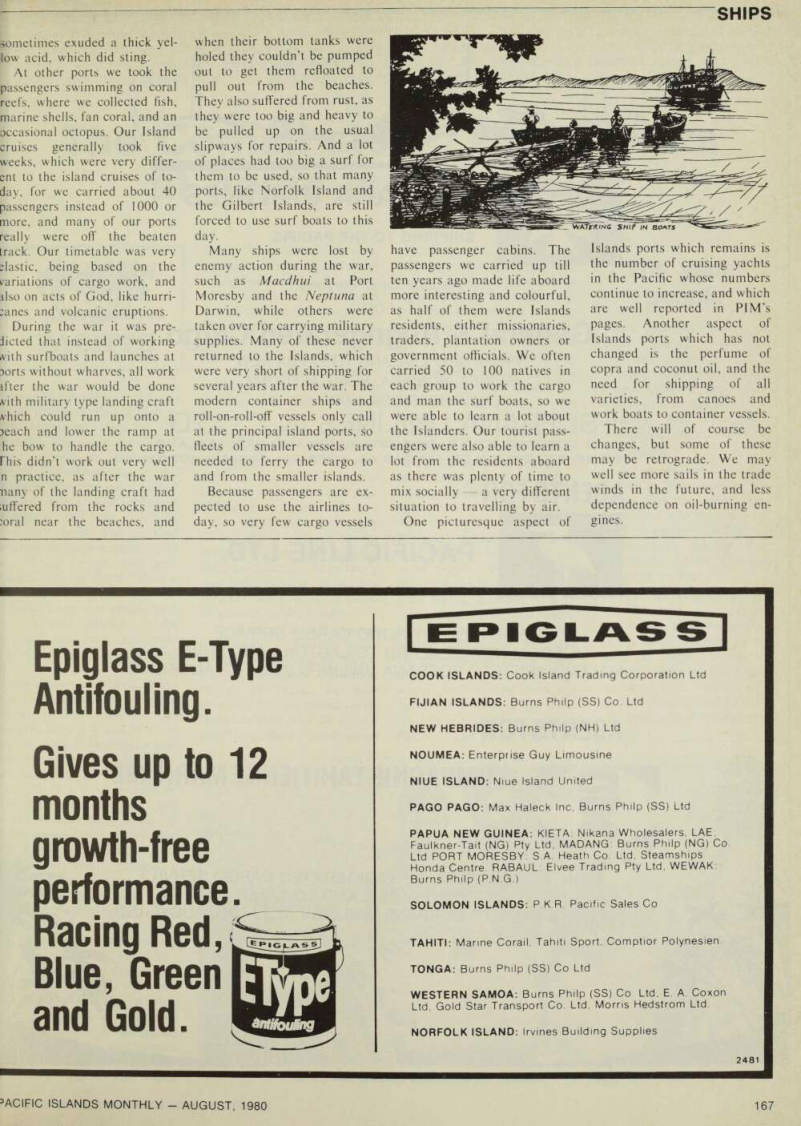
It happens that my 50-odd years at sea have coincided with the life, to date, of the Pacific Islands Monthly. I think I first met R. W. Robson at a port in New Guinea in 1931, aboard the Macdhui.
The ship was brand new then, having been launched in 1930, the same year as R.W.R. launched PIM.
Very few ships live for 50 years, and the Macdhui fin ished her active service in a blaze of fire, bombed by the Japanese at Port Moresby in 1942. After she was abandoned on fire, she drifted broadside onto a reef in the harbour, and her remains are still there.
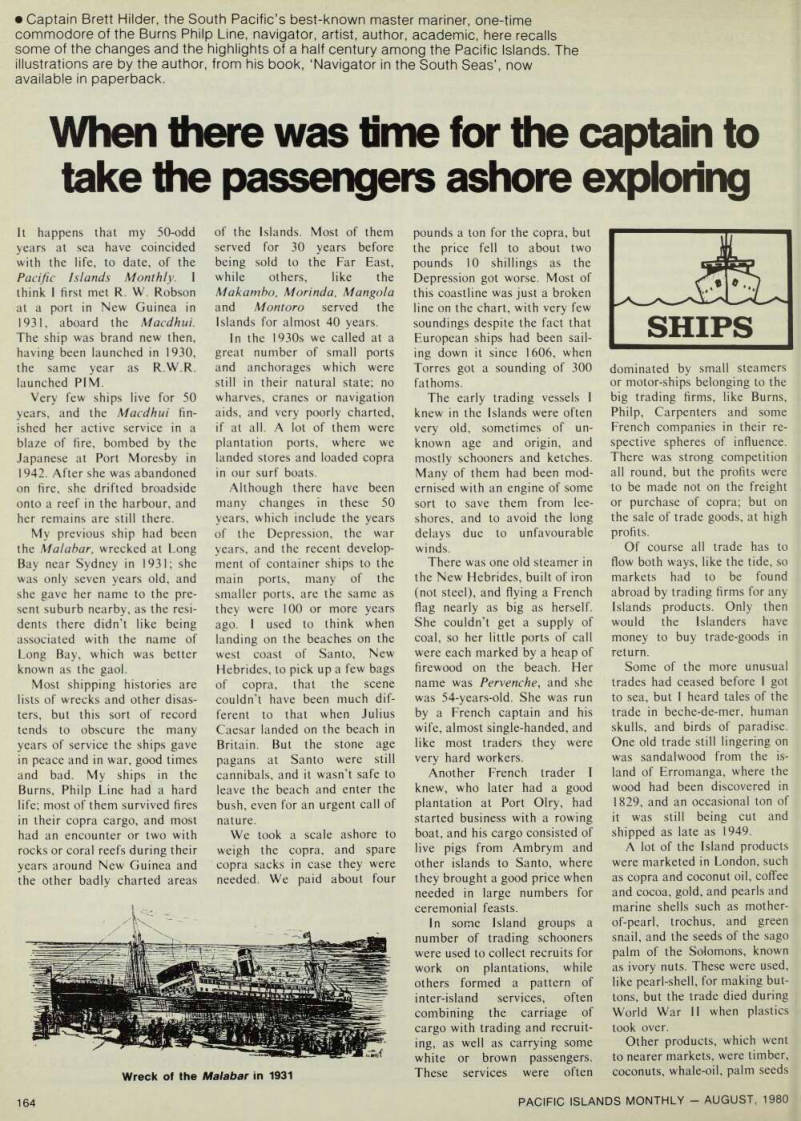
My previous ship had been the Malabar, wrecked at Long Bay near Sydney in 1931; she was only seven years old, and she gave her name to the pre sent suburb nearby, as the resi dents there didn’t like being associated with the name of Long Bay, which was better known as the gaol.
Most shipping histories are lists of wrecks and other disas ters, but this sort of record tends to obscure the many years of service the ships gave in peace and in war, good times and bad. My ships in the Burns, Philp Line had a hard life; most of them survived fires in their copra cargo, and most had an encounter or two with rocks or coral reefs during their years around New Guinea and the other badly charted areas
of the Islands. Most of them served for 30 years before being sold to the Far East, while others, like the Makambo, Morinda, M angola and Montoro served the Islands for almost 40 years.
In the 1930 s we called at a great number of small ports and anchorages which were still in their natural state; no wharves, cranes or navigation aids, and very poorly charted, if at all. A lot of them were plantation ports, where we landed stores and loaded copra in our surf boats.
Although there have been many changes in these 50 years, which include the years of the Depression, the war years, and the recent develop ment of container ships to the main ports, many of the smaller ports, are the same as they were 100 or more years ago. I used to think when landing on the beaches on the west coast of Santo, New Hebrides, to pick up a few bags of copra, that the scene couldn’t have been much dif ferent to that when Julius Caesar landed on the beach in Britain. But the stone age pagans at Santo were still cannibals, and it wasn’t safe to leave the beach and enter the bush, even for an urgent call of nature.
We took a scale ashore to weigh the copra, and spare copra sacks in case they were needed. We paid about four
pounds a ton for the copra, but the price fell to about two pounds 10 shillings as the Depression got worse. Most of this coastline was just a broken line on the chart, with very few soundings despite the fact that European ships had been sail ing down it since 1606, when Torres got a sounding of 300 fathoms.
The early trading vessels I knew in the Islands were often very old, sometimes of un known age and origin, and mostly schooners and ketches.
Many of them had been mod ernised with an engine of some sort to save them from lee shores, and to avoid the long delays due to unfavourable winds.
There was one old steamer in the New Hebrides, built of iron (not steel), and flying a French flag nearly as big as herself.
She couldn’t get a supply of coal, so her little ports of call were each marked by a heap of firewood on the beach. Her name was Pervenche, and she was 54-years-old. She was run by a French captain and his wife, almost single-handed, and like most traders they were very hard workers.
Another French trader I knew, who later had a good plantation at Port Olry, had started business with a rowing boat, and his cargo consisted of live pigs from Ambrym and other islands to Santo, where they brought a good price when needed in large numbers for ceremonial feasts.
In some Island groups a number of trading schooners were used to collect recruits for work on plantations, while others formed a pattern of inter-island services, often combining the carriage of cargo with trading and recruit ing, as well as carrying some white or brown passengers.
These services were often
dominated by small steamers or motor-ships belonging to the big trading firms, like Burns, Philp, Carpenters and some French companies in their re spective spheres of influence.
There was strong competition all round, but the profits were to be made not on the freight or purchase of copra; but on the sale of trade goods, at high profits.
Of course all trade has to flow both ways, like the tide, so markets had to be found abroad by trading firms for any Islands products. Only then would the Islanders have money to buy trade-goods in return.
Some of the more unusual trades had ceased before I got to sea, but I heard tales of the trade in beche-de-mer, human skulls, and birds of paradise.
One old trade still lingering on was sandalwood from the is land of Erromanga, where the wood had been discovered in 1829, and an occasional ton of it was still being cut and shipped as late as 1949.
A lot of the Island products were marketed in London, such as copra and coconut oil, coffee and cocoa, gold, and pearls and marine shells such as mother of-pearl, trochus, and green snail, and the seeds of the sago palm of the Solomons, known as ivory nuts. These were used, like pearl-shell, for making but tons, but the trade died during World War II when plastics took over.
Other products, which went to nearer markets, were timber, coconuts, whale-oil, palm seeds
Wreck of the Malabar in 1931
(from Lord Howe Island), bean seeds from Norfolk, passion fruit pulp, pyrethrum, bananas and oranges, and even venison from Port Moresby. Although these cargoes lacked the ro mance of the spices from the East Indies, we sometimes had living cargoes of birds, snakes, fish including stone-fish and crocodiles, and more like able items like tree-kangaroos and possums, mostly bound for the Sydney Zoo. Until quite recently most cargo was visible to the eye, and they made life at sea more interesting than to day, when most cargo travels between main ports in con tainers, an endless stream of great boxes. Even copra is carried in containers, instead of in bags or loose in the hold.
Most containers in the Island ;rade are 20 feet long and weigh 20 tons, but the overseas traders use 40-ton boxes all these require specially large gantries and cranes on the wharves.
Apart from the container ships there are many ro-ro ships, which carry cargo on ;railers, driven in and out of ships’ bows or sterns on a ramp o the wharf. These ships look ess like ships than ever, nonstrosities both in size and ippearance. Of course there vere some ugly, dirty and incomfortable ships 50 years igo, and it was incredible what lardships the passengers and :rews managed to live with.
The early services to the slands from Australia, New Zealand, Hong Kong, the J.S.A. and Europe were nu nerically dominated by Burns, > hilp ships from Sydney,
Union Company ships from New Zealand, N.D.L. from Hong Kong, Bank Line from England, Messagerie Maritime from France and the varied services of Carpenter’s. There were many other ships which ran for a few years, such as those of the K.P.M. from the East Indies, and tramp ships of all colours picking up copra and shell for Europe.
The cargo we carried to the Islands naturally included everything from a needle to an anchor, the necessities for life and a few for death, such as tombstones for graves and the contraband muskets and bul lets, gunpowder and dynamite which was vital to the trade in the New Hebrides. Amongst the various painkilling bever ages was ‘square-faced gin’, which sometimes cured pain for ever.
A much better tonic was good red wine from South Aus tralia {vin ordinaire ), shipped in huge barrels called tuns, weighing about one ton and holding about 200 gallons. This was decanted in Vila into empty beer bottles and corked with a crown-seal. Twenty bottles fitted into a kerosene case and sold for one pound, so that one bottle cost one shil ling, the same price as beer.
Most fuel for the small craft in the Islands was still carried in cases and kerosene tins, as the 44-gal. drum was slow in becoming popular. Coal for our own inter-island steamers was carried in bulk, but if any op position ships wanted coal it had to be shipped as freight in copra sacks, to make it a cleaner cargo. We sometimes
carried live-stock, cows in pod for dairies and other cattle for breeding for beef. Most of our difficult or dangerous cargo was carried on deck (so it could be more easily thrown over the side), petrol and other inflam mables and cases of non-safety matches.
Extra large and heavy lifts such as large boats, machinery, long iron rails, or pipes and telegraph poles were also on deck, adding to the congestion.
People to-day are so used to seeing cranes and fork-lifts handling heavy packs of cargo that they couldn’t believe the way that heavy lifts could be manhandled from boats onto a beach, and dragged to their destination by sheer ‘rice power’ (that is numbers of natives). Where we could land the telegraph poles onto a wharf, these were slung care fully in the centre and lowered gently onto the shoulders of a line of husky Melanesians.
When they had taken the weight the sling was cast off and the pole would then walk away up the wharf like a giant centipede. I always forgot to get a photograph of the strange sight.
Other heavy pieces of cargo were ten-ton power plants and cylinders for plantations, which were landed from rafts made of surf boats lashed together.
Once on the beach they were pulled and pushed over rollers into the required site on the plantation.
In the Makambo in 1932 they had the strangest item of cargo a young baby from Sydney. It had been ordered by the trader at Lenakel, on Tanna, who occupied the site once owned by the notorious beachcomber Ross Lewin, and
more recently by the Wilkin sons and today by Bob Paul.
The baby was for the Worthingtons, a childless couple, but the ship was pass ing Tanna in the middle of the night en route from Sydney to Vila, and the cargo was landed and heaped on the beach in the dark with the baby in a basket on the top, to await collection in the morning!
The cargo between islands was often a challenge, such as dismembered mission houses and schools being moved to new stations, railway lines from one plantation to another, and live sheep from Erromanga, some of which the ship bought each trip so as to feed the crew.
One trip we loaded a dozen wethers for ourselves and a dozen ewes and a ram for Norsup in Malekula. At each port the boys collected leafy branches from beach trees, about two boatloads of green ery to feed the sheep. A week or so later when we got to Norsup we found that the Chinese Cook had used the ram and some of the ewes instead of our wethers, but there was little we could do to correct that error.
A more difficult but less frequent cargo was an oc casional water-buffalo from Kavieng to a plantation near Madang, PNG. These animals had been brought from Java by the Germans, pre-1914, for plantation work, and although a small species, they were enormously strong. They ap peared to be built of steel springs and powered by light ning, as they could take off vertically, ten feet into the air without warning, and had to be securely anchored to the deck.
Horses were much more
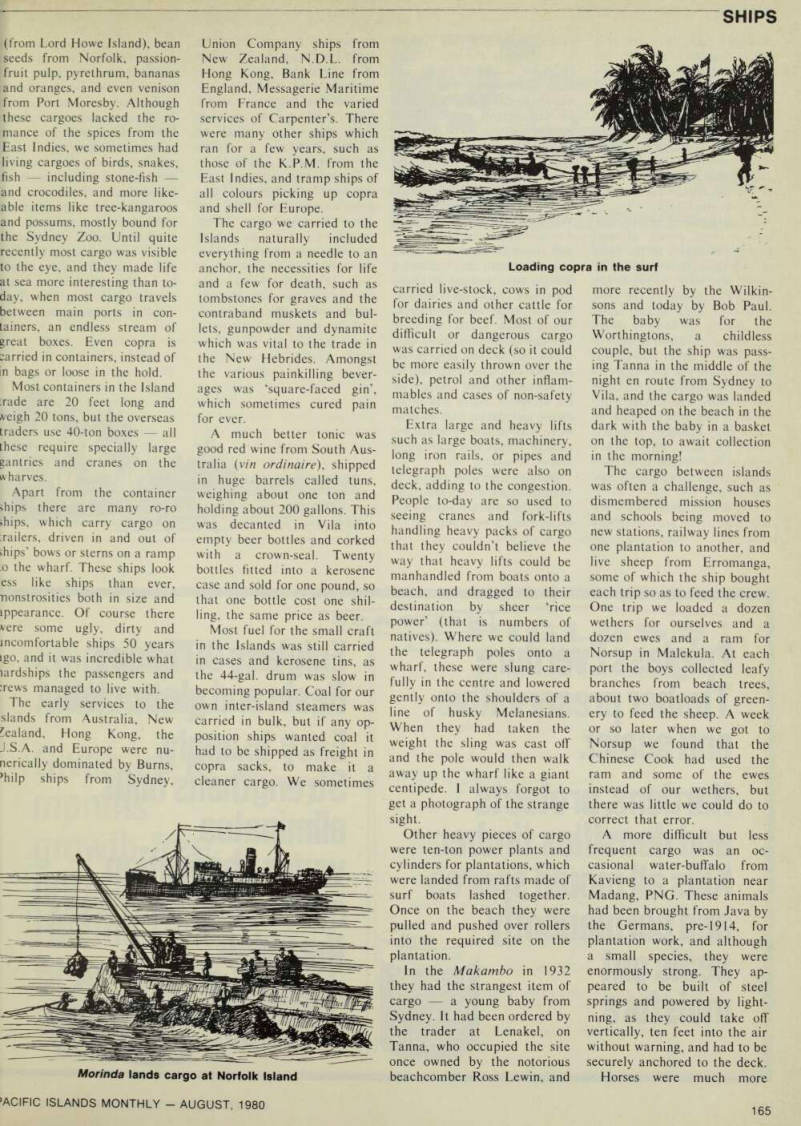
Morinda lands cargo at Norfolk Island
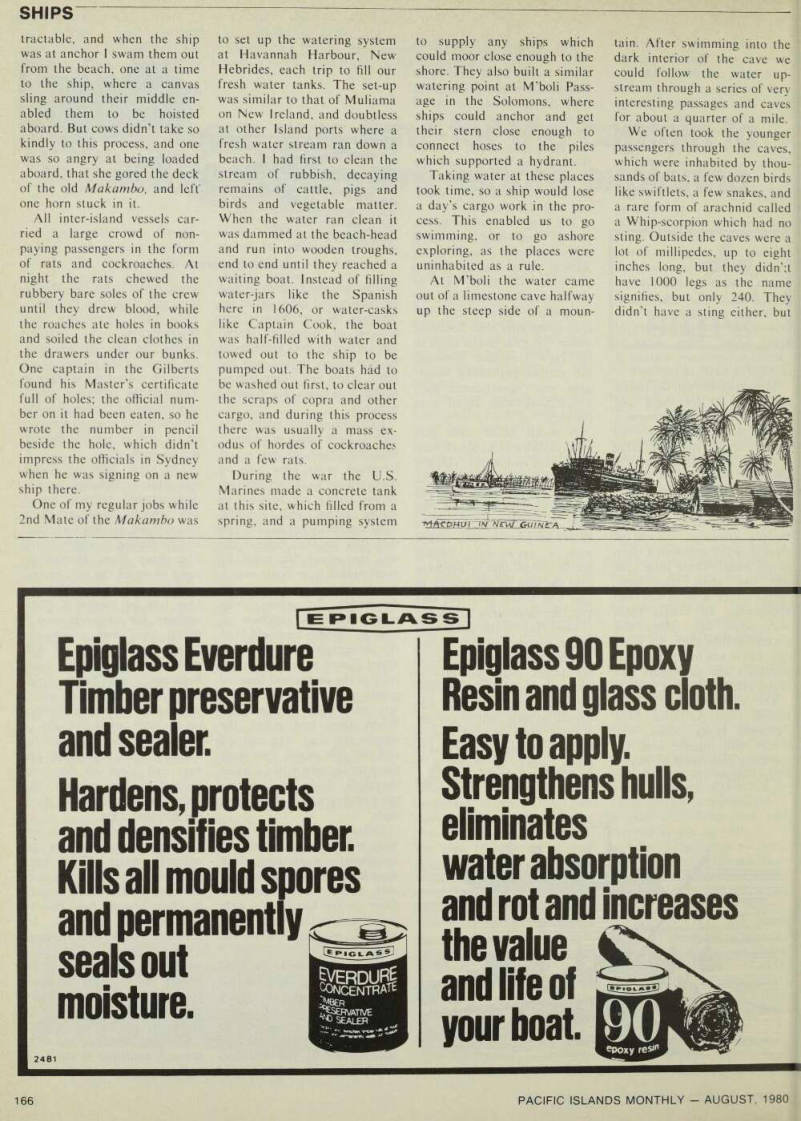
Loading copra in the surf
tractable, and when the ship was at anchor I swam them out from the beach, one at a time to the ship, where a canvas sling around their middle en abled them to be hoisted aboard. But cows didn’t take so kindly to this process, and one was so angry at being loaded aboard, that she gored the deck of the old Makambo, and left' one horn stuck in it.
All inter-island vessels car ried a large crowd of non paying passengers in the form of rats and cockroaches. At night the rats chewed the rubbery bare soles of the crew until they drew blood, while the roaches ale holes in books and soiled the clean clothes in the drawers under our bunks.
One captain in the Gilberts found his Master’s certificate full of holes; the official num ber on it had been eaten, so he wrote the number in pencil beside the hole, which didn’t impress the officials in Sydney when he was signing on a new ship there.
One of my regular jobs while 2nd Mate of the Makambo was
to set up the watering system at Havannah Harbour, New Hebrides, each trip to fill our fresh water tanks. The set-up was similar to that of Muliama on New Ireland, and doubtless at other Island ports where a fresh water stream ran down a beach. I had first to clean the stream of rubbish, decaying remains of cattle, pigs and birds and vegetable matter.
When the water ran clean it was dammed at the beach-head and run into wooden troughs, end to end until they reached a wailing boat. Instead of filling water-jars like the Spanish here in 1606, or water-casks like Captain Cook, the boat was half-filled with water and towed out to the ship to be pumped out. The boats had to be washed out first, to clear out the scraps of copra and other cargo, and during this process there was usually a mass ex odus of hordes of cockroaches and a few rats.
During the war the U.S.
Marines made a concrete tank at this site, which filled from a spring, and a pumping system
to supply any ships which could moor close enough to the shore. They also built a similar watering point at M’boli Pass age in the Solomons, where ships could anchor and get their stern close enough to connect hoses to the piles
which supported a hydrant.
Taking water at these places took time, so a ship would lose a day’s cargo work in the pro cess. This enabled us to go swimming, or to go ashore exploring, as the places were uninhabited as a rule.
At M’boli the water came out of a limestone cave halfway up the steep side of a moun
tain. After swimming into the dark interior of the cave we could follow the water up stream through a series of very interesting passages and caves for about a quarter of a mile, We often took the younger passengers through the caves, which were inhabited by thou sands of bats, a few dozen birds like swiftlets, a few snakes, and a rare form of arachnid called a Whip-scorpion which had no sting. Outside the caves were a lot of millipedes, up to eight inches long, but they didn’;t have 1000 legs as the name signifies, but only 240. They didn’t have a sting either, but
-sometimes exuded a thick yel low acid, which did sting.
At other ports we took the passengers swimming on coral reefs, where we collected fish, marine shells, fan coral, and an occasional octopus. Our Island cruises generally took five weeks, which were very differ ent to the island cruises of to day, for we carried about 40 passengers instead of 1000 or more, and many of our ports really were off the beaten track. Our timetable was very elastic, being based on the variations of cargo work, and also on acts of God, like hurri eanes and volcanic eruptions.
During the war it was pre dicted that instead of working with surfboats and launches at sorts without wharves, all work after the war would be done with military type landing craft vhich could run up onto a seach and lower the ramp at he bow to handle the cargo.
Phis didn't work out very well n practice, as after the war many of the landing craft had ;uffered from the rocks and :oral near the beaches, and
when their bottom tanks were holed they couldn’t be pumped out to get them refloated to pull out from the beaches.
They also suffered from rust, as they were too big and heavy to be pulled up on the usual slipways for repairs. And a lot of places had too big a surf for them to be used, so that many ports, like Norfolk Island and the Gilbert Islands, are still forced to use surf boats to this day.
Many ships were lost by enemy action during the war, such as Macdhui at Port Moresby and the Neptuna at Darwin, while others were taken over for carrying military supplies. Many of these never returned to the Islands, which were very short of shipping for several years after the war. The modern container ships and roll-on-roll-off vessels only call at the principal island ports, so fleets of smaller vessels are needed to ferry the cargo to and from the smaller islands.
Because passengers are ex pected to use the airlines to day, so very few cargo vessels
have passenger cabins. The passengers we carried up till ten years ago made life aboard more interesting and colourful, as half of them were Islands residents, either missionaries, traders, plantation owners or government officials. We often carried 50 to 100 natives in each group to work the cargo and man the surf boats, so we were able to learn a lot about the Islanders. Our tourist passengers were also able to learn a lot from the residents aboard as there was plenty of time to mix socially a very different situation to travelling by air.
One picturesque aspect of
Islands ports which remains is the number of cruising yachts in the Pacific whose numbers continue to increase, and which are well reported in PI M’s pages. Another aspect of Islands ports which has not changed is the perfume of copra and coconut oil, and the need for shipping of all varieties, from canoes and work boats to container vessels, There will of course be changes, but some of these may be retrograde. We may well see more sails in the trade winds in the future, and less dependence on oil-burning en gines.