full frontals
pp. 41-42 · Read in the full issue
Tropicalities
Gardiner said his department avoided acting as ‘arbiters of moral opinion’. What it did was to get advice from the Crown Law office on whether a book or magazine should be sold.
Desai shop assistant Miss Roshni Devi said the shop’s former owner had begun
importing magazines that
made a big feature of nudity and copies were always on the counters. ‘They are always sold out,’ she said.
However, the range of such magazines had been reduced since the Native Land
Development Corporation
took the company over four years ago.
Sense, or spoof,
in a bottle?
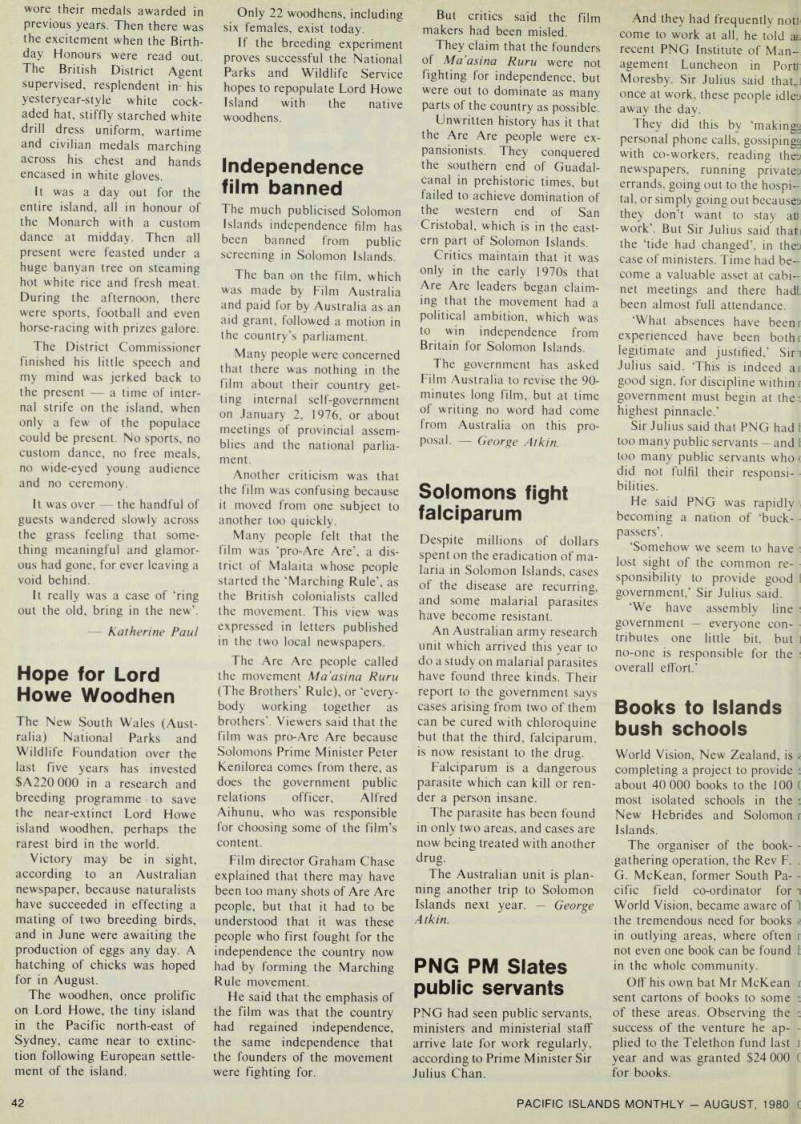
A letter received by PIM in June from D.W.J. Stewart, Acting Secretary-General of the South Pacific Commission, reads in full: ‘Please find attached several copies of a message contained in a bottle found by a young man, Antoine Kohnu, on 14 December 1979 at Kuto, Isle of Pines, New Caledonia. The message was given to the South Pacific Commission Fisheries Adviser on 16 December by Mr Follenfant, the Aircal Air line agent on Isle of Pines. ‘Several unsuccessful at tempts have been made since to obtain a translation. The language used does not appear
Fiji fuss on
full frontals
The ‘double standard’ appears to be alive and well among those responsible for censor
ship in Fiji.
While magazines featuring
photographs of women in full frontal nude poses are on sale, a ban was clapped in May on a magazine for women that features similar pictures of men.
Miss Sandra Marlow,
marketing manager for general
publications with Desai Book shops, told The Fiji Times that attempts to have the policy explained had not been suc cessful.
Desai handles Playboy and
Playgirl magazines and was
told by the Customs Depart ment that the release of Playgirl would not be per mitted. ‘We don’t want to bring por nography in and can under stand if the Customs Department bans it,’ said Miss Marlow. ‘But we don’t consider
Playgirl to be pornographic.’
Controller of Customs Les
to be Tahitian or Marquesan, nor is it of the Tuamotu Islands or the Cooks. It is unlikely that it could be Hawaiin. ‘We felt that if the text of this message were published in your magazine, it would have a very wide circulation and might reach somebody capable of translating it. Interested readers could write to PIM or directly to the South Pacific Commission, BP D 5, Noumea, New Caledonia. ‘1 must point out that the typed copies attached differ slightly from one another, be cause the writing on the orig inal is rather illegible. ‘A similar letter to this one has been sent to the Depeche de Tahiti and to Les Nouvelles in Noumea. ‘We would be very grateful indeed if you would bring this message to the attention of your readers.’
This we are more than happy to do.
It’s now over to the many Pacific Islands language buffs among our readers to tell us whether the text shown in the accompanying illustration is written in any known language - or whether, on the other hand, it’s a plain spoof!
We look forward to having your views.
PNG claims of
drug smuggling
The Papua New Guinea government believes there is increasing evidence that its air ports, beaches and wharves are
being used as staging points to
smuggle drugs from Southeast
Asia to Australia.
Deputy Prime Minister lam bakey Okuk announced re cently that the government was planning stronger measures to detect and prevent drug smuggling. Mr Okuk spoke in his capacity as transport minis ter, with responsibility for air and shipping movements.
He said he had asked for talks with the Australian Transport Minister, Mr Hunt, on how they could work together to stop aircraft and
ships being used to carry drugs
between the two countries. He would also direct civil aviation officers to hold talks with police and customs officials on ‘urgent measures to stop these
shocking practices’.
Mr Okuk said the closeness
of parts of PNG to North Queensland made it easy for light aircraft and ships to be used to carry drugs to Aus tralia.
He said ‘I regard this situ ation very seriously indeed.
This government will not allow dangerous drugs to be grown in this country, nor will we allow our airports to be stopover
points for light aircraft carrying
illegal drugs to Australia.’
Mr Okuk said that because of the length of the PNG coast line and the large number of small and isolated airstrips, considerable difficulty was encountered in detecting any smuggling. He believed how ever that this in no way reduced
the responsibility facing the
government, and firm action was needed to prevent what could become a deep-seated
problem.
A sad ‘Queen’s
Birthday’
It was such a sad little meet ing. As Tanna’s District Com missioner made his speech in pidgin saying again and again how sad it was that this would definitely be the last Queen’s birthday celebrations to be held in the New Hebrides, my mind went back to other such days.
Always the celebrations had been surrounded by pomp in the exquisite surroundings of flamboyant trees set in im maculate green lawns on the hilltop looking across to the blue Pacific. The British police in their sulu skirts, highly polished Sam Browns, bright green wool berets with scarlet pompoms went through the manoeuvres of the flag-raising, watched wide-eyed by the jun ior population. The bugle would resound across the lawn.
The snappy commands of the sergeant in charge and the light trade wind soughing through the she-oaks were the only noises to be heard. The silence was particularly weighty when for the first time on a recent Queen’s Birthday the British police went through the slow march routine. They were so proud one thought their jacket buttons would fly off.
Afterwards drinks and titbits were offered to the hundreds of guests, many of whom proudly
The letter in the bottle. The text appears to read as follows: August 1978 10 Teia tutu ari to matou no te avae August 10 no tera mana gigi muri mai o troni tapae matou i nuhiva 12 tapae matou i tahuia i nia ite pai o awahhee oceanic institute ...e reira farue matou no Tahiti. Nateka, Jon, Mary, Mike, Tom.
wore their medals awarded in previous years. Then there was the excitement when the Birth day Honours were read out.
The British District Agent supervised, resplendent in- his yesteryear-style white cock aded hat, stiffly starched white drill dress uniform, wartime and civilian medals marching across his chest and hands encased in white gloves.
It was a day out for the entire island, all in honour of the Monarch with a custom dance at midday. Then all present were feasted under a huge banyan tree on steaming hot white rice and fresh meat.
During the afternoon, there were sports, football and even horse-racing with prizes galore.
The District Commissioner finished his little speech and my mind was jerked back to the present a time of inter nal strife on the island, when only a few of the populace could be present. No sports, no custom dance, no free meals, no wide-eyed young audience and no ceremony.
It was over the handful of guests wandered slowly across the grass feeling that some thing meaningful and glamor ous had gone, for ever leaving a void behind.
It really was a case of ‘ring out the old, bring in the new’.
Katherine Paul
Hope for Lord
Howe Woodhen
The New South Wales (Aust ralia) National Parks and Wildlife Foundation over the last five years has invested SA22O 000 in a research and breeding programme to save the near-extinct Lord Howe island woodhen, perhaps the rarest bird in the world.
Victory may be in sight, according to an Australian newspaper, because naturalists have succeeded in effecting a mating of two breeding birds, and in June were awaiting the production of eggs any day. A hatching of chicks was hoped for in August.
The woodhen, once prolific on Lord Howe, the tiny island in the Pacific north-east of Sydney, came near to extinc tion following European settle ment of the island.
Only 22 woodhens, including six females, exist today.
If the breeding experiment proves successful the National Parks and Wildlife Service hopes to repopulate Lord Howe Island with the native woodhens.
Independence
film banned
The much publicised Solomon Islands independence film has been banned from public screening in Solomon Islands.
The ban on the film, which was made by Film Australia and paid for by Australia as an aid grant, followed a motion in the country’s parliament.
Many people were concerned that there was nothing in the film about their country get ting internal self-government on January 2, 1976, or about meetings of provincial assem blies and the national parlia ment.
Another criticism was that the film was confusing because it moved from one subject to another too quickly.
Many people felt that the film was ‘pro-Are Are’, a dis trict of Malaita whose people started the ‘Marching Rule’, as the British colonialists called the movement. This view was expressed in letters published in the two local newspapers.
The Are Are people called the movement Ma’asina Rum (The Brothers’ Rule), or ‘every body working together as brothers’. Viewers said that the film was pro-Are Are because Solomons Prime Minister Peter Kenilorea comes from there, as does the government public relations officer, Alfred Aihunu, who was responsible for choosing some of the film’s content.
Film director Graham Chase explained that there may have been too many shots of Are Are people, but that it had to be understood that it was these people who first fought for the independence the country now had by forming the Marching Rule movement.
He said that the emphasis of the film was that the country had regained independence, the same independence that the founders of the movement were fighting for.
But critics said the film makers had been misled.
They claim that the founders of Ma’asma Ruru were not fighting for independence, but were out to dominate as many parts of the country as possible.
Unwritten history has it that the Are Are people were ex pansionists. They conquered the southern end of Guadal canal in prehistoric times, but failed to achieve domination of the western end of San Cristobal, which is in the east ern part of Solomon Islands.
Critics maintain that it was only in the early 1970 s that Are Are leaders began claim ing that the movement had a political ambition, which was to win independence from Britain for Solomon Islands.
The government has asked Film Australia to revise the 90minutes long film, but at time of writing no word had come from Australia on this pro posal. George Atkin.
Solomons fight
falciparum
Despite millions of dollars spent on the eradication of ma laria in Solomon Islands, cases of the disease are recurring, and some malarial parasites have become resistant.
An Australian army research unit which arrived this year to do a study on malarial parasites have found three kinds. Their report to the government says cases arising from two of them can be cured with chloroquine but that the third, falciparum, is now resistant to the drug.
Falciparum is a dangerous
parasite which can kill or ren der a person insane.
The parasite has been found in only two areas, and cases are now being treated with another
drug.
The Australian unit is plan ning another trip to Solomon Islands next year. George A tkin.
PNG PM Slates
public servants
PNG had seen public servants, ministers and ministerial staff arrive late for work regularly, according to Prime Minister Sir Julius Chan.
And they had frequently notJ< come to work at all, he told ab recent PNG Institute of Man agement Luncheon in Portf Moresby. Sir Julius said that,.] once at work, these people idles away the day.
They did this by ‘makingg
personal phone calls, gossipingg
with co-workers, reading thes
newspapers, running privates
errands, going out to the hospi tal, or simply going out becauses they don’t want to stay atti work’. But Sir Julius said that the ‘tide had changed’, in thes case of ministers. Time had be come a valuable asset at cabi net meetings and there hadt been almost full attendance. ‘What absences have beenr experienced have been bothr
legitimate and justified,’ Sin
Julius said. ‘This is indeed ar good sign, for discipline within r government must begin at thee
highest pinnacle.’
Sir Julius said that PNG had 1 too many public servants and 1 too many public servants who c did not fulfil their responsi- bilities.
He said PNG was rapidly , becoming a nation of ‘buck- passers’. ‘Somehow we seem to have e lost sight of the common re- sponsibility to provide good 1 government,’ Sir Julius said. ‘We have assembly line ; government everyone con- tributes one little bit, but ] no-one is responsible for the ; overall effort.’
Books to Islands
bush schools
World Vision, New Zealand, is i completing a project to provide s about 40 000 books to the 100 ( most isolated schools in the s New Hebrides and Solomon r Islands.
The organiser of the book- gathering operation, the Rev F. .
G. McKean, former South Pa- cific field co-ordinator for i World Vision, became aware of \ the tremendous need for books g in outlying areas, where often r not even one book can be found t in the whole community.
Off his own bat Mr McKean r sent cartons of books to some s of these areas. Observing the s success of the venture he ap- plied to the Telethon fund last j year and was granted $24 000 C for books.