speaks out
pp. 35-39 · Read in the full issue
Letters
In 50 years of publication, few sections of PIM have sur vived for as long and expanded as much as the let ters section. As PI M's foun der R. W. Robson says, he began the magazine be cause he believed there was a need and an opportunity to provide a link between Pacific Islands people who were curious about the events and the affairs of the countries which shared the region with them.
Nowhere has this been demonstrated as clearly as in the letters section where humour, controversy, his tory, politics, prejudice, tolerance and at times annoyance have rubbed shoulders. PIM itself has come in fora fair share of cri ticism over the years, but has never hesitated to publish critical letters as well as pats on the back. An extraor dinary range of subjects has been covered in the letters, some of which have added new footnotes to the history of the Pacific.
The letter floating in a bot tle has long been a symbol of contact for people at sea or isolated on an island, PIM adopted this symbol as a heading for its letters in May last year perrhaps a peculiar reversal of history in view of the fact that earlier headings showed an envelope. (For a REAL story about a letter in a bottle see the Tropicalities section in this issue.)
An American
speaks out
I read with interest the letter in your magazine from a Mr David Noland of Canyon
Country, California (PIM Apr
p 7) regarding the ‘giveaway’ of
the interests of the United
States in the Pacific. It is cer tainly time and long past due that we should do so. The very idea in itself of anyone owning someone else or occupying their homeland for self-gain or personal interest is an abomin ation.
It is interesting to note that the United States after World War 11, especially in the Pa cific, felt it necessary to occupy and establish military bases throughout the islands, des troying the land, the cultures, creating a second-class citizenry of the island people, and making servants out of them for the American mili tary, as well as for all the American bureaucrats that wished to run around the world and visit paradise at the expense of the American tax payer.
After all this they took Japan, the object of the entire war in the Pacific, and spent hundreds of millions of dollars in assistance to rebuild and re establish their position in the world, to assist them in becom
ing a wealthy industrial giant to
the point of almost destroying our own industrial capacity and that of many of our fellow
European nations.
I say to the island people: obtain your independence and defend your right to have it.
More power to you. It will be rough, you will make mistakes.
Freedom and independence will not come cheap. It will take hard work and sacrifice on the part of everyone.
Believe me, as an American, I know what will happen to you at the hands of the real estate brokers and promoters,
wealthy American, European,
Chinese and Japanese bankers and industrialists seeking to buy up your land for tax shel ters and exploitation purposes, and you the islanders being bought out for very little if any thing and, in many cases, being completely swindled out of your property.
Do not feel badly towards the American, however. Most often they do not know or re alise just what takes place out side of their country. This is true of the people in most nations. They are fed the same line of propaganda that you are. Most do not agree with the policies of their governments in this respect. Most Americans
are benevolent-type people and truly have an unselfish atti tude and would give of them selves in your behalf asking nothing in return. We are vic tims of our political leadership, just as other nations are many times.
There are three rules that I would suggest to the island countries to help protect them selves: • Let all those who wish to come do so, provided they come as individuals under your employment and supervision. • Never let more than 20 people in any single group, in
any capacity, representing a
foreign government, inhabit your country at any one time.
• Never permit foreign
social clubs or churches of any type to be organised within your country, but permit all people to associate freely on an equal basis, even to assemble for worship, but never let any money leave the country that has been collected for or in the name of any church or re
ligious group.
I certainly believe in free
dom of religion, Christianity,
and the right of everyone to as
semble together to worship
God in their way. Most of these missionaries go out into the world preaching doctrines that their church leaders have taught them in their theological seminaries and most of them are young, impressionable people who do not really understand what it is all about.
Take their creed books away from them and they would be lost. I have been a student of the bible and bible history for many years and it does not teach or condone what most of these religious groups are
advocating.
I see much discontent and dissension growing among the people in the South Pacific, and a great deal of it in Tahiti at the present time. The French, who have done quite well. I feel, in many ways toward the people of Polynesia are now displaying an annoy ance, impatience and intolerance towards the Tahi tian. Many of the Chinese are now getting wealthier and gaining power and they no longer have any patience and tolerance for the Tahitian.
With their old family traditions and customs of separatism, and
their feeling of being a superior people, they no longer remem ber that they too came from a lower economic status.
I think that the attitude of the French has come about through the recent discontent on the part of the Tahitian over
the policy of nuclear testing by
the French in the islands.
I can see why the French feel that they need to develop some nuclear capability. They wish to keep up with the other powers and not be caught short. But all nations of the world that are determined to explore the wonders of nuclear power must stop and realise that they are headed for a desti nation of complete destruc tion.
Nuclear testing and the dumping of nuclear waste
should be stopped immediately
in the Pacific. I have observed in radiation biological labora tory tests what radiation will do in the mutation and destruction of life cells. Regardless of what the scientists tell you, remem ber this: There is no such thing as an admissible or permissible standard or amount of exposure to radiation without harm.
What the nuclear scientists are not telling the people, is, that a by-product of nuclear testing and other nuclear tech nologies is Tritium. Tritium is a radioactive form of hydrogen which has a strong tendency to form water and thus becomes a part of the water supply wherever it is released. It is toxic. Tritium enters the body primarily as triated water, water with one of its hydrogen atoms in the radioactive form.
Most tritium ends up as water in general circulation. Once it is in the form of triated water, it gets to human beings in the same way as any water, primar ily as drinking water, water taken up by agricultural crops, trees and other plants as well as fish and all sea life in the streams and the ocean.
Laboratory tests have shown that surprisingly low levels of tritium can kill 90% or more of the immature eggs developing in the ovaries of female mice.
Although these are mice being tested, the danger to humans is also serious. Some forms of mammal life are extremely sensitive to radiation effects at very low levels of tritium.
The island nations do need
and will need help for some time, but before they embark on wild investment schemes with outside sources of capital, and with the industrial and banking promoters, they should seek to develop the re sourcefulness of their own people and build an inner strength within themselves.
My heart lies in the islands and I wish for a great future for all of their people.
John T. Robinson
Ventura California
Usa
(This letter cut for length.)
Diving in Milne
Bay: A comment I enjoyed reading about the fantastic diving to be found in Milne Bay, Papua New Guinea (PIM Jun p 35). I have lived on the shores of the China Straits for some time now and have dived the whole strait.
Bob Halstead fails to men tion that although he takes the credit for discovering his China Strait fly dive, it was in fact introduced to him and his
‘adventurers’ by Douglas
Doodson.
I should like to point this fact out and to say ‘credit where credit is due’. Doug perfected that particular dive and offered to show it to Bob, who should in turn have thanked Doug with a small mention.
P. Plaatsman
Samarai Papua New Guinea
Authorship of a
Samoan history
PIM is a valued and respected journal of record, so I write to try to remove some of the mis
conceptions of fact underlying
Dr Leonard Goodman’s review of the book called History of Samoa by K. R. Lambie, pub lished by Commercial Printers
Ltd, Apia (PIM May p 45).
To begin with, the publishers have now realised the truth, which is that the book was not written by K. R. Lambie, but by Brother Fred Henry, for merly of the Marist Order in Tutuila. A loose leaf to this effect is inserted in the front of copies of the book now sold, but it is not clear whether the
loose leaf was inserted in the reviewer’s copy. What is clear is that the authorship of the book is wrongly stated. The cir cumstances were that Lambie, as he said in his preface, chanced upon a copy of ‘a his tory written by the late Brother Henry of Tutuila’, obtained the consent of the Marist Brothers to its republication, and arran ged for the well-known Pastor Faletoese to ‘translate the Samoan edition’. This Samoan translation does not unfortu nately appear to have been
published.
I agree that, as the reviewer has said, the quality of the pub lication is a credit to all con cerned, but it is a pity that the publishers failed to give proper effect to Lambie’s own preface to his publication of Brother
Henry’s history.
Just as unfortunately, the re viewer has been led into a series of errors about what he calls a ‘little known sequel’.
The facts, as I know them, are that Lambie, as Director of Education of Western Samoa, commissioned Mrs T. R. Smith (Sylvia Masterman) to prepare an outline of the history of Samoa, suitable for use in schools. This she did, and it was wholly her own work. This is made clear by Lambie’s preface, and her own introduc tory note, to the publication, which is entitled An Outline of
Samoan History, by Sylvia
Masterman. This is not ‘collab oration’ as that term is com
monly understood.
Sylvia Masterman’s history covers the whole period from Polynesian origins to 1958. In her introductory note, she ac knowledges her sources and mentions specifically that the chapter on Samoa before 1830 is based on material given in a history of Samoa collected by Brother Henry of Tutuila. Her Outline of History was not
printed it was cyclostyled
and stapled with a paper cover.
It is thought that not more than 100 copies were prepared. I know that it was not distributed as intended, but am not aware
of any copies being destroyed.
I certainly have a copy, and there are sure to be others. As to publishing it now, as the re viewer suggests, I think that Mrs Smith, who is at present in
England, would after this lapse of time (about 25 years) wish to revise her work before it was published.
What I have said is not intended in any way to detract from the value of Lambie’s ser vices to Samoa. He was my esteemed colleague and friend for many years, and his inspi ration was behind these his torical publications. In his
preface to Sylvia Masterman’s
book he says ‘every child should know, at least in outline, the history of his own country, but in Samoa this has not been possible, as no up-to date history has been avail able’. Lambie, devoted as he was to the children of Samoa, sought to remedy this de
ficiency.
(Sir) Guy Powles
Wellington
New Zealand
A ‘light-hearted’
murder report?
The kind report that you gave (PIM Jul 1979 pB3) about my proposal for a 500-mile inter national seafloor grant to the benefit of the island nations
warranted a timely thank-you.
My fieldwork commitment and related communication prob lems delayed my intended re sponse until it was too late, and I apologise for this apparent lack of courtesy.
However, I am writing you today about a very different and painful matter ... Olivier Breaud was a director of GEOMAREX and of our Polynesian affiliate, POLY MIN S.A. His dramatic loss was a blow to all of us and I don’t feel that the light-hearted
picture presented by the
Danielssons (PIM May p 17) was true to his character.
Olivier was handsome and well-studied, brilliant but soft
spoken. He had generosity,
wealth and charisma. Every thing to make him the most promising young Tahitian and everything also to expose him to slur and envy, to the extremes of kidnapping and murder. He was Tahitian on two counts: by blood and by free choice. He could have gracefully moved into some high-gear business life, clubs
and jet-sets, in Europe and elsewhere. He chose an every day working life in the island he belonged to. His involve ment in our companies’ oceanographic search was not motivated by economic interest
but, simply, by his deep con
cern with the future of French
speaking Polynesia and the
quest for new resources for the islands in general.
His Polynesian ancestry, his choice of the island life and his gifts would surely have made him a key character of the new Pacific. Now what is left of a legacy to his friends? The proof that there are unknown, bright, energetic young men of inter national stature able to manage their own insular nations.
The truly disheartening
lesson of his death is that such men and dreams could be so
easily destroyed by wandering
misfi-ts and gaolbirds from overseas, an old Pacific plague suddenly alive again. We ought to share the wrath of the Tahi tians about this senseless kill ing so that his life will not be in the end wasted but may serve a cause.
Andre Rossfelder
President
Geomarex
La Jolla California
Usa
• While we share Dr Ross felder's sentiments, we cannot share his belief that the treat
ment of the subject by Marie-
Therese and Bengt Danielsson was in any way flippant or light hearted Editor.
Refuting Kevin
Egan
As a citizen of Papua New Guinea I would like to make a few remarks on the report on law and order problems by the former PNG Public Prosecutor Kevin Egan (PIM Apr p 11).
Throughout his report Mr Egan consistently uses terms like tribal fighting, law and order, kiap and civilisation,
making value judgments which
I believe are based on a typical
colonial mentality.
Merely because a person has been in a country for a number of years does not give him the right to make value judgments, and does not justify value judg
ments. Firstly Mr Egan should clearly conceptualise some of
his terminologies, making
them' correct on the basis of PNG values and norms. My working definition of a tribal fight is as follows; ‘A tribal fight is a social institution which provides a means to re lease a society’s negative frus trations which have built up over a period of time.’ After the exchange of a few arrows from a distance of about 100 metres, the tribes withdraw to their own sides, and usually a feast follows to mark the ending. In other words, you would be a most unfortunate person to get an arrow.
Now compare this type of vi olence with what is happening in Northern Ireland, or in the new nation of Zimbabwe where hundreds are being killed or tortured daily. You walk through downtown Honolulu where there are re ports of two or three deaths a
day.
I am sure that the govern ment and the people of PNG would agree that Mr Egan has exaggerated when he says ‘Four years since indepen dence, 40 years of administrat ive achievement has been lost’.
There is no damn civil war in PNG. The Pacific Island nations have demonstrated to the world that they are made up of peace-loving people, and
have shown this by gaining pol
itical independence without
shedding a single drop of
blood.
The types of violence in con temporary PNG can be divided into two basic categories: (1) The urban problems among dissatisfied people who are the by-products of Western civilisation, and because these people are the product of the system who can blame them? (2) Real tribal fighting in rural areas, which in itself involves equality, the lack of oppression by a master race or dominant group, and the means to release frustrations which have built up over time.
What has happened in PNG is that 40 years of administrat
ive experience has suppressed
and taken over the traditional role of leadership. The tra ditional system has been
replaced by a Western system which operates on elitist sys tems instead of on equality.
This is not to say that Aus tralians were wrong or PNG is not grateful for the many things they did but the Aus tralians never gave serious thought to the fact that tra dition values and customs in PNG may have been just as valid, if not more so, than the values which the Australian
brought.
It is true there is no tribal fighting in Australia, but it is interesting to note how the people release their frus trations. I would be happy if someone could tell me the suicide rate in Australia and other Western countries, the death rate from gun injuries in USA and the full toll of drug addiction in USA, Britain, Aus tralia and many other Western countries.
I totally refute the suggestion that the kiap system should be reintroduced to PNG, and to a Papua New Guinean the term
kiap means superiority, fear,
dictatorship and cruelty. To
bring the scheme back would be the reimposition of colonialism, no matter who holds the position of kiaps.
I agree with Mr Egan that one of the causes of our law and order problems is failure to enforce the laws we already have, but in basic terms I treat his report as a biased pack of statements from a frustrated colonial-minded civil servant. I do not question his knowledge or his right to free speech, but his arguments do not reflect the real situation in PNG.
Concerned Png
Citizen
(Name and address supplied)
Too little cover
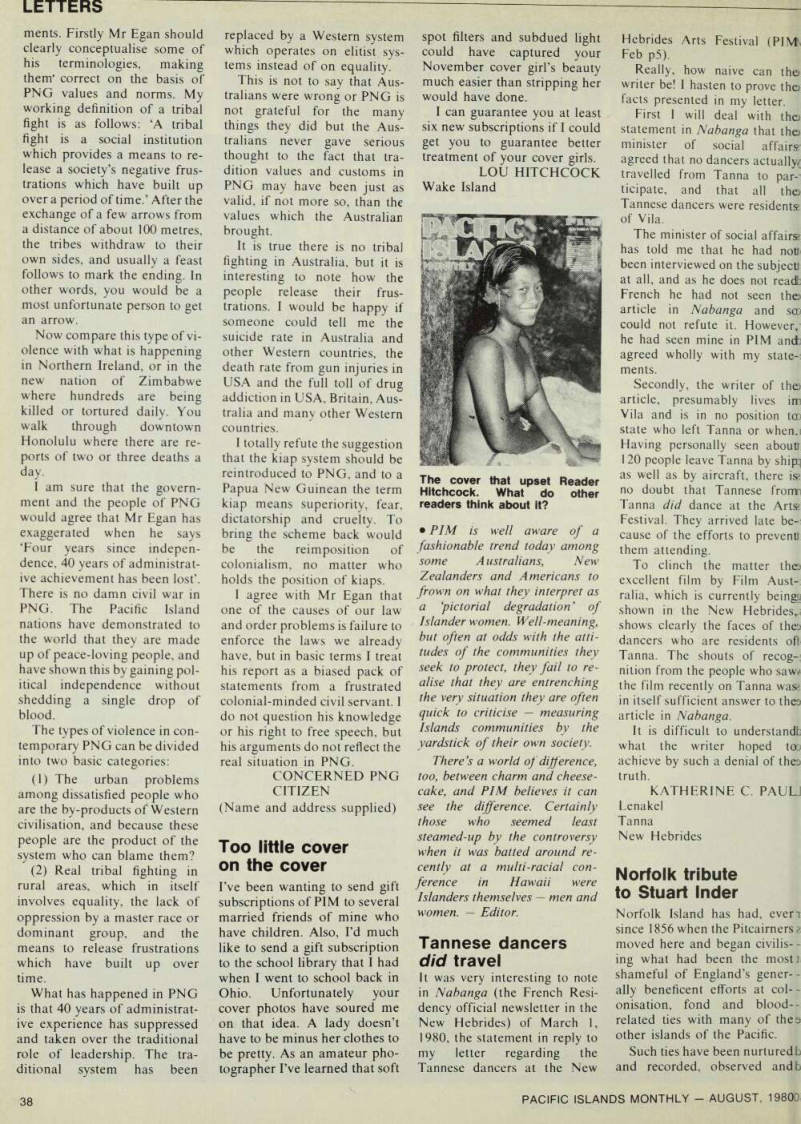
on the cover I’ve been wanting to send gift subscriptions of PIM to several married friends of mine who have children. Also, I’d much like to send a gift subscription to the school library that I had when I went to school back in Ohio. Unfortunately your cover photos have soured me on that idea. A lady doesn’t have to be minus her clothes to be pretty. As an amateur pho tographer I’ve learned that soft
spot filters and subdued light could have captured your November cover girl’s beauty much easier than stripping her would have done.
I can guarantee you at least six new subscriptions if I could get you to guarantee better treatment of your cover girls.
Lou Hitchcock
Wake Island
• PIM is well aware of a fashionable trend today among some A ustralians. New Zealanders and Americans to frown on what they interpret as
a \pictorial degradation ’ of
Islander women. Well-meaning, but often at odds with the atti tudes of the communities they seek to protect, they fail to re alise that they are entrenching the very situation they are often quick to criticise measuring Islands communities by the yardstick of their own society.
There's a world of difference, too, between charm and cheese cake, and PIM believes it can
see the difference. Certainly
those who seemed least
steamed-up by the controversy
when it was batted around re cently at a multi-racial con ference in Hawaii were Islanders themselves men and women. Editor.
Tannese dancers
did travel
It was very interesting to note in Nabanga (the French Resi dency official newsletter in the New Hebrides) of March 1, 1980, the statement in reply to my letter regarding the Tannese dancers at the New
Hebrides Arts Festival (PIM Feb p 5).
Really, how naive can tho writer be! I hasten to prove tho facts presented in my letter.
First I will deal with tho statement in Nabanga that tho minister of social affairs agreed that no dancers travelled from Tanna to par-i ticipate, and that all tho Tannese dancers were residents of Vila.
The minister of social affairs has told me that he had nott< been interviewed on the subject! at all, and as he does not readb French he had not seen the 3 article in Nabanga and sen could not refute it. However/ he had seen mine in PIM andb agreed wholly with my state-: ments.
Secondly, the writer of tho article, presumably lives im Vila and is in no position too state who left Tanna or when.i Having personally seen about! 120 people leave Tanna by shipq as well as by aircraft, there is no doubt that Tannese fromn Tanna did dance at the Arts Festival. They arrived late be-: cause of the efforts to prevent!! them attending.
To clinch the matter theo excellent film by Film Aust-J ralia, which is currently beingg shown in the New Hebrides/ shows clearly the faces of theo dancers who are residents off Tanna. The shouts of recog-i nition from the people who saw/ the film recently on Tanna was in itself sufficient answer to theo article in Nabanga.
It is difficult to understandb what the writer hoped too achieve by such a denial of theo truth.
Katherine C. Paul
Lenakel Tanna New Hebrides
Norfolk tribute
to Stuart Inder
Norfolk Island has had, even since 1856 when the Pitcairners z moved here and began civilis- ing what had been the most!; shameful of England’s gener- ally beneficent efforts at col- onisation, fond and blood--I related ties with many of the a other islands of the Pacific.
Such ties have been nurturedb and recorded, observed andb
The cover that upset Reader Hitchcock. What do other readers think about it?
; appraised by Pacific Islands
Monthly for a generation and more. During the mature life ]years of those in the islands who are beyond being chil dren, the patron saint of all that activity has been Stuart Inder.
Surely Norfolk Islanders can’t take first rank in saying this, but surely we would argue anyone else’s trying to take first rank; Stuart Inder has always been respected and liked here, and many on this island were sorrowed to read (PIM May p 47) that he can’t be PlM’s
publisher any longer.
Those of you remaining to produce the Pacific’s only real
monthly magazine will have
your job cut out for you. At the same time your parent company will be a bit better able to float you for a while
with Mr Inder concentrating
solely on the company’s Pacific books. PlM’s loss has to be a gain for Pacific Publications,
and for people everywhere
who are involved in the Pa cific.
Good luck to you; and three cheers for Stuart Inder and what he has done for the slands.
Ed Howard
Publisher Norfolk Island News Norfolk Island
Aborigines and
a PNG example
Sir John Gunther, in his book review (PIM Feb p 47), asked ‘why the Commonwealth and the State Governments have never used Papua New
Guinea’s medical teaching
facilities to train Aboriginals to care for their own?’
The Northern Territory has a population of about 25 000 Aboriginal people. Since 1973,
the Health Department has
embarked on a training pro
gramme for Aboriginal people
who will deliver primary health care in their own communities.
The principles adopted are
very similar to those men tioned by Sir John for the aid
post orderly training scheme:
entry into the scheme by the eommunity is voluntary and community selection of trainee [literacy is not required).
The training programme
consists of two levels: basic skills and post-basic skills. The emphasis in the training pro gramme is on: (a) the health needs of their own community receive priority in the training programme, and (b) a bi
cultural approach involving the
sharing of traditional and European concepts and prac tices is used, and (c) on-site training with maximum in volvement of local resources is
preferred.
The Health Department now employs and trains 219 Abor iginal Health Workers (AHWs) in 40 communities; 102 AHWs who had completed the basic skills course are now
undertaking the post-basic
skills course. It is expected that by the end of this year, 25 AHWs would have completed the post-basic skills course.
Most of the primary health care work in Aboriginal com munities in the Northern Terri tory is now carried out by AHWs. Their share of this work will increase as their com petency and, ultimately, re
sponsibility increases.
The Northern Territory Department of Health has dis cussed with the PNG Health
Department the possibility of
AHWs visiting PNG to
broaden their learning experi
ence through contact with aid post orderlies and health exten sion officers. We are hopeful that such a scheme will become a reality in the near future.
F S Soong
Director (Health Education) for Secretary For Health Darwin Northern Territory of Australia ‘Majestic 7 prose of Kevin Egan I do not wish to contest the validity of your writer’s com ments which inspired the letter ‘Kevin Egan Hits Back’ (PIM May p 5).
But I would comment fav ourably, and indeed rec ommend, to all scholars of Her Majesty’s English, to digest the fervour with which Mr Egan has responded to his critics.
Indeed majestic.
R. B. Daly
Boroko Papua New Guinea
Poetic farewell
to a Condominium As the sun of the New Hebrides Condominium sinks in the west, I wish to share my feel ings with PIM readers: Our Fathers which art in
Europe,
Ministers by thy name.
Thy Condomiunium’s being
done.
In London as in Paris.
Give us each day our Franis bread.
And forgive us our Joint De cisions.
As we forgive those that demonstrate against us.
Lead us not into taxation.
But deliver us unto the tour ists.
For thine is the Condominium no power, no glory, It can’t last forever.
Bob Paul
Tanna, New Hebrides
A grandstanding
S.l. minister?
On a recent political study tour to Papua New Guinea the Solomon Islands’ Minister of Law and Information was very
impressed by the legal set-up in
the country and said that Solomon Islands should follow
PNG’s example.
The minister’s attitude towards the matter contradicts
his government’s existing pol
icy when it refused to send any more students to study law in the University of PNG in pref erence to New Zealand universities. That move taken by the government indicates that the government sees no real need for training its
lawyers in a developing
country which undergoes the
same changes and experiences
in its development. The government could find no
similiarity and relationship in
the adaptation and develop
ment of the legal system be tween the two countries, and also the PNG legal system is not appropriate to the circum stances of a developing country like the Solomon Islands.
Such a government attitude had been publicly denounced by the minister concerned in an interview with the National
Broadcasting Commission.
From the tone of his state ment, the minister was very
impressed with the legal set-up, especially the institutions of Law Reform and Village Courts which have made sub stantial changes to the laws imposed on the country, and
permitted the application of
customary law in the introduced system. But such a flashlight statement is only meant to impress the public since the minister knows his government has no clear inten tion of setting up similar insti tutions.
Why did the government de cide to send its minister to PNG? They have shown through their action that they do not recognise the insti tutions there and have chosen instead to send students to study law in New Zealand.
New Zealand is a better venue for the minister’s tour, where they have decided to breed the legal brains of the nation.
Questions have been asked in parliament as to why the government decided to send law students to New Zealand universities in preference to a Melanesian university like UPNG. The minister con cerned did not give sufficient answers to support the de cision. which had been collec
tively approved by the
Cabinet.
If the government of the day is concerned for a legal system appropriate to the circum stances of the Solomon Islands
they must start thinking posi
tively in reviewing and forming
our existing laws to suit the
country’s development rather
than transplanting foreign con
cepts into the system. This could be done by training our students, who are going to be future leaders, in a country which has a similar cultural background and is facing like problems in its development.
The minister should be honest with his government’s attitude towards things when away in a different country, and stop giving highlight state ments just for the purpose of impressing the public. Such be haviour cannot benefit the nation and its people; but only the Minister concerned for his
image overseas
Sethuel Kelly
University of PNG Port Moresby