to go back to the village
pp. 5-15 · Read in the full issue

The Pacific Islands: Too late to go back to the village
STUART INDER provides a curtain raiser to PlM’s 50th anniversary issue with this special review of the recent past and survey of the present situation in the Pacific Islands. He also makes some forecasts on the likely turn of future events, basing his commentary on nearly 30 years’ experience writing and reporting on the Pacific Islands. His is a personal view, and everybody may not agree with the record as he sees it, but it is the kind of informed comment that has built PlM’s unique reputation over the last half century and which PIM will continue to provide. Inder himself will continue to be among our contributors, although he steps down as PlM’s publisher from this anniversary issue to concentrate on other aspects of publishing for Pacific Publications.
The Pacific Islanders have come to recognise that they have been divided by their historic past. To ensure a satis factory future, they now know they must learn to stand together and so avoid exploi tation by the entrenched econ omic and technological strength of the nations whose actions in earlier times divided them.
This essentially is what has happened in the Pacific Islands in the last 50 years and these are the main problems that lie ahead.
The struggles of the past are of small significance compared with what has to be faced in the next decade.
The drive to establish a worthwhile economy, and to ensure a measure of real politi cal autonomy, is of such im portance to their welfare that the Islands cannot afford to fail in it, ill-equipped as they are for the task. They cannot achieve it without understand ing from the West.
In recent years the energy of the Islands has been directed towards achieving political in dependence independence being seen by some islanders, although by none of the leaders, as a ceremonious cel ebration to which family and friends were invited rather like a big society wedding. But now that for most of them the tumult and the shouting are over, it is clearly understood that the next priority is to
develop self-sufficiency; and, as
it is inevitable that at times this must bring the Islands into conflict with the vested inter ests of the established world order who will not lightly she 4 profit or power, the real com plications are to come.
The modern history of the Islands has thus far been
uncomplicated. European pen etration was starkly direct and purposeful. Christianising missionaries from the West were the forerunners. But from about the second half of last century the various big powers, mostly European, began to share out ownership of the Island groups among them selves after considerable squabbling, and some horse trading. The native populations were not invited to participate.
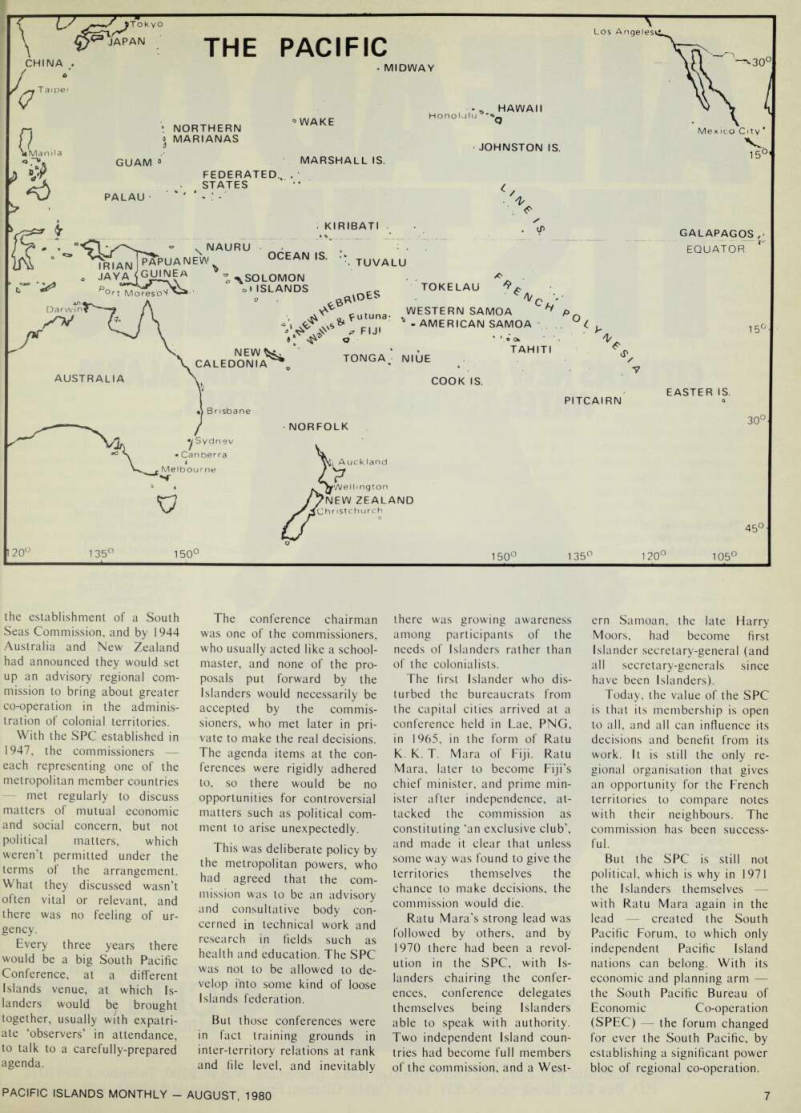
Thus is was, in rough order, that: • France took Tahiti and New Caledonia and their neighbouring islands, and still has them. • Britain took possession of Fiji (and soon began to compli cate its racial structure by importing workers from India).
The Fijians got their islands back in 1970, in company with the Indians, who by this time were 50% of the population. • Germany and Britain div ided up Papua and New Guinea (Britain then handing Papua to Australia, which later got New Guinea too as a result of World War 1). The Papuans and New Guineans got their islands back in 1975. • New Zealand took various far-flung islands, including Niue, administering them as the Cook Islands, and still has them.
• Germany took Nauru (then lost it to Australia as a result of World War I). The Nauruans got their island back in 1968. • America took Guam after a fight with Spain, who had had possession for centuries.
America still has it. • Germany acquired the Northern Marianas and the Carolines from Spain and added them to the Marshall Islands, which she had recently taken. (Japan later acquired all three groups as a result of World War I, and America took them from Japan in World War II.) The three groups, now known as the Trust Territory of the Pacific Islands, are in the process of being handed back to their native owners. • Britain took the Solomon Islands. The islanders got them back in a somewhat different form in 1978. • Britain took the Gilbert and Ellice Islands and later added Ocean Island. The Ellice Islanders got their islands back in 1978, renaming them Tuvalu. The Gilbertese got theirs, including Ocean Island, in 1979, renaming the islands Kiribati, but the Ocean Island people are not happy about it. • Britain and America div ided the Samoan Islands be tween them (Germany later accepting Britain’s share in a horse-trade for more of the Solomon Islands, only to lose it to New Zealand in 1914). The people in the western islands got their piece back in 1962 as Western Samoa; the eastern islands are still owned by America. • Britain moved in on Tonga to prevent anybody else from taking it (putting in British officials, who were given the power of veto over Tonga’s foreign affairs). The Tongans
got back full control of their islands in 1970. • Britain and France be tween them took the New Hebrides, as their way of re solving the squabble about which of them should control them. On July 30, 1980, the New Hebrideans were sched uled to get them back, with the French objecting to the very last minute.
The powers occupied the Pacific Islands for self interested, though not always selfish, reasons; to use them as bases or to deter anybody else from using them as bases, or to control their resources. Re sources varied from New Caledonia’s value to France as a convict settlement, to Britain’s blatant acquisition of Ocean Island for its rich phos phate (the extraordinary de tails of this particular piece of history are recalled on p 97 of this issue).
With permanent occupation came the eventual growth of government structures in the image and likeness of those used by the metropolitan power sometimes military (such as New Caledonia and American Samoa). But they have had in common a central authority dominated by the outside power to hand down decisions on important matters of policy or to constrict decisions made down the chain, this system existing virtually up to political independence. For the most part it exists still in those groups not politically indepen dent.
Some islands had their sys tem of government, education, etc, change on more than one occasion as political rulers came and went notably parts of today’s US Trust Ter ritory, which have been ruled in turn by Spanish, Germans,
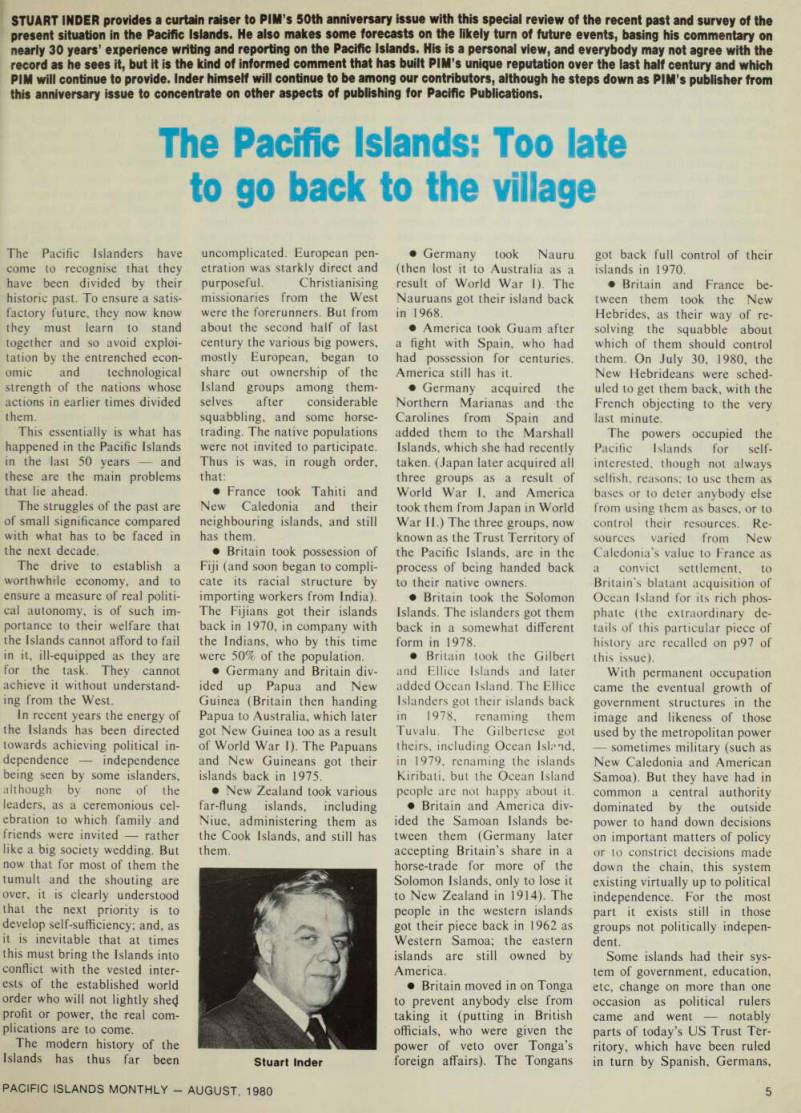
Stuart Inder
Japanese and Americans for periods long enough to have influenced their cultures.
The New Hebrideans, if there are such a people, have had the confused distinction of being ruled for 70 years by two governments at the one time, with different approaches to the question of political auton omy, to matters of land owner ship and the judiciary, with different currencies and languages. This twin-headed administrative monstrosity was imposed upon the islanders for the convenience of the outside powers.
Last century’s propensity for the rearrangement of tra ditional island groupings by the addition or subtraction of islands, for administrative con venience and without reference to the people, has caused ad ditional problems in the Pa cific. Thus it was no surprise that as independence ap proached recently, the Gilbert and Ellice Islands Colony div ided itself into the two separate states of Kiribati (Micronesians) and Tuvalu (Polynesians) resulting, inci dentally, in the mass exodus of the most experienced trained administrative officers from the Gilbertese capital of the old colony to their traditional islands in the new state.
The surprise with the scat tered Trust Territory islands is not that, with approaching autonomy, they are breaking into four separate groupings, but that they haven’t split into still smaller pieces. Anybody who makes even a simple examination of the boundaries imposed upon the Pacific Islanders by the accidents, the ignorance or the machinations of the recent past will have no problem understanding at least one of the reasons for the ‘breakaway movements’ that develop in some areas of the Pacific, not the least in Papua New Guinea which consists of many islands, and three million people, speaking 700 languages.
With only a week to go before Independence Day in 1975, PNG’s Prime Minister Somare was staving off Bougainville secessionists with one arm and, with the other, Papuan secessionists, who from different ends of the fledgling nation were seriously shouting
that they weren’t going to be part of a new entity with which they had nothing in common.
The Bougainvilleans argued that they were historically a part of the Solomons (and were allowed to change the name of the Province of Bougainville to the Province of North Solomons).
About the same time the Banabans of Ocean Island, now living on the Fijian island of Rabi, where they had been moved by the British Govern ment, argued that their old island should be given its inde pendence from the Gilberts because it never really was a part of that group. But it’s a moot point today because the phosphate that was on it was exhausted at the end of 1979, and Ocean Island is a moonscape, with no communi cations.
Nowhere can it be said that the powers grossly neglected their responsibilities in provid ing health and education ser vices to the islands, even if few people are likely to agree on what is an adequate level of health care and schooling. To some, whatever the level, it isn’t enough.
Nor will history say, with some exceptions such as the phosphate of Ocean Island and Nauru, and the nickel of New Caledonia, that the powers plundered the natural re sources of the islands to make themselves rich at the expense of the people.
Although fortunes have been made, corpc and individ ual, the Pacific Islands in col onial times proved not to be an El Dorado of fabulous wealth, with resources comparable to those exploited by the colonialists of Africa and South America. There is un likely to be any extensive resi due of resentment against past exploitation; although today’s Banabans will remain bitter at the massive exploitation of their home island by the British Phosphate Commis sioners, and resentment of France’s control of New Cale donian nickel, expressed in the past in Noumea, could be expected to intensify while France continues with her pres ent system of government in the islands.
With those exceptions, and with the exception of Nauru,
the resources of the Pacific Islands were not of such great value that they were worth the rising cost of administering colonies, especially as world opinion turned against the practice of one people ruling another, and politicians back home became increasingly vo cal on the questions of both cost and morality.
Nauru, with its rich phos phate deposits being exploited by Britain, Australia and New Zealand, would still be under control of the Powers were not Head Chief Hammer Deßoburt, a tough and relent less fighter himself, able to call on the support of world opinion through the United Nations, which luckily held trusteeship over the island. Neighbouring Ocean Island, not favoured with influential godfathers, continued to be worked until its phosphates were exhausted, which happened to coincide with independence.
Nor is there likely to be any extensive residue of resentment over the exploitation of Islands lands. Land alienation was never as great in the Islands as popular belief had it; the uncharacteristic exceptions such as New Caledonia and New Hebrides, where alien ation has been extensive, at tracted the popular criticism.
Of the biggest islands, alien ation of land ceased in Papua in 1906 and in New Guinea in 1914, and today in Papua New Guinea there are less than 216 000 ha of freehold out of more than 46 169 000 ha. It cannot now be purchased by expatriates, and will in any case be converted to leasehold.
Alienation of land in the Solomons was banned in 1914 and those early freeholds con verted to leases in 1977. Land alienation ceased in Fiji in 1909, and freehold land there, other than Crown freehold, totals 149 087 ha., out of a total of 1 829 799 ha.
Independence has invariably brought light land controls and reversals of colonial policies; the new constitution for the independent New Hebrides, in a single sentence, wipes the slate clean for those islands by bringing all land under the ownership of the indigenous custom owners and their de scendants on Independence Day. There will be no free holds.
Achievement of political in-r dependence has been helped by the development of a regional! identity among the smalll Island stales, followed by tho rise of regional co-operation. It is through this development! that the Islands learned t<D recognise and thus began to overcome the divisions forced) on them by the historic past.
Regional identity began to form with the establishment ok the South Pacific Commission in 1947 by Britain, Australia!
New Zealand, France, the US<: and the Netherlands (which then held Dutch New Guinea)( As early as 1921 the Fiji Legislative Council hao transmitted a resolution to London proposing a confederi ation of the British peoples oh the Western Pacific, buti nothing came of it. In the issue of PIM for January, 19311 PI M’s founder and editor.i R. W. Robson, proposed in as major article that a Pacific Islands Association be estab-( fished composed of indigenous and non-indigenous people ing in the Pacific as far north! as Hawaii, who would sencb delegates to an annual confer ence at Suva, Sydney or Auck-; land to discuss common prob-( lems and secure common ac< tion. He suggested delegates: should come from all terri-i lories, whether ruled by thea British, the United States,* France or Japan.
Robson pressed this plan im articles in the established PIM, which as thea only publication to specialises entirely in reporting Pacifies Islands affairs, and althoughrl aimed at white residents of aB white-dominated Pacific, wasz by its existence itself helping too develop a sense of regionalism..!
By July 1936 Robson wasz elaborating on his proposal in a£ radio broadcast in Suva, inn which he urged there should beo consultation and co-operative a action in the Pacific on ques—; tions of public health, natives education, agriculture, quaran--i tine regulations and other mau lers of interest to Islands resi--i dents.
Nothing had been done a when war came, but during the a war W. D. Forsyth, a memben of the Post-war Planning Sec--; tion of the Australian Depart- ment of External Affairs, pro- -< posed in a departmental report J
the establishment of a South Seas Commission, and by 1944 Australia and New Zealand had announced they would set up an advisory regional com mission to bring about greater co-operation in the adminis tration of colonial territories.
With the SPC established in 1947, the commissioners each representing one of the metropolitan member countries - met regularly to discuss matters of mutual economic and social concern, but not political matters, which weren’t permitted under the terms of the arrangement.
What they discussed wasn’t often vital or relevant, and there was no feeling of ur gency.
Every three years there would be a big South Pacific Conference, at a different Islands venue, at which Is landers would be brought together, usually with expatri ate ‘observers’ in attendance, to talk to a carefully-prepared agenda.
The conference chairman was one of the commissioners, who usually acted like a school master, and none of the pro posals put forward by the Islanders would necessarily be accepted by the commis sioners, who met later in pri vate to make the real decisions.
The agenda items at the con ferences were rigidly adhered to, so there would be no opportunities for controversial matters such as political com ment to arise unexpectedly.
This was deliberate policy by the metropolitan powers, who had agreed that the com mission was to be an advisory and consultative body con cerned in technical work and research in fields such as health and education. The SPC was not to be allowed to de velop into some kind of loose Islands federation.
But those conferences were in fact training grounds in inter-territory relations at rank and file level, and inevitably
there was growing awareness among participants of the needs of Islanders rather than of the colonialists.
The first Islander who dis turbed the bureaucrats from the capital cities arrived at a conference held in Lae, PNG, in 1965, in the form of Ratu K. K. T. Mara of Fiji. Ratu Mara, later to become Fiji’s chief minister, and prime min ister after independence, at tacked the commission as constituting ‘an exclusive club’, and made it clear that unless some way was found to give the territories themselves the chance to make decisions, the commission would die.
Ratu Mara’s strong lead was followed by others, and by 1970 there had been a revol ution in the SPC, with Is landers chairing the confer ences, conference delegates themselves being Islanders able to speak with authority.
Two independent Island coun tries had become full members of the commission, and a West
cm Samoan, the late Harry Moors, had become first Islander secretary-general (and all secretary-generals since have been Islanders).
Today, the value of the SPC is that its membership is open to all, and all can influence its decisions and benefit from its work. It is still the only re gional organisation that gives an opportunity for the French territories to compare notes with their neighbours. The commission has been success ful.
But the SPC is still not political, which is why in 1971 the Islanders themselves with Ralu Mara again in the lead created the South Pacific Forum, to which only independent Pacific Island nations can belong. With its economic and planning arm the South Pacific Bureau of Economic Co-operation (SPEC) the forum changed for ever the South Pacific, by establishing a significant power bloc of regional co-operation.
The Forum gives the South 1 Pacific Islands the freedom of ■ action that permits them to identify problems and to attack their root causes, irrespective : of their source or origin. This the South Pacific Commission could not do, and colonial gov ernments often would not. Fur thermore, the Forum brings Australia and New Zealand firmly into Island councils.
Speaking at that first, explora tory South Pacific Forum meet ing in Wellington in August 1971, Ratu Mara put it in these terms: ‘Since coming to New Zealand I have been con stantly asked why we are having this meeting and what do we hope to achieve. I can put it quite briefly. We are all leaders of our nations. As such, we feel the responsibility of leadership so keenly that we want to seek all the help and guidance we can. ‘We are leaders of nations emerging from a long period of tutelage with countries of European culture. Much of thh culture we have adopted parliamentary democracy, the rule of law, and constitutions organised for orderly manage ment of our affairs. We realise we are part of the modern world, with all its economic, sociological and political prob lems. And we realise in all humility that we cannot pursue the purposes of our leadership through our own cultures alone . . . We emergent nations in the Pacific would like to maintain the friendly relations that have existed with our former guides and protectors, beyond inde pendence and into the future.
It may be that the operation of independence in this way the Pacific way is what will distinguish us from other parts of the world, where this has not always been so. And in Aust ralia and New Zealand we have neighbours who have gone through the experience and can share it with us.’
But, significantly, Ratu Mara also stressed at that meeting that this was an era of aid from the more-developed to the less-developed countries of the world, and that this aid would be more forthcoming and belter utilised if the region continued to be stable and orderly. Although the Pacific Islands would accept aid gladly, trade was preferred to
aid, he said. One of the Pa cific’s main problems was that the pattern of trade was in herited from the colonial period, and any change or modification in the pattern could best occur if the people who controlled it could be influenced that is, the out side world.
So it was inevitable that another landmark in regional progress would come, as it did in March 1980 in Honolulu, when the Forum countries or ganised a new style of seminar involving the leaders of all Island states, whatever the state’s political status, plus representatives of developed countries and international agencies likely to be of help to the Pacific Islands.
The aim of this big meeting, ‘Development the Pacific Way’ was: To remind the world that the Pacific Islands are interde pendent like the rest of the world community, and that they need greater recognition of their development needs and problems.
The conference proceeded to report on the needs and prob lems that the leaders had ident ified in recent years, and to enumerate the Pacific-wide priorities, and to involve every body in attempting to resolve them. Some of the problems, such as the development of
new political/administrative
systems better able to serve Islands needs, are largely a matter for Islanders to resolve.
But many others, such as econ omic development and the ur gent search for new energy sources, cannot be resolved without outside help, and it is this drive for real support and recognition that the Islands are today engaged in.
Various recent studies have indicated that developing Is land countries face similar economic problems to those confronting developing countries generally. All mea sures in the field of trade and aid that other countries need so as to improve their prospects are equally important to developing Island countries.
Additional problems are due to their smallness.
A panel of experts asked to report on the characteristics of developing countries every where, including the Caribbean and the Pacific, for the United
Nations Conference on Trade and Development, found that they have these things in com mon: Most of them are small in area, with small populations.
Most of them are isolated from continents, and many are re mote from main shipping routes and world markets.
Most are exposed to natural disasters, such as hurricanes, and periodically suffer econ omic setbacks from them.
Even though they may be in dependent politically, most developing islands are more or less dependent in economic terms. The smaller islands have few natural resources. Many of their economies are highly specialised, dominated to the extent of more than 50% and sometimes up to 80% by one mineral or agriculture.
The economy of numbers of islands is dominated by one or more large foreign companies specialising in export crops, mining or trade, and the poli cies of these companies have an influence on the island’s development.
Particularly in smaller is lands the average income ap pears to be fairly high when compared with that in other developing countries, but these averages often conceal substan tial inequalities of income, sometimes to the benefit of expatriate elements who are in control of the principal econ omic activities as a result of colonisation.
Some islands have recently recently experienced a high rate of nominal growth, but the real standard of living may not have improved because of the income inequalities and the high rate of population growth.
They encounter special diffi culties in external communi cations because of their geo graphic position, and also be cause of the way in which air and shipping services have been organised. Groups with numbers of islands within their boundaries and most Pacific states are like this have special problems in providing such things as power and com munications, including trans port, because they don’t have the economies of scale of the mainland countries.
Unemployment is aggrava ted by a level of urbanisation which is normally greater than
in mainland developing coun tries.
The level of school attend ance is higher than in other developing countries, and there arc usually more doctors in proportion to the population.
But there may be poorer access to higher or specialised edu cation or medical services.
In a survey of Pacific Islands agricultural and nutritional patterns, Y. H. Yang, of Honolulu’s East-West Center, reported last year that some 70% of the Pacific Islands population are engaged in agriculture, yet per capita food production was dropping, which affected nutritional stan dards. Food imports were in creasing yearly to meet de mands, and in Fiji for example, 41% of the calorie and 58% of the protein intake came from imported foods.
Major allocation of resources in agriculture is on cash and export crops such as sugarcane, coconuts, oil palm, coffee and cocoa, and subsistence crops and staple foods for Pacific Islands villages have received much less attention. Livestock production has generally in creased, but fish catch for domestic consumption has failed to keep pace with the population growth.
Yang reported that in spite of voluminous migration of Islands people to New Zea land, Australia, Canada and the US population in the region has increased in the past 12 years from 3 478 400 in 1966 to 4 697 000 in 1978, or an increase of 35%. Food pro duction indices compiled by the UN Food and Agriculture Organisation (FAO), showing aggregated output of all food crops, indicated that the total food production in past years increased only moderately in most Island countries. Papua New Guinea had the best per formance, the only country in the South Pacific that matched the world average. All others were far behind. Looked at over the past 12 years, only Papua New Guinea can keep pace with her population, with a slight increase per capita of 7%, while Fiji declined 22% and Western Samoa 32%. Food production must be increased at least 3-4% a year in order to support the population.
From 1970 to 1977, food im
ports in the South Pacific countries occupied about 20%' of their total imports in mer chandise trade, ranging from 17% in French Polynesia to 28% in Solomon Islands. On monetary value, the per capita food imports in 1977 were $4OO in French Polynesia, $95 in Fiji, $59 in Western Samoa and at least $35 in PNG.
Says Yang: ‘This is appar ently a big drain to the foreign exchange reserve, particularly in countries with , a negative trade balance such as Poly nesia, Fiji and Western Samoa.
This pattern of import dependence in food supply was similar, of course, with other countries in the region and the trend was upward.’
Separate studies have indi cated that many people in the Islands are suffering from mal nutrition.
The development of markets by the Islands has involved the development of new skills and contacts, and experience so far has been salutary. Three Island countries, Fiji, Western Samoa, and Papua New Guinea, have their own rep resentatives at UN head quarters. There, their voting patterns on issues affecting the world at large have been the same, and through consultation they also present a united voice on the South Pacific. But, more to the point, by having formed a working group within the UN called ASEAN-plus-Pacific, where they have regular dis cussions with their Pacific Basin neighbours, they’ve got regular feed back on world developments, especially on economic matters, and this new knowledge is being dissemi nated through the Forum. The Pacific Islands cannot advance economically without an under standing of the world market ing trends, which, as Marshall Islands President Amata Kabua warns, is a whole new ballgame. ‘Changes in the postwar in ternational monetary system and the substitution of floating exchange rates,’ he says, ‘mean that the world capital markets can respond almost within a matter of minutes to major or even minor policy changes. The advent of sophisticated com modities futures markets throughout the world means that commodity markets reflect
within hours any sudden, ad verse changes in the weather or other related factors. ‘Similarly the recurrent in creases in world oil prices, which raise the cost of pro duction and transportation of other commodities, are also quickly reflected in world com modities markets. This global linkage can have particularly volatile effects on a developing country whose annual gross national product is heavily de pendent on commodity exports. ‘Given this growth of global interdependence, national and regional development policies must plan for extensive partici pation in the institutions cur rently charged with monitor ing, implementing and developing these global changes . . .’
But the matter goes further, as President Kabua says; ‘lncreasingly, states have re alised that fairly limited con cern related to one’s own nar row bell of national jurisdiction has now expanded beyond these confines. The realisation that an expanding global popu lation has pushed fishermen from distant water states such as the US, South Korea and Japan, and further afield, in search of more abundant food supplies is just one example. As a result, our former national and regional concerns must now extend beyond our own visible offshore horizons and now must include recognition of the global need for ad ditional food as well as energy sources. How we deal with the global demands made upon us, as well as how we present the demands we make upon the rest of the world, poses a crucial development question for the Pacific Island communi ties in the 19805.’
On this question of ocean resources. Dr James Maraj, vice-chancellor of the Univer sity of the South Pacific, Suva, has warned that probably ‘it is not by chance that the Islands have been rediscovered’. In a world one quarter land and three quarters water, if land resources are running out it could be that ocean resources are bringing the rush of atten tion to the Pacific area seen in the last two or three years, and in the Pacific age of the 1980 s this could mean that the Pa cific countries could be picked
off one by one if they don’t protect their interests.
Control of ocean resources is probably the most important economic objective currently faced by Island countries whose main objective in com mon is to control all natural resources in their region, of whatever kind.
But the Islands have recog nised the special economic po tential of fisheries, and all countries are now according a high priority to their develop ment in national programmes.
Many have already declared 200-mile exclusive economic zones, encompassing very large sea areas with considerable fisheries resources. This follows the South Pacific Forum’s 1976 declaration that it was the intention of member states to establish 200-mile zones and adopt a co-ordinated approach to fisheries.
The total value of tuna caught in the region in 1977 was worth over SUS3SO million to the fisheries industry, but no benefit was derived by the Islands from the bulk of the resource because 75% of the tuna is caught, processed and marketed for the benefit of countries entirely outside the region.
With the declaration of the 200-mile zones, these fishing resources are coming within Islands jurisdiction, particu larly of the smaller groups for which fisheries are the only natural resource of major econ omic value. This in turn is creating the problems of ocean management, no small task when over 98% of the central and western tropical Pacific, in the area of the Micronesian islands, is water more than 20 million sq km of it. Apart from conserving resources there are the problems of policing, and of the Law of the Sea, in which the Pacific countries are having to involve themselves more deeply.
These problems can only be met through regional co operation. It was SPEC, the Forum’s executive arm, which convened a meeting of all coastal states to plan for the Forum Fisheries Agency, with headquarters in Honiara, which has now been estab lished for the collection and evaluation of information on fisheries, and which has yet to
tackle the complicated andb expensive problem of surveil-1 lance.
Not the least of the problems? ahead is the need for agree-; ment among the Islands as too their fishing needs so as too identify the regional position..!
Some countries still see fishings as a way to meet local proteinn needs, others to meet employ ment needs, others mainlyy want to see the development ofl export fisheries as foreignn exchange earners.
Control of fisheries might! well give the Islands their first! real opportunity to dictate terms, where in other com modities their production is? usually too small to enables them to do little but accept thee terms and prices dictated by\ more prosperous nations, as fori example with coffee, tea, natu ral rubber, sugar, timber, cop per and copra.
But in the meantime, and! perhaps for all time, they haves to keep themselves informed onr the market for their existing £ products if they are continue to ( get what returns they do. For i 'example, the new approach tO( keeping themselves informed 1 has caused Papua New Guinea i to feel that current high coffee ; prices could work against the ? promotion of coffee as a bever- age, to the detriment of Islands < exports. It is also cautious; about the future of coffee in i view of estimated increases in i production by the big coffee : producers.
On the other hand, PNG i feels that the expected compe- tition for natural rubber * against synthetic rubber will I not eventuate in view of cost J increases in the production of 1 synthetics due to rising oil 1 prices, and it has already em- barked on an expansion of its < rubber industry to take advan- tage of this.
Again the Forum, through i SPEC, has been a growing < force in widening Islands trade j opportunities. It has recently established in Sydney a Trade - Commission for the South Pa- cific to identify and develop c markets. It has come up with r the text of a plan, initiated at a i meeting of Islands Ministers of 1 Trade or Economic Affairs < held in Tonga in 1979, for a f comprehensive non-reciprocal I trade agreement in favour of 1 the Forum countries for pro- -
(gressively duty-free and unre stricted access to the markets of Australia and New Zealand over as wide a range of prod ucts as possible.
Having identified pharma ’ ceuticals as being substantial high cost imports into the I Islands, SPEC established a . South Pacific Joint Pharma • ceutical Service for joint pur [ chasing and warehousing of pharmaceuticals. It also acts on quality controls and as a : drug information service.
Other collective purchasing ar ' rangements are likely to follow.
The Pacific Forum Line is in existence because of the recog nition that Forum countries are disadvantaged by the high cost and irregularity of shipping.
Since its establishment the Fo rum Line has been hampered by constraints, and losses due basically to initial under capitalisation. But for the smaller islands the direct links it has offered have led to reduction of freight rates and import bills, and higher returns on exports. Exporters at least have some assurance that their products will reach the mar kets.
The Forum Line cannot be called an unqualified success, which doesn’t dismay its allies, among them Ratu Mara, who told the big Honolulu confer ence in March that as 60% of islands trade went out of the Pacific, it was no wonder that regional shipping was unprofit able. But he said the shipping could work if the Islands ana lysed the problems and really co-operated. Each year about 400,000 tons of sugar are ex ported from Fiji on non-Forum lines, which represents a loss of revenue to the regional line of $25 a ton.
The same thing is to be said for the Pacific’s efforts to es tablish a regional airline in Air Pacific, based in Fiji, and facing competition from a number of airlines operated by Islands governments with simi lar pretensions.
Because of the growing en ergy problems in the Pacific, some leaders think now might be considered a time for ration alisation rather than rivalries in Pacific transport. Shipping and air cargo rates have risen sub stantially with increased fuel costs, and shipping is concen trating on fewer ports, leaving
some places with increasingly irregular services, which in turn restricts development plans as well as exports. Devel opment plans based on earlier cost of fuel and power have had to be reconsidered.
Although SPEC has been stressing what it sees is the urgent need for South Pacific countries to recognise the mag nitude and implications of the region’s energy problems, it is doubtful if any Island country is not now fully aware of their seriousness.
The Islander on Guam or Saipan who finds there is no fuel left in his local gas station for the last few days of each month because the monthly quota has been exhausted, or can’t work in an air conditioned office, or supervise a machine, or pays more for his groceries, is acutely aware of
his vulnerability.
When PIM asked Island leader to state what they con sidered their single most serious problem of external
affairs, Ratu Mara said with out hesitation, ‘Energy. Where can we get an assured source of energy right at this moment?
All our foreign policy is motiv ated by the need for energy.
What if our oil goes?’
All other leaders made it clear in discussion that the search for energy sources was a top priority. Tonga was es pecially gloomy about pros pects. It says, ‘lt is an inescap able conclusion that no substi tute is likely to be forthcoming in the near future for the flexibility of liquid fuels, par ticularly for the small Island economies where transport is a vital prerequisite for develop ment. Further economic devel opment thus seems closely tied to continuing importing of en ergy, at ever-increasing prices.’
Tonga’s fuel imports have doubled in quantity since 1975 and imports are now equivalent in value to some 60% of annual exports. The kingdom sees the position worsening ‘as pet roleum prices rise and coconut
prices fall, as they both are expected to do’, and it adds; The energy situation is the most immediate problem facing us all. If it cannot be met, many of our development goals will be unreachable, and our brave strategies will be come meaningless.’
Illustrating the general en ergy problem now facing the Islands, Tonga currently has projects for increasing Nukualofa’s generating ca pacity, rural electrification, road upgrading, crop and fish ing expansion and for the growth of tourism, all of which will need more fuel and thus contribute to the rising cost of imports. Tonga can’t now re turn to the candle-nut lamps of their forefathers.
The Islands are tackling the crisis in energy in two ways: first by attempting to secure their current energy sources at predictable and manageable cost, and second, by searching for new energy sources from alternative fuels, the sun, sea,
‘We emergent nations would like to maintain the friendly relations that have existed with our former guides and protectors, says Ratu Sir Kamisese Mara,thearchitect of the New Pacific,seen here in Canberra with Australian Foreign Minister Andrew Peacock. But Ratu Mara has always made it plain that the independent Pacific states are not subservient, despite their need of assistance and understanding
wind, or even the stars if this is possible.
On the first objective, the Forum strategy is to seek petrol direct from the OPEC nations at concessional prices, whilst monitoring commercial prices in the region to ensure that local rises are related to OPEC increases. Preparations are be ing made for top-level del egations to OPEC countries.
Public hearings which began in Honolulu in July, sponsored by the US Senate Committee on Energy and Natural Re sources, heard experts describe various projects for alternative energy sources that are now under way.
These include small electric cells activated by sunlight and said to be suitable for residen tial power, which can return unused electric power into a central power grid to be used by others; land-based ocean thermal energy conversion (OTEC) plants; development in Hawaii of a geothermal turbine generator in a volcano (to be completed in 1981 and which should provide new knowledge about geothermal power); development, again in Hawaii, of a 200 kw wind tur bine generator (currently much more expensive than oil). There is also work being done on alternative fuels, from prod
ucts such as sugar cane and beet.
The US Territories Depart ment is spending SUS 3 million on a survey of energy sources in its Island territories and to draft a plan for long-term development.
The Honolulu inquiry was told that money spent on the development and use of renew able energy resources was ‘a realistic alternative to the lower standard of living that will inevitably come should the Islands’ heavily dependence on imported oil continue’.
Guam, which currently pays out about one-third of its annual gross business receipts for petroleum imports, has re cently committed itself to a firm policy of alternate energy development and is considering establishing an OTEC plant on Guam.
The urgent search for new energy sources, which is be yond the capacity of the Pacific Islands to resolve although they are among those worst affected, is probably the most dramatic illustration of how the Islands are dependent on outside aid and know-how to resolve problems not of their own making. Aid, whether in finance or in the provision of skills the Islands have yet to acquire, is a vital part of Island economies, and many countries
could not survive without it.
Western Samoa, first and thus the oldest of the South Pacific’s independent nations, now independent for 17 years, is still heavily dependent on aid from a number of developed countries and lending agencies for its foreign exchange, capi tal and skills. And it is still not self-sufficient in basic food stuffs such as fish and meat, Samoa’s announced objective is to reduce the degree of. dependence on foreign aid, in this case by strengthening the balance of payments, and by increased exports and in creased production of import substitutes.
But what is true of Western Samoa is true of the Pacific.
PNG’s Prime Minister, Sir Julius Chan, stresses that aid and self-help go together.
PNG, he says, aims to reduce its dependence on Australian aid in real terms over a period, so as to satisfy Australian taxpayers that PNG is ‘playing fair’ in using its aid sensibly by building up its economy so as to reduce its dependency.
It is true that if aid were curtailed then many countries could somehow survive, but at a fish and coconut subsistence level that might be accepted in the outer islands but not in the urban areas, where the style of living is one originally made
possible by the level of hand outs from the colonial adminis trations.
This is especially true of the living standards of PNG, New Caledonia and America’s Micronesian territories.
But such a severe curtail ment is certainly not immedi ately likely, for today there are something like 84 aid agencies operating in the region, together with multi-lateral and bi-lateral aid donors, and in the past 10 years developing Island countries have had access to a cornucopia of assistance.
Island countries are now also borrowing from each other as well as from the developed countries and from inter national agencies. Nauru par ticularly has given assistance to its friends.
Gone are the days when the Pacific Islands were tradition ally the preserve of the Aust ralian and New Zealand trading banks. British, Indian and commercial banks have entered the arena, as well as there being a growth in national banks. A number of countries now operate a central banking system.
Because of the propensity of Island governments to follow the British rather than United States system by embarking on the establishment of statutory bodies and government corpor
ations for specialist functions such as housing, telecommuni cations, internal air services and industries, there has been an increase in the variety of aid funds required. Regional oper ations such as the Forum Ship ping Line and Air Pacific, also need credit to sustain their expansion, and functions like these have changed the Pa cific’s financial scenario.
But despite its abundance, aid in many cases is not work ing satisfactorily. Streamlining is necessary.
A man with many years practical experience in Fiji and Papua New Guinea on govern ment financial management, Rodney Cole, of the Australian National University’s Develop ment Studies Centre, told a Canberra seminar last year that many South Pacific countries were able ‘to play by the rules of the aid game’.
These had the manpower to service their credit gathering activities, and they belonged to the ‘right’ organisations.
But other countries were too rich, too small or too tied to a a metropolitan power to be readily assisted by the big agencies, and needed some thing else probably some thing like a South Pacific Re gional Development Fund, or membership of the Asian De velopment Bank under a re vised set of rules. (A plan for a Regional Development Fund with wide ramifications is cur rently being examined as a result of the March Honolulu conference.) Cole says, and SPEC agrees with him, that what the smaller countries need is the ability to talk to somebody about their requirements when they want to talk, not just when a visiting mission arrives: and quick im plementation.
Tonga made the point for the smaller countries when it told the Honolulu conference in March this year: ‘The funds available for implementing de velopment projects acceptable to donors are often much larger than the total expenditure of government on its on-going re current activities. This is cer tainly the case in Tonga, where the total resources available through aid and soft loans in 1979/80 are more than twice the amount of all locally raised revenues. This growth in re
sources has placed great strains on a system designed to cope with the old level and range of activities. The problems have been exacerbated by the fact that each aid agency seems to have its own complex program ming and disbursement pro cedures.’
It is not merely the small countries that find implemen tation of aid can be a frustrat ing experience because of do nor requirements, lack of understanding by the donor of the Islands situation, or lack of suitable people to deal with the loan.
PNG found on independence that grants or soft loans began to come not as budgetary sup port, but for special projects the ADB, the World Bank, and Japanese, NZ and Australian governments funding a small number of individual projects, at a time when the country was trying to work out for itself an independent development strat egy.
PNG found it didn’t have the human resources to develop a planning system that could best use this aid. It was forced to lay down a policy which stressed, and still stresses, that its preference is to receive untied budget support grants.
If project aid is to be accepted then it must be only to fund projects already included in PNG’s national public expendi ture plan.
This ensures that the PNG Government determines priorities, and that projects aren’t undertaken merely be cause another government is prepared to provide money for something that government re gards as desirable. This ap proach hasn’t deterred aid from NZ, Japan, West Germany, the EEC and Kuwait.
There is a general complaint in the Pacific that aid donors fail to recognise that their requirements for economic jus tification and confirmation of projects after local officers have already said what they want, consumes time and money because it puts a heavy administrative burden on small states with few human re sources. Local officials are inti mately aware of local con ditions.
The situation is uncomfort ably reminiscent of colonial
times, when white adminis tration officials in the Islands were continually frustrated and had expensive time consumed by frequent queries and calls for reassessment for this proj ect or that from the metropoli tan capitals. But now this ex pense is coming out of local budgets that can ill-afford it.
The difficulties of the recipi ent in receiving aid are in fact usually understood by the do nors, for the administration of aid has become a fulltime profession in itself in the devel oped countries. The difficulties for the donors are that their aid procedures may have been laid down as a result of past, sometimes even bitter, experi ence, and that some checking procedures are also designed to make the Islands’ use of the aid more efficient.
Nevertheless, many Island governments believe there must be a middle course, poss ibly by there being more on the-spot visits by people with authority to get a project mov ing before the local situation changes yet again in the
swiftly-developing Islands
scene. And they want to see donors adopt a ‘roll forward’ approach so that funds are provided say for five years, and as the first year elapses, one year is added. If it isn’t added, there are still four years for the recipient to wind down.
There is another kind of aid.
As Tonga reminded the Honolulu conference in March: ‘For some of us smaller nations, development assistance in the form of trade support and emigration quotas may be more valuable and meaningful in the long term than much of the aid we now receive,’ it said.
Tonga pointed out what many smaller Pacific countries such as Niue, the Samoas and the Cooks, know well enough, that a major problem in some countries is the rate of popu lation increase, which comes at the same time as people are seeking higher living standards in the face of rising costs.
Those who emigrate usually remit funds back to their fam ilies, or if the whole family goes, take the strain off the local economy.
There are twice as many Niueans living in New Zealand as on Niue (3500 on the island), and more Cook
Islanders in New Zealand) (20 000) than in the Cooks; (18 000).
There will in the future be< pressures on developed) countries, particularly on Aust-J ralia, to assist the Islands witM this kind of aid by taking migrant quotas. The time might come when Papua Neww Guineans will be asking font entry, but for the time being iti is the small countries, unden' economic pressure and with as growing unemployment prob-( lem, who see out-migration as an important way of resolvingg some of their difficulties de-j spite the disadvantages, suchrl as the drain in brains as well asa brawn.
Meanwhile, the pressures onn the Islands of every sort, econ-i omic, political and social, area combining to force othen changes on the structure off government.
The system of the public:) service particularly is con--i sidered an expensive coloniall leftover, which needs to bea transformed from an organis-; ation designed particularly too promote law and order, to ann instrument of development.
Most islands are under pres--; sure for decentralisation, which r is not always recognised as a£ demand for change in thea political structure, but which r usually has that effect, andfc what most islands are looking*] for are better alternatives toe the borrowed models.
Ratu Mara says, ‘There is a£ Fijian saying, cavu lawe, whichri is said of a person who donsa somebody else’s garments. Let! it not be said that we dress upq our governmental systems withrl woollen attire made inn Lancashire when somethingg lighter to suit the climate off the South Pacific would beo more appropriate.’
Decentralisation of decision n making clearly best suitsa Islands attitudes and age-old b methods of consultation. Over--formalisation of governing pro--< cedures has in the past created b the main problems, together! with an over-centralised b government. The task is to findb methods which effectively al--l low local communities to indi--i cate their priorities and to helpq in achieving them while ae central government still retains 2i overall direction.
Kiribati is one Island states
■ (which although independent ■ only since 1979) is currently making a thorough review of I its system of local government ■ which it says, has ‘generally proved unsatisfactory and in sensitive to traditional decision-making processes’.
One of its more imaginative plans is to establish in the remote Line group of islands, which comprise half the land area of Kiribati, a new ministry solely concerned with the ad ministration and co-ordinated development of those islands, the aim being to make a concentrated effort on their exploitation, and thus use government as an instrument of development.
One of the disadvantages of decentralisation in small and widely scattered groups, such as Kiribati, is that it can dilute the already thin pockets of skilled people to the point where they may not be able to form effective teams, and thus knowledge is not efficiently transformed into action.
The role of Big Government, too, is being examined in the Islands, and there is more than a suspicion that the Westminster-type system is not appropriate, although it may have served its purpose in the past. It is seen as a system of adversaries, encouraging con frontation, and thus probably inappropriate in Islands where politicians are often known per sonally to the whole com munity.
As Governor Peter Coleman, of American Samoa, sees it (and American Samoa does not follow a Westminster system): ‘We don’t believe in the party system. These are small islands and in the heat of the cam paign, families split according to labels.’
Anybody with knowledge of the deep divisions in the Cook Islands community (which fol lows the Westminster system) under the last years of Albert Henry’s control, and which will be a long time healing, will appreciate the problems.
There is a party system in Papua New Guinea, but in March Sir Julius Chan came to power with 11 ministers in his Cabinet of 25 who had for merly been ministers under the Somare government. Sir Julius
explained to a Sydney audience in July, ‘Our parties in PNG do not have the unyielding ideologies which keep parties in other countries apart. Our coalition has come about be cause of shared principles that are basic to our way of governing. We are to develop our country for the greatest good of our people, and we decide how to do so by constant consultation.’
The Pacific Way may well turn out to mean more national coalitions. But whatever comes, it will develop from the grass roots that have always been in Island soils.
And there is little doubt that each island group will defend its right to find political sal vation on its own terms, to suit its people, as Western Samoa fought in the UN, and won, in defence of a niatai system of local control which has proved its value in the 17 years of independence, as it had in the generations that went before.
The Samoans knew best what they needed.
Despite the rise of regionalism in the Pacific Islands, they are still individu alists, for that is their whole history.
That is why France will not always convince the world, or even some French Polynesians or New Caledonians, that its Pacific territories are indivis ible parts of continental France, and that New Caledonia can continue to be owned and occupied by as many outsiders as Islanders.
It is not stated as a criticism but as a statement of fact that with the continued develop ment of the Pacific community as an identity, the pressures will be too great to allow France to continue with its present system of government here. French Polynesia appears already to be on the way to evolving some sort of free association with her colonial power, without bloodshed, as is the Pacific way. New Caledonia must follow, but it is continental France who will have to decide whether or not
New Caledonia’s passage will be painful.
None of this is to say that Pacific regionalism will not have its own severe internal problems. Specifically because of Islands individualism, regionalism cannot be treated as a sacred cow, as Kiribati’s young President leremia Tabai has recently warned. Islanders will only accept its advantages.
Ratu Sir Kamisese Mara, the true architect of the new Pacific, is well aware of the conflicting problems posed by people who have become inde pendent yet are reaching out for help at the same time. As it grows, the South Pacific Forum may not always be as harmoni ous as it has been.
But the Pacific Islands must now keep moving, for as Ratu Mara says: ‘We have been discovered, Christianised, col onised and capitalised. The capitalised aspect directly challenges our Pacific Way. Do we go for one world? Go back to nakedness? Or somewhere in between?’
Colonial scenes such as this, with Governor Derek Jakeway, in morning suit, with a bewigged Speaker by his side, at the opening of Fiji’s Legislative Council in 1966, have not gone from the Pacific but they may become rarer as the Islanders examine their present parliamentary system and ask themselves whether something less formal, and less divisive, is more suited to their needs.