in Tonga
pp. 67-69 · Read in the full issue

Trade
Winds
Industry
in Tonga
Asian Development Bank funds were used to establish a small industries centre in Tonga under a scheme which is expected to reduce Tongan imports of some basic goods and materials from Australia and New Zealand.
The centre, which was
opened recently at Ma’ufanga
by King Taufa’ahau, consists
of a 20-acre site on which small
factory buildings are being
constructed and made avail able for light industrial pro jects.
Just over half the site has
already been fully prepared,
and seven factory buildings
have been established. Work will start shortly on the con struction of more factory build ings and on a housing estate for owners and operators of the
new projects.
Paper products, saddlery,
welded wire mesh, machine knitteds, furniture, building material, building accessories and footwear are among the first products to come from the new industries centre. Exper iments are being conducted to use the stems of coconuts as a basis for particle board to be used as wall panels in the
building industry. Normally
large quantities of coconut
stems are dumped as rubbish, but Tonga hopes to use the stems to at least partially re place the import of wallboard from Australia and New Zealand.
The new centre is being
administered by the Ministry
of Labour, Commerce and Industries. The total govern ment investment is SUSSSO 000 of which about three-quarters was provided by the Asian
Development Bank under a 40-year interest-free loan.
Air Niugini
Not On Sale
An offer by Ansett Transport Industries of Australia to buy out the Papua New Guinea national airline Air Niugini reportedly under financial strains has been flatly refused and described by the PNG government as ‘naive’. The re fusal came from the Transport Minister, Mr Okuk, who said that the Ansett group was
obviously angling for airline
landing rights in areas served by Air Niugini. The areas are
PNG itself, Hong Kong, Japan,
Singapore, Indonesia, Solo mon Islands, the Philippines and Hawaii.
The Ansett group already has an 11 percent share in the airline, a leftover from the for mation period of Air Niugini when two other Australian air lines, Qantas and TAA, also held shares. The PNG govern ment now holds all the shares apart from the small Ansett holding and has the option to eventually buy out the Ansett shares.
Mr Okuk, who has conceded some financial constraints in Air Niugini, says it is still government policy to buy out Ansett as soon as possible. He is examining the possibility of making available government funds to assist the airline in its present situation.
A correspondent in Port Moresby said the general im pression in the PNG Govern ment was that the Ansett offer was ‘audacious’. The Prime Minister, Sir Julius Chan, who called a press conference to emphasise that Air Niugini was
not for sale, said ‘Nobody seems to remember that our national airline is owned by our people.’ Sir Peter Abeles,
joint managing director of
Ansett Transport Industries, said in Australia later he was
surprised that his company’s
‘inquiry’ had been made pub lic. He said ‘We were making an inquiry which was a sincere attempt to help Air Niugini out of its financial troubles.’
Travel Mart
For Pata
Fiji will be this year’s host country for the Second South Pacific Travel Mart, a con ference and publicity occasion for the marketing sector of the tourist and travel industry.
Travel Mart 1980 is being organised by the Pacific Area Travel Association (PATA) and will involve about 250
travel industry representatives
from 13 countries in PATA’s South Pacific region. They will meet from October 7 to October 10 at the Hyatt Re gency Hotel, Korolevu.
The countries represented will be American Samoa, Aus tralia, Cook Islands, Fiji, Kiribati, New Caledonia, New Hebrides, New Zealand, Papua New Guinea, Solomon Islands, Tahiti, Tonga and Western Samoa.
Canberra To
Put Up Aid
Australia has increased its aid programme to Fiji, and during the next three years will con tribute $A30.5 million in government to government aid. This is an increase of about
$7 million over the amounts of aid paid during the past three years.
The commitment forms part of a larger commitment of SAI2O million for civil aid to the South Pacific announced earlier this year by the Aus tralian Prime Minister, Mr Malcolm Fraser. The Aus tralian High Commissioner to Fiji, Mr Raymond Greet, said that the Australian aid pro gramme was the primary means by which the Australian Government contributed to the economic and social advance ment of the developing world, particularly in the South Pacific.
Detailed discussion on how the Australian aid grant to Fiji should be applied was held in Suva last month during a visit by officials of the Australian Development Assistance Bu reau. Australia is already com mitted to financial aid in a beef
farming development project
and in water supply and drain age works.
Outlook Is
Good In Fiji
General economic indicators, a review by the Central Monet ary Authority and reports from the sugar industry all indicate a generally sound and stable economy in Fiji.
The indicators show an in crease in the real value of the gross domestic product, a 29% increase in exports over the past year, higher sugar pro duction and sales and an immediate prospect of higher financial returns from the
sugar industry.
But reports also reveal that
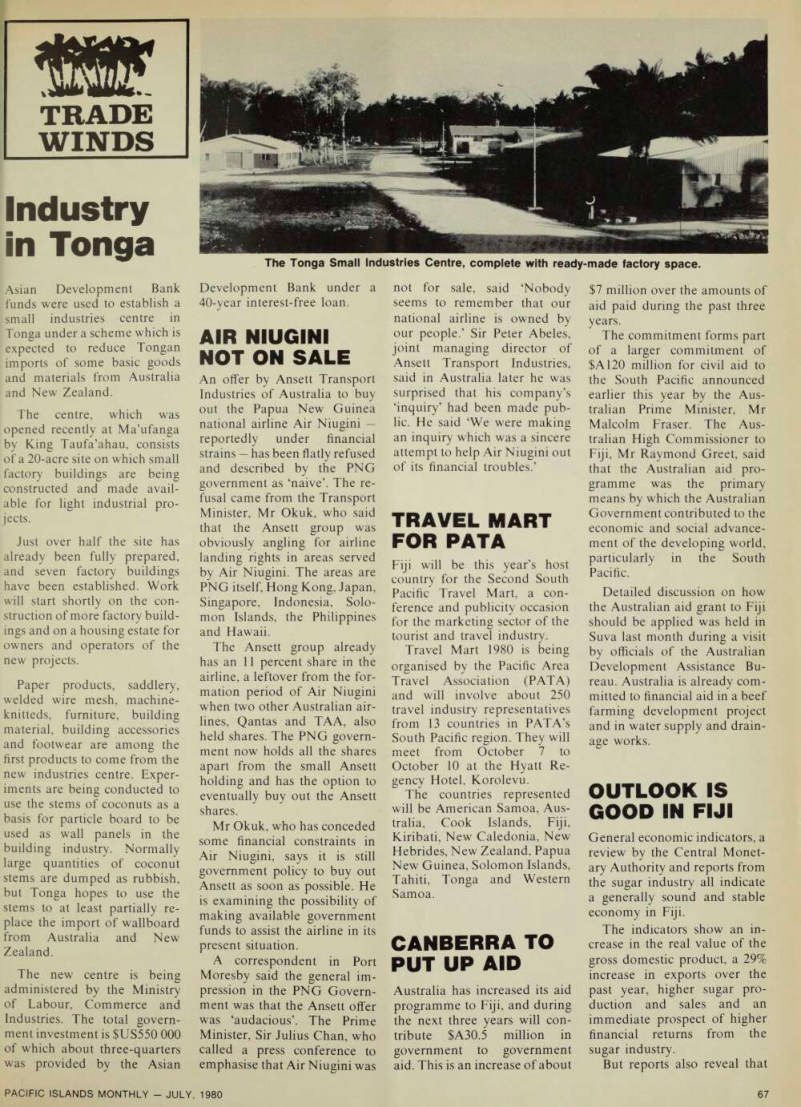
The Tonga Small Industries Centre, complete with ready-made factory space.
inflation accelerated during the final quarter of last year and that there is a widening gulf be tween exports and imports reflected in the balance of pay ments current account.
Issuing its annual report re cently the Central Monetary Authority said that Fiji had performed ‘remarkably well’ despite an economic slowdown and uncertainties in the inter
national, foreign exchange and
capital markets. In real terms after allowing for inflation the value of the gross domestic product in 1979 had increased by more than 6% for the year.
The previous year’s growth had
been only 2.5%.
The Central Monetary Auth ority said that the inflation rate at the close of the year was 7.7% compared with 6.1% for the previous year. Most of the in crease had occurred during the final quarter of the year and reflected ‘imported’ inflation from Fiji’s main trading part ners. Petroleum-based fuels were one of the main factors involved in inflation, but in
comparison with general in
flation figures for the world
Fiji’s performance had been
good.
In another review involving the Fiji economy the Indepen dent Chairman of the Sugar Industry, Mr lan Thomson, said that an immediate pros pect existed for higher financial returns. He warned however that in the long term the international price for sugar was likely to drop, and that in many countries the sugar industry could become
‘thoroughly uneconomic’.
Mr Thomson said that world consumption of sugar was
increasing and production was
falling, but ironically this did not indicate a long-term pros pect of prosperity for pro ducers. There were indications
of production expansion pro
grammes designed to cash in on the situation, and there was an excessively steep climb in
prices which history showed
usually caused consumption to
drop. The final result was likely to be a turn in the tide with ex
cessive production, falling
markets and a recession for many producing countries.
Reviewing technical aspects of the Fiji sugar industry last
year Mr Thomson said one of the few disappointments was that more tonnes of cane had been processed for each tonne of sugar produced. The early start and late ending of the season had contributed to this situation. Mill expansion pro grammes were now being undertaken to ensure that a shorter crushing season could be followed, processing the cane when sucrose quantity was at its peak.
Last year Fiji crushed 4.06 million tonnes of cane for a yield of 473 000 tonnes of sugar.
Access Bid
By Islands
Representatives of nine Pacific Island countries met Australian and New Zealand officials in Canberra recently for a new round of talks on regional trade under arrangements established by the Pacific Aus tralia New Zealand Regional Trade and economic Agree ment (SPARTECA).
Australian officials reported later that significant progress had been made in preparing the way for eventual nego tiations to give Pacific Island countries greater free access to markets in Australia and New Zealand. The need for easier access to these markets is
becoming an increasingly sen
sitive issue for many of the new nations of the Pacific who see Australia and New Zealand isolating themselves from the
Pacific region by adopting
partly-protective trade poli
cies.
SPARTECA originated in a recommendation from a Re gional Trade Ministers’ Meet ing in Nukualofa, Tonga, in July 1979. The Tenth South Pa cific Forum, which met at Honiara also in July 1979, acted on that recommendation.
It resolved that early nego tiations should commence to establish by the July 1980 Forum a Trade Agreement designed to achieve progress ively, duty free and unrestric ted access to the Australian and New Zealand markets for as wide a range of Island products
as possible.
Australia and New Zealand began work on a joint draft text
shortly after the Honiara Forum, and the first Officials’
Meeting of participating
Governments was held in Sep tember 1979. Australian Minis ters decided that Australia should use a positive list ap proach, detailing items which could be imported duty free or at concessional rates (some on quotas) while New Zealand adopted a negative list ap
proach, detailing items which
could not be imported at con cessional rates.
A second round of officials’ talks was held in Suva in February 1980 and a composite text was produced for further examination by governments.
The most recent talks, in Canberra, were attended by representatives from the Cook Islands, Fiji, Kiribati, Nauru.
Niue, Papua Guinea, Solomon Islands. Tonga and Western Samoa, as well as New Zealand and Australia. The New Hebrides, which are due to become independent
shortly, were granted observer
status.
Australia vi&ws the trade agreement as an important step which, in the longer term, will help its Pacific Island neigh bours become more self-reliant and less dependent upon aid. It represents a key element in Australia’s comprehensive ap proach towards the welfare and development of its South Pa cific partners.
It will complement the pro jected 40% increase in aid to the South Pacific ($l2O million for the next three years), an expanded cultural relations programme, a strengthening of Australian diplomatic rep resentation in the region, Aus tralia’s support for the Forum Fisheries Agency and the Pa
cific Forum (Shipping) Line, a civil coastal surveillance exer
cise currently being under
taken to evaluate the needs of the Forum island states in managing their 200 nautical mile economic zones, and other regional activities.
Few Shares
To Growers
The Fiji National Provident Fund was the purchaser of more than half of the six
million Fiji Sugar Corporation
shares which were made avail able some time ago by the Fiji Government. Fewer than 100 buyers of the released shares were from sugar growing and
marketing backgrounds. The
figures were released recently
by the Fiji Development
Bank.
Commenting on the break down of sales the Minister for Agriculture, Mr Mavoa, said he did not believe the absence of cane growers from the list of
buyers was necessarily sig
nificant. He believed many producers were still interested in a stake in the total industry, but were delaying immediate action pending a decision on what was to be done with SFII million still held in the Sugar Price Support Fund.
When the government put the shares on the market it
hoped that a large proportion
of purchasers would come from mill workers, cane growers and others involved in various aspects of the sugar
industry.
Apart from the Fiji National Provident Fund, another major purchaser of shares was the Unit Trust of Fiji. It bought 500 000 shares.
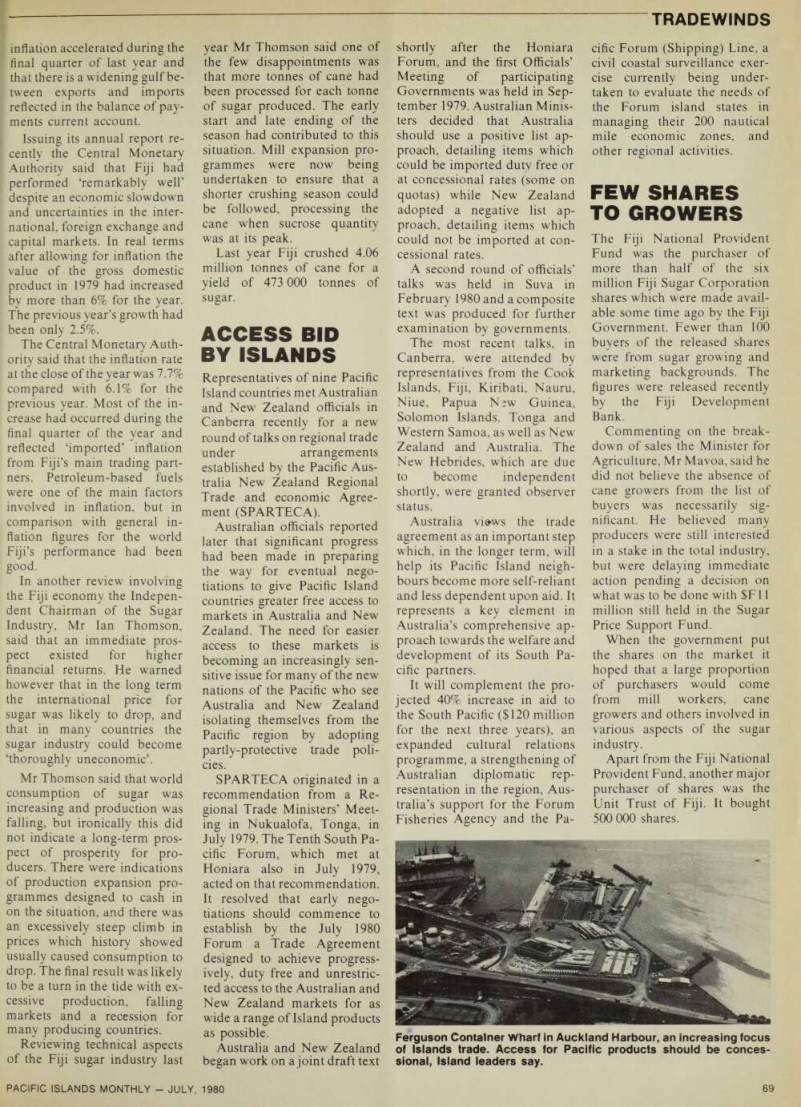
Ferguson Container Wharf in Auckland Harbour, an increasing focus of Islands trade. Access for Pacific products should be conces sional, Island leaders say.