filling
pp. 57-66 · Read in the full issue
The '70s: Comic opera, some mayhem, and lots of backing and filling
Concluding her decade-by-decade review of PlM’s 50 years, JUDY TUDOR this month examines the magazine’s journey through the 70s. She finds it reflected ‘some comic opera happenings, a little mayhem, and much backing and filling in true Islands fashion’. She also makes the observation: The pages of PIM in the 70s were largely devoted to Islands politics, the magazine itself, originally aimed quite without apology at European residents and their enterprises, having managed to move swiftly with the times.’
No fewer than six island groups became independent in the 19705. Niue (population under 5000) became self-governing in the same way as the Cook Islands had in 1965, thus satis fying the United Nations; New Hebrides was trembling on the brink (“independence sched uled for mid-1980); the United States Trust Territory, while awaiting the dissolution of the Trusteeship in 1981, amoeba like split into two, then four, while keeping firm hold of US dollars; and the two large French territories achieved some sort of painful rapprochement with France, giving them a considerable amount of the autonomie they had been seeking.
None of this was achieved without millions of words being tossed about, some comic opera happenings, a little may hem, and much backing and filling in true Islands fashion.
The pages of PIM in the ’7os were largely devoted to Islands politics, the magazine itself, originally aimed quite without apology at European residents and their enterprises, having managed to move swiftly with the times.
Expatriate residents of the Islands and there are still many thousands of them rarely got a mention, unless they had been Very Important and recently dead; were having
their property resumed and kicking up a fuss about it; or were strangers from some where else, cooking up some get-rich scheme for some unsuspecting Islander leader.
Tonga was first cab off the
rank independently, becoming
fully free of Britain on June 4, 1970, with festivities but no
outward political change. Most
people, including Tongans,
would have considered Tonga
independent already, as Britain
had not been observed throw ing her weight around there in anyone’s memory. Tonga was, however, legally still a British
protectorate through a Treaty
of Friendship first drawn up in the early years of this century, although amended several times since.
Fiji, although it had been waiting in the wings in 1969, was thus only second of the ’7os crop to haul up its own flag.
May 1970 saw another con stitutional convention in Lon don, the Fiji Governor, Chief Minister Ratu Sir Kamisese Mara, Leader of the Oppo sition S. M. Koya (successor to the late A. D. Patel), and 38 members of the Fiji Legislative
Council attending, along with
officials of the UK Common wealth and Foreign Office.
There was little of the acri mony that had marred the pre vious London convention a few years before, although the Op position party still wanted a common roll at elections. Ratu Mara stuck out for communal
rolls, plus cross-voting in
special electorates that in cluded all races, and got it.
Fiji would become indepen
dent on October 10, 1970, 96 years to the day after the orig inal Cakobau and attendant chiefs had ceded the islands to
Britain. There would be no election before independence.
That would take place sub sequently, when a 52-member House of Representatives would be elected, and a 22member Senate appointed.
Only sometime after that would a Royal Commission be set up to examine the best method of conducting future elections.
In early October all political hatchets were temporarily buried and Fiji was en fete. On October 9 the Union Jack came down, and next day, with great pomp and ceremony, the new flag of Fiji was raised in the presence of Prince Charles, representing the Queen, hun dreds of invited guests and thousands of ordinary citi zens.
Fiji chose to be a Dominion within the British Common wealth, with Queen Elizabeth also Queen of Fiji, and to seek membership of the United Nations.
At this time, Papua New Guinea, which by its very nature was going to have a dif ficult birth as a united state, and which had much further to
go intellectually and politically
than Fiji, had scarcely begun to
think about self-government, much less independence. There were still seats in the House of Assembly reserved for mem bers with certain educational
qualifications, which usually
meant Europeans. It was the European element at that time that was still contributing the tax money, the enterprise and the technical know-how, and there were many indigenous
people who thought they could
not do without them an idea that they got over in the next few years.
The rate of political change in PNG was being left to the House of Assembly select com mittee on constitutional
development, which period
ically travelled the territory,
tested the temperature of the political water, and made recommendations. But all PNG got a jolt in early 1971 when it was visited by Gough Whitlam, then Leader of the Australian Opposition, who
was already scenting victory for
his Labor Party, which was achieved in the following year.
In PNG he went politicking, promising to bring the country
quickly to self-government
even if it had to be done through an act of the Aus
tralian parliament. Although
many judged his speeches
aimed more at the Australian electorate than at PNG, he cer
tainly confused local people
who imagined that in order to please his friends in the Third World he was ready to leave PNG in the lurch. Many of
PNG’s pre-independence
troubles stemmed from this
period, and although they had
many roots the Whitlam visit did not help matters.
In the uncertainty of the next 18 months an economic re cession hit the country for the first time since the war, as neither expatriate nor local could see the future clearly. In the public service there was considerable uncertainty and loss of direction, seen more clearly in outer areas. In the Highlands, where a quarter century of firm rule by District Services had kept tribal fight ing down, it took on a new lease of life and involved larger
groups. In pre-European days
such feuding was very local
ised, involving neighbouring
villages or small groups, but now with road and motor ve hicles, truckloads of belliger ents could be up and away in a flash, travelling miles to instant wars.
But PNG’s House of Assembly was enlarged again for the elec tion of 1972, and there was another constitutional step for ward in that ministerial mem bers become ministers. With this election, party politics also came to stay, although no single party got a mandate to rule on its own. In fact, many
aspirants stood as indepen
dents, expecting to be wooed
during the horse-trading that
went on afterwards if they won seats. In the wash-up Michael Somare’s Pangu Pati was
joined by the People’s Progress
Party and Somare became Chief Minister. It was in this election that Miss Josephine Abaijah also made her debut, the only female member, and one who was to make her pre sence felt.
But if 1972 brought PNG a step closer to self-government, it also seemed to have brought it closer to the law of the jungle.
In the Gazelle Peninsula popu lar and experienced District Commissioner Jack Emmanuel was cold-bloodedly murdered by Kaibaira people in order, they said, to draw attention to their alleged grievances. In the Highlands, extortion, black mail and payback killings had taken a new twist. A European
planter who had accidentally
killed a man in a motor acci dent was exonerated by the court but forced to pay to the dead man’s relatives $lOOO and four pedigreed bulls in a public ceremony apparently con doned by the District Office in order to remove a death threat from his wife and family. On Christmas Eve that year, two
Bougainvillean public servants
stationed at Goroka, one the
highly respected district medi
cal officer, accidentally knocked down a small girl, were incautious enough to stop after the accident and were both chased and beaten to death.
Nonetheless self-govern
ment was put on the official agenda, and the very naming of
the day, December 1, 1973, gave it a magical quality.
Many Papua New Guineans thought it was the day when they would inherit the earth, or at least many European pos sessions. Some expatriates, including the Chinese com
munity, were apprehensive
as well they might be in view of inflammatory utterances from a few radicals. The great day was, when it came, a non event, passing off without undue incident, and at that time full independence seemed just around the corner, only to remain coming and going like the grin on the Cheshire cat, while Chief Minister Somare kept the secret of it close to his chest. Heaven knows he had plenty of troubles.
Miss Abaijah had announced a Papuan secessionist move ment, (Papua Besena) soon after the 1972 election, believ ing that Papua would be swamped by New Guinea in
any independent Papua New
Guinea combination. The Trobriands, the Highlands and the Gazelle Peninsula of New Britain also did their best periodically to shatter the idea of a united PNG. Bougainville, of course, topped the lot in nuisance value.
While this big island was a backwater, little was heard pol
itically of Bougainvilleans
wanting to cut adrift from the rest of PNG although geo
graphically the island belonged
in the Solomons region and the only reasons that it was politi cally with New Guinea stemmed from an arrangement between Britain and Germany at the end of the last century.
However, when giant Bougain
ville Copper Ltd began to de velop around Kieta, a great
fillip was given to digging up
ancient history and to Bougain
ville aspirations.
Violent riots took place around the mine in May 1975 when $5OO 000 worth of dam age was done to buildings and vehicles before they were
quelled by police using tear
gas.
Virtually on the eve of
independence Bougainville’s
leaders declared the province
independent as Miss Abaijah
had done in respect of Papua earlier in the year. Somare de
cided, however, to go to
independence ignoring them
both, and it was only months after achieving it that he talked
again to the Bougainvillean
leaders who by then had ex perienced another series of riots and were indicating sec ond thoughts. In August 1976 an agreement was signed giv
ing the province (rechristened
Northern Solomons) provin cial government, with defined powers, while it acknowledged the authority of central govern ment, Secession was off, at least for the time being.
Papua New Guinea became
officially independent on Sep
tember 16, 1975 in the presence of Prince Charles, the Governor-General of Aus tralia Sir John Kerr, Prime Minister Whitlam, many Old PNG Hands up from South by invitation, and VIPs from neighbouring Pacific states. No one committed a nuisance, tore up either the Australian or the PNG flag; no one else seceded.
PIM devoted most of the October 1975 issue to the event.
The territories of the British Western Pacific High Com mission were next for the traumas leading up to self determination. An impatient UK set the ball rolling in January 1972 when it removed the Gilbert and Ellice Islands Colony from the High Com mission and gave it a governor instead of a resident com missioner. This left only the Solomon Islands and the Bri tish half of the New Hebrides with the High Commission. In
1973 the New Hebrides be came the direct responsibility of the Commonwealth and Foreign Office in London, thus
effectively ending the WPHC
which had administratively drawn together these scattered bits of the British empire since 1877.
By then the Solomon Islands and the Gilbert and Ellice were on their way to ultimate self government and indepen dence, the Gilbert and Ellice as separate entities because at the end of 1972 the Ellice Islanders had thrown a spanner in the
works by announcing that
come independence, they
wanted to go it alone, separate from the Gilberts. The reason was fear that their 7000-8000 Polynesians would be
swamped by the more vigorous
40 000 Micronesian Gilber tese.
Neither the GEIC governor nor the British official sent from London was able to per suade them that the advantages of being part of a large group outweighed racial consider ations. To emphasise this point it was made clear that no GEIC assets outside the Ellice Islands would be transferred to them, except one colony ship, nor could they expect any revenue from Ocean Island phosphate.
The Ellice Islands nonetheless remained adamant and were duly declared a separate col ony.
From 1974 to 1978 all three, Solomons, Gilberts and Ellice, wobbled along on their uncer tain ways, all at last achieving their constitutional talks in
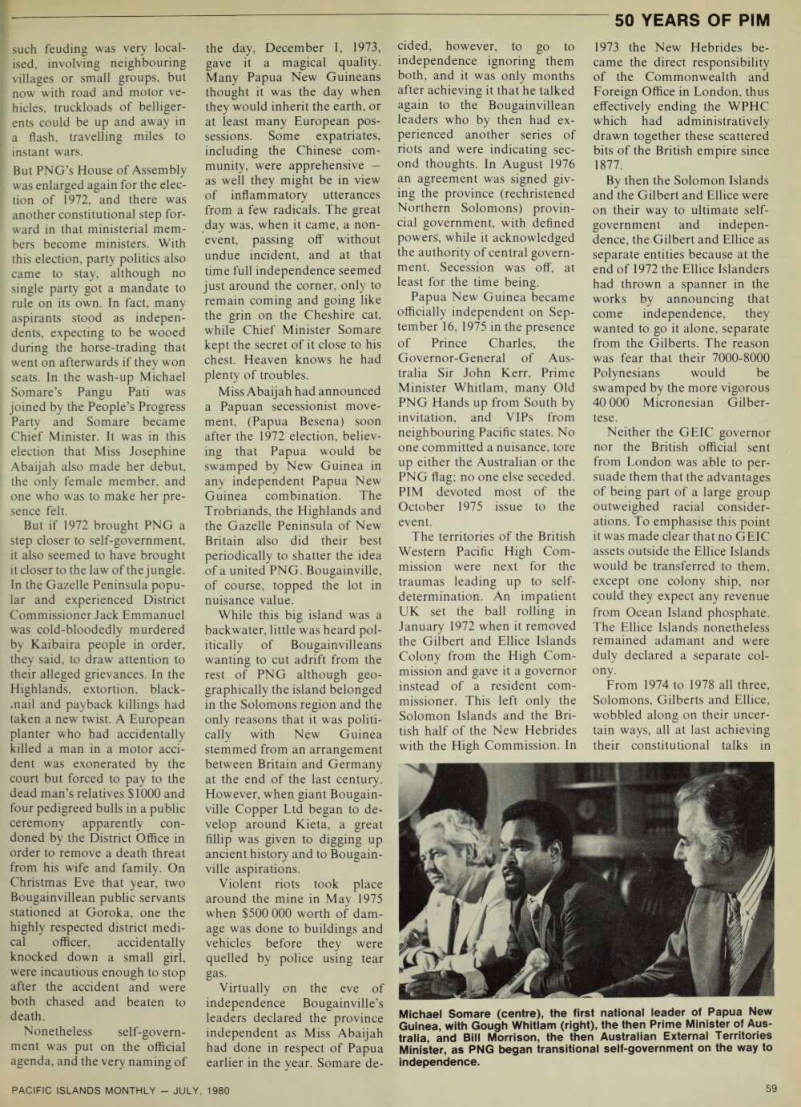
Michael Somare (centre), the first national leader of Papua New Guinea, with Gough Whitlam (right), the then Prime Minister of Aus tralia, and Bill Morrison, the then Australian External Territories Minister, as PNG began transitional self-government on the way to independence.
London, all receiving promises
of continuing aid after the event and, in the fullness of time, raising their own flags.
The Solomons did so on July 7, 1978, with the Duke and Duchess of Gloucester present (the Solomon Islanders would have preferred Prince Charles and said so loudly). The Ellice, rechristened Tuvalu, followed on October 1 when Princess Margaret was sent to do the Royal honours and turned out to be a no-show she had a temperature. And lastly came the Gilberts, which chose to be called Kiribati (pronounced Kiribas except when followed by a consonant, when the ‘i’ is pronounced). Their flag went up on July 7,1979 with Princess Anne and Captain Mark Phillips healthily present.
New Zealand’s Niue had already been given self government, on the same terms as those covering the Cook Islands, on October, 19, 1974.
This had appeased the United Nations which had been beat ing its collective anti-colonial breast on the subject, and more than satisfied the Niueans who
felt that they had been hustled into political advancement fas ter than they would have chosen. So, with the settlement of the old WPHC territories in 1978-79, British interests in tue Pacific were concerned only with the New Hebrides.
Dealing with this proved as
protracted as anticipated, be
cause of the Franco-Briti.sh condominium background that even well into the decade had failed to provide the necessary
political machinery for ad
vancement. Not only was it
complicated by the three
government system French, British and Joint but by the fact that the French had always been the more vigorous and dominant partner, and that far more French nationals were permanently domiciled in the Hebrides than British.
By the time these compli cations were overcome, deep divisions had appeared among the New Hebrideans them selves. In 1975 the first Rep resentative Assembly, was
elected by universal suffrage,
but nine of the 42 seats were re
served for private enterprise
interests. The National Party gained a majority, but the as sembly did not meet for seven months while there were argu ments about the special seats.
In February 1977 the National Party changed its name to Vanuaaku Party, and refused to sit with the commercial mem bers, holding this system to be undemocratic. Another elec tion was held in November that year but was boycotted by Vanuaaku, so that seats were ‘won’ by default. This situation continued until January 1979 when there was a reconcili ation. New elections held in November resulted in a sweep ing win for the Vanuaaku Party
led by an Anglican priest, Fr
Walter Lini, who became Chief Minister, hopefully to lead New Hebrides to indepen dence in 1980.
So much for the British. For the Americans it was a decade of talks with the Micronesian inhabitants of the unwieldy Trust Territory of the Pacific Islands which was due to end in 1981 (but not necessarily).
PIM issues in the 1970 s were peppered with headlines say
ing yet another lot of US talks with the Congress of Micro nesia over future status had broken down, sometimes on the question of the money they hoped to continue to get, oc casionally on the question of military bases, often on the individual aspirations of the disparate bits and pieces that make up the TT.
In 1972, apparently despair
ing of ever getting anywhere, the Northern Marianas set up separate constitutional status talks with the US, negotiated a covenant -that will come into full effect in 1981, or whenever,
making them officially the
Commonwealth of the North ern Marianas, in political union with the US. (Mean
while they are already using
the title.) Later, the Marshalls and the Carolines also wished to con duct separate negotiations with the US, and the idea of a united Micronesia finally began to fade. It appeared, at the end of 1979, that there would be four separate states after 1981; the Marianas, a Commonwealth, as outlined above; the Federa-
ted States of Micronesia, which will cover Yap, Truk, Ponape and Kosrae; the Marshall Islands; and the Republic of Belau, formerly the Palau Dis trict. The three last expect to be ‘in free association with the US’.
The Americans found their older Samoan possession easier to deal with. Not only were the American Samoans happy to go along with what they already had, they were even reluctant to break away to the extent of electing their own governor instead of having a
Washington appointee. Three
times they turned the idea down before succumbing in 1979 and voting in Peter T.
Coleman, of Part-Samoan parentage and a former US ap pointee. American Samoa in 1980 remains an unincorpor ated Territory of the United States.
The decade in the French Pacific territories of French Polynesia and New Caledonia continued politically stormy, as battles between the so-called autonomists and the conserva tives in each country pursued their excited Gallic way, although at the ballot box the battles rarely meant more than a one-seat majority in the Ter ritorial Assemblies for either side.
In New Caledonia the nickel company and all its works was
periodically damned by the
radicals, along with metropoli
tan appointees to administra tion; while in French Polynesia the continuing nuclear exper iments and/or tourism came in for periodical abuse.
In early 1979 French High Commissioner Paul Cousseran neatly hit the nail on the head as far as French Polynesia was concerned when he said: ‘One can be intellectually for CEP (the nuclear test agency) or one can be intellectually against it. But the fact is that this country lives off it 3200
families directly not counting
Polynesian military personnel,
thousands more indirectly.
Independence is not a problem faced by this country. On the contrary its problem is depen dence ... Polynesia does not produce what it consumes.’
In mid-1977 France gave wider powers of autonomy to the new Territorial Assembly under new political status laws which provided for election of the Vice-President of the
governing body the Govern
ment Council. Francis San ford, a leading autonomist
from way back, was elected to the position. At the 1977 elec tion for the Assembly his Front Uni Party won handsomely from the conservatives while
those advocating full indepen
dence from France polled only 1.4% of the vote.
A larger measure of self determination came to New Caledonia also in 1977, mainly, by increasing from five to seven the members of the Government Council who are elected by the Territorial
Asembly.
The September 1977 elec tions for the latter resulted in an almost even split between pro- and anti-administration factions. Next election is not due until 1982 and for the nonce New Caledonia remains a territory of France, sends two deputies and one senator to Paris, is not yet sold on com
plete independence but no
doubt will go on pressing for more say in local affairs.
The Problems
of PMs
So much for tossing off the yoke of colonialism. But, as the poet said, man is born to strife
as sparks to fly upwards and
this applies to Prime Ministers and Presidents as well as the rest of us.
In March 1980 Michael Somare lost his numbers in the PNG parliament and was suc ceeded by Sir Julius Chan, leader of the People’s Progress Party which had been Somare’s
coalition partner from 1972 to 1978. In a tribute to Somare, PlM’s Angus Smales said; in eight years of leading his country, Michael Somare fashioned a stability envied by a large part of the Third World and gave PNG a reputation for political and economic stab
ility.’
Some people traced Somare’s downfall to the Rooney affair that had blown up in September 1979 when the Supreme Court sentenced Mrs Nahau Rooney, Somare’s Jus tice Minister, to eight months gaol for contempt of court. She had written to the Chief Justice stating that a university lec turer then before the court
fighting an expulsion order
should be deported, and advis ing the Judges to use greater discretion in making de cisions.
She was in gaol only one day before Somare was instrumen tal in having her released on li
cence. Four judges, including
the CJ, thereupon resigned and there was the usual media sen sation.
However, PIM believed that this was a side issue and saw more significance in the fact that much of the new leader ship consisted of men whom Somare had sacked or alien ated in the previous two years.
Several small parties, including
Miss Abaijah’s Papua Besena
joined with the PPP to defeat Somare.
Even Hammer Deßoburt, who seemed a fixture as Presi dent of Nauru, had his troubles after the elections of December 1976 when a group of younger Nauruans tried to force him to make changes in his cabinet.
Deßoburt maintained that choosing a cabinet was his pre
rogative, the majority
disagreed and he was suc ceeded by bearded Bernard Dowiyogo, 30. But not for long.
The ex-president never let up on his successor and in May 1978, over a bill dealing with
phosphate royalties, was able
to oust his younger rival,
although not before Lagumot
Harris had a feel of the top job, and the presidency is still regarded as insecure.
Although Ratu Sir Kamisese Mara has not had a break in his long Prime Ministership of
Tribal fighting continued to concern the PNG government
New Caledonia nickel works damned by the radicals.
Fiji, this was a matter of doing
things Fiji-style rather than
Westminster fashion.
The whole of Fiji was shocked numb, reported PIM after the elections in 1977, when it was found that the Federation Party had won a majority of the seats. This turn about was put down to Fijian apathy about voting, plus the influence of a breakaway group called the Fijian Nationalist Party. Whatever the cause, the numbers were against the Alliance and, a few days after the results were in, the leader of the Opposition, Mr Koya, drove up to Govern ment House confidently expecting to return as the first Indian Prime Minister of Fiji.
He was back in half an hour, a disillusioned and furious man, having been told by the Governor-General, Ratu Sir George Cakobau, that Mara had already been reappointed.
According to the G-G there was disunity in the Federation Party and it was Mara who commanded the respect of par liament and people.
Mara professed great sur prise, as clearly the Federation Party could topple him as soon as parliament met. The result was, in fact, a stalemate lasting six months. The Federation could not make up its mind to chance its arm until forced to it, and in an election of Sep tember 1977, the Alliance Party romped home with 36 seats out of 52. Mr Koya lost his seat and the Federation Party got a new leader, Mr Jai Ram Reddy.
But the biggest troubles of all were to fall on the head of Sir Albert Henry who had exer cised almost dictatorial powers in the Cook Islands since those islands became self-governing in 1965. In the elections of March 1978 Sir Albert’s Cook Islands Party again scored heavily against Dr Tom Davis’
Democratic Party by flying in
planeloads of Cook Islands voters from New Zealand. But victory was snatched away once the NZ government appointed an auditor to inquire as to whether NZ aid money had been used to charter the planes, and Dr Davis pet
itioned the Cook Islands court
alleging irregularities in the
poll.
Stuart Inder, who was in Rarotonga for PIM in July 1978, reported how Sir Albert’s CIP government ‘disappeared in a puff of smoke on July 24 and was replaced almost magi cally by the government of the Democratic Party led by Dr Tom Davis’.
The verdict that brought about the miracle was delivered by Chief Justice Gaven Donne after a hearing that lasted 18 days and, accord
ing to Inder, kept Rarotonga
agog by ‘providing a sensation as star witness Sir Albert Henry unfolded in court under exam ination an extraordinary tale of do-or-die electioneering and international finance. A key figure who to popular regret never appeared in person was Finbar Kenny, the New York boss of the Cook Islands Phila telic Bureau which for years made a mint out of its government-supported mon
opoly of Cooks Stamps’.
The reason for Henry’s dis
missal was $337 000 advanced
by Kenny and used by Henry
for six charter flights carrying supporters from New Zealand.
They had paid $2O each for food on the way but the rest was free and having arrived in Rarotonga they were shown at once into polling booths to do their duty. The Democrats also organised two flights of sup porters but these people paid their own way and there were no selection methods to help them do the decent thing, although one presumes they did it.
Henry, at the court hearing, said that the money was a loan from his good friend Finbar; but the judge found that it was an advance from the Philatelic Bureau’s stamp revenue.
Votes cast by those on Cook Islands Party charters were disallowed, and with these re moved the Democratic Party
won easily.
Sir Albert, Finbar Kenny and Mr J. Little, managing director of the Cl Develop ment Co (Kenny’s agent in the Cooks), were later charged
with fraud, and fined. Later still, Sir Albert was stripped of
his knighthood.
The downfall of Sir Albert had another result the exit of so-called cancer expert Milan Brych who had been established in Rarotonga for some time under the protection of Sir Albert, in spite of being discredited,
Brych had taken over a sec
tion of Rarotonga’s public
hospital, to the chagrin of Dr Davis who took the orthodox medical view, and was attract ing patients from Australia and New Zealand willing to pay heavily for treatment, About the time Sir Albert’s troubles blew up, Brych left for California and did not return.
Continuing Banaban Saga
The saga of the Banabans’ claim to the phosphate income of Ocean Island, past and pre sent, ran through the 1970 s and into the 80s. In 1970 they appointed an ex-Fleet Street journalist, Bertram Jones, as their Fiji-based adviser, and on the legal side, Sir Dingle Foot in Britain and K. C. Ramrakha
in Fiji.
The Rev Tebuke Rotan was back in London in mid-1971 asking the British Government for 50% of the phosphate pro ceeds from Ocean but by the early months of 1972 the Banabans had upped the ante and had decided to take their case to the UK High Court and, in a sentence, ask for the full financial benefit of phosphate mining for the past 60 years, plus the rehabilitation of the island.
The case did not come up for over two years and was still dragging on in mid-1975 when the judge, Sir Robert Megarry, decided to adjourn it in order to visit Ocean Island and Rabi much against the wishes of the British Government be cause of the time involved in such an expedition, and the added cost of an estimated SA4OO 000 to the already col ossal sums involved.
Nonetheless, in October 1975, Sir Robert and a large part of his court, including his clerk, counsel leading for the Crown, the barrister represent ing the British Phosphate Com missioners, the barrister leading for the Banabans, all with attendant solicitors, set out from London for Fiji, from there flew to Honiara where
they were picked up by Air
Nauru and deposited on Nauru. There they found that the small Banaban vessel that
they expected to travel on had already departed with a BBC TV crew which was making a documentary of the saga. The Nauru Government then put their 4400-ton Eigamoiya at the party’s disposal for the voyage to Ocean.
They arrived off the island in strong winds and big seas, the ship’s captain could not moor the vessel but went in as close as was safe while some of the lesser legal eagles were conned into a steel box dangled by the ship’s crane over the side, try
ing valiantly for long periods to
make contact with a heaving barge sent out from shore with out dashing the passengers to pieces on the side of
Eigamoiya.
At last it was proclaimed a definite no-go, the box was de posited back on the ship’s deck and the legal eagles decanted,
visibly shaken. The skipper
then put out to sea, a gangway was put down on the lee side, the High Court personnel lined up and, gingerly, one by one were taken down the gangway and, at the appropriate time, assisted to leap into a launch.
A PIM staff man witnessed it all from woe to go.
Back in London the case,
having made legal history,
finally finished in mid-1976,
after 221 sitting days. Judg
ment was not given until the end of that year when Sir
Robert Megarry found against
the Banabans in their claim for £2l million back royalties. He did, however, have plenty to say in criticism of the British Government and the BPC in their treatment of the islanders, and suggested that the BPC should make them a payment that was ‘neither nominal nor
too large’.
It was then, and only then, that the British Establishment, in which can be included the BPC, felt called upon to say anything in its own defence having allowed the excellent Banaban public relations to take all the points in a game where an uninformed public is always a sucker for David and Goliath stories.
In mid-1977, UK, Australia and New Zealand offered the Banabans a SMO million ex gratia payment which the Banabans said they would accept if they v ere given immediate self-government of Ocean Island. This they did not get as Ocean was included in the Gilberts at the time n be came independent as Kiribati in mid-1979.
The phosphate mining dam
age to Ocean Island was asses sed at SAMOOO by the British
High Court, another disap
pointment as the Banabans, who were still staking their claim to Ocean Island into the 80s, had been privately offered SAI.S million by Britain but had considered that they would get more from the High Court.
The Games
There were three South Pacific Games during the 19705, attended as usual by PIM staf fers. The first in Papeete in September 1971, was voted a howling success by all con cerned. ‘Delightful Girls + Perfect Weather + Friendly
Tahiti = Magnificent South Pacific Games’ was the PIM headline.
The second was in Guam where the headlines told the story there as well: ‘Biggest Rain-soaked, Near-disaster in Islands History’, was how PIM headed its lead story in Sep tember 1975. Guam had been in trouble from the moment it had been decided as the venue back in Tahiti in 1971. Twice the government had tried to wriggle out of it, but had been pressured into going on, with the result that hardly anything was ready when the athletes from 13 territories started
arriving.
‘The athletics venue was a shambles,’ reported John Carter in PIM, and would have remained so if New Guinea officials had not weighed in with know-how and got it into some sort of order with hours to spare ... The PR was hope less, no one on Guam except those directly involved knew anything about the Games so they stayed away in droves from the various events.’
Then it rained and rained and rained for 10 days out of the 11, and although the Guam officials could not be blamed for that, PIM asked why the middle of the local wet season had been chosen for the event.
In spite of all this, PIM de voted 10 pages to descriptions and results.
New Hebrides was chosen as the venue for the 1979 games only to back out swiftly on maturer reflection. No one else
Banabans pray before protesting over their compensation award
was willing so Fiji found itself stuck with it. These Games (the 6th in the series) duly took place in Suva in late 1979 and were pronounced a success with some qualifications. It was
suggested that they might be
the ‘last of the extravaganzas’
and many hoped so, as 2500 athletes and officials attended and general opinion was that this number was too large to cope with, As in the other two 1970 s games, New Caledonia again topped the medals count.
A Little Light Relief
In spite of the Islands being mad with politics at this period, there were more interesting events that bobbed up from time to time. In 1972, for example, an international group calling itself the Ocean Life Research Foundation set itself up to found a ‘sea city’ on crescent-shaped Minerva Reef, 450 miles south of Fiji, the only purpose of which to that time had been to provide a grave
yard for ships.
The reef had made world headlines in 1962 when a Ton gan sea captain, Tevita Fifita, and 16 of his crew, spent 100 days there when their vessel was wrecked.
Four years later Fifita had
raised the Tongan flag there although in 1972 it was not known whether Tonga had ever ratified this or not.
In January 1972 a Mr Mike Oliver, a US citizen and mem ber of the Ocean Life Foun dation, arrived in Fiji, hired a ship to take him to the reef and, after constructing two mounds of sand and coral, planted the Foundation’s flag. On his return to Suva he stated that a
dredge would be arriving
within weeks to reclaim another 400 acres.
Naturally all this infuriated Tonga but Mr Oliver swept it aside his new republic meant business, he said. It already had a constitution and a provisional
president, Maurice (or Morris) C. Davis, an electronics project engineer from California.
Next move was up to Tonga and King Taufa’ahau moved quickly. Dressed in wet weather gear he boarded the Olovaha and headed for the reef where 90 Tongan prisoners were put ashore to build an artificial island of coral rock and concrete. It was about the size of a suburban carport and fitted with a flagpole. The King, not being of athletic build, did not land on it but standing on the deck of the Olovaha he
heard a police bugler signal
that the Tongan flag had duly
been raised.
It was now Mr Davis’ turn to be infuriated. From his office
in Orange County, California,
he thundered: ‘Our Rights as individuals and citizens of a sovereign state have been violated; we intend to defend
those Rights.’
On June 15, 1972 Mr Davis arrived in Nukualofa with a feasibility study of the pro-
posed development of pier-
supported concrete platforms
which would create an artificial land surface. He wanted to talk to the King but the King refused to see him.
It would be interesting to re cord that a naval battle duly took place between the two contenders for Minerva Reef, But it didn’t happen. The King continued to treat the Ocean Life Research Foundation as though it didn’t exist. Minerva Reef now belongs to Tonga, This was not the last strange American encountered by Tonga’s King in the 70s. The other was Mr John Meier who,
against considerable criticism!
had been given a charter for a merchant bank (Bank of the South Pacific) to be set up in
Tonga. Unfortunately in late
October 1978 Meier was arrested in his Vancouver home in connection with an
obstruction of justice charge
pending in the US courts, the
central charge against him
being that he had defrauded his former employers, the
Howard Hughes empire, of
US$5B million by selling them worthless mining shares.