two wheels
p. 67 · Read in the full issue
Exploring Niue on two wheels
Yachtie P. BREMER KAMP was on Niue not long ago as part of the crew of Scheherazade. Following is his account of a day ashore exploring Niue by motor bike.
Captain Cook was the first European to discover Niue Island in 1774. His efforts to put ashore to explore and talk to the natives were repelled with such violence he withdrew and called the discovery ‘Sav age Island’. When we arrived off the town of Alofi, the cus toms and immigration officers were friendly and made us most welcome. I’m sure if the good captain were to return today he also would be made more welcome at Niue than at some other of the more demanding ports of the South Pacific.
Niue Island is 370 kilometres east of Vavau and 500-odd kilometres south of Samoa.
The inhabitants of the northern half generally are of Samoan ancestry, while those of the south are of Tongan origin. In the days of Cook there was no love lost between the two tribes and this, possibly, was the reason for his ferocious rebuff.
Today the population is a meld
of easy-going Polynesians, who
quickly dispel any unfavour
able impression that may linger from the ‘Savage Island’ incident.
Downtown Alofi has five or six buildings, built of corru gated iron and coral stone, while the government build ings are of more modern materials. A short strip of bitu men keeps the dust from set tling on the already faded paintwork, while the ever
encroaching vegetation hides
the plumbing defects and is pleasing to the eye.
Inquiring at the post office I found it was possible to hire motor bikes at the local garage.
Armed with cameras, costumes and sandwiches we chugged off on our motor bikes to where luck would lead us.
Niue lies in the earthquake belt between New Zealand and the Solomons and in past cen turies was subjected to con siderable elevating forces.
Originally a coral atoll about three to five metres above sea level with an enclosed lagoon, subterranean forces lifted the whole atoll out of the sea about 60 metres. Today the island is terraced in two levels. The coastal terrace is bordered by cliffs up to 21 metres high which have eroded into numer ous caves. The tropical rainfall has turned the decaying veg etation into a mild carbonic acid which has readily eaten into the coral stone to such an extent that the whole island is honeycombed with caves, chasms and spectacular land forms.
The first of the caves we visi ted was called Avaiki. The de scent from the road was quite steep and made with the assist ance of roots and vines from a nearby tree. Once inside the cathedral-like void, it was ironic to notice that it was being used for canoe stowage.
From time to time we could hear the ocean surging through the other entrances. I decided to follow one through and came upon a delightful grotto, where we cooled off with a swim.
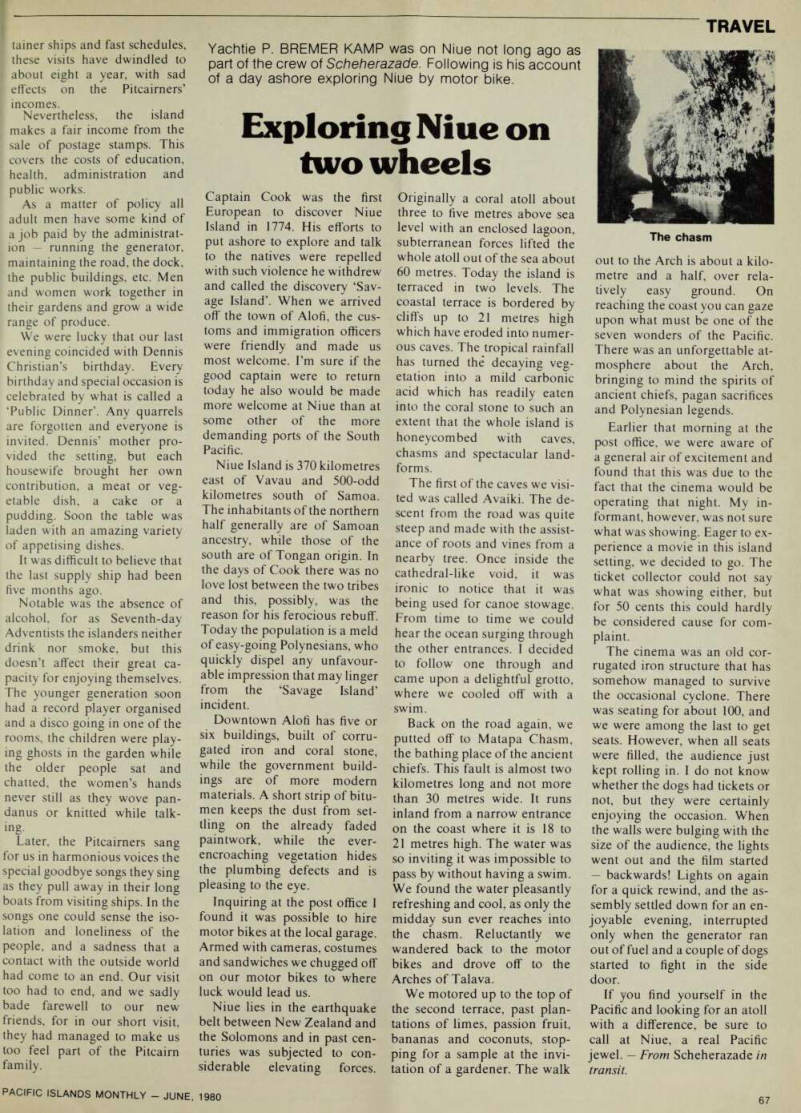
Back on the road again, we putted off to Matapa Chasm, the bathing place of the ancient chiefs. This fault is almost two kilometres long and not more than 30 metres wide. It runs inland from a narrow entrance on the coast where it is 18 to 21 metres high. The water was so inviting it was impossible to pass by without having a swim.
We found the water pleasantly refreshing and cool, as only the midday sun ever reaches into the chasm. Reluctantly we wandered back to the motor bikes and drove off to the Arches of Talava.
We motored up to the top of the second terrace, past plan tations of limes, passion fruit, bananas and coconuts, stop ping for a sample at the invi tation of a gardener. The walk
out to the Arch is about a kilo metre and a half, over rela
tively easy ground. On
reaching the coast you can gaze upon what must be one of the seven wonders of the Pacific.
There was an unforgettable at mosphere about the Arch, bringing to mind the spirits of ancient chiefs, pagan sacrifices and Polynesian legends.
Earlier that morning at the post office, we were aware of a general air of excitement and found that this was due to the fact that the cinema would be
operating that night. My in
formant, however, was not sure what was showing. Eager to ex perience a movie in this island setting, we decided to go. The ticket collector could not say what was showing either, but for 50 cents this could hardly be considered cause for com
plaint.
The cinema was an old cor rugated iron structure that has somehow managed to survive the occasional cyclone. There was seating for about 100, and we were among the last to get seats. However, when all seats were filled, the audience just kept rolling in. I do not know whether the dogs had tickets or not, but they were certainly enjoying the occasion. When the walls were bulging with the size of the audience, the lights went out and the film started
backwards! Lights on again
for a quick rewind, and the as sembly settled down for an en
joyable evening, interrupted
only when the generator ran out of fuel and a couple of dogs started to fight in the side door.
If you find yourself in the Pacific and looking for an atoll with a difference, be sure to call at Niue, a real Pacific jewel. From Scheherazade in transit.
The chasm