independence and elections
pp. 69-78 · Read in the full issue

The ’60s: Tangled tales of independence and elections
JUDY TUDOR, nearing the end of her review of 50 years of Pacific Islands events as reported in the pages of PIM, here examines the politically-frantic sixties, when some of the metropolitan powers began to come to terms with the real state of the Brave New World. Next month she will wind up the series with a look at the seventies, and in August PIM will produce a fat issue to mark our 50th anniversary of publication.
In the Pacific Islands, the 1960 s were when the metaphorical chickens of the United Nations Committee of 24 anti colonialists and other theorists started to come home to roost.
The fifties had started out still making good the years of war, one foot in the past. But by the end of that decade, some administering powers were already beginning to see the light and the virtue of the brave new world of majority rule, one-man-one-vote and in dependence for all. The main reason for this was that colon ies, far from being valuable assets, were turning out, in the post-World War II era, to be more likely bottomless sinks for taxpayers’ money. Further, they were targets for mischief making Russians and Third World members of the United Nations.
Better by far to bring them quickly to some semblance of Western democratic govern ment, promise them continued financial support and get out.
Britain had already had a fill of colonial problems in Africa and South-east Asia. So why not make a virtue of leaving the Pacific by giving these islands up, as Prime Minister Menzies of Australia had said, too soon rather than too late?
If it was Britain which started the trend, Australia and New Zealand were quick to follow and had swifter success, as some of Britain’s bits and
pieces were exceedingly dif
ficult to move. But between the three of them in 1960 were div ided the administrations of Fiji, Gilbert and Ellice Islands, Western Samoa, Cook Islands, Niue, Papua-New Guinea, Nauru, the British Solomon Islands Protectorate, half of the New Hebrides, plus the over sight of Tonga and Norfolk
Island. What was left to the Netherlands, France and the United States was minor by
comparison.
The Netherlands, which had been reduced to West New Guinea, had even less to lose than the British and liquidated its liabilities in another way.
The French still had use for their Pacific territories, had
already given them universal
suffrage, representatives in the French Senate and Chamber of Deputies and managed to insist that that was enough.
The United States, theore tically the greatest anti colonialist of the lot, was still exploding H-bombs in the North Pacific in the early 1960 s and building an anti-missile base at Kwajalein, in the Marshalls. Independence for its territories was complicated anyway by the differing out looks of the scattered Micronesian groups and the desire of most to continue having US support, no matter what kind of independence
they ultimately achieved. The
setting up of the Congress of Micronesia in 1965 seemed to
do little to weld the disparate groups into one people. Guam had already settled its relation ship with the US and the American Samoans were still suffering from the withdrawal of the Pago Pago navy base.
Generally, however, the six ties saw much political ad
vancement everywhere.
Advisory Councils grew into Legislative Councils; those with Legislative Councils got Assemblies; a few achieved parliaments or Houses of Rep resentatives. Nominated mem bers gave way to elected members through electoral
colleges, then by straight-out
universal suffrage, while the elite became under-secretaries, ministerial members and, finally, full-blown ministers.
There were Leaders of Government Business who grew into Chief Ministers and finally into Premiers or Prime Ministers. By the end of the decade, two countries had be come independent states, one had self-government, one had been thrown to the wolves and many were on the brink of cut ting loose from colonial apron
strings.
In the race to nationhood it was fitting that the Western Samoans, who had known where they wanted to go for decades, should have been the first to hoist their own flag and sing their own anthem and, on January 1, 1962, experience the delicious joys of total indepen dence also, in due course, to
experience the problems that
went with it.
Also quick of solution was the West New Guinea situ ation. In May 1960 the Dutch announced a 10-year plan of building up the WNG Papuans
politically and economically
with the territory immediately
getting a New Guinea Council
with a Papuan majority.
This was followed by more
sabre-rattling by Indonesia’s
Soekarno and. later, visits to Australia by his General Nasu tion, who was told that Aus tralia could not take any initiative in a procedure de signed to hand over sover eignty and the right to self-determination in WNG. In spite of these fair words, by the time the Indonesians were
dropping parachute troops into
WNG in 1962, Australia had retreated into masterly silence.
The end came in August 1962 with a settlement that had the Netherlands handing over immediately to a temporary UN administration which would, in turn, hand over to Indonesia on May 1, 1963.
The only action on the Aus tralian side was the panic set ting up of patrol posts along the P-NG - West NG border which had never been the sub ject of proper survey or treaty.
The rest of the world looked on just as cynically, while the wishes of the WNG Papuans were ignored ‘sold like cattle’
as their leaders expressed it abandoned by the Dutch, suppressed by the UN tem porary public servants who were more interested in keep ing the lid on the situation until they could themselves get out than in assisting the unfor tunate victims of Dutch- Indonesian bitterness to further their aspirations.
The settlement, however, had two face-saving clauses: the Dutch undertook to pro vide something like $3O million over the first three years for
Papuan development, the
amount being paid into a special UN fund; and, by 1969, the Papuans were to be allowed an ‘act of free choice’ as to whether they would remain with Indonesia or not.
The first concession was hamstrung from the start, as at the successful conclusion of his WNG adventure, Soekarno began his confrontation with
Malaysia and eventually took
Indonesia out of the UN. By the time the Indonesians had got rid of him and were back in the UN, Indonesia was on the brink of economic and pol itical disaster and WNG, out at the end of the line, in parlous state.
The Dutch fund had been frozen by the UN and the thaw had scarcely begun in 1968 when an article by Peter Hast ings appeared in PIM, describ ing his visit to this forlorn place. It was without shipping, planes or cash; Papuans were
seen only in the background, disillusioned Indonesians were everywhere. Papuans who did manage to get near him told of
deprivation, harassment, gaol
and even executions.
Half the UN fund was at that time being used to try to get communications and some of the utilities restored; half was earmarked for small-scale
development mostly of agricul
ture a mere drop in the bucket of what was required.
There was then remaining the second face-saver, the act of free choice to be taken be fore the end of 1969.
The United Nations, which had insisted that Western Samoa, of one mind about independence and with New Zealand willing, must hold a plebiscite based on universal
suffrage before independence,
made no such stipulation in the case of WNG. Instead, the business was allowed to follow Indonesian custom under which a few thousand selected voters, by some mysterious means, arrived at a consensus on behalf of their million com
patriots.
It was no surprise that the vote was to remain with Indonesia. There was, in any event, nowhere else for them to go by that time. Virtually aban doned by the United Nations,
any pipedreams they might
once have had of joining PNG had long been exposed for the myths they were; to go it alone in an underdeveloped country that had been stripped down to bare bones, was clearly imposs ible. The Papuans, who were no longer permitted to call themselves that, were stuck with the Indonesians for the foreseeable future.
In contrast to the malign fate that overtook the WNG Papuans, the fewer than 3000 Nauruans from the valuable phosphate island got all they wanted in the 19605, pressed down and running over.
Australia brought up the future of these people in mid-1961 when it was believed
that the phosphate deposits
would run out in 30 years. It was announced then that Aus tralia, on behalf of NZ and UK, the other two partners in
the joint Trusteeship, was
offering Nauruans a home in
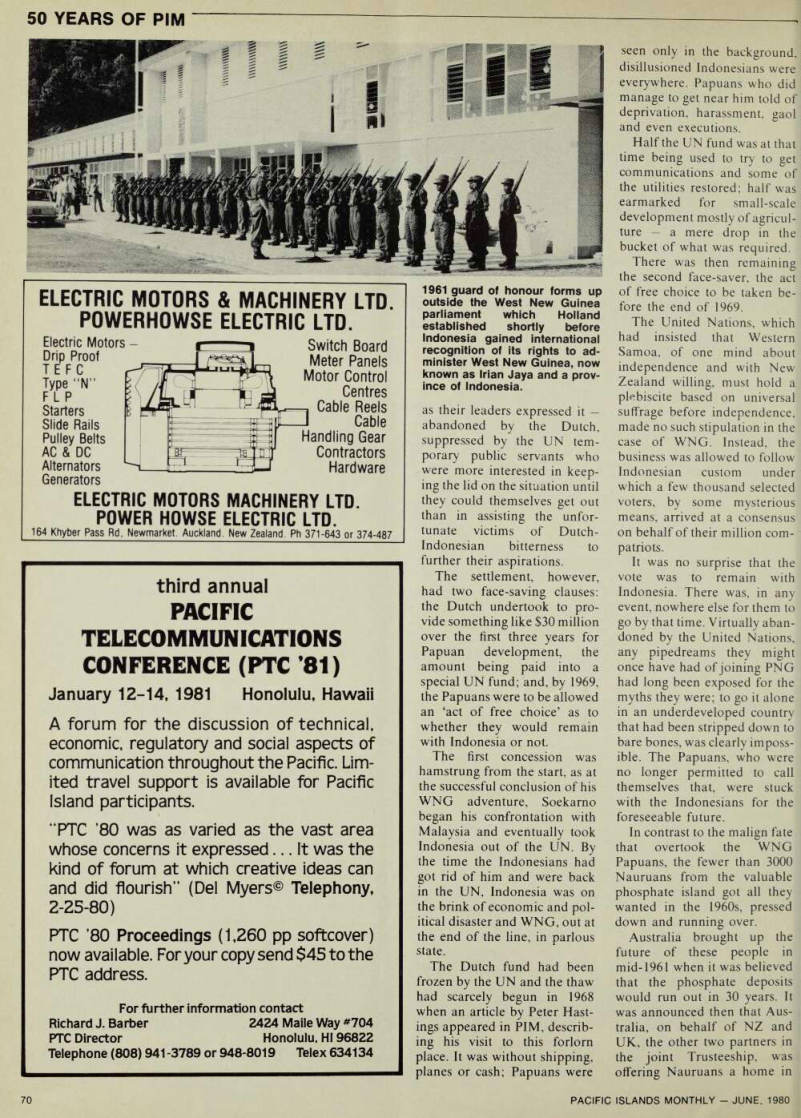
1961 guard of honour forms up outside the West New Guinea parliament which Holland established shortly before Indonesia gained international recognition of its rights to ad minister West New Guinea, now known as Irian Jaya and a prov ince of Indonesia.
: Australia, with Australian citi
f zenship.
The Nauruans weren’t interested they wanted an [ island of their own, they said, where they could retain their identity, and a search for this
began immediately. Starting
with Prince of Wales Island in Torres Strait, the hunt con tinued to Fraser Island and finally Curtis, both inside Queensland’s Great Barrier Reef. But all efforts failed, wrecked on Nauruan insistence on independence and sover eignty on any island on which they settled, and Queensland’s equally adamant refusal to give up territory in these circum stances.
At the end of 1964 the Nauruans decided to stay put on Nauru, with the old work ings rehabilitated. Australia, ever obliging, sent in a team of experts whose opinion was that
it was physically possible, by
blasting down flat the coral
pinnacles left after phosphatic
rock was extracted. Cost was another matter; that had not been in their terms of refer ence.
Nothing further was heard about rehabilitation as Nauru
soon engaged Australian pub
lic relations experts to put their case for independence, and two economic advisers to show why the Nauruans should become owners of the phosphate indus try which had been run on be half of Australia, NZ and UK since shortly after World War I by the British Phosphate Commissioners.
Talks went on through 1965 and 1966 and by mid-1967 it was all over. The Nauruans, led by Head Chief Hammer Deßoburt and advised by Aus tralian experts, were to buy out the BPC assets for something aver $2l million, paid out of profits over three years. Agree
ment on Nauruan indepen
dence followed, the
announcement being made in
Canberra on October 24, 1967,
and setting the date at January
H, 1968, three months hence.
While the official machinery
vas set in motion, back home
amongst the phosphate that
vould soon be theirs,
Nauruans were designing a
lag, a coat of arms, stamps; ippointing senior public ser-
vants; organising a guest list
and making preparations for
the January celebrations. They
were whipping up a consti tution with the help of Pro fessor Jim Davidson, holding a convention to approve it; even holding a by-election for the seat of one member of the Legislative Council, Victor Eoaeo, who had resigned be cause he thought they were
rushing too quickly into
independence.
They’ll be independent or
bust,’ was the headline in PIM in January 1968, and on the
appointed day the new royal
blue flag with gold central
stripe (representing the
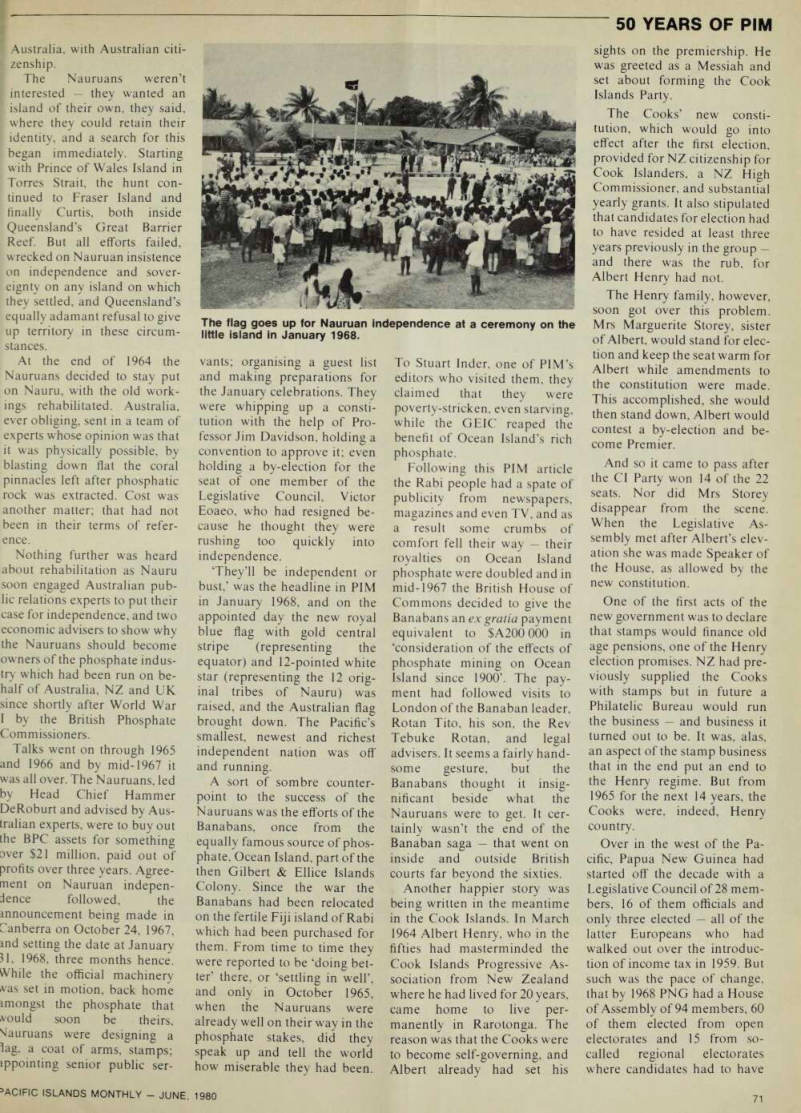
equator) and 12-pointed white star (representing the 12 orig inal tribes of Nauru) was raised, and the Australian flag brought down. The Pacific’s smallest, newest and richest independent nation was off
and running.
A sort of sombre counter point to the success of the Nauruans was the efforts of the Banabans, once from the equally famous source of phos phate, Ocean Island, part of the then Gilbert & Ellice Islands Colony. Since the war the Banabans had been relocated on the fertile Fiji island of Rabi which had been purchased for them. From time to time they were reported to be ‘doing bet ter’ there, or ‘settling in well’, and only in October 1965, when the Nauruans were already well on their way in the
phosphate stakes, did they
speak up and tell the world how miserable they had been.
To Stuart Inder, one of PlM’s editors who visited them, they claimed that they were poverty-stricken, even starving, while the GEIC reaped the benefit of Ocean Island’s rich
phosphate.
Following this PIM article the Rabi people had a spate of publicity from newspapers, magazines and even TV, and as a result some crumbs of comfort fell their way their royalties on Ocean Island phosphate were doubled and in mid-1967 the British House of Commons decided to give the Banabans an ex gratia payment equivalent to SA2OO 000 in ‘consideration of the effects of
phosphate mining on Ocean
Island since 1900’. The pay ment had followed visits to London of the Banaban leader, Rotan Tito, his son, the Rev Tebuke Rotan, and legal advisers. It seems a fairly hand some gesture, but the
Banabans thought it insig
nificant beside what the Nauruans were to get. It cer tainly wasn’t the end of the Banaban saga that went on inside and outside British courts far beyond the sixties.
Another happier story was being written in the meantime in the Cook Islands. In March 1964 Albert Henry, who in the fifties had masterminded the Cook Islands Progressive As sociation from New Zealand where he had lived for 20 years, came home to live per
manently in Rarotonga. The
reason was that the Cooks were to become self-governing, and Albert already had set his
sights on the premiership. He was greeted as a Messiah and set about forming the Cook Islands Party.
The Cooks’ new consti tution, which would go into effect after the first election, provided for NZ citizenship for Cook Islanders, a NZ High Commissioner, and substantial yearly grants. It also stipulated that candidates for election had to have resided at least three years previously in the group and there was the rub, for Albert Henry had not.
The Henry family, however,
soon got over this problem.
Mrs Marguerite Storey, sister
of Albert, would stand for elec tion and keep the seat warm for Albert while amendments to the constitution were made.
This accomplished, she would then stand down, Albert would contest a by-election and be come Premier.
And so it came to pass after the Cl Party won 14 of the 22 seats. Nor did Mrs Storey disappear from the scene.
When the Legislative As sembly met after Albert’s elev ation she was made Speaker of the House, as allowed by the new constitution.
One of the first acts of the new government was to declare that stamps would finance old age pensions, one of the Henry election promises. NZ had pre
viously supplied the Cooks
with stamps but in future a Philatelic Bureau would run the business and business it turned out to be. It was, alas, an aspect of the stamp business that in the end put an end to the Henry regime. But from 1965 for the next 14 years, the Cooks were, indeed, Henry country.
Over in the west of the Pa cific, Papua New Guinea had started off the decade with a Legislative Council of 28 mem bers, 16 of them officials and only three elected all of the latter Europeans who had walked out over the introduc tion of income tax in 1959. But such was the pace of change, that by 1968 PNG had a House of Assembly of 94 members, 60 of them elected from open electorates and 15 from so called regional electorates where candidates had to have
The flag goes up for Nauruan independence at a ceremony on the little island in January 1968.
* had about four years pf second- I ary education. Although this I was a device for ensuring that
[ some Europeans (who paid all
the taxes) got back, four I indigenes won four of these educated seats, and Europeans won 10 of the open, unedu- I cated variety. In addition to all this a Ministerial Member sys tem was introduced, the chosen
elite sharing responsibility with
departmental heads.
Between the old Legislative Council of 1960 and the House of Assembly of 1968 some wonderful and weird things had happened, not the least of which was what PIM called the extravaganza of the 1964 elec tion for the first House and what preceded it the mam moth task of recording the names of about one million people on electoral rolls. This was achieved by Native Affairs officers visiting 12 000 villages scattered over about 177 000 square miles of rugged, gener
ally roadless, country, using
everything from helicopters to
their own two feet.
At this time PNG was about 60% illiterate, fewer than a third of the people had ever voted and then only at local councils, yet the authorities introduced ballot papers with names only, no symbols, and
modified preferential voting
after the style of the Australian system, where one lists all can didates in order of preference.
Where voters could not read or didn’t know what to do, they
could whisper their preferences
to officials stationed there for that purpose.
It was small wonder that the result was, as PIM said in one of the understatements of the age, ‘full of surprises’. Of the dozen native members who had sat in the last ‘Legco’ only two survived the cataclysm,
their places being taken by 35
new, unknown quantities.
Although for the first time official members were out numbered and therefore could technically be outvoted, 10 under-secretaries were chosen from elected members and paid £l3OO a year, in contrast to the £950 paid ordinary mem bers. It was believed that the £350 differential in salary would keep these honest and
toeing the official line. In any event Australia, through its Minister for Terrilories and the PNG Administrator, still had power to withhold assent to
any legislation.
There were about 40 000 Europeans in PNG at this time, a large proportion of them rug ged individualists whose out look on life still lagged about 50 years behind that of those who called the shots in the United Nations Trusteeship Council. The newly elected, indigenous members of the House assembled, clothed in identical outfits made from the same bolt of grey cloth. This garb sat uneasily on frames that a few weeks before had more usually worn a cotton lap-lap or even a few strings and bustle of leaves. The white cynics stood on the sidelines and said: ‘Poor, silly bug
gers’.
They didn’t realise that it was against them that the gun was loaded.
By the second House elec tion in 1968, there was no
doubt which way events were shaping. There were now pol itical parties, including the so called ‘radical’ Pangu Pati run by a triumvirate for whom the spokesman was someone PIM at first designated merely as M.
Somare.
Adherents of Pangu in the House varied in numbers from time to time, were regarded with hostility by other mem bers, and were given small chance of surviving by out siders — forecasts that history has shown were wide of the mark. Pangu, with changes of mood, aspirations and adher ents, survived, and Michael Somare was to become PNG’s first Prime Minister — though that was still seven years away.
In 1960 Fiji still awaited the result of an investigation by a team of experts headed by Sir Alan Burns which had been set up the previous year to inquire into Fiji’s economic situation and chart a course for orderly development in the future.
The 154-page report was re
leased in mid-March that year and PlM’s founder. R. W. Rob son, who reviewed it from Lon don, called it a thoroughly practical, down-to-earth diag nosis of Fiji’s embarrassments and a blueprint of measures that should be taken to over come them.
Others thought otherwise,
especially the Fijians who
resented the Burns recommen dation that something be done about the unequal distribution of land which was traditionally secured to them. Nor did they like the suggestion that the sys tem of Fijian administration which preserved communal or ganisation be modified or scrapped.
Local bureaucracy also found parts of the recommen dations difficult to put into effect or otherwise unpalatable and although many of the
minor changes were adopted,
many of the major ones were
delayed or shelved altogether.
Race relations were at a low ebb in the early 19605, which was another reason for the poor response to Burns’ recom mendations.
Of more immediate impact was the report and recommen dations of the Trustram Eve in quiry into the sugar industry which had followed years of wrangling between growers and millers, bringing this major Fiji export industry close to
anarchy.
Acting quickly on the Eve re port, a Sugar Industry Board, headed by a permanent chair man, was set up along with a Sugar Advisory Board of 18 members representing all fac tions in the industry. The re port also recommended that the CSR Cos, the only millers, set up a Fiji subsidiary in order that the company’s Fiji oper ations could be more readily available for examination by the Sugar Industry Board. CSR
complied, establishing South
Pacific Sugar Mills Ltd with a nominal capital of £ls million.
Thereafter things remained fairly tranquil on the sugar front until 1969 when the 10-year contract between millers and growers on the Eve formula for fixing an annual price for cane was coming to an
end. Arguments again arose
The Papua New Guinea common roll elections of the 1960's created history when patrols spent weeks in remote parts of the country collecting votes from isolated communities. Here a highland tribes man places his ballot paper in one of the lightweight fibre-glass ballot boxes.
and the UK sent a prominent jurist. Lord Denning, to ad
judicate.
His report was not issued until the end of January 1970 when he found for the growers as, in his opinion, the millers had had a good innings over the previous eight years. The new contract for the 1970 s would not be based on the Eve formula but on 65% of the pro ceeds of the cane going to growers and 35% to the millers.
It was a bombshell in Fiji, leading to the withdrawal of the CSR Cos which had been milling sugar in Fiji for 90 years, and a whole new ball game for Fiji’s sugar indus try.
Sugar squabbles notwith
standing, the British Colonial Office by 1965 was impatient at the country’s slow political ad vancement. In August that year, with a view to thrashing out something more acceptable in the world of the 19605, the whole 18 non-official members of the Legco were flown to London at great expense to get down to business with Colonial Office staff.
Acrimony and disharmony
were part of the proceedings, popularly blamed on the four Indian delegates led by Mr. A.
D. Patel; nonetheless the ma jority carried the day and took home a plan for an enlarged Legco with common rolls for three special electorates cover ing the whole country as well as the traditional communal rolls. A Ministerial Member system was also to be introduced.
Back home. Ratu K. K. T.
Mara was instrumental in
forming the Alliance Party
which aimed to be multi-racial, and A. D. Patel became leader of a largely Indian Federation Party. Elections at the end of 1966 resulted in the majority of seats going to the Alliance while the Federation got only nine.
Ratu Mara took the newly created post of Leader of Government Business heading an Executive Council, or Cabi net, of 10 chosen on party lines.
At the first meeting of the new Council, the nine Federation members walked out, their
seats ultimately being declared
vacant and by-elections held.
The same number of Feder ation members then romped back again.
A wave of anti-Indian feel ing swept the rest of the popu lace and then gradually subsided into unexpected calm.
By 1969 Lord Denning was engaged in a marathon hearing of new sugar disputes and poli tics were marking time. Never theless, Whitehall was again planning a constitutional con ference but expecting more preliminary agreement be tween the parties than had been manifest at the 1965 talks
something that was perhaps
made easier following the sud den death in 1969 of the Feder ation Party’s fiery leader, A. D.
Patel.
Political events were at last on the move in Fiji at the end of 1969, although few would have bet then that indepen dence and Dominion status were just a year away.
Politics were not the only activities in the Islands in the 19605. In other spheres there were equally notable advances.
In education, the South Pacific acquired two full-blown uni versities, the first in Port
Moresby followed closely by
one in Suva. Lower down the scale, Papua-New Guinea got a crash programme of primary
education guided by crash
trained teachers to try to make up for the generations of neglect. Even more innovative was the educational system introduced into American Samoa by Governor Rex Lee under which almost all instruc tion was through television.
Regarded as somthing of a mir acle early on, by the end of the decade experts and parents alike were to have serious reservations about the scheme.
Economically all islands made progress, one way or another. Prices for the old tra ditional export crops fluctu ated widely with more left to indigenous growers, for the big
European plantations were on
the way out or under challenge over land ownership or legality of titles. But other large-scale developments included the establishment of Bougainville
Copper Ltd, following five
years of intensive prospecting
and testing by the parent company, Conzinc Riotinto, at Panguna in the mountains be hind Kieta in Bougainville.
Final cost: S4OO million.
In Western Samoa, Potlatch Forests Inc, one of the largest timber producers in the US, obtained extensive leases on the island of Savaii where a new port and airstrip were built. By 1970 it was producing kiln-dried timber and veneer sheets for the US, although troubles were to come later.
Elsewhere, in P-NG and the Solomons, large-scale forest leases were being exploited for timber and timber-products,
mostly designed for Japan,
while in New Britain oil palm was being established in a big way, and was planned for the Solomons as well.
Mining on the South Pa cific’s third phosphate island, Makatea in French Polynesia, ceased in the 19605, but the French company responsible set up the large-scale manga nese mine at Forari in the New Hebrides which did well before
fading.
Tourism was an industry that bloomed universally, even in such places as the Cooks and Western Samoa, previously wary for fear it changed local ways or impinged on sacred Sundays.
In Fiji there was a great expansion in hotel building and by the end of the decade revenue from the visitor indus try was second only to sugar production.
As an accompaniment, com munications improved every where, in all departments, from
roads to jet airports, plus two
British round-the-world cables.
COMPAC, completed in 1963 at a cost of £Stg3o million, linked Australia, NZ, Fiji, Flawaii and Canada with the UK and Europe. The £Stg24 million SEACOM cable fol lowed, to open in 1967 linking
Singapore, Jesselton, Hong
Kong, Guam, Madang, Cairns
and thence by landline to Syd ney and COMPAC. The only non-British station in SEACOM is Guam, where per sonnel from OTC Australia
A development phase in the 1960s led to the establishment of the Bougainville copper mine - one of the world’s biggest open pit mines -on Bougainville in Papua New Guinea.
! continue to operate under licence.
Amongst happenings of the i sixties common to almost all South Pacific countries was the change-over to decimal cur rency Australia and its islands in 1966, New Zealand, its appendages and Tonga in 1967, and Fiji in 1969. In each £1 became equivalent of two dollars, each dollar worth 100 cents.
With the exception of West ern Samoa, which at the end of the decade was still insisting that residents and visitors alike obtain permits to imbibe alcohol from a local Liquor Board, most territories re moved existing restrictions on non-Europeans. In most islands there had been some sort of previous permit system, but Papua New Guineans
graduated overnight in
October 1962 from total pro hibition to an open go at any thing they fancied. It was soon obvious that there were going to be few conservative social drinkers amongst them they drank to get drunk and alcohol continued to be a problem.
Among the important
people who died during the period under review was Ton ga’s beloved Queen Salote - in December 1965, after a record reign of 47 years and eight months. She was succeeded by her eldest son, Prince Tungi, who became King Taufa’ahau Tupou IV.
He was crowned on July 4, 1967, in European style, with a
Tongan installation following.
For the European ceremony the King and his Queen Mata’aho wore scarlet velvet robes trimmed with ermine and with ermine capes. The
Royal Chaplain and the
President-General of the Methodist Church in Australia officiated at the proceedings which had a strong resem blance to the crowning of Queen Elizabeth II at West minister Abbey 15 years be
fore. The heavy gold Tongan
crown used had been made in Australia 100 years before for the new King’s great
grandfather.
Over 70 000 Tongans were in Nukualofa for the occasion, plus overseas guests and rep resentatives of the media, one of whom (according to a report in PIM) felt that the event did not need to be written so much as set to music. Stuart Inder, PIM editor, who was there disagreed. Tonga was a Chris tian country with a consti tutional monarchy, he said. It was therefore fitting that it should crown its King in a Christian ceremony.
An event of even more inter national significance was the announcement by France in 1963 that a base for nuclear ex periments would be built on five remote atolls of the Tuamotu-Gambier group of French Polynesia, the actual
test site being Moruroa.
Although both the UK and US had tested atomic bombs in the north Pacific unhindered, the French announcement
brought howls of displeasure
from all quarters. The French, nonetheless, went on with their plans and although the first so called nuclear device was not detonated until July 1966, preparations for it changed the life of Tahiti which became a forward base for the Centre
d'Experimentations du
Pacifique (CEP). New build ings, new houses sprang up. A vast new harbour and appro priate installations were built; the main airport was vastly extended, with similar airstrips built out in the atolls.
On the more entertaining side, there were no fewer than three South Pacific Games held in the sixties the first in Suva (1963), which PIM said ‘Went off with a bang’; the sec ond in Noumea (1966) which also ‘Went off with a bang’, although there were some com plaints about food and accom modation; and the third (1969) in Port Moresby where there were complaints about the dis
tance the Games villages were from the main Konedobu sports arena. However, having
apparently got its gramophone
needle stuck on this subject, PIM said that these again ‘Went off with a bang’.
PIM also started a few rab bits of its own running during the sixties items that went on from issue to issue gaining reader momentum. For example, there was the occasion when John F. Ken nedy became odds-on favour ite for the US Presidency in 1959-60, with considerable re newed interest in his war ser vice in the SW Pacific when as Lieutenant Kennedy he was in charge of PT boat 109. In 1943, the PT boat was cut in half by a Japanese destroyer and he and 10 survivors reached a small island near Gizo.
There he was rescued, alleg edly by a New Zealand coast watcher, and in 1960 PIM started looking for this mys terious person. Eventually, the real Whodunit stood up ex- Coastwatcher Reg Evans, an Australian and not a New Zealander and we were able to set the record straight. Mr
In 1963 Fiji produced this flag to mark its role as first host country for the South Pacific Games, establishing the games as a regular interchange of sport and culture between Pacific Island countries.
After reigning for nearly 48 years, Queen Salote of Tonga died in 1965. She was one of the most widely known and loved of Pacific Island traditional or political leaders and Is shown here with Tongan students in Sydney during a visit to Australia not long before her death.
Evans eventually visited the United States and met Ken nedy, by then installed as the 35th President.
Then, in January 1967, when a Mr Ted Hebblewhite accidentally discovered an old, overgrown stone wall in the bush at Big Bay, Santo, New Hebrides, controversy as to who built it went on for months. Robert Langdon, then on PIM staff and sort of resi dent historian, claimed that it could have been build by Pedro Fernandez de Quiros who had tried to build a settle ment on this spot as long before as 1606 and of which no traces had been found. If the wall was, indeed, his wall then it would be a major historical find.
Vociferous NH readers thereupon came to light with a dozen reasons why Bob Lang don was wrong. It was the re mains of a 19th century trade store, mission station, pigpen
or what-have-you, they said.
The arguments dragged on for months, the origin of Lang don’s Wall, as it came to be called in the New Hebrides, getting no closer to solution.
As for PIM itself during this
period the magazine reached
its largest size, it began to be distributed in the Pacific Islands by air, and it burst forth into covers in full colour.
We lost to the Grim Reaper our long-time columnist and friend, Gordon Thomas, whose Talk-Talk column commented on current events in PNG and was a wonderful source of hap penings in the Territory away back to 1911 when Gordon had first gone there, during the German era.
His place was taken by Percy Chatterton with his individual column while at about the same time we introduced a sec tion called ‘Practical Planter’.
Stuart Inder, too, was ‘Up Front with the Editor’, being his usual cheerful and ever optimistic self as far as Islands and Islanders were concerned, while the other editor, writing
as ‘Sydneysider’, indulged in
her natural cynicism as often as she saw fit. The Inder-Tudor partnership of those busy years on PIM was a productive and
agreeable one.