Geographical isolation,
pp. 63-67 · Read in the full issue


Pitcairn’s hallmarks: Geographical isolation, human closeness
Travel
GWENDA CORNELL who, in the yacht Aventura, shares the Pacific-wide wanderings of husband Jimmy Cornell, PlM’s yachting correspondent extraordinary, here tells the story of the family’s recent visit (children Doina and Ivan were with them too) to Pitcairn Island. As a description of the lifestyle on remote Pitcairn on the threshold of the 1980 s, her account is of absorbing interest.
The mutiny on the Bounty must be the most famous mutiny of all time a fascinat ing true story that for decades has intrigued writers and film makers, and continues to do so.
The mutineers’ retreat, Pitcairn Island, had intrigued us too, so we decided to shape our sailing route across the Pacific to in clude it.
It was almost 2000 kilo metres from Easter Island, the nearest island to the east, and it was 12 days before we saw the tiny dot of Pitcairn rising 300 metres like a rock out of the ocean. Barely three kilo metres long, lying in the middle of the South Pacific,
exactly halfway on the ship
ping route between Panama and New Zealand, Pitcairn must be one of the remotest places in the world.
There is no regular passen ger service, a declining number
of supply ships, no airstrip, and
the only outsiders to visit Pit cairn come on the few yachts that call.
It was just this remoteness that made Pitcairn attractive to the Bounty mutineers, who fled there in 1790, led by Fletcher Christian, taking some Polynesian women from Tahiti along with them. Murder and violence in general brought death to most of the nine mutineers, and in 1808, when the island was rediscoverd, only one man, John Adams, remained, along with 10 women and 23 children. The women had been the main force in sustaining the life of
the community, clearing and
cultivating the land, tending
livestock, fishing and doing all the myriad other jobs. John
Adams had taught the children to read, using the Bible sal vaged from the Bounty, which had been burnt in the bay in an effort to avoid detection.
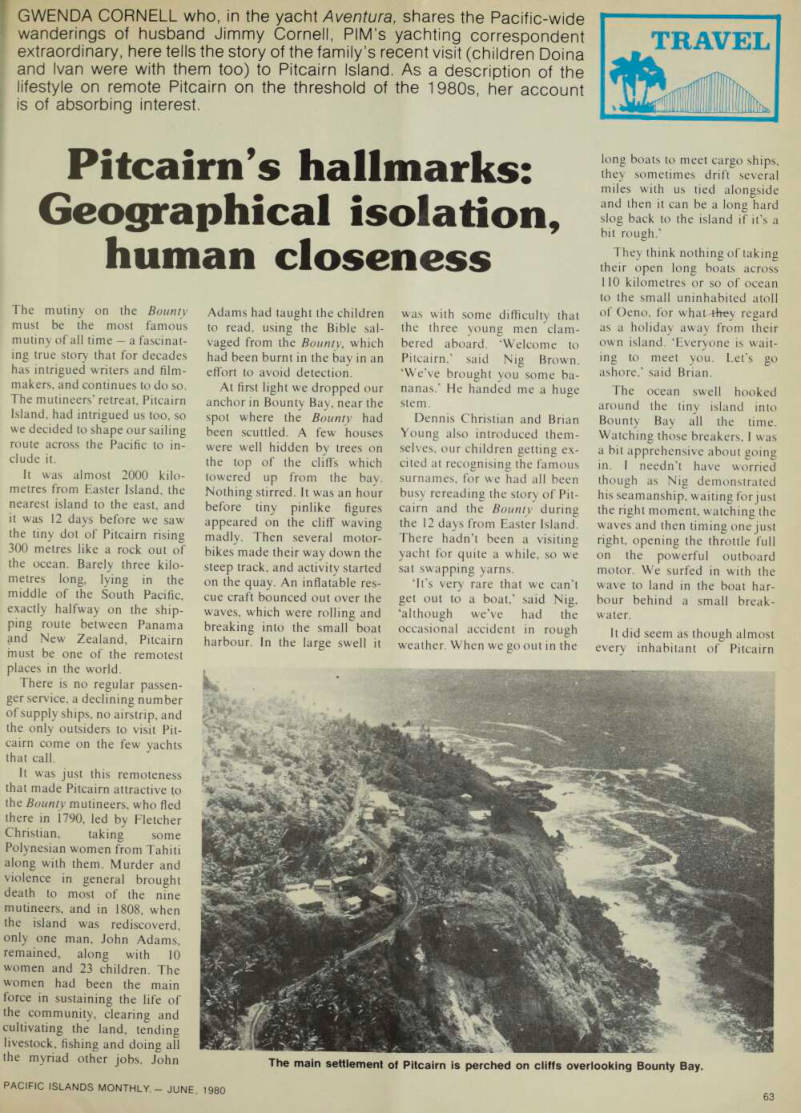
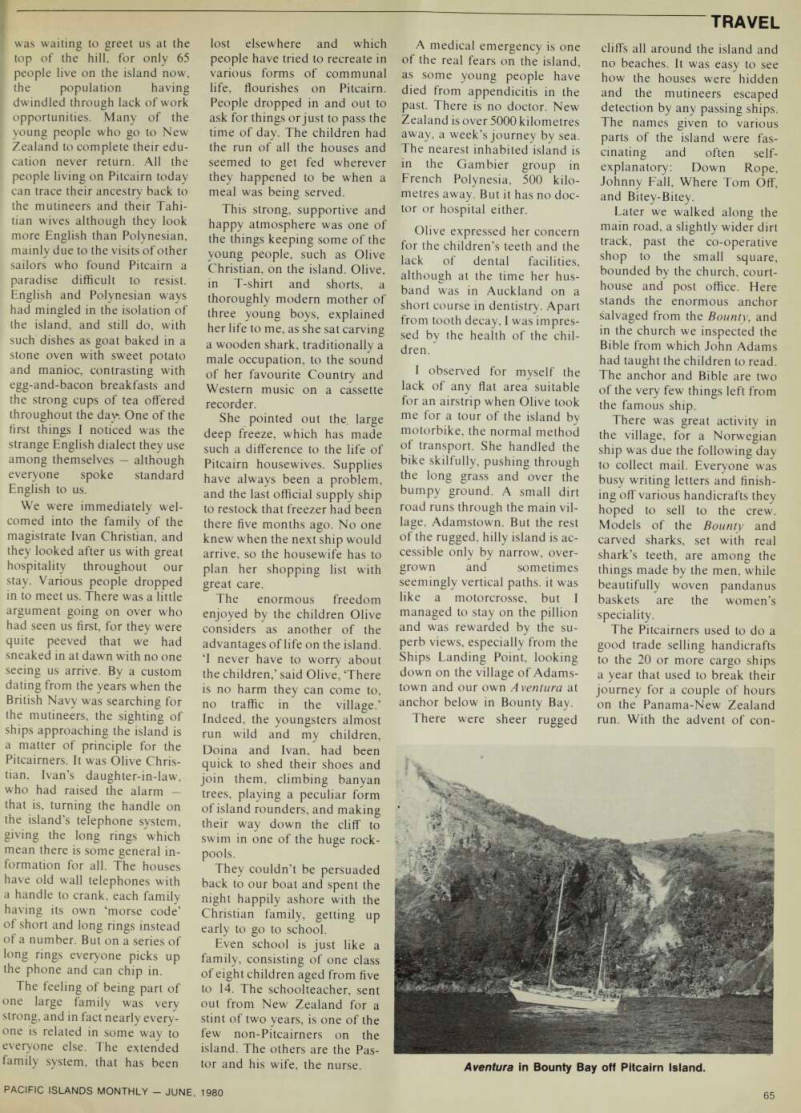
At first light we dropped our anchor in Bounty Bay, near the spot where the Bounty had been scuttled. A few houses were well hidden by trees on the top of the cliffs which towered up from the bay.
Nothing stirred. It was an hour
before tiny pinlike figures
appeared on the cliff waving madly. Then several motor bikes made their way down the steep track, and activity started on the quay. An inflatable res cue craft bounced out over the waves, which were rolling and breaking into the small boat harbour. In the large swell it
was with some difficulty that the three young men clam bered aboard. ‘Welcome to Pitcairn,' said Nig Brown. ‘We’ve brought you some ba nanas.’ He handed me a huge stem.
Dennis Christian and Brian Young also introduced them selves, our children getting ex cited at recognising the famous surnames, for we had all been busy rereading the story of Pit cairn and the Bounty during the 12 days from Easter Island.
There hadn’t been a visiting yacht for quite a while, so we sat swapping yarns. ‘lt’s very rare that we can’t get out to a boat,’ said Nig, ‘although we’ve had the occasional accident in rough weather. When we go out in the
long boats to meet cargo ships, they sometimes drift several miles with us tied alongside and then it can be a long hard slog back to the island if it’s a bit rough.’
They think nothing of taking their open long boats across 110 kilometres or so of ocean to the small uninhabited atoll of Oeno, for wfiat-fhey regard as a holiday away from their own island. ‘Everyone is wait ing to meet you. Let’s go ashore,’ said Brian.
The ocean swell hooked around the tiny island into Bounty Bay all the time.
Watching those breakers, I was a bit apprehensive about going in. I needn’t have worried
though as Nig demonstrated
his seamanship, waiting for just
the right moment, watching the waves and then timing one just right, opening the throttle full on the powerful outboard motor. We surfed in with the wave to land in the boat har bour behind a small break water.
It did seem as though almost every inhabitant of Pitcairn
The main settlement of Pitcairn is perched on cliffs overlooking Bounty Bay.
[ was waiting to greet us at the f top of the hill, for only 65 \ people live on the island now,
the population having
dwindled through lack of work opportunities. Many of the young people who go to New Zealand to complete their edu ; cation never return. All the
people living on Pitcairn today
can trace their ancestry back to the mutineers and their Tahi tian wives although they look more English than Polynesian, mainly due to the visits of other sailors who found Pitcairn a paradise difficult to resist.
English and Polynesian ways had mingled in the isolation of the island, and still do, with such dishes as goat baked in a stone oven with sweet potato and manioc, contrasting with egg-and-bacon breakfasts and the strong cups of tea offered throughout the day*. One of the first things I noticed was the strange English dialect they use among themselves although everyone spoke standard English to us.
We were immediately wel comed into the family of the magistrate Ivan Christian, and they looked after us with great
hospitality throughout our
stay. Various people dropped in to meet us. There was a little argument going on over who had seen us first, for they were quite peeved that we had sneaked in at dawn with no one seeing us arrive. By a custom dating from the years when the British Navy was searching for the mutineers, the sighting of ships approaching the island is a matter of principle for the Pitcairners. It was Olive Chris tian, Ivan’s daughter-in-law, who had raised the alarm that is, turning the handle on the island’s telephone system,
giving the long rings which
mean there is some general in formation for all. The houses have old wall telephones with a handle to crank, each family having its own ‘morse code’ of short and long rings instead of a number. But on a series of
long rings everyone picks up
the phone and can chip in.
The feeling of being part of one large family was very strong, and in fact nearly every one is related in some way to everyone else. The extended family system, that has been
lost elsewhere and which people have tried to recreate in various forms of communal life, flourishes on Pitcairn.
People dropped in and out to ask for things or just to pass the time of day. The children had the run of all the houses and seemed to get fed wherever they happened to be when a meal was being served.
This strong, supportive and happy atmosphere was one of the things keeping some of the young people, such as Olive Christian, on the island. Olive, in T-shirt and shorts, a thoroughly modern mother of three young boys, explained her life to me, as she sat carving a wooden shark, traditionally a male occupation, to the sound of her favourite Country and Western music on a cassette recorder.
She pointed out the, large deep freeze, which has made such a difference to the life of Pitcairn housewives. Supplies have always been a problem, and the last official supply ship to restock that freezer had been there five months ago. No one knew when the next ship would arrive, so the housewife has to plan her shopping list with great care.
The enormous freedom enjoyed by the children Olive considers as another of the advantages of life on the island.
T never have to worry about the children,’ said Olive, There is no harm they can come to, no traffic in the village.’
Indeed, the youngsters almost run wild and my children, Doina and Ivan, had been quick to shed their shoes and
join them, climbing banyan
trees, playing a peculiar form of island rounders, and making their way down the cliff to swim in one of the huge rock
pools.
They couldn’t be persuaded back to our boat and spent the night happily ashore with the
Christian family, getting up
early to go to school.
Even school is just like a family, consisting of one class of eight children aged from five to 14. The schoolteacher, sent out from New Zealand for a stint of two years, is one of the few non-Pitcairners on the island. The others are the Pas tor and his wife, the nurse.
A medical emergency is one of the real fears on the island, as some young people have died from appendicitis in the past. There is no doctor. New Zealand is over 5000 kilometres away, a week’s journey by sea.
The nearest inhabited island is in the Gambier group in French Polynesia, 500 kilo metres away. But it has no doc tor or hospital either.
Olive expressed her concern for the children’s teeth and the lack of dental facilities, although at the time her hus band was in Auckland on a short course in dentistry. Apart from tooth decay, I was impres sed by the health of the chil dren.
I observed for myself the lack of any flat area suitable for an airstrip when Olive took me for a tour of the island by motorbike, the normal method of transport. She handled the
bike skilfully, pushing through
the long grass and over the bumpy ground. A small dirt road runs through the main vil lage, Adamstown. But the rest of the rugged, hilly island is ac cessible only by narrow, over grown and sometimes seemingly vertical paths, it was like a motorcrosse, but I managed to stay on the pillion and was rewarded by the su perb views, especially from the
Ships Landing Point, looking
down on the village of Adams town and our own A ventura at anchor below in Bounty Bay.
There were sheer rugged
cliffs all around the island and no beaches. It was easy to see how the houses were hidden and the mutineers escaped detection by any passing ships.
The names given to various parts of the island were fas cinating and often self
explanatory: Down Rope,
Johnny Fall, Where Tom Off,
and Bitey-Bitey.
Later we walked along the main road, a slightly wider dirt track, past the co-operative shop to the small square, bounded by the church, court house and post office. Here stands the enormous anchor salvaged from the Bounty, and in the church we inspected the Bible from which John Adams had taught the children to read.
The anchor and Bible are two of the very few things left from the famous ship.
There was great activity in the village, for a Norwegian
ship was due the following day
to collect mail. Everyone was busy writing letters and finish ing off various handicrafts they hoped to sell to the crew.
Models of the Bounty and carved sharks, set with real shark’s teeth, are among the things made by the men, while beautifully woven pandanus baskets are the women’s
speciality.
The Pitcairners used to do a
good trade selling handicrafts
to the 20 or more cargo ships a year that used to break their journey for a couple of hours on the Panama-New Zealand run. With the advent of con-
Aventura in Bounty Bay off Pitcairn Island.
1 tainer ships and fast schedules, these visits have dwindled to about eight a year, with sad I effects on the Pitcairners’ incomes.
Nevertheless, the island makes a fair income from the sale of postage stamps. This covers the costs of education, health, administration and
public works.
As a matter of policy all adult men have some kind of
a job paid by the administrat
ion running the generator, maintaining the road, the dock, the public buildings, etc. Men and women work together in their gardens and grow a wide range of produce.
We were lucky that our last evening coincided with Dennis
Christian’s birthday. Every
birthday and special occasion is celebrated by what is called a ‘Public Dinner’. Any quarrels are forgotten and everyone is invited. Dennis’ mother pro vided the setting, but each housewife brought her own contribution, a meat or veg etable dish, a cake or a pudding. Soon the table was laden with an amazing variety of appetising dishes.
It was difficult to believe that the last supply ship had been five months ago.
Notable was the absence of alcohol, for as Seventh-day Adventists the islanders neither drink nor smoke, but this doesn’t affect their great ca
pacity for enjoying themselves.
The younger generation soon had a record player organised and a disco going in one of the rooms, the children were play ing ghosts in the garden while the older people sat and chatted, the women’s hands never still as they wove pan danus or knitted while talk
ing.
Later, the Pitcairners sang for us in harmonious voices the
special goodbye songs they sing
as they pull away in their long boats from visiting ships. In the songs one could sense the iso lation and loneliness of the people, and a sadness that a contact with the outside world had come to an end. Our visit too had to end, and we sadly bade farewell to our new friends, for in our short visit, they had managed to make us too feel part of the Pitcairn
family.