Relations With
p. 37 · Read in the full issue
Png Strengthen
Statistics can turn up some oddfacts from time to time, and in Papua New Guinea one of these is the revelation that tourists from New Zealand are among the heaviest spenders per head of any visi tors.
When it comes to spending money on artifacts bows and arrows, spears, shields and carvings to show the folk back home Americans take the
prize according to recent fig
ures in Port Moresby. But for sheer spending on accommo dation, tours, sightseeing and entertainment the New Zealanders are well out in the front row. New Zealanders themselves are somewhat doubtful about how they earned this reputation, claim ing that the air fares alone from New Zealand to PNG and return (travel is via Australia) don’t leave much change.
In real terms the number of New Zealand tourists visiting PNG is still fairly small, fewer than 800 a year. Latest reports however indicate a significant increase in inquiries, and tour ist officials say this is usually a symptom of an approaching in crease in tourist travel. The main criticism expressed by New Zealand tourists who have been questioned at Port Moresby airport is that internal travel in PNG is excessively ex pensive - an attitude shared by tourists of other nationalities and largely caused by the fact that most trunk travel has to be done by air.
Tourist trade links from New Zealand to PNG (there’s not much in the other direction) are part of the increasing awareness which New Zealand is showing for its regional neighbour which achieved
independence not quite five
years ago. There is now a
developing relationship be
tween the two countries fos tered by the fact that both are members of the Common wealth, both have similar views on regional politics and both are members of the South Pa cific Forum.
Both have also expressed
formal opposition to nuclear tests in the Pacific, and to any development of super-power rivalry in the Pacific.
The two countries have had
full diplomatic relationships
since PNG gained indepen
dence in 1975, each maintain ing a High Commission. Since that date New Zealand has made a marked attempt to in crease its trade relations with PNG, cutting into part of the
markets held traditionally by
Australia. These include canned and dairy foodstuffs, meat, ropes and fibres, marine
fittings and equipment, and
paints and chemicals.
Backed by a number of cam paigns these moves have been fairly successful. In 1974 - just before PNG independence the annual total sales of New Zealand products to PNG were worth SNZI.B million. By 1977 this had risen to 10.6 million, by 1978 to 16.9 million and the most recent projection exceeds 20 million. PNG exports to
New Zealand, mainly tropical
produce, are running at about 7 million a year.
Coffee sales are at present
PNG’s highest earning exports
to New Zealand, bringing in SNZS million a year. Other exports to New Zealand are
logs and specialised timbers,
tea and cocoa.
Papua New Guinea is a member of the Pacific region group which has been attempt
ing to negotiate preferential
trade agreements with New Zealand but in general terms New Zealand applies to PNG its blanket arrangements for
imports from developing coun
tries and there is no immediate move to vary these arrange ments to suit the specific re quirements of PNG.
There are no passenger ship ping links between the two countries, and cargo links have
gone through a period of flux which has created a measure of
uncertainty in trading arrange
ments. This situation has now largely settled down with the establishment of three regular operators on the run.
PNG shares in New Zealand’s overseas aid pro gramme, and aid was first pro vided in 1973 during PNG’s transitional self government period. Aid of about SNZ3 million a year is now being pro vided together with an under taking from New Zealand that it will continue ‘even if we find it difficult’ says the Deputy Prime Minister Mr
Talboys.
There have been minor dif ferences between the two coun tries on the nature of the aid
programme, mainly arising
from New Zealand stipulations that where possible purchases and services involved in aid projects should be contracted to New Zealand sources. As a matter of policy PNG gener ally does not accept this prin ciple. but representatives of both governments are quick to claim that any differences have
never interrupted the friendly
relationship which exists.
New Zealand aid also is directed to specific projects in PNG, and is not in the form of untied budget support. But here too the countries have reached a working arrange ment in which PNG submits lists of projects for which it is soliciting aid and New Zealand makes the final selection.
Under this scheme New
Zealand has provided support for agricultural and horticul tural research projects, a tim
ber industry training college,
marine transport and fresh
food marketing projects.
PNG is also a member of a New Zealand development scheme which operates in a number of Island countries, the Pacific Islands Industrial Scheme. New Zealand estab lished the scheme in 1976 with incentives to encourage its own companies to establish indus trial ventures in other coun tries. The reasoning was that, provided New Zealand companies met the investment requirements of the countries they entered, there would be mutual benefits for all partners and opportunities for regional
development.
So far however PNG has had little involvement with the scheme which is more strongly entrenched in Fiji. Western Samoa and the Cook Islands.
PNG observers share the view already expressed by critics in New Zealand itself that the scheme will never achieve real potential unless the goods it produces have better accessi bility to the New Zealand and Australian - market.
The New Zealand Volunteer Service Abroard scheme also has a small band of teachers, instructors and health workers in PNG, most of them working
through missionary organis
ations. The missionary organis
ations themselves draw staff and volunteers from New Zealand.
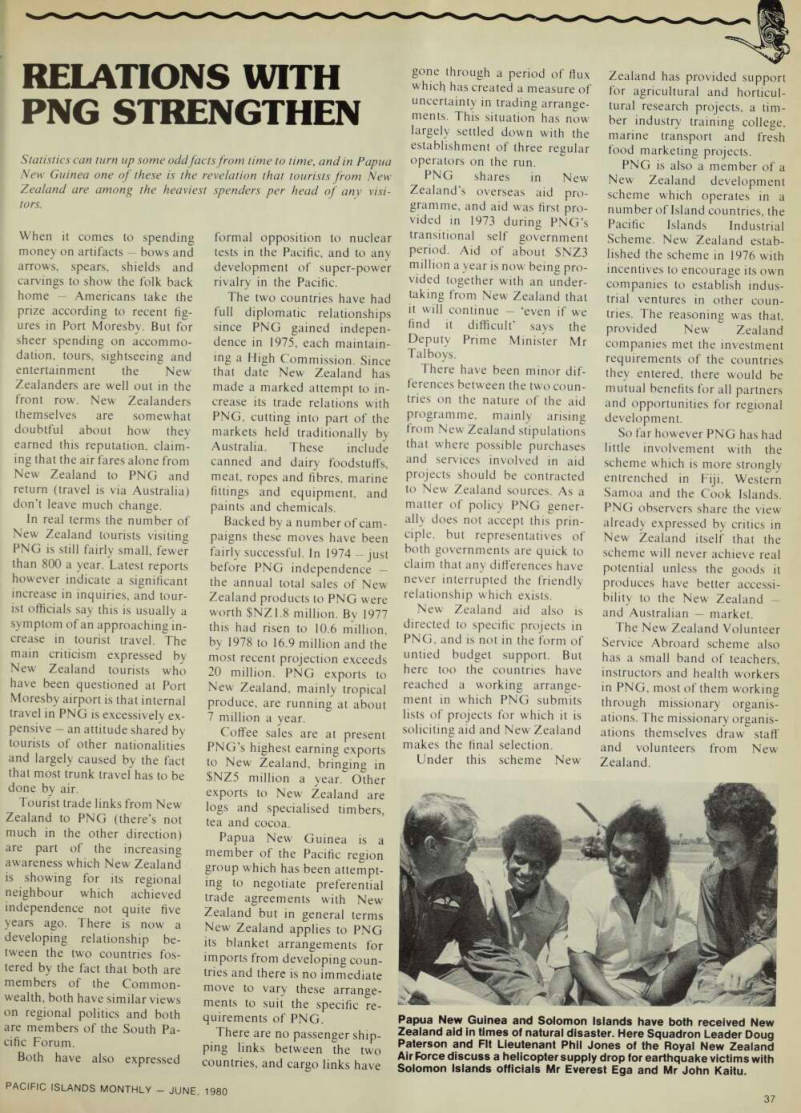
Papua New Guinea and Solomon Islands have both received New Zealand aid in times of natural disaster. Here Squadron Leader Doug Paterson and Fit Lieutenant Phil Jones of the Royal New Zealand Air Force discuss a helicopter supply drop for earthquake victims with Solomon Islands officials Mr Everest Ega and Mr John Kaitu.