Radio Nz Plans
p. 35 · Read in the full issue
Pacific Impact
Radio New Zealand is working on a plan to make a greater impact among the Pacific Islands during the 1980 s with shortwave broad casts and taped programmes.
It must do. On the one hand it faces increasing competition from a host of countries beam ing powerful transmitters to the Pacific Islands. On the other hand its two 37-year-old 7.5 kw transmitters are unequal to the
struggle.
Add to that a change in the
11-year sunspot cycle which
will bring concentrated use of lower frequencies to the Pacific Islands during 1982-86 and New Zealand faces little chance of maintaining a re liable shortwave service to the region with its present equip ment. That, many people argue, would be disastrous for a country aligning itself more and more with the region and playing host to thousands of Islanders whose relatives want to maintain contact with New Zealand.
Radio New Zealand’s battle to obtain the funds to provide the equipment for a viable ser vice that can promote the country reflects the peculiar New Zealand capacity to lose the international publicity stakes by default. But while the equipment might be of World War II vintage, the quality of the tailor-made programmes and service that Radio New Zealand staff produce for the Islands matches the world’s best with ease.
The pity of it is that many Islanders are unaware of the services offered and tend to look towards Radio Australia with its vast resources and
transmitting power.
Pacific Island broadcasters from commercial stations were given an insight into New Zealand’s operations this May on a three-week course spon sored by the Asia-Pacific Insti tute for Broadcasting Development. A second train ing course is scheduled for later this year on broadcasting in the vernacular which should also
benefit staff in New Zealand’s Maori and Pacific Island Programming Unit. In the past 18 months, New Zealand’s interest has swung quite sharply towards programmes
in Island languages internally
and overseas.
At present Radio New Zealand provides a special shortwave news bulletin for Pacific listeners from Monday to Friday in English and in the vernacular for Samoa, Tonga, the Cook Islands and Niue.
Shortwave also carries sports fixtures plus any other events that might interest the Pacific communities. Augmenting the shortwave service is Radio New Zealand’s growing transcription service which incorporates tapes and cas settes. This includes a weekly 30-minute vernacular newslet ter for Samoa, Tonga, the Cooks and a fortnightly pro gramme for Niue.
Then there are weekly 30minute programmes on the Pa cific and New Zealand, on sports and on any special items.
Expansion of this service sup ports the weak shortwave voice of Radio New Zealand. The new transcription programmes include Hymns on Sunday Morning which is proving very popular and is distributed to Samoa, Tonga, the Cooks,
Niue and Nauru. There are outside broadcast recordings of Polynesian church services.
This month the first of a series of 30-minute pro grammes of band music called Band Call begins while Pacific Comment talks on Pacific
topics has just begun.
Another new programme Pa cific Connection presents a pop programme targetted to Pacific radio listeners and laced with brief items about New Zealand and its way of life. Already this programme, which began some six weeks ago, has produced a heartening flow of appreciative mail.
Radio New Zealand’s next stage will be for Brian Jen nings, who hosts the pro gramme, to visit Pacific Islands and handle breakfast sessions there. Eventually he should be come radio’s Mr Pacific.
On the more serious side Radio New Zealand will also introduce a development pro-
gramme concerned with human and natural resources and social development. This will cover a host of topics associated with improving the
living standards of people.
While Radio New Zealand staff might express satisfaction with the progress made with these transcription pro
grammes, they realise they
hardly substitute for the immediacy and directness of short wave programmes.
Radio New Zealand looks on the transcription service more as an interim measure until it receives its high pow ered transmitters that can com pete more equally with other countries. That’s a political de cision which the Government must face and it must be a painful one for a Government now in the throes of tightening all the purse strings possible on
public spending.
But the question the Government must ask itself, and ask the Prime Minister, Mr Muldoon, in particular since he has taken a personal interest in the region, is: ‘Can the radio voice of New Zealand be al lowed to die?’ Compared with
the atmospheric chorus coming
from the Soviet Union, China and Australia who increased their output last year to cover the region with sound and in formation, New Zealand’s voice is just a whisper.
It’s high time it blew its own
trumpet.
William Gasson in
Wellington.
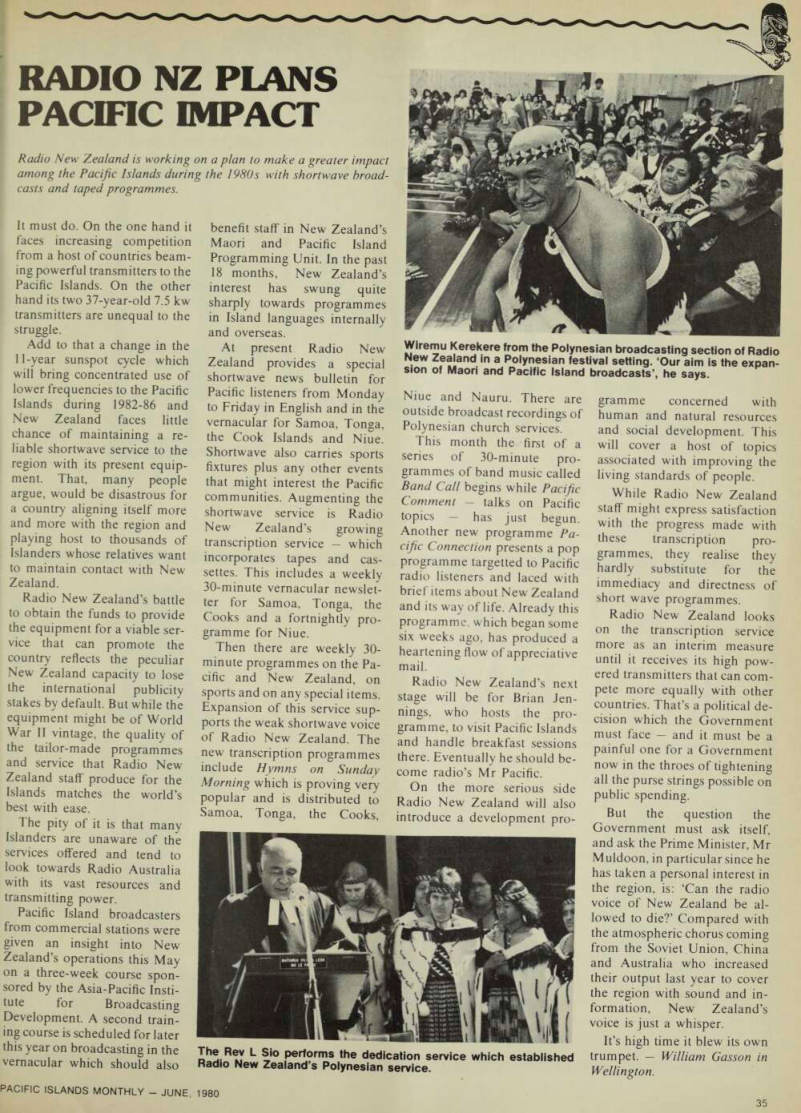
The Rev L Sio performs the dedication service which established Radio New Zealand’s Polynesian service.
Wiremu Kerekere from the Polynesian broadcasting section of Radio Ne w Zealand in a Polynesian festival setting. Our aim is the expan sion of Maori and Pacific Island broadcasts’, he says