NZ influence
pp. 31-33 · Read in the full issue

How to measure NZ influence in the Pacific?
Anyone using the level of aid to measure New Zealand’s interest in the Pacific Islands will be easily misled. The fact is that in real terms aid money slipped backwards in successive years but the interest taken by New Zealand in the Pacific continues to rise Prune Minister Robert Muldoon takes a personal interest m Pacific affairs as evidenced recently when Western Samoan Prime Minister Tupuola Efi arrived in New Zealand incensed by the
English language test imposed
on his country’s students studymg here.
Two days of talks and Efi was heading home full of praise for Muldoon, who‘when the chips are down never lets you down.’
After generations of looking beyond the Pacific Islands New Zealand now firmly ac knowledges the presence of its scattered neighbours and official policy is to adopt a high profile in the South Pacific which only makes it more frus trating for aid officials trying to make the diminishing New Zealand dollar go further While New Zealand’s econ omic future half way through the gQs looks promising, the
immediate years indicate a grim battle to control galloping inflation now at the 18.4% a year level to inject massive investments into energy and other industrial developments,
to overcome high unemploy
ment and to accelerate even more a growing range of exports to an equally growing range of markets. But that in cludes the Pacific Islands which overall now represent New Zealand’s sixth largest trading market. And that must grow in the years ahead as more islands gain their
independence and the region
inter-reacts as an economic unit.
While New Zealand uses the argument that the United States must open its trading doors to New Zealand’s pro ducts so that New Zealand can be strong economically and afford the kind of defence potential demanded of it by ANZUS membership, so too the Pacific Islands can use a similar argument on New Zealand for their products.
Economically weak communi ties are vulnerable communi ties.
That makes the present talks on the South Pacific Area of
Regional Trade and Econ omic Cooperation Agreement (SPARTECA) so important since its concept is to provide for the Pacific Forum islands free and unrestricted access to New Zealand and Australian markets. Related to that development is the New Zealand PUDS (Pacific Islands Industrial Scheme) which encourages businessmen to invest in the islands and de velop industries there, with the help of various incentives.
The main weakness is the lack of any guaranteed access to New Zealand’s market for island manufactured goods. In
fact eight applications for
access to New Zealand have been granted since the scheme began in 1976 and while many industries are aimed specifi cally at the island markets, New Zealand and Australia are looked on as the logical outlets
for goods. Wellington officials
are cautiously optimistic at the progress in putting together the text of the trade agreement that will be put before Forum members when they meet in July. While it seems inevitable that there will be a measure of protection built into the agree ment, the aim is to make island
products access free and unre stricted. ‘Our aim is to ensure that the list of items requiring per manent protection is very short,’ one official commented.
After the Australia-New Zealand officials’ talks in Can berra in May another official commented that the negative list of goods was surprisingly small. Officials have been impressed that the idea of free access for island products to New Zealand has been so eas ily accepted in a country that has hidden for so long behind protective trade barriers. They put it down to the growing feel
ing throughout New Zealand
of freeing the country from its protective blanket and letting market forces have greater in fluence.
For the Pacific Islands’
fledgling industries the timing
of that attitude is perfect since it suggests less opposition from the Federation of Labour that supports the trade agreement idea in principle but tradition ally has been sensitive to a flow of imported island products that might threaten New
Zealand jobs.
Ironically however New Zealand may be forced to insert restraints into SPAR TECA to protect the trade of islands such as the Cooks, Niue and Western Samoa that enjov special access to this market. In a free competition situation,
Niue’s passionfruit industry
might collapse.
Officials see the trade agree ment as an important political as well as trading exercise and the Island Forum members have insisted that the agree ment include a statement of principle from New Zealand and Australia that they will encourage regional trade and investment. As an introduction to the 80s, New Zealand sees the agreement as binding the South Pacific into a far stronger trading area that will be consolidated by the growing air and sea links and regional
operations such as harvesting
the fish resources.
In the development of air links New Zealand in the years ahead might find itself at log gerheads with expansionist
minded Island states. While its policy is to do nothing to hin der the development of re gional carriers in the area or to displace them, the fact is that with the merger of its domestic NAC airline and its inter national Air New Zealand into one airline, New Zealand now has jet aircraft suited for island
hopping.
‘This would only be in ac cordance with bilateral air agreements but in certain cases it may appear that New Zealand has changed its pol icy,’ one official said. For example. Air New Zealand has not yet flown on the Auckland to Tonga air route. If the two countries signed an air agree ment it might appear that Air New Zealand was attempting to displace other regional air lines. But the official’s view was that any such move would be within accepted bilateral practice.
On the sea New Zealand has shown its support for the two year-old Pacific Forum Line which has suffered rough times. New Zealand’s support is in the form of a container ship better suited to Islands op erations than two others in use.
American overtures to New Zealand to help usher the US Trust Territories into a measure of independence have met with a prompt and favour able response. A trade mission left Auckland in May for Micronesia with its members confident of business oppor tunities there. American plans
to accelerate capital develop
ments in that region have already attracted New Zealand interest and involvement.
As for moving closer to their Pacific Island cousins and New Zealand the response in Wellington is along the lines of: ‘We would encourage the Trust Territories to come to the Pacific and get to know the other islands. We would like a closer relationship as well.
There is great interest here in the region and we feel we have a part to play there.’ New Zealand also warmly welcomes the Forum Fisheries Agency a scheme that is likely to test the practicality of Forum
members working effectively
in assessing and developing a regional resource.
While the American policy of pursuing migratory tuna through the Islands’ economic zones is seen in New Zealand as an irritant. New Zealand is keen to assist in the vital re search program that must pre cede a concerted fishing operation. The whole oper ation also suggests to New Zea landers that the present agency’s membership limi tation to Forum countries may need to be expanded to encom pass countries traditionally interested in fishing.
Toss idea
aside
says PM
Any developing country har bouring the hope that New Zealand might boost its foreign aid in the next financial year can toss aside the idea.
Prime Minister Robert Mul doon seemed to make it pretty
clear when addressing Welling
ton Rotary clubs that continu ing oil price shocks have effectively cancelled out any increase in aid money.
With the country’s terms of
trade again heavily under
pressure more exports are needed to achieve the same relative income so, added Mr Muldoon: ‘in those circum
stances my Government in the last four years has held our aid roughly steady in dollar terms and that has meant a decline in real terms.’
To soften the blow for Pa cific Island neighbours how ever Mr Muldoon said that the
country’s aid emphasis had
swung towards them. About half of New Zealand’s $5O million aid goes to the South Pacific and Mr Muldoon sug gested that Rotary clubs focus their special projects in future also on their South Pacific
neighbours.
While the government itself looks like it will be unwilling to boost aid money levels when the new financial year starts in
April it hopes apparently that
the private sector might step into the growing decline in actual aid value.
At least Mr Muldoon will be able to say to Pacific Island leaders when next they raise the aid issue ‘we’re trying’. And if that is insufficient then he can repeat what he told the Rotarians. ‘The ability of the New Zealand Government to play a part in international aid pro grammes grows progressively more difficult as our balance of payments position comes under greater pressure from the increasing price of oil and other commodities relative to the price that we get from our
own exports.’
In laymen’s terms that will mean ‘no’.
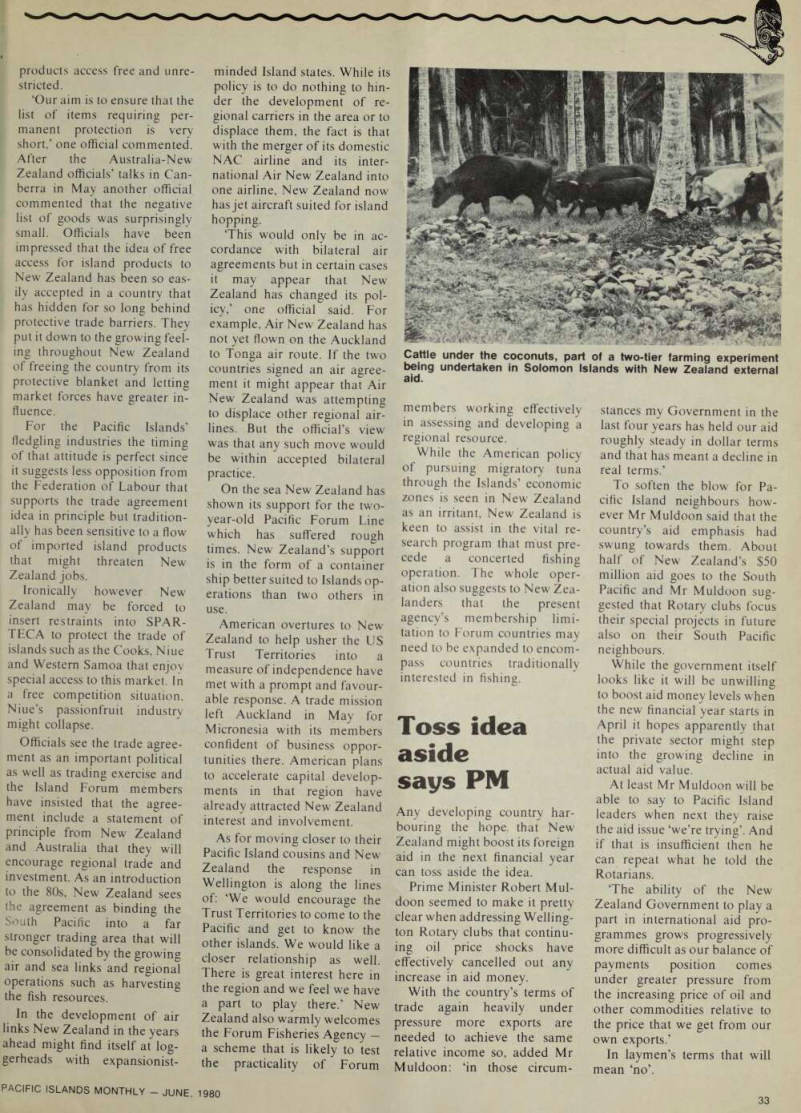
Cattle under the coconuts, part of a two-tier farming experiment being undertaken in Solomon Islands with New Zealand external aid.