Albert Henry
pp. 27-30 · Read in the full issue

It’S Plain Mr
Former Cook Islands Premier Sir Albert Henry was stripped of his knighthood by order of Queen Elizabeth II in April. WILLIAM GASSON tells the story in a despatch from Wellington.
When Cook Islands Premier Albert Henry learnt in 1974 that he was about to be knighted his first reaction was amazement.
In an interview after the investiture he laughed, and when asked to describe his reaction he said: ‘Well, I’ll tell you ... I thought that if some body had come up to me back in those days when I was clean ing buses in New Zeland to earn enough money to feed my family, and told me that one day I would be kneeling at the
new jet airport at Rarotonga
while the Queen of England knighted me . . . well, by jove, I would have started looking around for the men in the white coats with the butterfly nets who must be looking for this lunatic.’
Six years later Albert Henry was no longer laughing. The same Queen of England had just cancelled and annulled his Knight Commander of the Most Excellent Order of the British Empire in a notice headed ‘Forfeiture of an Honour’.
The sudden return to plain ‘Mr Henry’ from ‘Sir Albert’ followed his trial last year when he pleaded guilty to two charges of conspiring to de fraud the Crown and one other that came under the Public Monies Act all of which were related to flying in voters from New Zealand to support his Cook Islands Party in the 1978 general election with the help of government money.
He won the election but the result was later overturned and Henry found himself in a pol itical wilderness.
Now the wilderness has grown with him stripped of his title.
It was ‘sad, but inevitable’, said New Zealand Prime Minister Robert Muldoon who recommended the move to the Queen after discussing it with
the current Cook Islands Prem ier Dr Tom Davis during a visit
to Wellington.
‘lt was inevitable from the time of his conviction and the nature of the charge. It is in ac cordance with all precedents in these things and there was no option but for it to happen,’ said Muldoon.
Henry follows the keeper of the Queen’s art collection Anthony Blunt who was the last person to be stripped of a knighthood. Blunt’s error was in spying for the Russians.
What probably galls Albert
Henry most is the knighthood that was conferred on the Cook Islands chief justice, Gaven John Donne, who ousted Henry and his government after the last general election.
That knighthood came four months after the general elec tion which led to Henry step ping back into the anonymous ranks of ‘Mister’.
Regionalism
Trend In Png
Papua New Guinea has yet another political party in its parliament with the formation of the Papuan National Al liance, which will call itself Panal.
Panal, formed by the mem ber for Middle Fly, Mrs Waliyato Clowes, becomes the seventh group active in current politics and represents mem bers described as ‘moderate
Papuan politicians’. The party
exists within the newly-formed
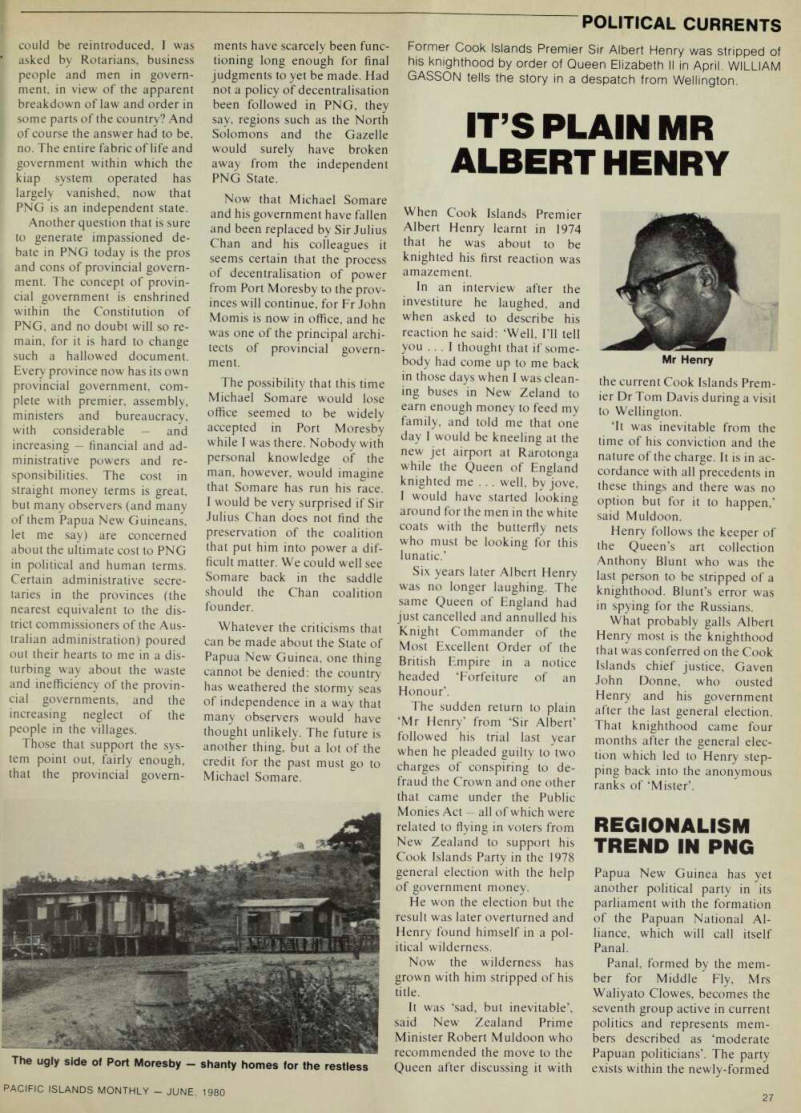
Mr Henry
Chan government and although its strength has not yet been determined it appears likely to have no more than
eight members.
Mrs Clowes, one of only three women in the PNG National Parliament, has been associated with three other groups in her parliamentary ca reer of only three years and this in itself highlights the con tinuous state of flux in PNG
political alignments.
The real significance of the new party however is that it demonstrates an increasing trend towards regionalism in the politics of PNG. In the pol itical sense neither ‘Papuans’ nor ‘New Guineans’ are sup posed to exist any longer the people are all ‘Papua New
Guineans’. The big political
issue in the days leading to independence was the need for national unity and the burying of any regionalism, which was seen as a threat to national
unity.
The first great exception to this was the formation of Miss
Josephine Abaijah’s Papua
Besena which saw and still sees Papua as an entity.
In theory Papua Besena still stands for separation, but in practice the attitude is largely symbolic and the party’s main concern is getting a fair deal for what it sees as ‘Papuan’
people.
Since independence region
alism has become increasingly obvious even in parties which were not originally created on a regional basis. The National Party became very much a
Highlands regional party, and
provincial politics led to press ure groups in national poli tics.
The newly-formed Panal is not a separatist group like Papua Besena, and this is demonstrated in the use of the term ‘moderate Papuans’ for its supporters. Mrs Clowes makes it clear, too, that the party’s area of interest extends slightly beyond the old Papuan border into part of the Highlands.
Nonetheless Panal is a regional grouping in a country which set out to avoid regionalism in its political factions.
Describing the aims of her new party Mrs Clowes said ‘We are not a radical separatist movement and we aim to work with, not against, our partners in government.’
Mrs Clowes, 29, was a school teacher before her election to parliament in 1977. She was linked with the United Party at the time of the elections, later aligned herself with the revived National Party and eventually was associated with Papua Besena in a calculated political move to maintain solidarity be tween the National Party and Papua Besena. Angus Smales.
Tupuola Efi
Interviewed
Looking back on a difficult year in which he had to fight desperately to remain in power. Western Samoa’s Prime Minister Tupuola Efi agrees that the political situation in his
country has changed markedly
since last year’s elections.
T think things have settled down now but it’s a little less easy to predict how things will go,’ he said on a recent visit to Auckland. He was in New Zealand for talks with Prime Minister Rob Muldoon.
They discussed the contro versial language achievement test for overseas students, Samoa’s request for fishing rights in New Zealand’s 200-mile exclusive economic zone, and the schedules of the Pacific Forum Line.
Tupuola Efi was delighted to learn that the New Zealand Government no longer wanted the so-called ‘Latos’ language test applied to Samoan students. Critics claimed it was
being used as a backdoor method to reduce the number of Pacific Island students studying in New Zealand.
On fishing, Mr Muldoon offered to look personally at Western Samoa’s application for fishing rights in 1981.
In Auckland, Tupuola Efi
discussed his political position
and the changing domestic pol itical scene since the formation of the opposition Human Rights Protection Party. ‘My opinion is that the oppo sition is still very much a loose grouping,’ he said. What did he think bound the opposition together? T suspect it’s wanting to oust the Government so they can get a crack at it.’
He acknowledged ‘a tend ency for some people not to like the pace of development they’d like to slow things down’. v Tupuola Efi admitted to
having been ‘caught napping’
by the opposition group: ‘l'd go so far as to say we were lulled into a false sense of security.’
He said he had an open mind about the growth of political
parties in Western Samoa. ‘I have always felt you need an interest that provides the im petus to set up an ideology and a party. That interest must be antagonistic to another interest. That’s not necessarily a bad thing.’
Looking back on his almost four years as prime minister, Tupuola Efi said he was happy with what’s been ac complished: ‘I think the record speaks for itself.’
There are some things I would do differently,’ he said.
‘Keeping people abreast was
something we tended not to emphasise. It is an important part of the growth of a country like ours that people under stand why we are doing
things.’
Asked how long he thought he would stay on as leader Tupuola said he would rather not say, ‘for the reason I would be plagued by such a remark for years afterward’. ‘One of the hardest decisions for a political leader is to know when to make a decent exit. I pray I will know when.’ -
James Tally, in Auckland.
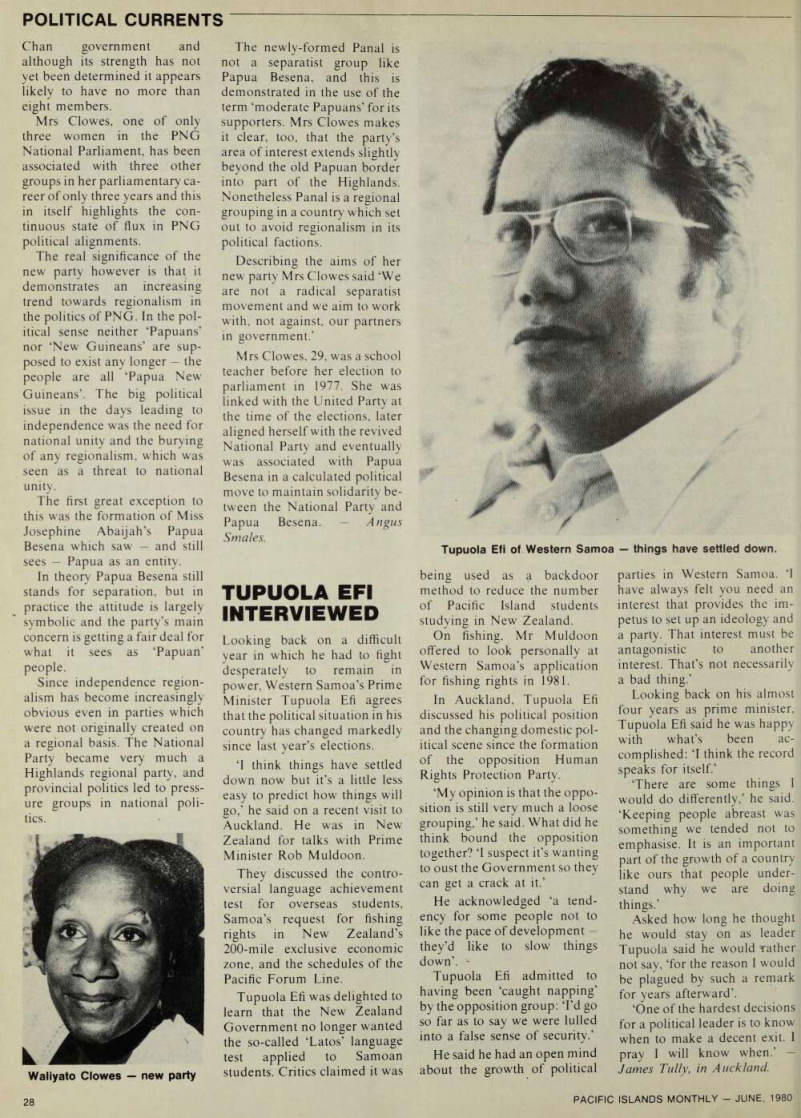
Waliyato Clowes-new party
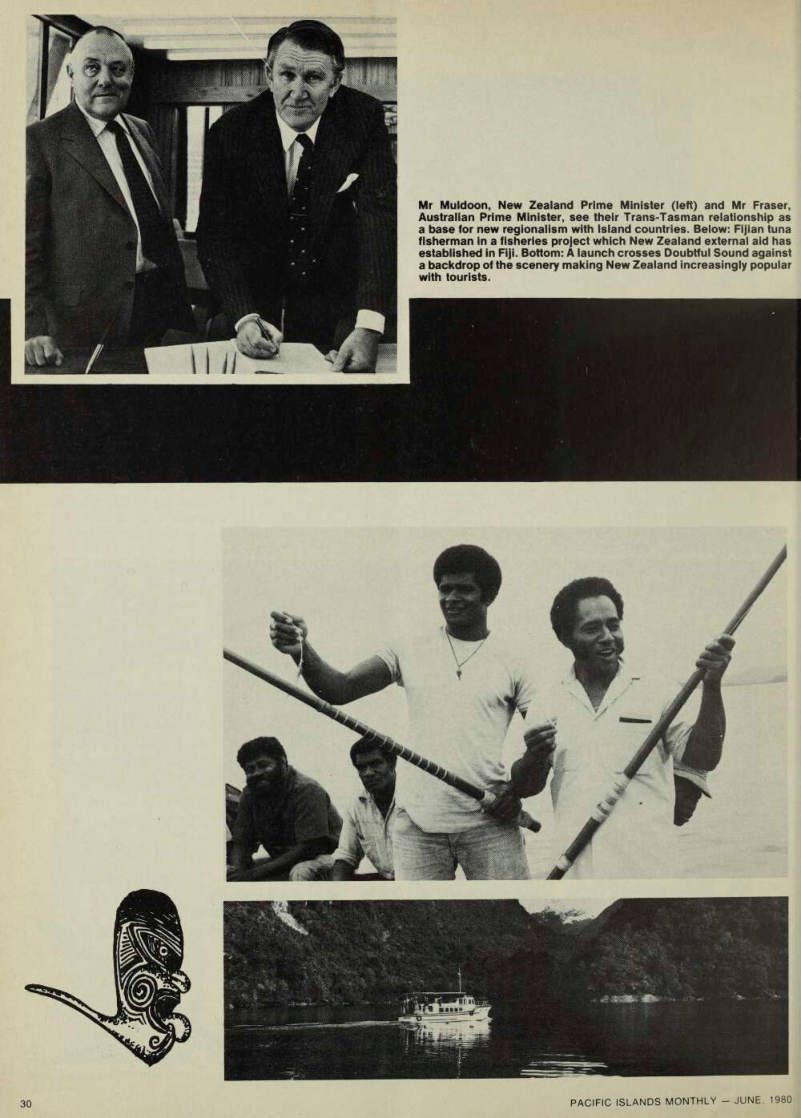
Tupuola Efl of Western Samoa-things have settled down.
Mr Muldoon, New Zealand Prime Minister (left) and Mr Fraser, Australian Prime Minister, see their Trans-Tasman relationship as a base for new regionalism with Island countries. Below: Fijian tuna fisherman in a fisheries project which New Zealand external aid has established in Fiji. Bottom: A launch crosses Doubtful Sound against a backdrop of the scenery making New Zealand increasingly popular with tourists.