Chile: Pinochet’s hot
pp. 25-27 · Read in the full issue
Political
Currents
Eggs And Anger
Chile: Pinochet’s hot taste of Fiji
The unofficial rebuff which Fiji people gave in March to the President of Chile, General Pinochet, (PIM May p 9) has not gone unnoticed in the wider field of international re lations.
The Fiji incident, coupled
with a more formal rebuff from the Republic of the Philip pines, suggests that public dis taste for the Pinochet regime in Chile may be more deep seated than some governments themselves have realised. The Philippines cancelled General Pinochet’s visit only a few days before he was due to arrive, and in Fiji public reaction was a major factor in his premature
departure.
Hard on the heels of what happened, there are now indi cations from news agencies with links in Japan and the South American continent that General Pinochet may have to call off his plans for a visit to Japan. There is speculation, too, about the outcome of his tentatively-planned visit to China.
A detailed look at what hap pened in Fiji suggests that General Pinochet manipulated his Fiji visit in an attempt, to bolster his international stand ing, but the plan failed lar gely through the action of church groups and trade unions.
He initially informed the Fiji Government that he and his party of 38 would welcome the opportunity for a ‘private tran sit’ visit on their way to the
Philippines. His Foreign Policy
Office announced however that he was ‘accepting an invi tation to officially visit Fiji’.
The Fiji Government, puzzled but anxious not to offend, then revised its plans to provide for a full State wel come including guards of honour and a State luncheon and accommodation at Government House. A brief newspaper announcement of the arrangements was followed
by protest letters and then by a statement from the powerful Pacific Conference of Churches that it would boycott all activities involved in the visit. The PCC said it could not be party to a situation which smacked of sympathy for a regime well-documented in denying human rights.
The Fiji Prime Minister, Ratu Sir Kamisese Mara, cri ticised the PCC for an ‘unchris tian attitude’, and described the visit as an opportunity for citizens of a free country to per suade and influence General Pinochet.
Opposition mounted as the Fiji Council of Trade Unions, the University of the South Pa cific Students Association, the YWCA, the Federated Airlines Staff Union and the Fiji Coun cil of Churches mounted a
campaign through press re
leases, letters to the editor and
paid advertising.
These events occurred while the executive members of the Pacific Conference of Churches were holding a meet ing in the remote Cook Islands.
When the Catholic Bishop was told of the radio broadcast of one of his flock, he declared, it was time that the Prime Minis ter be paid a clergy visit.
Then the combined churches of Fiji placed an advertisement
in the Fiji Times encouraging churches to hold a special day of prayer for persons known to be suffering gross violations of
human rights, and indicating
their expectation that the Prime Minister would seriously discuss with President Pinochet the well documented cases of 39 persons arrested and miss ing in Chile.
Fiji citizens were encour aged to show their opposition to the visit by public, peaceful demonstrations. The govern ment, obviously perturbed, switched the public lunch eon from the Governor- General’s grounds to a nearby hotel, and it was announced that General Pinochet would not stay at the Governor- General’s house, but at the Government guest house. A
subtle but significant change.
On the day of General Pinochet’s visit, the arrival times of his visit bounced from 11 am to 11 pm (purposefully?) confusing would-be demon strators at the Nadi Inter national Airport. Local papers once again were filled with let ters to the editor, articles, pho tos, and paid ads. The National Youth Council joined with the trade unions and Students As sociation to state that by wel
coming and entertaining
General Pinochet Fiji was
recognising him as legitimate
leader, condoning the inhuman
regime, inconsistently present
ing Fiji’s foreign policy and
wrongly using Fiji taxpayers’
money entertaining a mass murderer comparable to Idi Amin and Hitler.
Two hours before General Pinochet’s scheduled arrival time, radio news from Aus tralia announced that President Marcos had cancelled Pinochet’s state visit to the Philippines. Churches and trade unions in the Philippines had staged massive demon strations even before the visit of the Chilean dictator. Fiji was left to entertain solely the unwanted general.
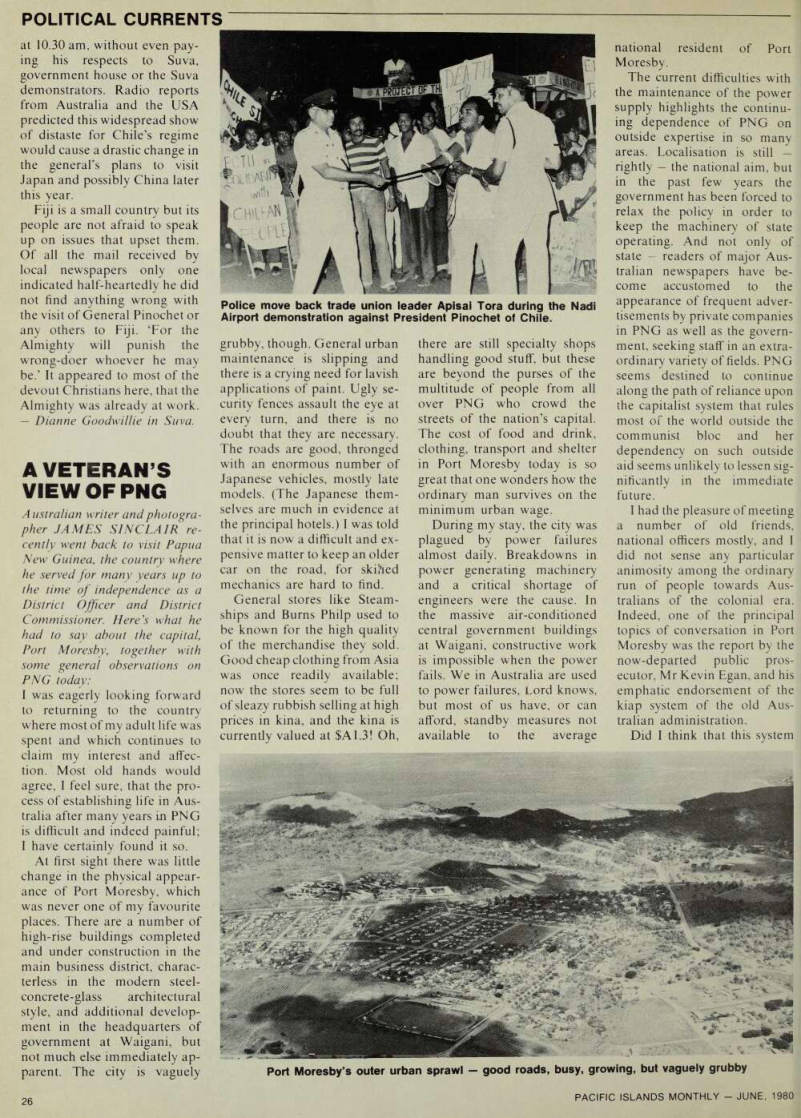
The evening was balmy, the crowd quiet but determined. A group of Fijians wearing tra ditional grass skirts performed ceremonial mourning. Others wore black arm bands, chanted protests and held placards in
Spanish and English. About
1500 people lined the streets to
protest against the general’s
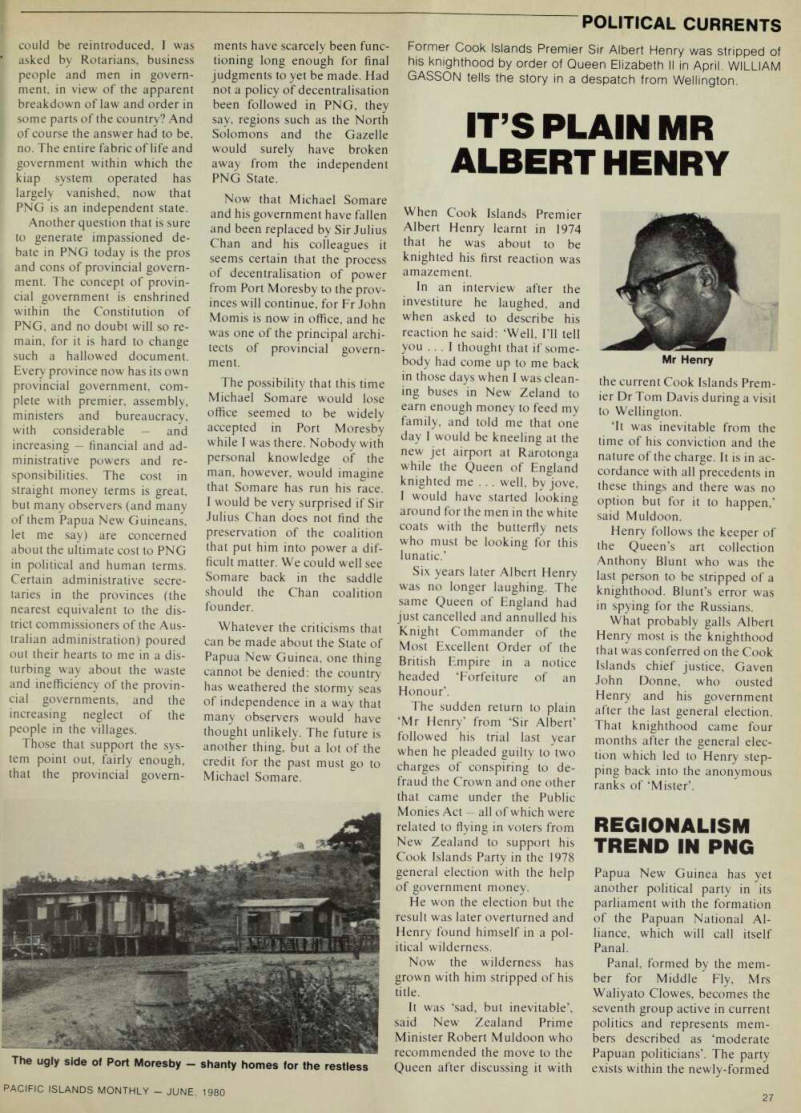
visit to Fiji. Since airline workers were protesting, Qan tas management staff had to service the Lan Chile 707 when it landed at 11.30 pm. Heavily guarded cars emerged from the airstrip to be met by a chanting crowd; ‘Chile si, Pinochet no’.
The Pinochet car whisked through the crowd, but not be fore several eggs and water bombs splattered across the windshield.
Early next morning, it was obvious that General Pinochet knew he was unwelcome in Fiji. ‘Due to cancellation of the Philippines visit, General Pinochet decided to cut short his visit to Fiji,’ said an official announcement. In fact he fled
Decorated with leaves and holding anti-Pinochet placards, demonstrators line the roadside.
at 10.30 am, without even pay ing his respects to Suva, government house or the Suva demonstrators. Radio reports from Australia and the USA
predicted this widespread show
of distaste for Chile’s regime would cause a drastic change in the general’s plans to visit Japan and possibly China later this year.
Fiji is a small country but its people are not afraid to speak up on issues that upset them.
Of all the mail received by local newspapers only one indicated half-heartedly he did not find anything wrong with the visit of General Pinochet or any others to Fiji. ‘For the
Almighty will punish the
wrong-doer whoever he may be.’ It appeared to most of the devout Christians here, that the Almighty was already at work.
Dianne Goodwillie in Suva.
A Veteran’S
View Of Png
A ustralian writer and photogra pher JAMES SINCLAIR re cently went back to visit Papua New Guinea, the country where he served for many years up to the time of independence as a District Officer and District Commissioner. Here's what he had to say about the capital.
Port Moresby, together with
some general observations on
PNG today:
I was eagerly looking forward to returning to the country where most of my adult life was spent and which continues to claim my interest and affec tion. Most old hands would agree, I feel sure, that the pro cess of establishing life in Aus tralia after many years in PNG is difficult and indeed painful; I have certainly found it so.
At first sight there was little change in the physical appear ance of Port Moresby, which was never one of my favourite places. There are a number of
high-rise buildings completed
and under construction in the main business district, charac terless in the modern steel
concrete-glass architectural
style, and additional develop
ment in the headquarters of government at Waigani, but not much else immediately ap parent. The city is vaguely
grubby, though. General urban
maintenance is slipping and there is a crying need for lavish
applications of paint. Ugly se
curity fences assault the eye at every turn, and there is no doubt that they are necessary.
The roads are good, thronged with an enormous number of
Japanese vehicles, mostly late
models. (The Japanese them selves are much in evidence at the principal hotels.) I was told that it is now a difficult and ex pensive matter to keep an older car on the road, for skihed mechanics are hard to find.
General stores like Steam ships and Burns Philp used to be known for the high quality of the merchandise they sold.
Good cheap clothing from Asia was once readily available; now the stores seem to be full
of sleazy rubbish selling at high
prices in kina, and the kina is currently valued at $A 1.3! Oh,
there are still specialty shops handling good stuff, but these are beyond the purses of the multitude of people from all over PNG who crowd the streets of the nation’s capital.
The cost of food and drink, clothing, transport and shelter in Port Moresby today is so great that one wonders how the ordinary man survives on the minimum urban wage.
During my stay, the city was
plagued by power failures
almost daily. Breakdowns in
power generating machinery
and a critical shortage of engineers were the cause. In the massive air-conditioned central government buildings at Waigani, constructive work is impossible when the power fails. We in Australia are used to power failures. Lord knows, but most of us have, or can afford, standby measures not available to the average
national resident of Port Moresby.
The current difficulties with the maintenance of the power supply highlights the continu ing dependence of PNG on outside expertise in so many areas. Localisation is still rightly the national aim, but in the past few years the government has been forced to relax the policy in order to keep the machinery of state operating. And not only of state readers of major Aus tralian newspapers have be come accustomed to the appearance of frequent adver tisements by private companies in PNG as well as the govern ment, seeking staff in an extra ordinary variety of fields. PNG seems destined to continue along the path of reliance upon the capitalist system that rules most of the world outside the communist bloc and her dependency on such outside aid seems unlikely to lessen sig nificantly in the immediate future.
I had the pleasure of meeting a number of old friends, national officers mostly, and I did not sense any particular
animosity among the ordinary
run of people towards Aus tralians of the colonial era.
Indeed, one of the principal topics of conversation in Port Moresby was the report by the
now-departed public pros
ecutor, Mr Kevin Egan, and his emphatic endorsement of the kiap system of the old Aus tralian administration.
Did I think that this system
Port Moresby’s outer urban sprawl-good roads, busy, growing, but vaguely grubby
Police move back trade union leader Apisai Tora during the Nadi Airport demonstration against President Pinochet of Chile.
could be reintroduced, I was asked by Rotarians, business people and men in govern ment, in view of the apparent breakdown of law and order in some parts of the country? And of course the answer had to be, no. The entire fabric of life and government within which the kiap system operated has largely vanished, now that PNG is an independent state.
Another question that is sure to generate impassioned de bate in PNG today is the pros and cons of provincial govern ment. The concept of provin cial government is enshrined within the Constitution of PNG, and no doubt will so re main, for it is hard to change such a hallowed document.
Every province now has its own provincial government, com
plete with premier, assembly,
ministers and bureaucracy, with considerable and increasing financial and ad ministrative powers and re sponsibilities. The cost in straight money terms is great, but many observers (and many of them Papua New Guineans, let me say) are concerned about the ultimate cost to PNG in political and human terms.
Certain administrative secre taries in the provinces (the nearest equivalent to the dis trict commissioners of the Aus tralian administration) poured out their hearts to me in a dis turbing way about the waste and inefficiency of the provin cial governments, and the
increasing neglect of the
people in the villages.
Those that support the sys
tem point out, fairly enough,
that the provincial govern
ments have scarcely been func
tioning long enough for final
judgments to yet be made. Had not a policy of decentralisation been followed in PNG, they say, regions such as the North Solomons and the Gazelle would surely have broken away from the independent PNG State.
Now that Michael Somare and his government have fallen and been replaced by Sir Julius Chan and his colleagues it seems certain that the process of decentralisation of power from Port Moresby to the prov inces will continue, for Fr John Momis is now in office, and he was one of the principal archi tects of provincial govern ment.
The possibility that this time Michael Somare would lose office seemed to be widely
accepted in Port Moresby
while I was there. Nobody with personal knowledge of the man, however, would imagine that Somare has run his race.
I would be very surprised if Sir Julius Chan does not find the preservation of the coalition that put him into power a dif ficult matter. We could well see Somare back in the saddle should the Chan coalition founder.
Whatever the criticisms that can be made about the State of Papua New Guinea, one thing cannot be denied: the country has weathered the stormy seas of independence in a way that many observers would have thought unlikely. The future is another thing, but a lot of the credit for the past must go to Michael Somare.
The ugly side of Port Moresby- shanty homes for the restless