of a bogus Eden
pp. 22-23 · Read in the full issue
Law catches up with the serpents of a bogus Eden
A correspondent in Funafuti, Tuvalu, here backgrounds our report (RIM May p 9) on the bursting of the Texas ‘Green Valley Acres’ land bubble into which Tuvaluans poured tens of thousands of their hard-earned dollars.
The hopes of numerous Tuvaluans faded at the end of March with the receipt by Prime Minister Toalipi Lauti of a letter from Dr Joseph Fin
ney of Lexington, Kentucky.
Dr Finney lived for about six months in 1971 on one of the islands of Tuvalu, Nanumaga.
Some of his Tuvaluan friends had written to him to ask his advice concerning land which they had bought in ‘Green Valley’ in Texas. He made in quiries with the Texas State authorities and the US Government and, as he put it: ‘The news is bad. The people of Nanumaga are victims of fraud. The developers of Green Valley have obtained more than SUSIB millon by selling bad land to persons lacking information, and have done so by making false state ments about the land.’
With his letter Dr Finney en closed copies of a letter he had received from the US Federal Trade Commission in Dallas, Texas, together with a copy of the press release put out by the commission’s head office in
Washington. This pointed out
that on March 4, 1980, the FTC had asked a federal court in Texas to require three land
development companies
Southwest Sunsites Inc, Green Valley Acres Inc, and Green Valley Acres, Inc 11, all of Encino, California to freeze all future payments, estimated to be worth $lO million, for some 40 000 acres of land in West Texas. About 60% of the lots involved were sold by brokers Porter Realty Inc. of Coral Gables, Florida. It then gave details of some of the instances of misrepresentation alleged to have been made by those involved. At the end it listed three persons named in the application in addition to the corporate respondents Sidney Gross, Edwin Kritzler and Irvin Porter. The American ambassador sub sequently confirmed that the
injunction had been granted.
As anyone who has followed the fortunes of Tuvalu will know, the name of Sidney Gross rings a very loud bell.
Tuvalu’s brief and unhappy love affair with Sidney Gross is
something the country’s
leaders would like to forget as soon as possible. Having itself been taken in by the smooth talking Mr Gross, the govern ment now has to face the unpalatable fact that many of its citizens were also taken in by his business colleagues. The people of Nanumaga are said to have subscribed between SASO 000 and $6O 000, pay ing SUSIOOO per acre for land worth no more than $5O an acre, according to the Texas attorney-general. On Niutao, too, a part-Tuvaluan, Mr Bula Tokotasi O’Brien, persuaded the people to hand over some SA2O 000 for the land in Texas.
One wonders what will happen to the flashy silver cup he received from a grateful company for being ‘salesman of the month’, and which was included among the indepen dence gifts now kept in the prime minister’s residence.
In his letter Dr Finney urged the prime minister to do some thing to help the people try to recover their money. It is sug gested that an attorney be briefed to collate the evidence of which plenty is available to help the FTC bring a pros ecution. Understandably, the leaders of the Nanumaga and Niutao people are still some what numbed by the news. The secretary to government stated on Radio Tuvalu that although the government had pointed out the dangers of getting involved with purchases of this kind, it was still prepared to see what could be done to retrieve the losses if the people as a whole decided that that was what they wanted.
From the figures quoted by the FTC it is obvious that the Tuvaluan people are not the only ones to have been taken in indeed many people on Funafuti know people in Kiribati who ‘invested’ in the same project. It is to be hoped that those responsible will never again be able to per petrate such despicable frauds on their fellow men.
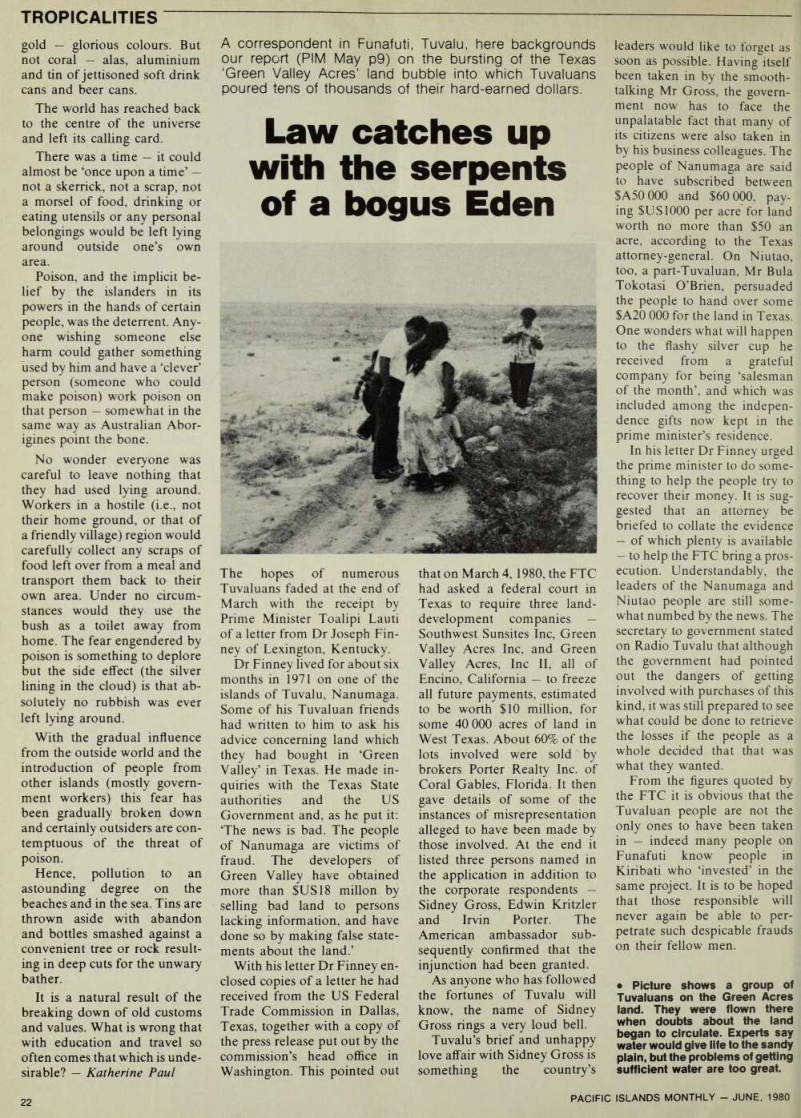
Picture shows a group of Tuvaluans on the Green Acres land. They were flown there when doubts about the land began to circulate. Experts say water would give life to the sandy plain, but the problems of getting sufficient water are too great.
USAAF Sgt finds
old Fiji flag
Fiji has got back what is poss
ibly its only remaining pre
independence governor’s flag
thanks to a US air force ser geant stationed at Langley Air Force Base, Virginia, USA.
TSgt Martin W. O. Collett Jr returned the flag at a ceremony in Washington in March. He discovered it while stationed in Fiji in 1969. ‘I was looking for a Union Jack which had either flown over the Government Building or the Government House,’ he said. His search took him to the governor general’s mansion, and to a soldier on the staff of the
governor-general’s aide-de
camp. ‘He told me to look through a cabinet they had there and pick out what I wanted from 10 or 12 Union Jacks waiting to be destroyed,’ Collett said. He made his find while looking
through the rumpled contents
of the cabinet.
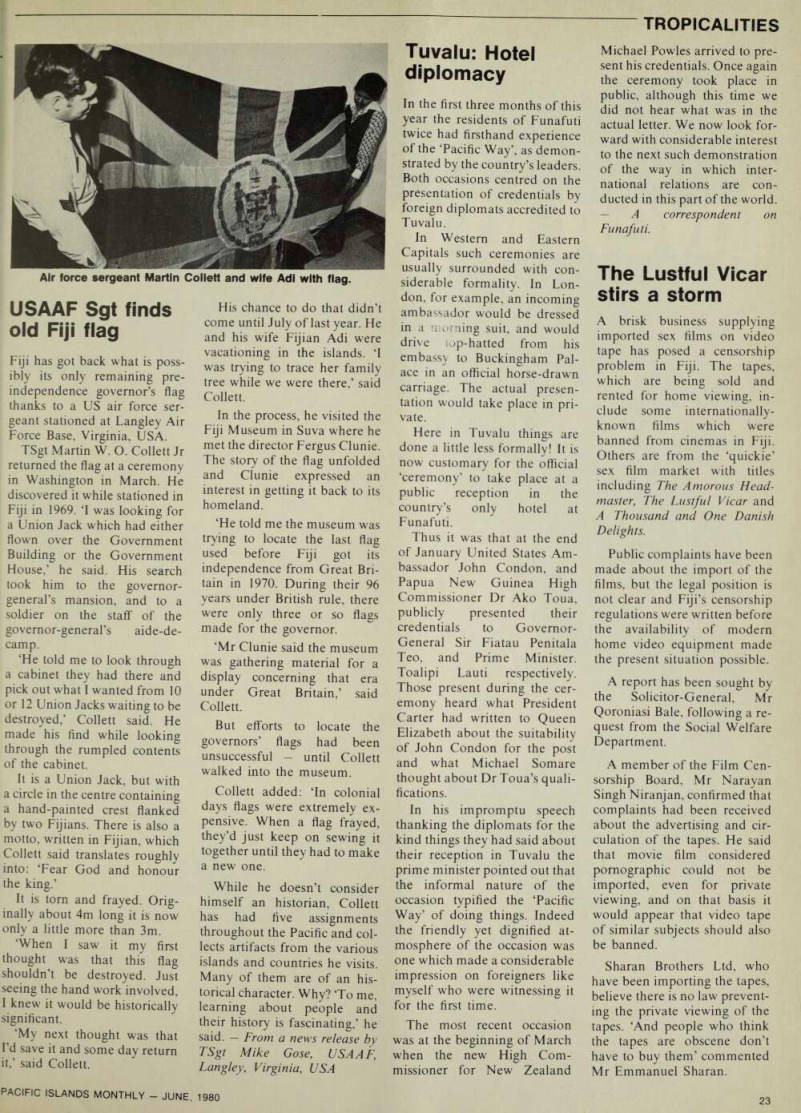
It is a Union Jack, but with a circle in the centre containing a hand-painted crest flanked by two Fijians. There is also a motto, written in Fijian, which Collett said translates roughly into: ‘Fear God and honour
the king.’
It is tom and frayed. Orig inally about 4m long it is now only a little more than 3m. ‘When I saw it my first thought was that this flag shouldn’t be destroyed. Just seeing the hand work involved, I knew it would be historically
significant.
‘My next thought was that I’d save it and some day return it,’ said Collett.
His chance to do that didn’t come until July of last year. He and his wife Fijian Adi were vacationing in the islands, i was trying to trace her family tree while we were there,’ said Collett.
In the process, he visited the Fiji Museum in Suva where he met the director Fergus Clunie.
The story of the flag unfolded and Clunie expressed an interest in getting it back to its homeland. ‘He told me the museum was trying to locate the last flag used before Fiji got its independence from Great Bri tain in 1970. During their 96 years under British rule, there were only three or so flags made for the governor. ‘Mr Clunie said the museum was gathering material for a
display concerning that era
under Great Britain,’ said Collett.
But efforts to locate the governors’ flags had been unsuccessful - until Collett walked into the museum.
Collett added: ‘ln colonial
days flags were extremely ex
pensive. When a flag frayed,
they’d just keep on sewing it
together until they had to make a new one.
While he doesn’t consider himself an historian, Collett has had five assignments throughout the Pacific and col lects artifacts from the various islands and countries he visits.
Many of them are of an his torical character. Why? ‘To me,
learning about people and
their history is fascinating,’ he said. From a news release by TSgt Mike Gose, USAAF, Langley, Virginia, USA
Tuvalu: Hotel
diplomacy
In the first three months of this year the residents of Funafuti twice had firsthand experience of the ‘Pacific Way’, as demon strated by the country’s leaders.
Both occasions centred on the presentation of credentials by
foreign diplomats accredited to
Tuvalu.
In Western and Eastern Capitals such ceremonies are usually surrounded with con siderable formality. In Lon don, for example, an incoming ambassador would be dressed in a morning suit, and would drive lop-hatted from his
embassy to Buckingham Pal
ace in an official horse-drawn carriage. The actual presen tation would take place in pri vate.
Here in Tuvalu things are done a little less formally! It is now customary for the official ‘ceremony’ to take place at a
public reception in the
country’s only hotel at Funafuti.
Thus it was that at the end of January United States Am bassador John Condon, and
Papua New Guinea High
Commissioner Dr Ako Toua,
publicly presented their
credentials to Governor- General Sir Fiatau Penitala Teo, and Prime Minister.
Toalipi Lauti respectively.
Those present during the cer emony heard what President Carter had written to Queen Elizabeth about the suitability of John Condon for the post and what Michael Somare thought about Dr Toua’s quali fications.
In his impromptu speech thanking the diplomats for the kind things they had said about their reception in Tuvalu the prime minister pointed out that the informal nature of the occasion typified the ‘Pacific
Way’ of doing things. Indeed
the friendly yet dignified at mosphere of the occasion was one which made a considerable
impression on foreigners like
myself who were witnessing it for the first time.
The most recent occasion was at the beginning of March when the new High Com missioner for New Zealand
Michael Powles arrived to pre sent his credentials. Once again the ceremony took place in public, although this time we did not hear what was in the actual letter. We now look for ward with considerable interest to the next such demonstration of the way in which inter national relations are con ducted in this part of the world.
A correspondent on
Funafuti.
The Lustful Vicar
stirs a storm
A brisk business supplying imported sex films on video tape has posed a censorship problem in Fiji. The tapes, which are being sold and rented for home viewing, in clude some internationally known films which were banned from cinemas in Fiji.
Others are from the ‘quickie’ sex film market with titles including The Amorous Head master, The Lustful Vicar and A Thousand and One Danish
Delights.
Public complaints have been made about the import of the films, but the legal position is not clear and Fiji’s censorship regulations were written before the availability of modern home video equipment made the present situation possible.
A report has been sought by the Solicitor-General, Mr Qoroniasi Bale, following a re quest from the Social Welfare
Department.
A member of the Film Cen
sorship Board, Mr Narayan
Singh Niranjan, confirmed that
complaints had been received about the advertising and cir culation of the tapes. He said that movie film considered pornographic could not be
imported, even for private
viewing, and on that basis it would appear that video tape of similar subjects should also be banned.
Sharan Brothers Ltd, who have been importing the tapes, believe there is no law prevent
ing the private viewing of the
tapes. ‘And people who think the tapes are obscene don’t have to buy them’ commented Mr Emmanuel Sharan.
Air force sergeant Martin Collett and wife Adi with flag.