The world leaves
pp. 21-22 · Read in the full issue
Tropicalities
For Mona Bailey
‘Big is beaut’
When Mona Bailey arrived in New Zealand from Apia in 1944, she could say only ‘yes, please’ and ‘no, thank you’ in English. Today, she owns three
‘big girl’ boutiques in
Auckland that draw clients not only from all over the city but also from Wellington, Christchurch and Dunedin.
She also conducts a sizeable mail order business.
In 1960, she returned to Apia, married and stayed there till 1968. Now, she has four children, all at secondary school.
Besides running a home and business, she lectures to women’s groups on the fashion problems of the ‘over endowed’ and has also featured on a Radio Pacific talk-back show.
Mrs Bailey understands the problems of ‘big girls’ she weighs in at 16 stone, having reduced from 22.
Her business began as a hobby five years ago and grew out of the fact that Samoan women, especially ministers’ and chiefs’ wives, could not buy pulatasis in Auckland but had to import them from home. Otherwise, they had no choice but to wear European dress. Since many required
supersizes, this posed prob
lems.
The clothes Mrs Bailey de signs have a definite Pacific flavour if only because New Zealand life has an increas ingly Pacific content. Pool par ties and outdoor entertaining call for kaftans, mu’umu’us and patio wear.
She certainly does not cater solely for Pacific Island women. Indeed 80% of her cus tomers are Pakehas whose size almost ostracises them from a society not geared to the idea that large is lovely even if rosy, billowy and amiable. For this reason, she sees her business as
a service to a sector of the com
munity never previously
catered for, and often the vic tims of frustration, foil) and fear.
Mrs Bailey finds that their size depresses many women, reducing them to tears, driving some even to the brink of suicide.
Stores do not help. Such large sizes as they carry tend to dowdiness, lack of colour, cut
and imagination, suiting the
wearer about as well as a top hat. Buyers for the stores have little idea of what ‘big girls’ want and wear. Manufacturers do not know what to make for them. Therefore, virtually no one specialises in large sizes which in most shops generally go no higher than 18. Mrs Bailey stocks up to size 36, a rarity in Auckland unlike Sydney, which has accepted the fact that the big woman needs public awareness of her needs.
Mrs Bailey regards good grooming as essential for the big woman who will stand out no matter how she tries to hide, to shrink like a cold monkey, to play down her presence.
Therefore, she aims to build confidence. With help and advice, she reckons she saves five marriages a year.
She recommends that the woman who makes Playboy’s playmates look like severe case of undernourishment should never go shopping with a friend, much less a slim one.
Therefore her shops have not
fitting rooms but consulting
bays for women who normally lack courage to ask for a size to fit a 60-inch bust or an 80-inch hip.
Some manufacturers make specially for Mrs Bailey. What she cannot get from them, a team of outworkers makes.
She also intends going into jewellery and accessories, further making hers the first boutiques, she believes, cater
ing for ‘big girls’ with young
styles.
T can’t sew and I can’t draw', she confesses but she can put her ideas across, illustrating,
elaborating, criticising, illumi
nating.
Women coming into her shop seldom leave with only one item. Some buy a whole wardrobe, will spend $lOOO in one crack and leave no longer feeling as if burdened with the misery of the Wandering Jew,
Molly G. Elliott in
Auckland.
Papa Doc takes
to the sea
Sir John Guise, one of the father figures of Papua New Guinea politics and a former governor-general of PNG, will sail in one of the Milne Bay canoes taking part in the sec ond stage of the Festival Armada, which will be one of the highlights of the Third South Pacific Festival of Arts to be held from the end of June
into July.
He will sail from Mullins Harbour to Port Moresby, a voyage of seven days.
The world leaves
its calling card
The New Hebrideans con sidered the New Hebrides the centre of the universe, and why not?
The centre must be some where and what better place than a verdant chain of isles with spokes radiating to the rest of the world, totally indif ferent to the rest of the world
and unaffected (they thought)
by outside influences? The glossy illustrated brochures speak of lucid emerald green sea water that folds you in its
satiny embrace, and tropic
scents with clean white sand beneath you and coral of vivid hues to gaze on.
True! But they don’t men tion the medley of colours that one now finds on the sandy bottom: orange, bright blue, shamrock green, silver and
Mona Bailey
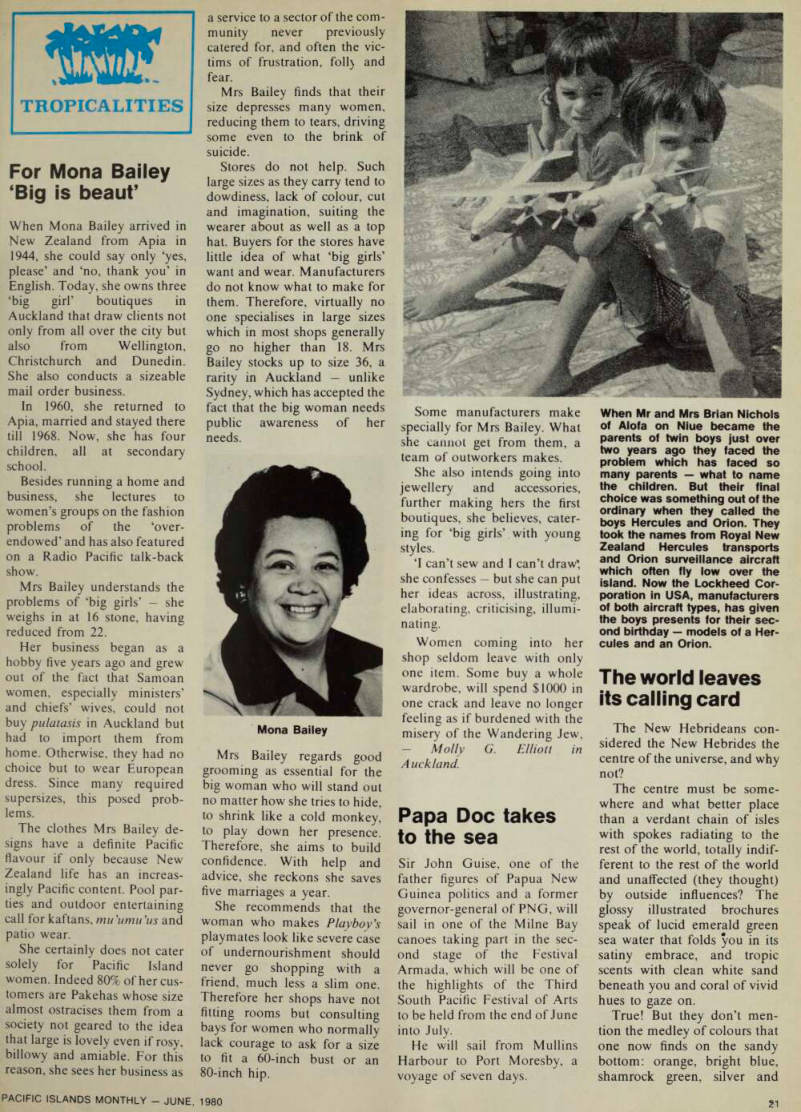
When Mr and Mrs Brian Nichols of Alofa on Niue became the parents of twin boys just over two years ago they faced the problem which has faced so many parents what to name the children. But their final choice was something out of the ordinary when they called the boys Hercules and Orion. They took the names from Royal New Zealand Hercules transports and Orion surveillance aircraft which often fly low over the island. Now the Lockheed Cor poration in USA, manufacturers of both aircraft types, has given the boys presents for their sec ond birthday models of a Her cules and an Orion.
gold glorious colours. But
not coral alas, aluminium and tin of jettisoned soft drink cans and beer cans.
The world has reached back to the centre of the universe and left its calling card.
There was a time it could almost be ‘once upon a time’ not a skerrick, not a scrap, not a morsel of food, drinking or eating utensils or any personal belongings would be left lying around outside one’s own area.
Poison, and the implicit be lief by the islanders in its powers in the hands of certain people, was the deterrent. Any one wishing someone else
harm could gather something
used by him and have a ‘clever’ person (someone who could make poison) work poison on that person somewhat in the same way as Australian Abor
igines point the bone.
No wonder everyone was careful to leave nothing that they had used lying around.
Workers in a hostile (i.e., not their home ground, or that of
a friendly village) region would
carefully collect any scraps of food left over from a meal and transport them back to their own area. Under no circum stances would they use the bush as a toilet away from home. The fear engendered by
poison is something to deplore
but the side effect (the silver lining in the cloud) is that ab solutely no rubbish was ever left lying around.
With the gradual influence from the outside world and the introduction of people from other islands (mostly govern ment workers) this fear has been gradually broken down and certainly outsiders are con temptuous of the threat of
poison.
Hence, pollution to an
astounding degree on the
beaches and in the sea. Tins are thrown aside with abandon and bottles smashed against a convenient tree or rock result ing in deep cuts for the unwary bather.
It is a natural result of the breaking down of old customs and values. What is wrong that with education and travel so often comes that which is unde sirable? Katherine Paul