Poll Supports
p. 39 · Read in the full issue
Boost In Aid
A public opinion poll carried
out by a political scientist indi cates that a majority of New Zealanders want to see their country maintain its level of overseas aid, and a ‘substantial minority’ favour an increase in aid.
The survey was carried out
by Dr Stephen Hoadley, As
sociate Professor of Political Studies at the University of
Auckland. Dr Hoadley points
out that even to maintain the present level of aid means increasing the annual grant to maintain the buying power of the funds. In real terms, he says, New Zealand aid to over seas countries is decreasing.
Dr Hoadley’s poll was car ried out from a cross-section of 251 people in the Eden elec toral district in New Zealand.
Here is what he had to say about the survey and its re sults:
Survey Report
The first question I asked was, ‘Do you think the New Zealand Government should give aid to develop the poorer countries?’
A total of 175 (69.6%) were in favour, 53 (21.4%) were opposed and 23 (9%) were undecided or had no opinion.
Clearly the aid programme
enjoys general public approval,
albeit with some exceptions.
The results, when compared with surveys in two overseas countries, indicated that New Zealanders were more in favour of giving aid than were people in USA and Britain.
However, New Zealand’s aid has gone up and down in the last few years. What did the Eden respondents think the level of aid should be?
Rather than ask for specific figures, which might be confus ing to the average person, I asked a question which British and Australian polls have introduced successfully: ‘Do you think New Zealand’s aid to the poor countries should be
increased, decreased, or kept about the same?’
Answering this question 53.7% said aid should be kept about the same, 34.2% said it should be increased and 12.1% said it should be decreased.
About half the respondents appear satisfied with the pre sent level. Fully 14% of respon dents volunteered the apology that New Zealand couldn’t
afford more, implying they
would favour an increase when economic circumstances im prove. But noteworthy was the predominance of those wishing aid increased over those wish ing it decreased, without quali fication.
It would be safe to say, then, that a preponderant proportion wish to keep aid at least up to the present level and a substan tial minority wish to increase it.
This stands in contrast to Government’s policy of hold ing dollar aid levels static with the consequence that real aid levels continue to fall in value.
Much early aid was moti vated by humanitarian sen timents. But more recently an element of self-interest has been formalised in official aid policy as a result of the invi tation in 1969 by Prime Minis ter Holyoake to the private sector to execute aid projects, partly to help offset the un favourable balance of pay
ments by stimulating the
export of New Zealand goods and services abroad.
And the Ministry of Foreign Affairs appears to view aid as an element in New Zealand’s
diplomatic outreach.
How do the public rate these three motives altruism, econ omic interests, and political interests - in the aid pro gramme? The Eden respon dents were asked to rate on a
four-point scale the desirability
of each of 11 reasons New Zealand might have for help ing poorer countries.
Altruistic reasons were found to have been chosen over economic self-interest reasons by 16 percentage points on the average.
One is inclined to conclude that altruistic reasons for aid carry more credibility than economic or political interest reasons among respondents.
Turning more specifically to
the kinds of aid projects New Zealand should implement, opinions vary from immediate relief through educational and agricultural assistance to long term infrastructural construc tion work. The Government favours the latter for reasons of administrative convenience, financial accountability, avail ability of expertise, and desire
by recipient government offi
cers.
Recently, however, develop mental theorists and inter national agencies have begun to acknowledge that ‘conven tional’ aid of this sort has not reduced poverty, created jobs, or filled basic human needs, particularly in the rural areas, and has sometimes resulted in showpiece projects which actu ally induced further social imbalances and economic dependency in recipient coun tries. I asked Eden respondents to rate the importance of vari ous sorts of aid projects.
Projects dealing with basic
human needs were found to have been chosen in favour of conventional aid projects by 10 percentage points on the aver age.
In summary, responses to the Eden poll suggest that New Zealanders wish to see overseas aid maintained at its present level or increased (which means raising the vote to keep up with inflation); that they wish the aid programme to be based more upon altruistic motives than economic or pol itical interests; and that they favour projects directed to serving basic human needs more than conventional infra structural or industrial
development.
Dr Hoadley
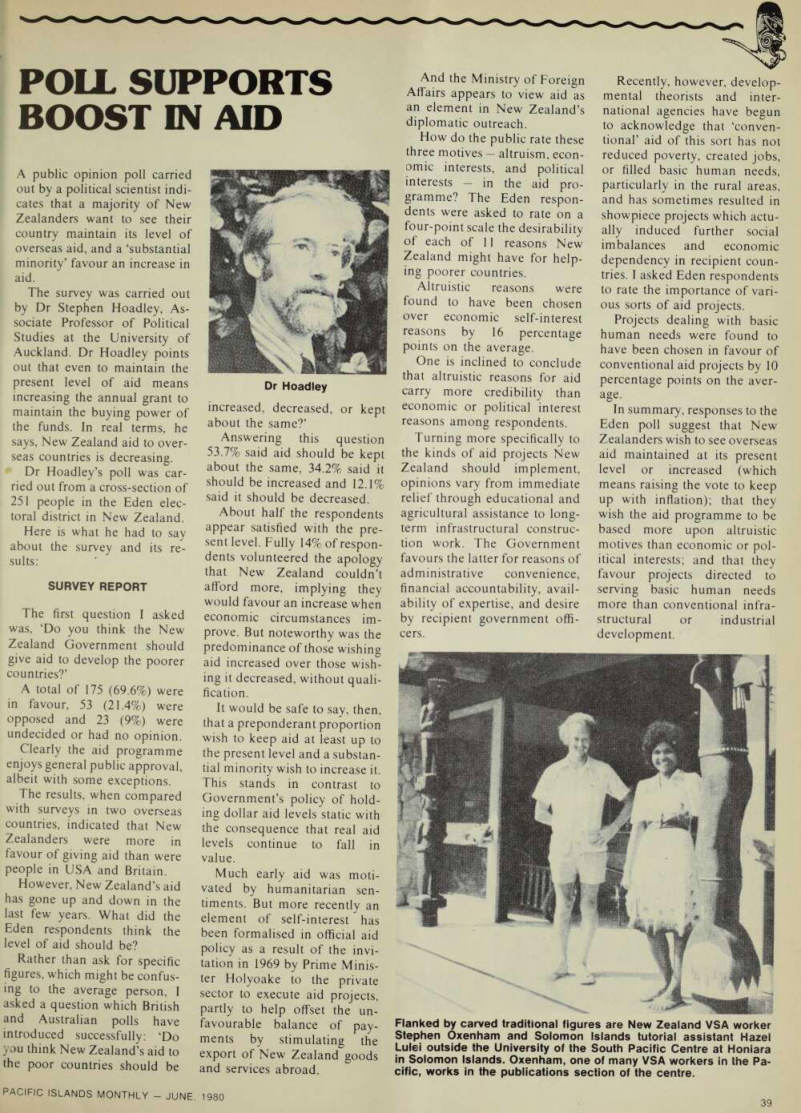
Flanked by carved traditional figures are New Zealand VSA worker Stephen Oxenham and Solomon Islands tutorial assistant Hazel Lulei outside the University of the South Pacific Centre at Honiara in Solomon Islands. Oxenham, one of many VSA workers in the Pa cific, works in the publications section of the centre.