a bucketing
pp. 63-64 · Read in the full issue
‘Colonial’ BPC gets a bucketing
The British Phosphate Com mission, for so many years in control of phosphate extraction operations on Nauru and Ocean Island, has been cri ticised for ‘colonial’ practices in its continuing administra tion of phosphate mining on the Indian Ocean island of Christmas.
The report of an Australian Government inquiry into Christmas Island goes so far as to recommend termination of BPC’s appointment as manag ing agent for the Christmas Island Phosphate Commission, a body formed for this specific
activity.
The inquiry also found that while BPC expected to close the operation by 1983, it is economically viable for another eight years. Moreover, this conclusion was reached on the basis of calculations of pay ment to island workers,* many of them recruits from Malaysia and Singapore, of the Aus tralian minimum wage. (The CIPC which had only two days before the report was due to be tabled in the Australian Parlia ment announced it would make a pay rise offer to the Union of Christmas Island Workers bringing them up at least to minimum Australian wage levels. The decision followed many months of agitation by the union on this and other issues.) The report of the com mission of inquiry, chaired by Mr W. W. Sweetland, de scribed the BPC as an organis ation which has ‘not adapted
quickly enough or willingly
enough to the passing of the colonial era’. Responsibility is put upon the shareholders, the governments of Britain, New Zealand and Australia.
It also described as ‘out
moded, discredited and in many ways repugnant’ the in stitutional framework on which Christmas Island oper ates. Recommending the abol ition of the post of Administrator, the report suggests that the Adminis trator’s residence should be made available to residents of the island for a purpose of their choice.
The finding that Christmas Island phosphate reserves, which have traditionally been of high quality with low costs of extraction, are expected to last another eight years will ease the minds of Australian and New Zealand farmers.
The nod for two
PNG schemes
The Papua New Guinea Government in March gave the final go-ahead for the develop ment of the Ok Tedi copper and gold deposit in the country’s remote Star Moun tains.
The mine is 15 km from the PNG-Indonesia border on top of 2070 m Mount Fubilan. It will cost about $27 million to
develop at today’s prices, and
have an expected life of 25-30 years.
The announcement by the then Prime Minister Michael Somare means that the inter national consortium of BHP, Amoco Minerals, and Copper Exploration Co of West Ger many has 12 months to arrange finance and marketing ar rangements for its products.
The announcement followed three weeks of tough nego tiations between the govern ment and the consortium. The talks followed the submission of the consortium’s $14 million
feasibility study in late 1979.
Consortium study figures — regarded as very conservative — say that there is more than $1 billion worth of gold and $6 billion worth of copper in the mountain.
The PNG Government intends to take up a 20% share in the development company, at a cost of about $46 million.
It already has a 20% share in the country’s other big gold and copper mine at Bougain ville.
Earlier, the government had announced that the $100 million Ramu sugar project will go ‘on stream’.
The project, designed to make PNG self-sufficient in sugar in five years, will be
managed by the London-based
agricultural development
company Booker McConnell.
The PNG Government will be the biggest shareholder in Ramu Sugar Ltd with 49% of the 25 million 1-kina shares issued. Next largest share holder will be the Common wealth Development Corporation of Britain with 25%.
Fiji firm wins
sugar rights
The Fiji firm of Yatulau Sun dartex Ltd has won the contract to buy and sell all Fiji’s sugar exports to South Pacific Forum countries for the next two years.
The South Pacific Bureau for
Economic Co-operation
(SPEC) said in a statement in March that agreement had been reached among Forum countries on sugar prices and quotas for 1980-81.
The agreement had been reached at a meeting of five Forum member countries: Fiji, Western Samoa, Kiribati, Tonga and Tuvalu. The Solomons and Nauru could not attend, and Papua New Guinea attended as an ob server.
Big NZ push in
Micronesia
A major push by New Zealand
exporters to gain a foothold in Micronesia is to be launched with the departure due on May 25 of an exporters’ delegation to the Marshall Islands and Guam, and possibly to the Northern Marianas and
Ponape.
Leader of the delegation, Gilbert W. Ullrich, vice president of the Export Insti tute of New Zealand, says stimulus was given to the plan by the opening of a new direct airline service from Auckland to Guam and Micronesia by Air Nauru, who were recently
granted landing rights in NZ.
At the same time a new direct shipping service was an nounced by the Daiwa Line to most ports in Micronesia and Guam.
The delegation, which has been given the status of an
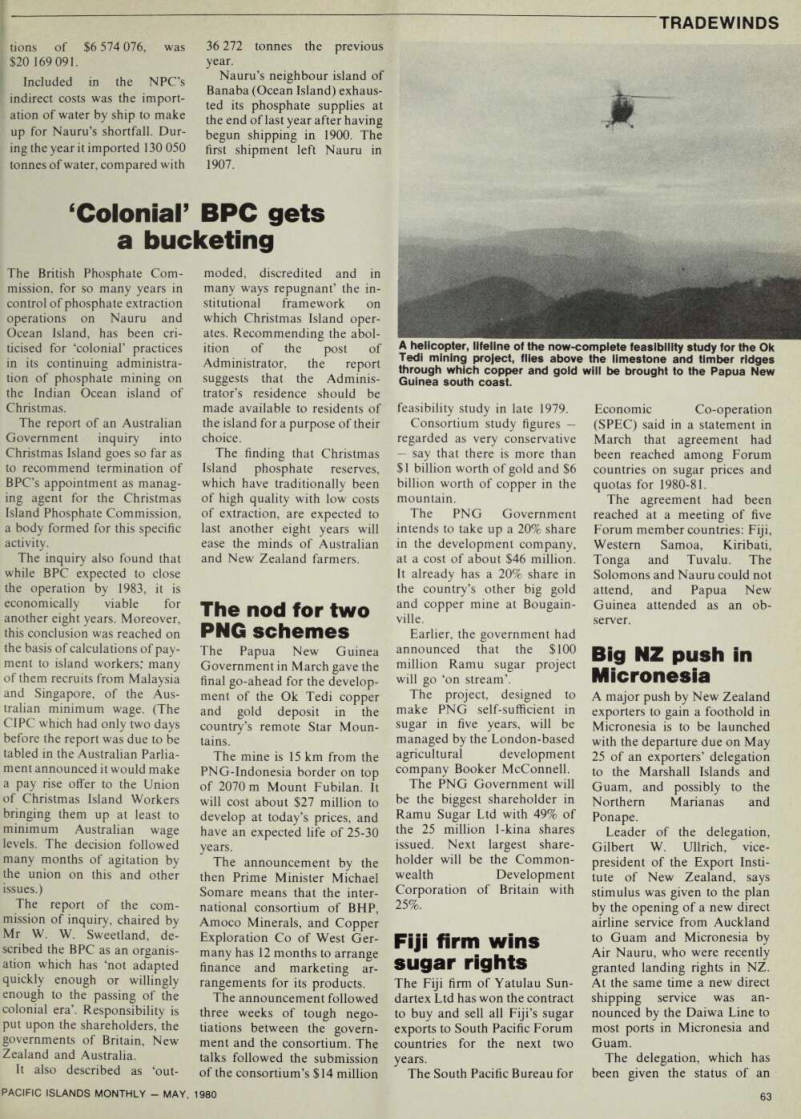
A helicopter, lifeline of the now-complete feasibility study for the Ok Tedi mining project, flies above the limestone and timber ridges through which copper and gold will be brought to the Papua New Guinea south coast.
official trade mission by the New Zealand Government, will also visit Honiara, Nauru and Tarawa.
BP heavily into
Fiji Industries
Bums Philp in April emerged as the largest shareholder in the
cement-making firm. Fiji
Industries Ltd.
Bums Philp (South Sea) Co bought out the 13.3% held by interests associated with CSR Ltd for S442 530.
With its original stake of 7.5%, BP thus controlled 22.8% and was expected to stand in the market for a month to accept all Fiji Industries shares at $2.50.
The purchase followed two other expansionary moves made in the Pacific by BP interests over the past year: in June 1979 BP (SS) paid $1.8 million for Cope Allman Inter national Ltd’s South Pacific Subsidiary: and in the follow
ing month bought the Papua
New Guinea-based Tutt Bryant Pacific Ltd for $3 million.
BP’s Pacific area subsidiaries provide more than half of the group’s annual profit. Accord ing to the 1979 annual report.
Pacific subsidiaries brought in $8.47 million of a total profit of $14.29 million. In 1978 the figures were $7.75 million of $11.23 million.
Qantas thanked
for airline aid
Qantas, the Australian air line which helped pull New Hebrides Airways out of its
pioneering problems, has sold
back the financial stake it held in the operation.
The equity has gone back to Bob Paul of Tanna Island in the New Hebrides, co-founder and chairman of New Hebrides Airways which became part of the Air Melanesiae consor tium. Qantas, Burns Philp and
British Airways joined New
Hebrides Airways 12 years ago to help put the then struggling operation on its feel.
New Hebrides Airways hosted a reception in Sydney last month to thank Qantas for
the aid and expertise it had offered over the years, not only to New Hebrides Airways but to other regional operators in the Pacific. Mr Paul presented a plaque to the Qantas Deputy General Manager, Ron Yates, to commemorate the occasion and to express his company’s thanks.
Mr Paul said that in 1967 the problems of his airline had appeared insurmountable and he had appealed to Qantas for help. ‘From that time on the future of the airline was never in doubt,’ he said.
He said that Qantas had organised the airline opera
tionally and administratively
and had supplied equipment
on a lease-purchase basis.
New Hebrides Airways was formed in 1960 using a single aircraft, a DH89 Rapide. which had earlier been an aerial am bulance in Queensland. The company still has many of its original New Hebridean share holders from Tanna, Aoba and Tongoa. It now operates as an element of Air Melanesiae using Britlen-Norman Island ers and Trislanders.
PNG plantation
takeover ends
The new government in Papua New Guinea has scrapped the controversial scheme under
which plantations owned by
non-nationals were being bought and distributed to Papua New Guineans.
However the move does not represent a switch in attitudes towards foreign ownership.
The six year-old acquisition
scheme had run into problems for a number of reasons and the previous Somare govern ment had already frozen it pending a review. The new Chan government is satisfied that the scheme has failed and that the money being spent on it would be better applied to
new rural development.
Announcing the end of the scheme the Prime Minister. Sir Julius Chan, said that PNG could not afford to confuse ac
quisition with development.
He said that too often money had been paid to acquire run down properties and the money had been repatriated out of PNG. The same amount spent on opening unused land would have stimulated the local economy and retained the money in the country.
The government’s decision also follows representations from a number of PNG com munities which claim that the retention of properly-managed
plantations, even if foreign
owned, is a stimulus to overall
development.
Since the scheme was intro duced, about SA6.B million has been spent to buy 54 planta tions. Many of the local communities which bought the properties from the govern ment on long-term loans have run into management and financial difficulties and some of the properties have ceased
production.
Bob Paul, chairman of New
Hebrides Airways. ‘Qantas put
us on our feet,’ he said.
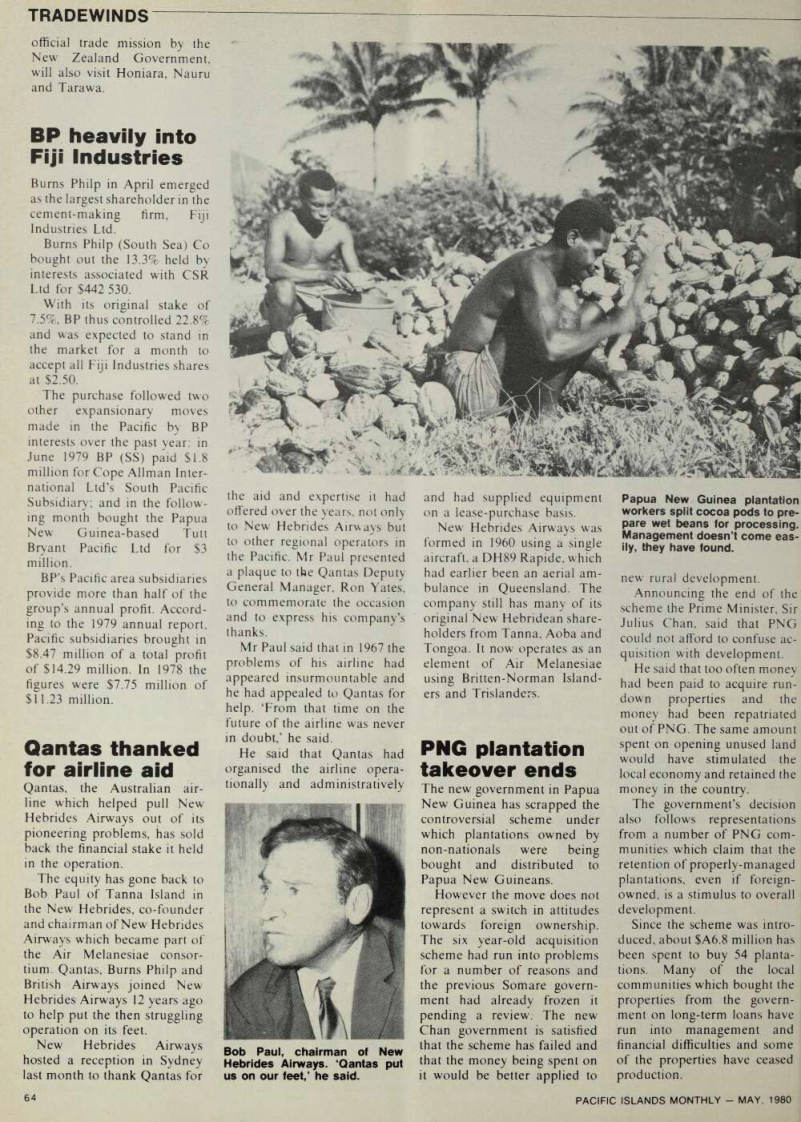
Papua New Guinea plantation workers split cocoa pods to pre pare wet beans for processing.
Management doesn’t come eas ily, they have found.