Nauru phosphate: How much
pp. 61-63 · Read in the full issue
Trade
Winds
Nauru phosphate: How much longer, 8 years or 13?
The Nauru Phosphate Corpor
ation has officially estimated that Nauru’s phosphate
supplies the republic’s life
blood will last only another 13 years at the ‘present antici
pated rate of depletion’.
It made its estimate in a re port tabled in the Nauru Par liament in March following a suggestion made in Nauru’s
independent weekly news
paper the previous week that Nauru may have only eight years to go before the phos phate is exhausted.
The Nauru Post said that it had made its own investigation in the absence of any official statement ‘on this nagging
question’.
The newspaper, which is edited and part-owned by a former President of Nauru, Bernard Dowiyogo, said that it had heard from a reliable source that the lands which were at present being mined by the NPC were yielding less phosphate than had been expected because of their
shallower depths.
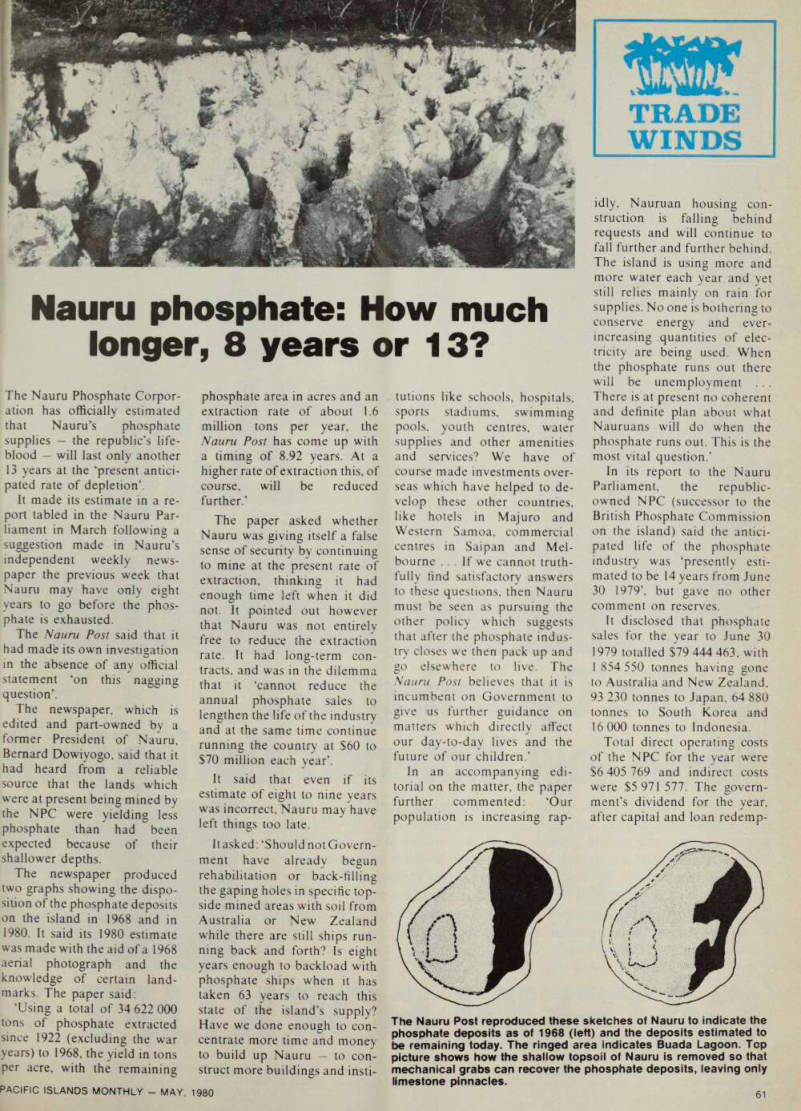
The newspaper produced
two graphs showing the dispo
sition of the phosphate deposits on the island in 1968 and in 1980. It said its 1980 estimate was made with the aid of a 1968 aerial photograph and the knowledge of certain land marks. The paper said: ‘Using a total of 34 622 000 tons of phosphate extracted since 1922 (excluding the war years) to 1968, the yield in tons per acre, with the remaining
phosphate area in acres and an extraction rate of about 1.6 million tons per year, the Nauru Post has come up with a timing of 8.92 years. At a higher rate of extraction this, of course, will be reduced further.’
The paper asked whether Nauru was giving itself a false
sense of security by continuing
to mine at the present rate of extraction, thinking it had enough time left when it did not. It pointed out however that Nauru was not entirely free to reduce the extraction rate. It had long-term con tracts. and was in the dilemma that it ‘cannot reduce the annual phosphate sales to lengthen the life of the industry and at the same time continue running the country at $6O to $7O million each year’.
It said that even if its estimate of eight to nine years was incorrect, Nauru may have left things too late.
Itasked; ‘Should not Govern
ment have already begun
rehabilitation or back-filling the gaping holes in specific top side mined areas with soil from Australia or New Zealand while there are still ships run ning back and forth? Is eight years enough to backload with phosphate ships when it has taken 63 years to reach this state of the island’s supply?
Have we done enough to con centrate more time and money to build up Nauru to con struct more buildings and insti
tutions like schools, hospitals, sports stadiums, swimming pools, youth centres, water supplies and other amenities and services? We have of course made investments over seas which have helped to de velop these other countries, like hotels in Majuro and Western Samoa, commercial centres in Saipan and Mel bourne ... If we cannot truth
fully find satisfactory answers
to these questions, then Nauru must be seen as pursuing the other policy which suggests that after the phosphate indus try closes we then pack up and go elsewhere to live. The Nauru Post believes that it is incumbent on Government to give us further guidance on matters which directly affect our day-to-day lives and the future of our children.’
In an accompanying edi torial on the matter, the paper further commented: ‘Our
population is increasing rap
idly, Nauruan housing con
struction is falling behind requests and will continue to fall further and further behind.
The island is using more and more water each year and yet still relies mainly on rain for supplies. No one is bothering to conserve energy and ever
increasing quantities of elec
tricity are being used. When the phosphate runs out there will be unemployment .. .
There is at present no coherent and definite plan about what Nauruans will do when the phosphate runs out. This is the most vital question.’
In its report to the Nauru Parliament, the republic owned NPC (successor to the British Phosphate Commission on the island) said the antici pated life of the phosphate
industry was ‘presently esti
mated to be 14 years from June 30 1979’, but gave no other comment on reserves.
It disclosed that phosphate sales for the year to June 30 1979 totalled $79 444 463, with 1 854 550 tonnes having gone to Australia and New Zealand, 93 230 tonnes to Japan, 64 880 tonnes to South Korea and 16 000 tonnes to Indonesia.
Total direct operating costs of the NPC for the year were $6 405 769 and indirect costs were $5 971577. The govern ment’s dividend for the year, after capital and loan redemp-
The Nauru Post reproduced these sketches of Nauru to indicate the phosphate deposits as of 1968 (left) and the deposits estimated to be remaining today. The ringed area indicates Buada Lagoon. Top picture shows how the shallow topsoil of Nauru is removed so that mechanical grabs can recover the phosphate deposits, leaving only limestone pinnacles.
tions of $6 574 076, was $2O 169 091.
Included in the NPC’s indirect costs was the import ation of water by ship to make up for Nauru’s shortfall. Dur ing the year it imported 130 050 tonnes of water, compared with
36 272 tonnes the previous year.
Nauru’s neighbour island of Banaba (Ocean Island) exhaus ted its phosphate supplies at the end of last year after having begun shipping in 1900. The first shipment left Nauru in 1907.