Rescuing
p. 45 · Read in the full issue
some of Samoa's history
History of Samoa. By K. R.
Lambie. Presented by Adele R.
Meredith. Published by Com mercial Printers Ltd, Apia,
1979. Sws9.So
Finding no book on Samoan history available for use in schools, the late K. R. Lambie, New Zealand-born Director of Education in Western Samoa
1948-59, was ‘greatly pleased
when he chanced upon’ a copy of Samoan traditional history which had been transcribed by the Marist Brother, the late Fred Henry. Since there was no written history in Polynesia be fore the coming of Europeans, this record derives entirely from oral tradition. In this tra dition, the skill, oratory, and genealogical memory of the Samoan failauga were and are
deservedly renowned.
It was essential that this should be so. Not only was it necessary for individuals to know their descent and status in the extremely stratified Samoan hierarchy, but such knowledge was needed to sub stantiate their claims to titles, status and land.
The credence attributed by anthropologists to oral tra dition in the Pacific, and its in terpretation, has been dealt
with elsewhere, notably by
P.M. Mercer in an essay in the
Journal of Pacific History. But
even the non-academic will understand how details of his tory and genealogical suc cession transmitted orally from generation to generation are vulnerable to error, change of
emphasis, and, especially, to
manipulation of their time scale.
Prehistoric myths of folk memory become fable, fables evolve into legends, and,
eventually legends become
accepted ‘history’. Moreover,
after European missionary
contact, orators were doubtless tempted to attenuate their nar rative and excise the less at tractive characteristics of their forefathers cannibalism for example in the light of the new lotu.
The time scale is especially vulnerable as the recurrence of similar names in different gen erations leads to a telescoping of time. To align traditional Samoan history with contem porary European historical dates, Lambie adopted the usual empirical estimate of 30 years to a generation. But the
Polynesian Society (Bishop
Museum, Hawaii) considers 25 years to be more accurate in this context.
Be that as it may, it cannot detract from the value of this book, and Adele Meredith and her collaborators deserve the
highest praise for rescuing a
work which not only preserves the history of pre-European Samoa, but is also a monument to Lambie and his valuable so journ in Western Samoa. The book, a facsimile of Lambie’s
original typescript, includes
some old photographs and, for
the purist, several parallel
translations. Beautifully repro duced on very high quality paper and bound in hard covers, it is a credit to all con cerned with its production.
With its publication, time and circumstance now make possible the revelation of a
little known sequel. Although
this book ends with the coming of the Europeans (about 1830) it is quite clear from Lambie’s original introduction that he
intended to continue the his tory ‘up to the present time’ (1958), and it is not generally known that, in collaboration with the English Pacific his torian S. Masterton (later Mrs S. Smith), in fact he did com plete his task.
The 50s in Samoa were years of intense political activity. The euphoria of the ‘dollar manna’ of World War II and the broadening of world contacts by a younger generation, left a vacuum in which a resurgence of nationalism and the cry of Samoa mo Samoa found fertile ground. O. F. Nelson had died in 1944, but his immediate de scendants (the present Prime Minister, Tupuola Efi, is his grandson), and many who, in the ‘troubles’ of 1926-36, had taken up arms in the Mau re bellion against the New Zealand Mandated Adminis tration, were very much alive and active in petitioning the United Nations for assistance in the attainment of indepen dence.
In this, his later book, Lam bic was no longer dealing with orally transmitted accounts of
history, but with heavily
documented recent events, and although he wrote in the introduction ‘as the recent his tory concerns people still living it is ground upon which one must tread lightly’, he and his collaborator did not temper their account of the Mau re bellion, nor their history of the
vacillating policies of success
ive New Zealand governments in Wellington, or of the re peated ineptitudes of the ad ministration at Vailima.
It would appear that this later history, written as it was for senior school students, was too meaty a dish to be set be fore adolescents excited by the prospect of independence from New Zealand, and notwith standing that it was printed and bound, its distribution was not approved. Lambie retired in July 1959, and at about this time the copies of the publi cation were destroyed.
Fortunately, certainly one,
and possibly two, copies sur vived this biblioclastic exercise, and now, after more than 20 years, and with a cooling of passions, it may well be that some day it will be published as Lambie intended. Leonard Goodman.
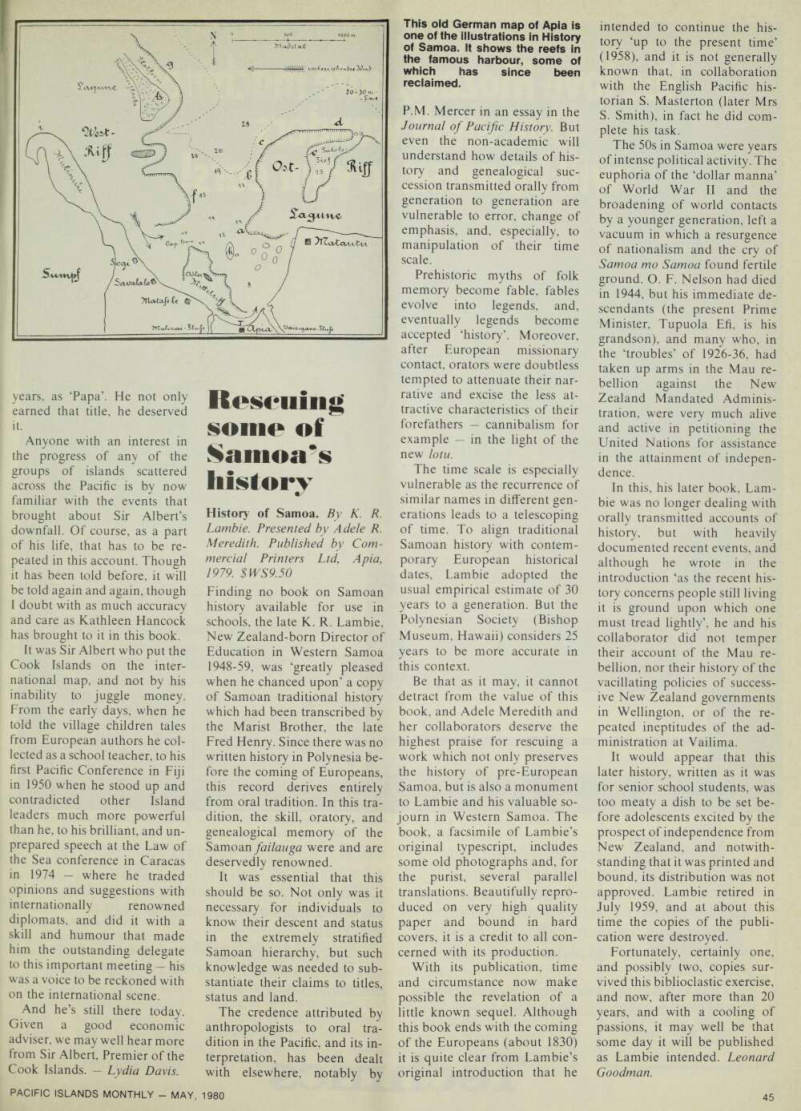
This old German map of Apia is one of the illustrations in History of Samoa. It shows the reefs in the famous harbour, some of which has since been reclaimed.