Sir Albert_and
pp. 44-45 · Read in the full issue
Books
Sir Albert_and the f 'money that was eaten ...'
Sir Albert Henry: His Life and Times. By Kathleen Hancock.
Published by Methuen, New Zealand. 5NZ9.95.
The choice of Kathleen Han cock as a biographer of Sir Albert Henry is a happy one.
Almost 20 years of factual reporting on the comic opera goings on of the Pacific Islands have given the author not only a facility for separating small amounts of fact from large amounts of fiction, but, having laboriously marshalled what is nearest to the truth, for untan gling the skein, sorting out a logical timetable of events, and then presenting them to the reader in fresh and lively
style.
So much has been written and said about Sir Albert and his sometimes innocent, or often naive, efforts to remain in the seat of Premier of the Cook Islands that seeing his name on the cover of a full-length book might tempt a would-be reader to say ‘Oh no, not again!’, and pass on. However, this book is more than the biography of one man. It is a carefully researched history of the Cook Islands and their past policies and politics, dating back to the arrival of the first white settlers sailors, missionaries and ne’er do wells.
They’re all in here, the individuals each described in terse prose that gives one an
immediately clear picture of
what, when I lived in the islands, we used to call ‘old island characters’. They were men who, with no qualifi cations whatever for the job sei about shaping the destiny of the Cook Islands and, in ad dition, were the progenitors of most of today’s leading famil ies, including that of both Sir Albert and Lady Henry. Now it is only in the more remote islands of the group that a leader can boast that he or she is of pure Polynesian descent.
That dash of European inherit
ance still seems to mean white equals clever which it does not.
But of one thing you can be sure; among the many and varied talents handed down to today’s mixed-blood Cook
Island legislators, now carrying
a heavy responsibility of steer
ing their tiny islands safely into
contemporary society, a strong financial sense remains totally absent. What Kathleen Han cock refers to as the ‘barn dance’ Sir Albert’s frantic endeavours to launder a vast sum of money through the financial labyrinth, and have it come out spotless at the other
end, while remaining spotless
himself would have non plussed a Rockefeller or a
Rothschild. What chance did a
Henry have?
The Cook Islanders are talkers. They come up with ideas of breath-taking
ingenuity, with only vague
notions of how to put them into effect and pay for them.
Their hospitality is deservedly
legendary. Each new idea must be celebrated, and never mind the cost. They are big spenders and eager borrowers. But they have never quite got the hang of the idea of projecting a budget and sticking to it, much less of balancing it now and
again.
The author likes the islanders’ expression ‘the money is eaten’. She tells us of Sir Albert’s talent for fund-
raising, but she also makes it clear that once raised, the funds just slipped away, here and there, no one quite knowing
exactly where.
Not even the dazed auditors sent by the New Zealand government to try to balance the books could fathom the large figures on the credit side and the often total absence of any figures at all on the debit side. They came and went, marking their reports ‘Con
fidential’ and hoping they
would get lost in the New Zealand system before anyone noticed. They still seem to be lost.
Right from his boyhood, we learn that when it came to schemes at first for his own per sonal improvement and later for the improvement of the economics and life-style of his people, Albert Henry was a whizz. One loses count of the jobs he took in New Zealand, at first to make a comfortable life for his family, and later move up in the trade union movement and to widen his political education. He worked like a navvy, often doing four things at a time. But despite what must have been an exhausting life, he always had time to care for his people.
He worked and cared for the confused newcomers who had abandoned hope of making a living in their homeland; he cared about the exploitation of the growers by the trading companies. The growers, as usual mistaking credit for gift, could not understand why the traders seized their plantations for non-payment of debt.
He cared about the shipping
companies high-handedly
withdrawing transport, setting
the fruit prices plummeting.
Even though he lived in New Zealand, far away from what was happening in the Cooks, he worried about dirty drink ing water, unpaved roads, lack of access to the outer islands, poor shipping and slave wages for those with brown skins. He cared about the appalling fig ure of 34% infant mortality rate, caused, and I quote, by ‘malnutrition of mother and child resulting in death of the infant from pneumonia’.
He saw himself as the saviour of his people and he worked towards that goal. He liked to refer to himself, in later
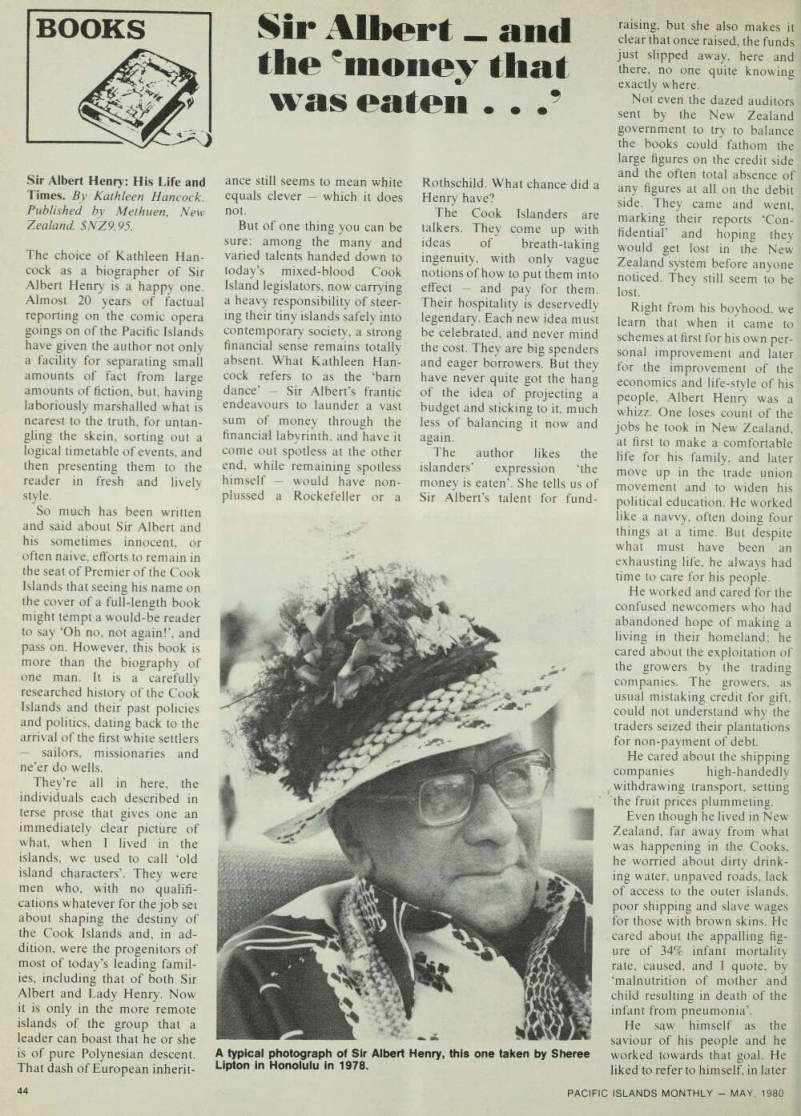
A typical photograph of Sir Albert Henry, this one taken by Sheree Lipton in Honolulu in 1978.
years, as ‘Papa’. He not only earned that title, he deserved it.
Anyone with an interest in the progress of any of the groups of islands scattered across the Pacific is by now familiar with the events that brought about Sir Albert’s downfall. Of course, as a part of his life, that has to be re peated in this account. Though it has been told before, it will
be told again and again, though
I doubt with as much accuracy and care as Kathleen Hancock has brought to it in this book.
It was Sir Albert who put the Cook Islands on the inter national map, and not by his
inability to juggle money.
From the early days, when he told the village children tales from European authors he col lected as a school teacher, to his first Pacific Conference in Fiji in 1950 when he stood up and contradicted other Island leaders much more powerful than he, to his brilliant, and un prepared speech at the Law of the Sea conference in Caracas in 1974 — where he traded
opinions and suggestions with
internationally renowned
diplomats, and did it with a skill and humour that made
him the outstanding delegate
to this important meeting — his was a voice to be reckoned with on the international scene.
And he’s still there today.
Given a good economic adviser, we may well hear more from Sir Albert, Premier of the
Cook Islands.
Lydia Davis.