Exit
pp. 56-58 · Read in the full issue


Trade
Winds
Exit Mister Gross
Tuvalu Prime Minister Toalipi Lauti’s dream of achieving prosperity for his country
through a partnership with
Californian real estate dealer Sidney Gross has ended. In a radio address on Funafuti he said that the joint venture with Mr Gross for the creation of a fishing fleet for Tuvalu was off.
Such a scheme would lose money, he said, in what was widely regarded as an honest and dignified admission that he had been wrong in planning the deal.
This seems to have ended an adventurous dream which began for Mr Lauti when he flew to the United States in February, 1979, and handed a cheque for SASSO 380 to Mr Gross, who promised to invest it at 15% and negotiate for the purchase of fishing boats to be financed from a $5 million loan which Mr Gross would raise.
The fleet, of four ships, would earn more than SUS 9 million in four years, 80% of the profit going as repayment for the $5 million loan. The rest would go into Tuvalu’s investment account to be handled by Mr.
Gross.
In his radio address, broad cast in the local language, Mr Lauti told his people that the Planning Department had advised him that a joint fishery venture would be a loss to Tuvalu and to Mr Gross. He had seen Mr Gross in Honolulu and told him that the venture was ended because of the high cost of running a fish
ing fleet.
Mr Gross, said the Prime Minister, had asked him to postpone his decision to end
the scheme until his experts; had reviewed the situation. He: had expected one fishing boat:
to be ready by February 1.
Mr Lauti told his listeners: ‘Since the Planning Officer has; revealed that nothing will be; gained from it, you are now 1 informed that this will be post poned until such times that the: world currency is more: stable.’
He added that his govern ment was having talks with interests in Japan,, South Korea and Taiwan andl ‘from what we know the talks are progressing well’.
In December, parliament! was told that Mr Gross had! been asked for the return of the; $555 000-plus which Mr Lautii had invested in Mr Gross’ Blue; Chip Realty. The money was needed to buy the Tuvaluans into a joint venture withr Barclays Bank International! which will open a bank onr Funafuti.
Meanwhile, many\ Tuvaluans who had paid a totall of $75 000 for land in Greenr Valley, Texas, are also askings for their money back.
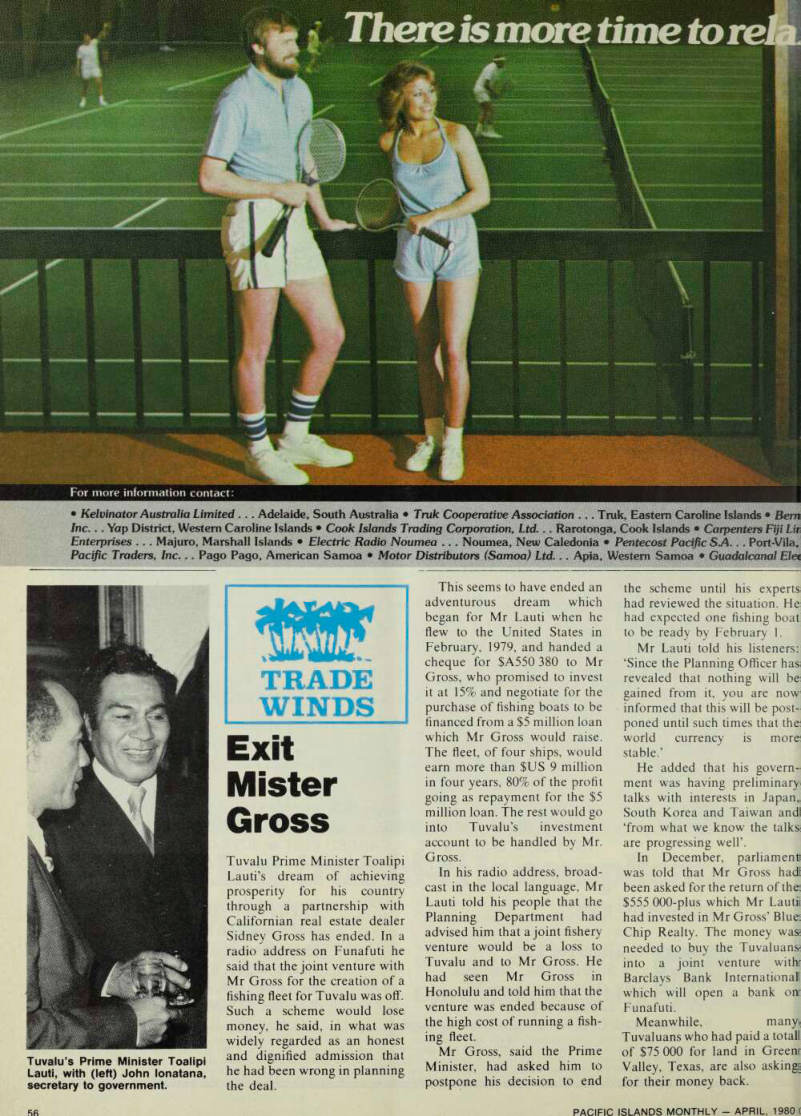
Tuvalu’s Prime Minister Toalipi Lauti, with (left) John lonatana, secretary to government.
All-in-all, it seems clear that Mr Gross and Tuvalu have parted company.
Profit Lifts
; Or Bp, Wrc
fhe South Pacific’s two trading ;iants, Burns Philp and Car >enters, have reported big lifts n profits for the half year to he end of 1979 - Burns Philp ip by 20.8% to $7 111 000 and Carpenters by 73% to ;6 090 000.
The former’s islands sub idiary, Burns Philp (South lea) Co Ltd, contributed its [uota to the group’s profitable
ix months through its
•ranches in Papua New juinea and the New Hebrides /hich showed increases in sales nd profits, mainly in the lotor divisions. For some sason Fiji and Western Samoa on’t merit a mention in the iterim report to the Sydney
tock Exchange.
Carpenters reported lower rofits from Fiji, mainly
irough the merchandising op
rations and the copra mill, but lere were strong profit contri
butions from the motor div ision and the engineering support services, thanks to the Monasavu hydro-electric pro ject. The Papua New Guinea operations increased their
profit through the motor, plan
tation and oil mill divisions and merchandising, but the tea and coffee estates had reduced output and profit because of
drought.
Burns Philp has also an nounced a rights issue of shares, the first cash issue to its shareholders for 24 years. It will be on a 1 for 4 basis at $l.BO a share to registered shareholders. This will raise $l6 736 932 to supplement funds required for the continu
ing growth of the group’s oper
ations. During the six months the group acquired Cope All man (South Pacific) Ltd, which has a biscuit factory and a soap factory in Rodwell Road, Suva, and Tutt Bryant Pacific Ltd, of Papua New Guinea which will contribute to the group’s motor division.
Carpenters reported selling
the Southern Pacific Insurance Co Ltd.
Windfall for
Malolo
Malolo Islanders in Fiji received $lO 000 a block for 12 blocks on their small island on
which luxury holiday homes
are being built. On top of that they well get an annual rental for the land.
Mr Errol Fifer, a Sydney
property developer, recently
raised $1.3 million from Aus tralians to buy the luxury homes. The resort is expected to open in April.
The homes on Malolo Island, which is west of Nadi Airport, form part of a private club, the Naitasi, which is owned by residents of the re sort. Each has two adjoining bures which may be used by friends.
PNG inflation
up, but . . .
Papua New Guinea’s inflation rate for 1979 was 7.9%, up 1.9% from the previous year.
Finance Minister Barry Holloway said the rise was
reasonable by world stan dards.
He added: ‘Most countries in the world, especially our major trading partners, have much higher inflation rates. Our country inevitably feels the effect of that when we import products from countries with
higher inflation.’
Of Spec
and OPEC
Armed with a brief prepared by the South Pacific Bureau for
Economic Co-operation
(SPEC), a delegation of Islands countries will go to Vienna later this year to ask for aid from the Organisation of Pet roleum Producing Countries
(Opec).
The delegation will ask for guaranteed fuel supplies at concession prices as a help in cushioning the shock of high energy costs on their fragile economies.
The delegation, which will be at ministerial level, aims to have a report ready for the next
South Pacific Forum meeting later this year.
Members of the delegation have not yet been chosen.
3 times to
Honolulu
Air Micronesia will restore its
third weekly flight between
Ponape and Honolulu from May 1. The flights were discon tinued last October when the airline withdrew its third jet operating in Micronesia after it failed to secure the right to fly between Osaka, Japan, and
Saipan.
President of Continental Air Micronesia Dan Peck told a conference on Ponape in February that he did not know how long the third flight would be in operation. It may be dis continued after September if traffic falls off seriously after summer.
Hydro-power
plans in PNG
Papua New Guinea’s Elec tricity Commission (Elcom) is planning a massive power scheme which could involve as
many as 12 power stations on the Vanapa River outside Port Moresby.
The scheme could eventually produce between 1200 and 1500 megawatts a day.
Port Moresby at present uses only 38 megawatts a day. The scheme is aimed at encourag
ing large-scale foreign invest
ment in the national capital district.
Water used in the scheme would drop several thousand metres from two lakes built on the 4000-metre Mount Albert Edward, about 90 km north of Port Moresby. It would cascade through a series of hydro electric stations on the Vanapa River, and into a third weir closer to the coast.
The scheme is planned in stages, with moves from one to
another depending on develop
ment of demand.
In another move to develop PNG’s hydro-power resources, Australia’s Snowy Mountains
Engineering Corporation
signed an agreement in February for a SA73 million scheme to be built in the West ern Highlands.