ssm plans for fishing boats,
pp. 61-63 · Read in the full issue
ports, in Solomon Is., Tonga
Ships
Projects with price tags totali ng more than $5 million are mder way in Solomon Islands md Tonga with the purpose of jpgrading the fishing indus ries of the two countries. • In Solomon Islands, 10 )ole and line ferrocement fish ng vessels are being built with i $3.6 million loan from the Vsian Development Bank, md • In Tonga, the European
iconomic Community and the
r ongan Government have greed on a $2 million EEC
unded fishing harbour project
t the Nukualofa waterfront.
Jimmy Cornell reports on
he developments in Solomon
slands: Ten pole and line
errocement fishing boats are
o be built by a shipyard set up or the purpose by National r isheries Development Ltd at ; asapi, on Tulagi, an island ome 32km from Guadalcanal cross the notorious Iron Bot om Sound, graveyard of scores f Japanese, American and Australian warships. The pro pel is financed by a $3.6 lillion loan from the Asian )evelopment Bank, the ompany itself having a 75% articipation from the olomon Islands Government nd 25% from Solomon
(Taiyo,) a joint Solomons- Japanese fishing venture.
General manager of the
Sasapi shipyard is Trevor
Holmes, a UK fisheries expert from Grimsby, who is con vinced that building in ferro cement is the most advan tageous method for a develop ing nation. In his opinion, building of the hulls can start more or less immediately,
using locally available labour
and very little equipment, pro vided one has a ferrocement expert supervising the initial stages of the project.
Building in ferrocement is usually a labour-intensive method, and thus expensive in a country where wages are high. But it can be very econ omical where labour is easily available and cheap. The Solomons were ideally suited for it, as there were a few welders, metal workers and plasterers available, who had worked in ferrocement before, and even some shipwrights who had learned their trade on locally built timber boats.
According to Trevor Holmes, one of the fer rocement hulls should cost only 60% of the price of a similar hull built in steel, fibreglass or timber.
The project started in August 1978 on the site of a former boatyard. By the end of 1979 the first hull was ready for launching, while the second hull was reaching the p astermg stage The boats will have a typical Japanese look about them, with an elongated beak and fishing platforms all around. They will carry
Japanese skippers and fishing
masters from Okinawa. But the entire crew of 23 will be made up of Solomon Islanders. The
fishing method employed by
these boats will be the proven
Japanese technique of spraying
the chosen area first, followed by pole and lining with live b a j t Designed by Auckland naval architect Jerry Breckveldt, the boats will be 24 m LOA the hull having a length of 20 m, breadth 6m, draft 2.73 m.
They will have an ice capacity of 27.5 m 3, but no refrigeration, as they will be used as day boats only, returning to base each night to land the catch and load the bait for the next day’s fishing. Propulsion will be provided by a 450 hp Caterpillar engine, giving a speed of 10.5 knots. Each boat will be equipped with two generators to provide electricity, drive the
pumps etc, a G & M of 34 KVA, and a smaller Yanmar of 4 KVA for emergency use.
Aware of one of the major shortcomings of a ferrocement hu „ ? |a(era , ; re . sistanc /_ Trevor Holmes is ■ t 0 build the boats as stron 5 as ible bu( without mak ing them too heavy in the procesf. Watson’s mesh is used throughout , with two , a s inside and thrce outside . V he side decks will be of fer . rocement, but superstructure and imerior wi „ be timber The estimated fishing weight wi |, be about , 30 tonnes.
shipyard has a large
building shed in which two hulls can hashed side by Slde - Projected time from hull
laymg t 0 commissioning is 12
months four months for loftm g and armature work, four m °nths for plastering, curing,
painting and launching, plus a
our mont hs for the fitting-out, to be carried out afloat.
Obviously the first two boats are taking longer: the first will be 17 months, the second 15 months. But the next eight hulls should be rolling off every four months after that, so that the projected 10 vessels
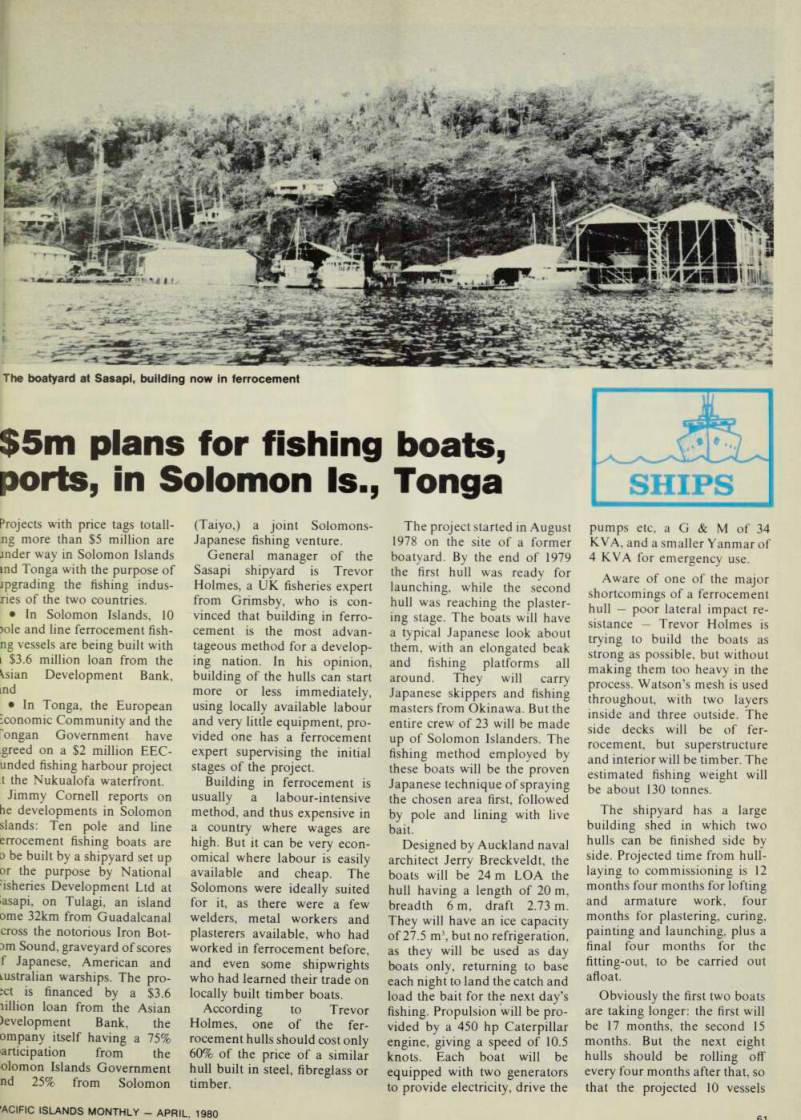
The boatyard at Sasapi, building now in ferrocement
should take only four years to build.
Besides the general man ager, three foreign experts a
ferro specialist, an engineer
and a shipwright are also
employed by the yard, all pro
vided by either British or New Zealand aid.
A total of 120 local men work at the shipyard, about 75% of them employed on the boats under construction, the
remaining doing general work
as the Sasapi shipyard also offers maintenance and repair facilities for private commer cial shipping, which cannot use the government shipyard, also based at Tulagi. Two slipways up to 80 tonnes are available at
Sasepi, the shipyard being
capable of carrying out all basic repair work. Plans are also underway for a larger 350 tonnes slipway to be built soon.
The shipyard will also build 20 bait-catching boats, two for sach catcher boat. The bait :atchers will be 8 m long, breadth and a draft of 1 m.
Two have already been built in ferrocement, but as this material tends to be too heavy for this size, the remaining boats will be probably built of GRP. The shipyard also has on
irder 15 8 m plywood fishing
Doats for the Solomon Islands Development Bank, which will jell these on credit to local ishermen.
The boatyard at Sasepi is already operating two line and Dole fishing boats of similar dimensions to those under con duction. Built in Japan, one of
Jteel, one of fibreglass. They
lave already proven to the management that neither of hese materials is suitable for he Solomons, as major struc ural repair work cannot be :arried out in the islands. In :ase of serious hull damage
is has already happened - the
loats had to be sent to Japan
or repair.
Both the existing boats and he projected 20 will be opera ed by National Fisheries Development Ltd and will sell hier catch to Solomons Taiyo,
vhose freezing and canning
actory is also on Tulagi.
Agreement on the Tonga
iroject was reached at a
February meeting in
Nukualofa between govern ment officials and two rep resentatives of the Suva regional office of the EEC.
The project includes exten sion of the eastern side of the Faua Wharf, removal of the old slipway and building of a new one.
A new mooring site will be built for the new fishing vessels now being built at Sopu by the Fisheries Division of the
Ministry of Agriculture, For
estry and Fisheries.
A fish market will be built and freezing units installed.
A spokesman for Tonga’s
Central Planning Department
said that the new extension of the Faua Wharf will be used by cargo vessels for loading and unloading purposes when proposed extension work at Queen Salote Wharf gets under way.