The bitter and the sweet of Islands postwar rehabilitation
pp. 47-55 · Read in the full issue
Islands postwar rehabilitation
The turbulent postwar years 1945-50 are the focus of this month’s article by JUDY TUDOR in her anniversary-year review of PlM’s 50 years in the Pacific. The magazine’s campaigns, pro and con on a variety of issues, are vividly recalled.
Although peace had been the objective for almost six years, the euphoria that the cessation of hostilities brought in 1945 soon wore olf. Disillusion was, however, more complete for some than for others. If evacuees from Papua, New Guinea, British Solomons or the Gilberts ever imagined that
they would immediately take
up where they had left off four years before, they were soon undeceived.
At the time PIM blamed the socialist governments in Aus tralia and UK for this, because they made rehabilitation more difficult and protracted. But with 1980 hindsight, it is obvious that whatever the pol itical colour of the administer ing authorities, getting back to normal in islands that had been battlefields, where the fabric of existence had been tom apart, was going to be slow as well as
painful.
Furthermore, if conditions in 1939 were to be regarded as ‘normal’ then it can be said now that no island or territory ever became normal again. The war speeded up communi cations and produced new ideas of social justice.
People who had never been nearer a Pacific island than King’s Cross or Palmerston North, Birmingham or Cin cinatti, who had never spared a thought for them or the people who lived in them, now
had developed fixed opinions
about them. That they were often cock-eyed and unin formed opinions seemed be side the point at the time.
Islands that had not been battlefields but had been blessed with so-called dollar
prosperity by providing
American support bases or air fields, had not escaped what British Prime Minister Mac millan, years later, called the winds of change but in com parison with the hurricanes that raged in P-NG and BSI
they were gentle zephyrs. My
own personal experiences
emphasised this point. I was then based in Sydney as PlM’s assistant editor.
I arrived in Suva in Sep tember 1945, when peace was only a couple of weeks old, to find colonial society in full blast, no clothes or food ration
ing, beer and liquor flowing
freely, dinner parties, cocktail
parties, even balls, the standard forms of entertainment.
The Grand Pacific Hotel was
providing rooms then regarded
as high class, solid Union
Steam Ship Company-type
food and pussy-footed Indian servants that brought you tea with the dawn, turned down your bed and arranged the mosquito net at night, and in between scrubbed, cleaned, served food and drink and remained unobtrusive.
The only inconvenience that I could see was lack of passen
ger ships, the only regular visi
tor being the Matua from New Zealand. She had been built in the 1930’s to carry 40 passen gers plus general cargo north, and bananas and fruit south.
During the war and for a con siderable time after it she car ried 100 passengers and always had a waiting list a mile
long.
Who was to have the privi lege of travelling on her was decided by a Movements Con trol Board. For some reason the alleged power of the press I presume the MCB decreed that I could travel to New Zealand on her, in a bunk in a two-berth cabin with a third body on a mattress on the floor.
This was de luxe.
Others not so fortunate were accommodated in what had been the lounge, where tiers of bunks had been built, or in one of the holds. The ex-lounge was known as The Jungle and the hold (males only) as The Concentration Camp. Meals were served in two or three sit tings, depending on the state of the sea and the number of people who felt strong enough to face them. In spite of the dis
comfort, Fiji people were
grateful to Matua which had provided their only link with the outside world during the war and who had given the owners a brass plate stating this fact.
The MCB not only allowed me passage to Auckland but an excursion around the islands and back to Suva Apia, Pago Pago, Nukualofa and Vavau.
In October 1945 war already seemed so far removed from these places as to make me
wonder if it had ever happened at all.
A year later, in October 1946, I went back to New Guinea, in a Qantas DC3, overnighting in Townsville.
Viewed from afar most of Port Moresby’s landmarks ap peared to be in place, including HP’s store with its distinctive tower. Closer inspection showed many of the buildings to be hollow shells but further round the harbour there was a mushroom growth of per manently, temporary hut ments, ex-military, now
occupied by the public servants
of the Provisional Administrat ion, which came to be known collectively as Konedobu, in the same sense that Whitehall means British or Canberra Australian governments.
The Provisional Adminis tration had been functioning for a year and every ship and
plane brought more returning
or joining Territorians who had screwed the necessary Permit to Enter out of Eddie Ward’s Department of External Terri tories.
I had arrived in Moresby in the middle of a public service fracas over non-existing ac commodation and as counter to their threats the Director of the PWD stated that, if left alone, he could produce a house every two weeks. The challenge was taken up and he
actually performed the miracle
in 11 days —a 4 rm. bung., all mod. cons., with external and internal walls of Sisalkraft (a sandwich of a heavy brown paper with bitumen filling).
The paper house had a tin roof and was not far from the ‘native hospital’, then situated on the Ela Beach side of Paga Point.
There were also regular houses being built of fibro cement, usually referred to as Stubbs’ houses, after the con tractor. The most outstanding feature of these was that they
were usually pinned up against
Moresby’s steep hillsides, perched on spindly legs, 12 ft to 20 ft high in places.
The ‘bottom pub’, Hotel
Moresby, was functioning,
over-full and supposed to accommodate only bona fide travellers like me or the dozens of Australian buyers of War Disposals Commission goods who were descending like vul tures from South. But apart from us, all and sundry who
were living in hidey-holes
God-knows-where all over Moresby, ate all their meals there. The bottom pub was at the bottom of the hill.
The Top Pub, the Hotel Papua, which had been built at the top of the hill on the site of an older establishment, and completed just as the balloon went up in 1942, had func tioned as a club during the war.
In October 1946 all furniture had disappeared from it, all the electrical fittings had been torn out by their roots, even lava tory fittings had been detached and were lying around. Huge holes had been bashed in the interior walls. Burns Philp, who owned both hotels, was weeping over the state of its
Top Pub.
I went across to Lae and from there to Bulolo and Wau by courtesy of Lee Ashton who drove a vehicle called a weapons carrier, and to Mt Hagen, courtesy of Adminis trator J. K. Murray and the RAAF, as it was still a closed area. Little or nothing remained of Wau and Bulolo,
but embryo Hagen, eventually
to be HQ town of Western Highlands district, looked cool, neat and civilised.
I went by pinnace across Huon Gulf to Salamaua, once the port and HQ town of Morobe goldfield and of which nothing remained and which had been permanently aban doned by the administration.
Lae, on the other hand, which had had few buildings before the war now had many, all Quonsets or made of native materials and thatch, black iron and Sisalkraft.
The District Office was func tioning in a large native materials building, ex-US Army, on the terrace, every thing else including a Burns
Philp store was down on the flat. Two miles out, across the Butibum River, Mrs Flo Stewart had taken over a women’s army barracks as a temporary hotel. The long dor mitory blocks were partitioned into cubicles with tar paper and furnished with hospital beds; the primitive ablutions block, mess hall and amenities room were scattered at varying dis tances and although Mrs Stewart and her daughter Ela worked like demons, it was a
pretty depressing place. For
transport one depended on the good nature of anyone who had managed somehow to ac
quire an ex-Army jeep.
During this time I went from Lae to Madang and back on the old Montoro which was struggling to keep some sort of service going. Never a luxury ship, all the amenities she had had, including the fans that stirred up the languid air in cabins, had disappeared. The heat inside that ship was in credible.
We were stuck at the wharf at Madang about a week due to a shortage of labour while Captain Bill Wilding gave out even more heat than his old tub. Montoro was a coal burner and chewed up 12 tons of it a day even in port. There were no bunkers in P-NG and ‘Wild Bill’ had to calculate down to the last lump of coal just how
long he could delay and still get to Bowen in North Queens land, the nearest supply. In the end he sailed, leaving 1500 bags of copra on Madang wharf.
Madang was the end of the shipping route. Anyone want ing to go further out, such as Wewak, the Sepik River or Manus, was in dire distress, as the old hotel at Madang, which had been built in German times and looked like a trans plant from Bavaria rather than a tropical pub, had been de stroyed along with most of the coconuts of Modilon Plan tation which extended right into the town and had been the pri vate estate of Mr James Burns, of BP & Co. Until they could get an onward schooner or pin nace, travellers decanted at Madang were forced to camp in abandoned war-time huts if they did not know someone who had a more respectable roof over their heads.
Such was the state of Islands life immediately after the war.
Back in 1945 PIM began its
peace-time activities by
demanding an inquiry into the loss of 300 NG civilians on the Montevideo Maru. Of these, eight had been heads of
government departments,
including the Government Sec retary, Mr Harold Page; 25 were well known plantation
owners; 58 merchants, man agers or professional people; 68 plantation managers; 100 public servants, 11 missionaries and 60 in various types of pri
vate employment.
‘These men should never have become prisoners of the
Japanese,’ said PIM. ‘They
should have been evacuated from Rabaul on a ship in the harbour within 40 hours of the invasion, between the time when it was known the Japanese were coming and when they arrived.’ The Aus tralian Government remained silent on the subject.
The fate of others who had been abandoned in Rabaul was coming to light in the first months of peace. Early in the Japanese occupation, four men were chosen to look after the local freezer. Apparently their selection was a matter of luck, as one of the men, J. H. Ellis, was an electrician but the others were not and included Gordon Thomas, editor of the local newspaper, the Rabaul Times.
Twelve others were also detached for special duties and lived in a special camp. They were known to be there in late 1944 but then were seen no more and it was believed that they had been killed by the
Japanese.
Another group, including some well known planters, held out in the bush for some time after the invasion but in July 1942 went into Rabaul and gave themselves up. The
Japanese apparently thought
they had been too long about it. The freezer group saw them taken away in a truck one day, after which they were not seen
again.
These and endless other stories of malign fate or of escape and rescue, a whole saga of now-it-can-be-told, appeared in the PIM for years following the war, wonderful source material for endless novels of adventure and hero ism, should anyone ever tap it.
Rehabilitation: In Papua New Guinea the Provisional Administration began to func tion on October 31, 1945, but it was not until mid-1946 that the last of the 90,000 Japanese POW’s were repatriated from
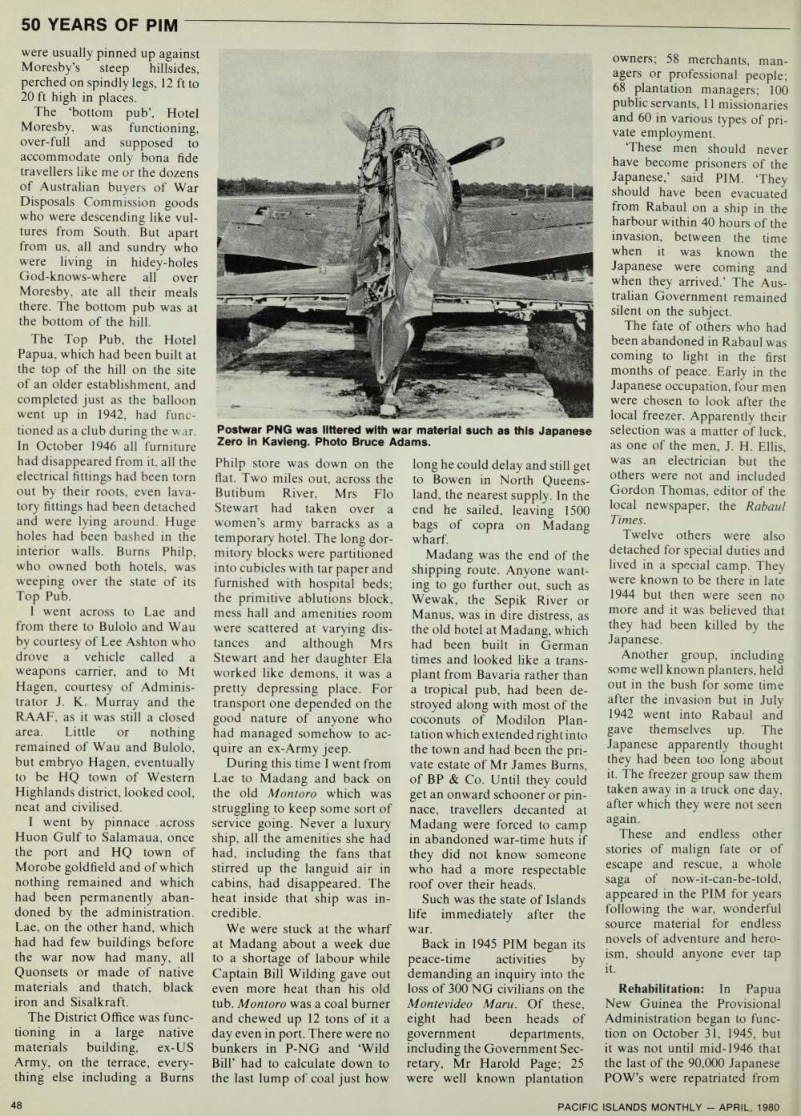
Postwar PNG was littered with war material such as this Japanese Zero In Kavieng. Photo Bruce Adams.
i New Britain and the whole of the old Mandated Territory re verted to civilian administrat ion. What Administrator Murray and his officials were left with then was complete devastation. From this distance one can wonder how they did as well as they did, as soon as
they did.
With all their troubles, how ever, Territorians had one great piece of luck. Just under £lO million probably equivalent to at least $lOO million in today’s terms had been distributed to claimants by the Australian War Damage Commission and this even PIM
acknowledged was exceedingly
generous.
In contrast, private individuals in the British Solomons got nothing,
although hopes were raised
when the UK Government an nounced that a commission was being set up in 1946 to inquire into the matter.
It was made clear at the time that compensation hinged on whether or not Japan paid war reparations and, as by 1949 it seemed it would not, compen sation was off as well. PIM, never short of solutions, half
seriously suggested that Aus
tralia should take over the BSI and use the £5 million left in Australia’s War Damage Com pensation Fund to put Solomons’ planters and traders on their feet.
Apart from compensation, the rehabilitation of private individuals in BSI was far more difficult than for Territorians in neighbouring P-NG. There were comparatively few of them and they must have seemed very unimportant in London’s Whitehall in the sec ond half of the ’forties. Terri torians, on the other hand, howled long and loud and were heard all over Australia even if
ignored by Canberra.
By January 1946 permits to
return to the Solomons were no longer required but as there was no transport of any kind, except a small government vessel running between Suva and Honiara, no accommo dation in Honiara and nowhere to purchase stores, evacuees were left seething in Australia and elsewhere. In March 1946 a dozen planters got away by
working as crew on the 250-ton mission vessel Southern Cross which had just been released from Navy service.
In the next year, by dribs and drabs, other individuals found their way back to the Solomons, only to be greeted by the news that a 15% export tax had been put on copra.
They took this as final proof that the socialist masterminds in Britain did not want private individuals to return to the Solomons.
The Good Pickings: In the Solomons and New Hebrides the Americans, at the end of hostilities, deliberately de stroyed millions of dollars worth of equipment, the story being that the US Government had agreements with US manufacturers to do this. So called Million Dollar Point in Santo, New Hebrides, was
an example. Here jeeps,
trucks, earth-moving equip
ment, freezers and all manner of machinery were dumped in the sea in 1945-46, not far away from the entrance to Segond Channel where the President Coolidge had come to grief early in the war. She had brought 6000 troops and much gear to Santo only to be mis directed into a defensive mine field. The captain, trying to extricate himself in narrow waters, reversed into another, then beached the sinking vessel
on a reef. She later slipped off it into deep water and lay there for a decade, most of her cargo intact.
The salvage of ex-war material, everything from the steel plates called Marsden matting used to surface bush
airstrips, through sunken
vessels to the duralumin of
wrecked planes, kept hundreds
occupied for years, all the way from the Marianas to the Hebrides. It became a great overseas currency earner for dozens of islands for some their only export and a great deal of the scrap found its way
to Japan
In Papua and New Guinea the scrap merchants were
preceded by the Australian
customers of the War Disposals
Commission, scarcely waiting
for the body to grow cold be
fore they began cutting it up.
In the early months of 1946 these sales were in full swing, to the chagrin of returning Ter ritorians who saw ex-military materials as a means of rehabilitation. They couldn’t compete with buyers who bought in bulk, but that was not to say that hundreds of jeeps, small trucks, freezers and the like, timber, black irons and whatnot were not ‘libera ted’ by some of the more enter
prising Territorians.
All the main PNG centres
had so-called car-parks cover ing many acres, in which jeeps and trucks were parked in long
rows, jungle creepers already
festooning them. One Mel bourne dealer bought 900 ve hicles from one of these parks for 38/- each; and the whole of
Lae park was bought by a
dealer named O’Connor. Up the Markham Valley at Nad zab there was a ‘plane park’ which was bought and worked on at a later stage for the duralumin and instruments.
Ships Out, Planes In: The world wide destruction of ship ping during the war took years to make good; on the other hand the wartime development of air power and the construc tion, in the Pacific, of literally thousands of airstrips, some of them in remote and lonely islands which would never have aspired to one normally, pro vided a ready-made basis for a whole series of air services that developed in the last half of the ’forties.
On the shipping side, Matua and the NZ Government’s Maui Pomare continued to ser vice Fiji and the Polynesian groups until Tofua was built and went into service in the early 19505. P-NG and the Solomons continued to suffer until Malaita, hit by a torpedo off Port Moresby in 1942, and Bulolo , after nine years war ser
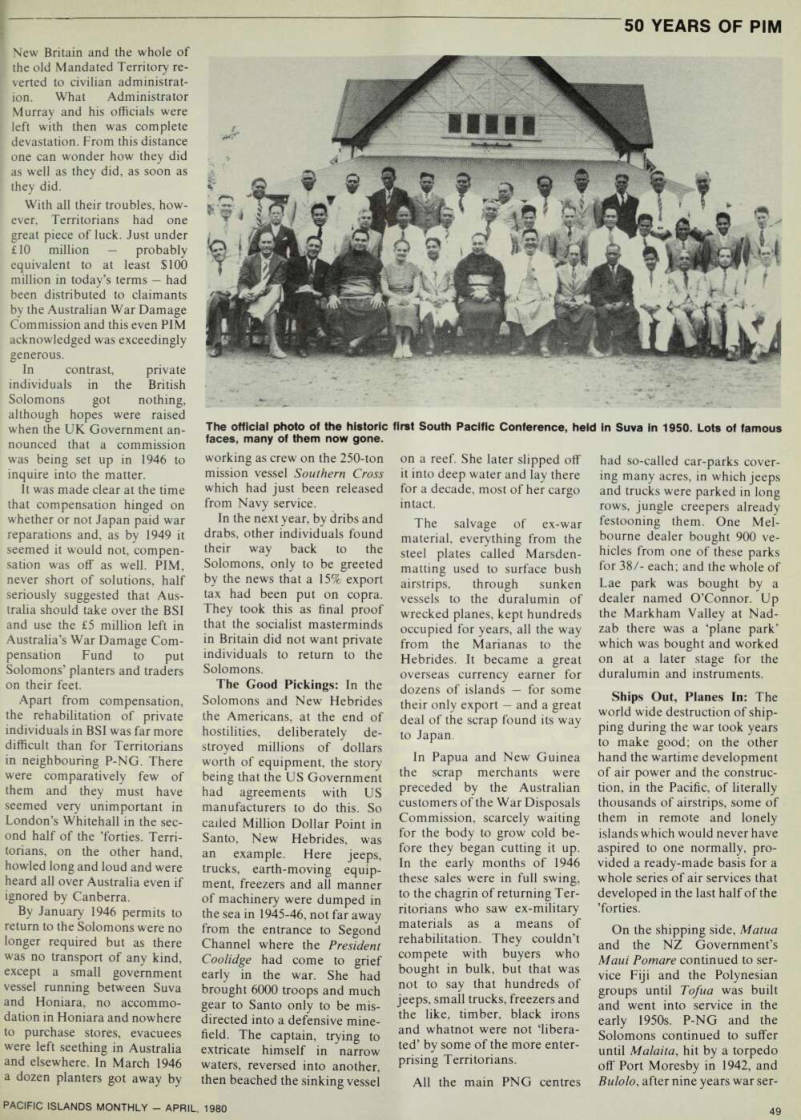
The official photo of the historic first South Pacific Conference, held in Suva in 1950. Lots of famous faces, many of them now gone.
vice, were back in business.
In August 1948 the Canadian-Pacific liner Aorangi, which also had been on war service, recommenced Pacific voyages linking Aus tralia and New Zealand with US west coast ports via Fiji and Honolulu. But she ran at a loss from the outset and was finally withdrawn in the early 19505.
Meantime air services began to take up the slack. Pan- American Airways announced resumption of its trans-Pacific service within months of the end of the war; Australian National Airways, then owned
privately (much later bought
out by Ansett), announced a parallel service. Both used
‘giant Skymaster aircraft, car
rying 40 passengers’, reported
an admiring PIM.
ANA’s enterprise lasted two years, carrying out the service on behalf of the governments of Britain, Australia and New Zealand who had formed Bri tish Commonwealth Pacific Airlines (BCPA) in 1946, in order to keep all international air services in government hands. BCPA began to operate on its own account in April 1948 and ANA reluctantly was forced to return to internal ser vices. Canadian Pacific Air lines, the third trans-Pacific service, did not begin operating until 1949.
Meantime controversy raged in Fiji as to whether Nausori or Nadi would be the inter national airport. Nadi, at the time was regarded as a hot, flat area covered with sugar-cane and without tourist potential; Suva, on the other hand, just 17 miles from Nausori, wet and all as it was, was regarded as the place to be.
Finally the choice went to neither a fine new airport would be built at Suva Point, within spitting distance of the city itself, although it meant resumption of land and de struction of some houses. Sur veys were actually made before wiser counsel prevailed. Jet airliners were already on the drawing board, and Suva Point looked a bit cramped for those.
It was back to Nadi and the eventual development of that area as a tourist trap in its own
right.
The RNZAF was running
services from Auckland to Fiji, Western Samoa and the Cooks before the war ended, and con tinued to keep these services warm until NZ’s National Air ways Corporation could take over. Qantas ran DC3’s to Port Moresby, Lae and Rabaul;
flying-boats to Fiji via
Noumea; privately owned Trans-Oceanic was putting the New Hebrides and the Solomons on the air map and venturing even as far as Tahiti on charter runs. Air France and TRAPAS were taking care of New Caledonia. In short, although much in the Pacific was still bogged down in post
war depression and red-tape,
the air age was off to a good start in 1950.
Advancement of the Islanders: A conference to plan the advancement of South Pa cific people, attended by 43
delegates representing UK,
USA, France, Netherlands, Australia and New Zealand, was held in Canberra in January-February 1947. An agreement was drawn up which, in effect, established the South Pacific Commission.
Twelve commissioners, two from each country were pro vided for, also a secretariat with a secretary-general and other permanent officers. A working fund of £stg4o,ooo was agreed on, of which Australia was to provide 30%. The next meeting was not held until May 1948 when a committee was set up to recommend a head quarters. Suva or Noumea were the hot favourites, with the choice finally falling to
Noumea, in the old Pentagon
building vacated by the
Americans at Anse Vata which not only had office space but living quarters for the SPC’s first Secretary-General, Mr W.
D. Forsyth, of Australia.
Appointments were made to the research council, and it was announced that a South Pacific Conference, at which the del egates would be Islanders, would be held in Suva in April 1950.
The conference was duly held and pronounced a success although some territories
obviously had difficulty in
finding delegates advanced
enough to know what it was about.
Operating in a wider field, the Trusteeship Council of the United Nations had nothing to do until the end of the Japanese war. It then set about converting old Mandated Ter ritories (West Samoa, New Guinea, Nauru and the Marianas, Marshalls and Carolines) to Trusteeships.
New Zealand was quick off the mark, sending its draft trusteeship agreement on Western Samoa to Samoan leaders for their comments.
The Samoans turned it down and asked UN to grant independence instead. A Trusteeship mission sub sequently visited W. Samoa but was not in favour, merely ask ing NZ to give a larger measure of self-determination. NZ fell into line, giving Samoa a High Commissioner instead of an Administrator, a Council of State of the three Fautua and
a Legislative Assembly instead
of a Legislative Council when the group became a Trustee ship in November 1947.
Nauru became a Trusteeship territory in October 1947 with out fuss but New Guinea remained technically a Manda ted Territory due to the fact that Australia wished to make permanent the Provisional ar rangement of administering Papua and New Guinea together. It was allowed to do so.
The former Japanese Man date of the Marianas, Marshalls and Carolines be came the US Trusteeship of the Pacific Islands on July 18, 1947 but it was a TT with a dif
ference, designated a strategic
area under the administration of the US Navy. What went on there, especially in Saipan, was so secret even the HQ was kept in neighbouring Guam, while various nuclear devices were tested in the Marshalls and visitors were unwelcome every where.
Bits and Pieces Copra and the MOF: In the early post-war the price of copra rose steeply in spite of the fact that someone had invented a substitute for soap called detergent. All Common wealth territories kept a firm
hand on things by setting up
control boards, stabilisation funds, export taxes and the like. Fiji, West Samoa, and the BSI had their copra sold to the UK Ministry of Food and in 1949 Papua-New Guinea joined this club. The price was fixed annually and could not rise or fall by more than 10% in any one year. The price for 1949 was £stg4B, fob islands ports but by the time the vari ous government instrumen talities got at it, planters actually received about 50% of what copra was bringing on the free market.
By late 1950 they were fed up with this. BSI planters threa tened to defy their copra board and P-NG planters sent a del egation to Canberra. Needless to say, the MOF contract con tinued for the full nine years.
Honour Roll: In January 1946 PIM published an 8-page
supplement carrying the names
of servicemen and civilians of the South Pacific who had lost
Suva Point airport plan. It never happened.
their lives, been casualties or had been decorated. It had a coloured Union Jack on the cover which must have made the Frenchmen spit, whose names appeared in it.
A Knighthood for Western Samoa’s retiring Administra tor Alfred Turnbull was an nounced in the New Year Honours of 1946.
Manus Base: Sir Thomas Blarney, C-in-C Australian forces, said that P-NG’s Manus base, built by the Americans into a junior Pearl Harbour, should stay in Australian hands. PIM called him a ‘dangerous dreamer’. It went on to say that Australians were fools in international affairs but even they must see that Australia alone could not de fend herself. ‘lf America (who saved us in 1942) wanted a few square miles of tropical island as a base let us give them gladly.’ Of course, Australia didn’t; the Americans pulled out and Manus disintegrated.
Mrs Ruby Boye, BEM: All women did not leave the BSIP
during the general evacuation.
Mrs Boye stayed with her hus band on Vanikoro, HQ of the Kauri Timber Co. and manned the radio station, sending weather and other reports to the Allies in the face of threa
tened Japanese reprisals. For
this she received the BEM, one of the few women in 1946 New Years Honours to receive it, and the personal congratu lations of Admiral Halsey,
Usn.
The CIPA: In mid-1946 trouble was continuing in the Cook Islands between the Cook Islands Workers’ Union and the Auckland-based, Albert Henry-led Cook Islands Progressive Association as to who would work ships. It came to a head the following year when a plane-load of New Zealand police were sent to
Rarotonga to straighten things
out. The CIPA later set out to run stores and an inter-island
ship.
Banabans of Ocean Island were said, in June 1946, to be settling in on Rabi, the Fiji island bought for them, with Major D. G. Kennedy, DSO, who had had distinguished war service in the Solomons in charge. This transfer of 703
Banabans and 300 Gilbertese from a semi-barren phosphate island to copra-producing Rabi
was interesting, PIM thought,
but would the experiment meet with success? (We all know the answer to that.) Candle-nut Oil was a new industry in Fiji in 1946, made from nuts gathered in Fiji, Tonga and Samoa. It was a substitute for linseed oil used in paints and varnishes, flourished for a few years and then faded out as linseed oil became more plentiful and
people tired of gathering
nuts.
The King’s Medal was awarded to C. H. Meen (Hoi Meen Chin) of Rabaul in October 1946. The citation said in part that although he was in terned with a small group of Chinese in Japanese-occupied Rabaul, he managed to make contact with Allied Intelligence and began to work for them. In 1943 he sent detailed maps and written information which ena bled the Allied forces to make successful air attacks on Japanese installations. He had also managed to hide Allied airmen and arrange for them to be evacuated.
Niuafoou, in the Tongan Group, was devastated by an
eruption in September 1946
and the whole population of 1800 evacuated to Eua.
Casino: It was reported in June 1947 that a large casino and modern 200-room hotel was to be built at Anse Vata beach in Noumea and was expected to become the ‘most brilliant resort in the South Seas’. PlM’s paragraph did not say when this would happen but, in fact, 20 years later the report became true.
Royal Marriages: Tonga was en fete in June 1947 when
Prince Tupouto’a Tungi, heir
to the throne, married Miss Halaevalu Mata’aho, and Prince Tu’ipelehake married Miss Melenaite Tupou- Moheofo, in a double cer emony. The Methodist Church wedding was followed by Ton gan ceremonies.
Kon Tiki: In July 1947, PIM reported that six young Scan dinavians led by Thor Heyer dahl were out in the Eastern Pacific somewhere on a raft trying to prove that Poly nesians could have come from South America. In the follow ing month PIM was able to re port their arrival in the
Marquesas, 81 days after they
had left the port of Callao.
Eniwetok atoll in the Marshalls was taken over in
December 1947 by the US Atomic Energy Commission to test a ‘super secret atomic weapon’. The 145 inhabitants of the atoll were relocated else where.
NG Timber Scandal: What turned out to be a cause celebre broke in December 1947 when Mr Jock Garden, a friend of Australian External Territories Minister Eddie Ward, was charged with forging a letter purporting to give a timber lease in the Bulolo Valley to Brisbane timber merchants Hancock and Gore, for a con sideration of £50,000. The sen sation and all its ramifications
dragged on, involving three
other members of Garden’s syndicate a man named Far rell, Garden’s son and veteran
flyer Ray Parer, and finally
Minister Ward himself who was the subject of a Royal Commission. Garden went to gaol, the other members of the syndicate were cleared and the Royal Commission found Mr Ward not involved in any way.
Blue Lagoon: Miss Jean Simmons, then 18, arrived in Suva in December 1947 with other actors to star in the film Blue Lagoon part of which was made in the Yasawas, a fact that indirectly started popular cruises to those isolated islands, originally run by Mr Trevor Withers.
Oil: It was announced in June 1948 that the NG Pet roleum Co of Dutch New Guinea expected to begin pro duction from wells in the extreme tip of the Vogelkop,
near Sorong, by the beginning
of 1949.
Tuna Fishing: In late 1948, Mr Harold Gatty, who had done much to establish Pan- Am’s air service across the Pa cific, went in for a new venture when he registered South Seas Marine Products in Suva with the idea of catching and can ning tuna for the insatiable American market. Three mod ern tuna clippers, two live bait vessels and a refrigerated vessel were purchased plus a long range spotter plane. It took little more than a year to show that whatever tuna did else where they could not be caught
in Fiji waters by the pole
method employed in the north
Tonga’s royal wedding, June 1947. Prince Tungi (heir to the throne, and now King Taufa’ahau), with his brother Prince Tu’ipelehake (now Premier) en route for the chapel to claim their brides.
ern hemisphere. The ships were sold and the company wound up. The Japanese who 1 came in later proved that it could be done by the long-line method, but that was another story.
The Fingerprint Murder: Three Brisbane detectives who had gone to Ocean Island in
April 1949 and fingerprinted
everyone on the island before charging a Chinese labourer, Tai Shek, with the murder of Mr T. Allen, a BPC engineer, and his wife, were off again on their travels in September. The accused had been sent to Suva for trial, some technical hitch arose, he was then sent back to Ocean for re-arrest and re committal and returned to Suva. On the strength of his fingerprints being found on a window sill in the Allens’ house, he was found guilty and
eventually hanged at Suva
gaol.
Devaluation: In October 1949. Britain devalued the £Stg against the US dollar by 30% and all British Pacific countries followed suit. The price of
commodities written in US dol lars rose in terms of deyalued £’s but as far as the Pacific was concerned this mainly affected gold, which shot up from £A 10.15.0 an ounce to approx £A 15.10.0. But as far as the US was concerned gold remained at SUS3S per ounce and was to stay that way for the next 20 years.
Timber: Commonwealth New Guinea Timbers was born at the end of 1949 49% owned by Bulolo Gold Dredg ing, the Australian government having the balance. Object was to harvest the klinkii and hoop pine of the Bulolo Valley and turn it into plywood and veneer while at the same time, through reafforestation, create a per manent forest asset.
Goodbye to Socialism and all That was the headline in PIM in December 1949. Labour governments had been de feated in both New Zealand and Australia in that month and PIM commented that no communities had suffered more under their controls and regulations than their ‘voiceless
people of the South Pacific ter ritories’. Events were to show, however, that eggs, once scrambled, are hard to re assemble.
US Navy Out: American Samoa was given a year’s notice that after 51 years the USN would bow out of admin istration of the territory on July 1, 1951, the US Department of the Interior taking over. The Samoans were unhappy at the prospect of losing their Fairy Godfather, not expecting their new bosses to be so open handed.
SPP: After months of frus tration and delays, P-NG got its first post-war newspaper.
First issue of the South Pacific Post was published on Sep tember 26, 1950.
Deputy Administrators were to be appointed in Papua-New Guinea two of them, at salaries ranging from £2OOO to £2500. 1950 Ended on a happy note. The price for copra sold to the United Kingdom MOF would rise in 1951 by the full 10% allowed.
This PIM cover never appeared.
It was designed by a regular PIM reader and contributor who signed himself Kupa. Many readers over the years sent unsolicited cover designs, in variably including the coconut palms that have become PlM’s motif.