island of Erromango
pp. 35-37 · Read in the full issue
Travel
From Dillon’s Bay to Happy Land on the island of Erromango
‘Dr Geoff, a Sydney medical specialist whose favourite relaxation is surfing (combined with travel to out-of-the-way Pacific islands), has already introduced PIM readers to the island of Rurutu in the Austral Group (PIM Nov 1979 p 43). He’s just returned from another surfboard safari, this time to the New Hebridian island of Erromango the new offically approved name of the island previously known in English as Erromanga. As readers of his previous article would expect, ‘Dr Geoff’s’ story combines a vivid descriptive picture of the natural features of the island along with warm and sympathetic portraits of the people he met along the way.
Stretching some 800 km in a north-south direction, with a total land area of 11 880 square kilometres, are 73 islands comprising the New Hebrides condominium, soon to become the Republic of Vanuaatu.
Eighty per cent of the 100 000 Melanesian original inhabitants live in rural com munities, many of them in very isolated areas. From the Banks Islands of the north, to Anatom in the south, dramatic scenery changes are the norm lush
jungles to ash-covered plains,
undulating hills to erupting
volcanoes. All can be seen and experienced within this 800-km
strip.
Erromango, 56 km long and 40 km wide, is the largest island in the group south of Efate.
Difficult terrain and lack of
good harbours are probably
the reason for its lack of
‘development’ especially in
comparison with Efate to the north and Tanna to the south.
Sandalwood trade with China led to European settle ment at Port Resolution (Tanna), and later Dillon’s
Bay, Erromango. An Irishman,
Peter Dillon, was a key figure in this development. Sandal wood, ‘blackbirding’, and dis ease left the native population with a negative attitude towards Europeans. It was not
surprising that hapless mis
sionaries should feel the brunt, and in 1839 the Revs John Williams and James Harris of
the London Missionary Society
met their deaths at Dillon’s Bay. H. A. Robinson, in a his tory of the London Missionary Society settlement at
Erromango, described it as the
‘Martyr Isle’.
After a week of total physical commitment on Efate including many kilometres of walks, surfing (with a difficult paddle of 2 km each way) and of course the traditional Mon
day evening paper chase
around Vila I was ready for
a quiet change.
Mateson’s Guest House, Dillon’s Bay just the name conjured up an almost Somer set Maugham picture of warm, cosy somnolence. Nursing a badly cut shin from a coral reef encounter while surfing, I gin gerly wedged myself into the back seat of the Air Melanesiae Britten Norman Islander.
Forty-five minutes later the
low-flying, bumpy ride neared
its end as the rugged cliffs of the western side of Erromango sprang into view. After the mandatory circular reconnais
sance just to make sure no wild cattle or horses were
around the pilot skilfully
landed on the sloping grassy strip perched on the edge of the cliff.
John, William Mete’s son, stood by the airport’s transmit ting shed, waiting to greet me.
The bumpy, slippery, rich red volcanic soil ‘road’ to Dillon’s Bay is one of the more interest
ing airport-to-village roads of
the South Pacific. Near Nounapon a winged relic of World War II lay at its site of terminal impact. For a 33-year old wreck it was in surprisingly good order. A short distance away, a ‘Frenchman’s’ house stood alone: a windmill clang
ing and clattering in the gusting
trades, cattle contentedly
munching in paddocks, a
couple of horses galloping
along a boundary fence pacing
the four-wheel-drive, chooks
running around in a small shed an Australian country scene if ever there was one. The last few twisting kilometres from plateau to coast were par
ticularly breath-taking.
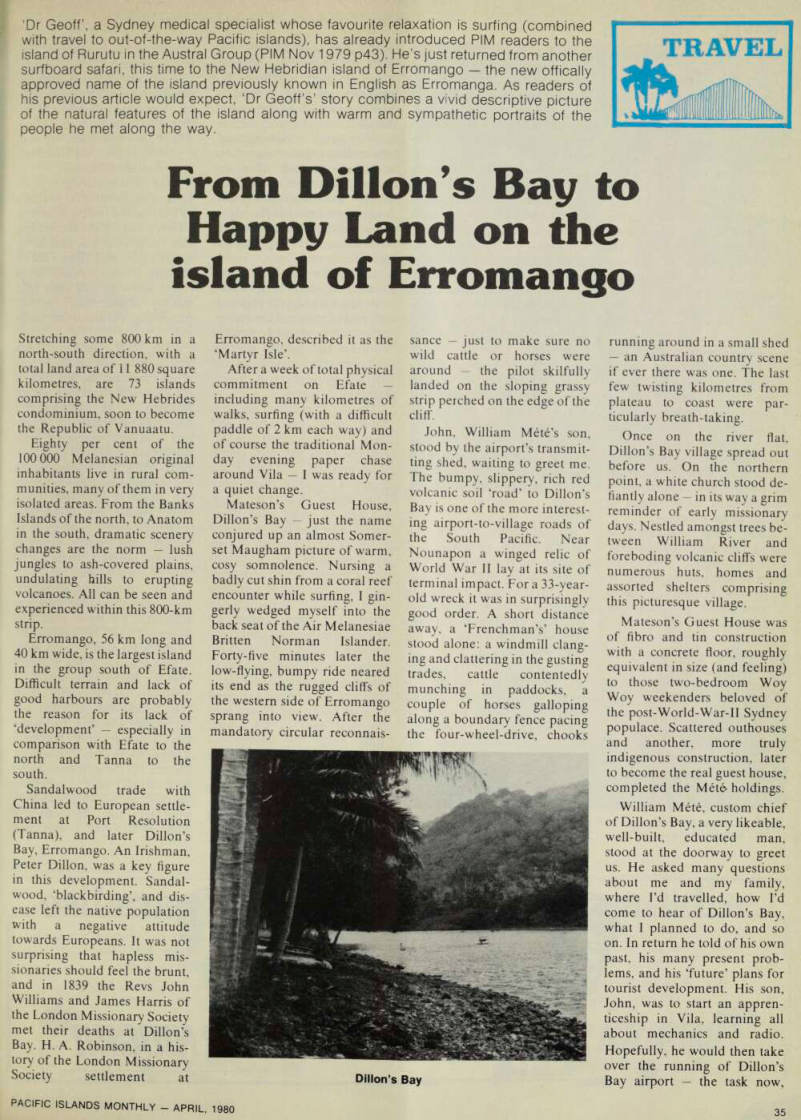
Once on the river flat, Dillon’s Bay village spread out before us. On the northern point, a white church stood de fiantly alone in its way a grim
reminder of early missionary
days. Nestled amongst trees be tween William River and foreboding volcanic cliffs were numerous huts, homes and assorted shelters comprising
this picturesque village.
Mateson’s Guest House was of fibro and tin construction with a concrete floor, roughly equivalent in size (and feeling) to those two-bedroom Woy Woy weekenders beloved of the post-World-War-II Sydney populace. Scattered outhouses and another, more truly indigenous construction, later to become the real guest house,
completed the Meto holdings.
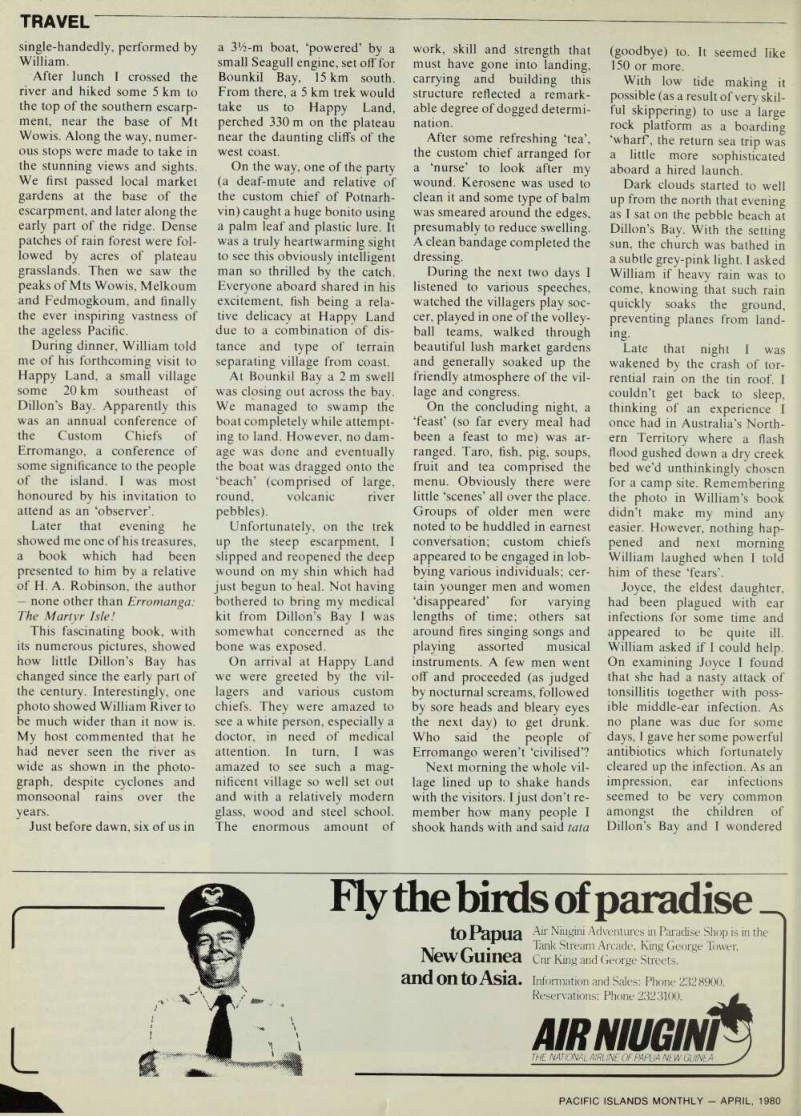
William Mete, custom chief of Dillon’s Bay, a very likeable, well-built, educated man, stood at the doorway to greet us. He asked many questions about me and my family, where I’d travelled, how I’d come to hear of Dillon’s Bay, what I planned to do, and so on. In return he told of his own past, his many present prob lems, and his ‘future’ plans for tourist development. His son, John, was to start an appren ticeship in Vila, learning all about mechanics and radio.
Hopefully, he would then take over the running of Dillon’s Bay airport - the task now,
Dillon’s Bay
single-handedly, performed by
William.
After lunch I crossed the river and hiked some 5 km to the top of the southern escarp ment, near the base of Mt Wowis. Along the way, numer ous stops were made to take in the stunning views and sights.
We first passed local market gardens at the base of the escarpment, and later along the early part of the ridge. Dense patches of rain forest were fol lowed by acres of plateau grasslands. Then we saw the peaks of Mts Wowis, Melkoum
and Fedmogkoum, and finally
the ever inspiring vastness of the ageless Pacific.
During dinner, William told me of his forthcoming visit to Happy Land, a small village some 20 km southeast of
Dillon’s Bay. Apparently this
was an annual conference of the Custom Chiefs of Erromango, a conference of some significance to the people of the island. I was most honoured by his invitation to attend as an ‘observer’.
Later that evening he showed me one of his treasures, a book which had been presented to him by a relative of H. A. Robinson, the author none other than Erromanga: The Martyr Isle!
This fascinating book, with its numerous pictures, showed how little Dillon’s Bay has changed since the early part of the century. Interestingly, one photo showed William River to be much wider than it now is.
My host commented that he had never seen the river as wide as shown in the photo
graph, despite cyclones and
monsoonal rains over the years.
Just before dawn, six of us in
a 3 I A-m boat, ‘powered’ by a small Seagull engine, set off for Bounkil Bay, 15 km south.
From there, a 5 km trek would take us to Happy Land, perched 330 m on the plateau near the daunting cliffs of the west coast.
On the way, one of the party (a deaf-mute and relative of the custom chief of Potnarh
vin) caught a huge bonito using
a palm leaf and plastic lure. It
was a truly heartwarming sight
to see this obviously intelligent man so thrilled by the catch.
Everyone aboard shared in his excitement, fish being a rela tive delicacy at Happy Land due to a combination of dis tance and type of terrain
separating village from coast.
At Bounkil Bay aim swell was closing out across the bay.
We managed to swamp the boat completely while attempt ing to land. However, no dam age was done and eventually the boat was dragged onto the
‘beach’ (comprised of large,
round, volcanic river
pebbles).
Unfortunately, on the trek up the steep escarpment, I
slipped and reopened the deep
wound on my shin which had
just begun to heal. Not having
bothered to bring my medical kit from Dillon’s Bay I was somewhat concerned as the bone was exposed.
On arrival at Happy Land we were greeted by the vil lagers and various custom chiefs. They were amazed to see a white person, especially a doctor, in need of medical attention. In turn, I was amazed to see such a mag nificent village so well set out and with a relatively modern glass, wood and steel school.
The enormous amount of
work, skill and strength that must have gone into landing,
carrying and building this
structure reflected a remark able degree of dogged determi nation.
After some refreshing ‘tea’, the custom chief arranged for a ‘nurse’ to look after my wound. Kerosene was used to clean it and some type of balm was smeared around the edges,
presumably to reduce swelling.
A clean bandage completed the
dressing.
During the next two days I listened to various speeches, watched the villagers play soc cer, played in one of the volley ball teams, walked through beautiful lush market gardens and generally soaked up the friendly atmosphere of the vil lage and congress.
On the concluding night, a ‘feast’ (so far every meal had been a feast to me) was ar ranged. Taro, fish, pig, soups, fruit and tea comprised the menu. Obviously there were little ‘scenes’ all over the place.
Groups of older men were noted to be huddled in earnest conversation; custom chiefs appeared to be engaged in lob bying various individuals; cer tain younger men and women
‘disappeared’ for varying
lengths of time; others sat around fires singing songs and playing assorted musical instruments. A few men went off and proceeded (as judged by nocturnal screams, followed by sore heads and bleary eyes the next day) to get drunk.
Who said the people of Erromango weren’t ‘civilised’?
Next morning the whole vil lage lined up to shake hands with the visitors. I just don’t re member how many people I shook hands with and said tata
(goodbye) to. It seemed like 150 or more.
With low tide making it possible (as a result of very skil ful skippering) to use a large rock platform as a boarding ‘wharf, the return sea trip was a little more sophisticated aboard a hired launch.
Dark clouds started to well up from the north that evening as I sat on the pebble beach at Dillon’s Bay. With the setting sun, the church was bathed in a subtle grey-pink light. I asked William if heavy rain was to come, knowing that such rain quickly soaks the ground, preventing planes from land
ing.
Late that night I was wakened by the crash of tor rential rain on the tin roof. I couldn’t get back to sleep, thinking of an experience I once had in Australia’s North ern Territory where a flash flood gushed down a dry creek bed we’d unthinkingly chosen for a camp site. Remembering the photo in William’s book didn’t make my mind any
easier. However, nothing hap
pened and next morning
William laughed when I told him of these ‘fears’.
Joyce, the eldest daughter, had been plagued with ear infections for some time and appeared to be quite ill.
William asked if I could help.
On examining Joyce I found that she had a nasty attack of tonsillitis together with poss ible middle-ear infection. As no plane was due for some days, I gave her some powerful antibiotics which fortunately cleared up the infection. As an impression, ear infections seemed to be very common amongst the children of Dillon’s Bay and I wondered
how many of these kids suf fered from the terrible compli cations (meningitis, deafness) that are so rare in our more af
fluent society.
On Sunday night the
Dillon’s Bay ‘Women’s Group’ was to meet, and William in vited me to give a talk. I spoke with Celestial, a native health worker, and asked her guid ance on what topic I should choose. She was to speak on the importance of maternal and infant nutrition, with special
emphasis on breast feeding.
We agreed that basically I should encourage the women to adopt a more truly tra ditional approach to nutrition, rather than the more popular (but inadequate) ‘local’ intake of essentially starchy and pack
aged, highly refined, wester
nised foods. The valuable role of the humble coconut was es
pecially pointed out.
After the plane landed I could tell something was wrong. Following innumerable conversations between the
pilot, some rather important
looking Tanna natives, William and others, the pilot decided he would offload everyone and return, alone, to Vila.
Apparently, just on touch
down a brake warning light appeared and the pilot felt the ‘risks’ too great to continue on with his passengers to Tanna.
Everyone was upset by this unexpected change not least William who had to make ar rangements for an unscheduled overnight (at least) stay for six extra people. As the plane took off for Vila, a general dis cussion of that particular pilot took place. After all, there was
nothing else worth talking
about! He was described by the
locals as being ‘too frightened’, in their perceptive but disar mingly bland way.
Next morning, William organised for me to be taken to see the planned site of a further guest house. A visit to a local
and ‘very important’ burial
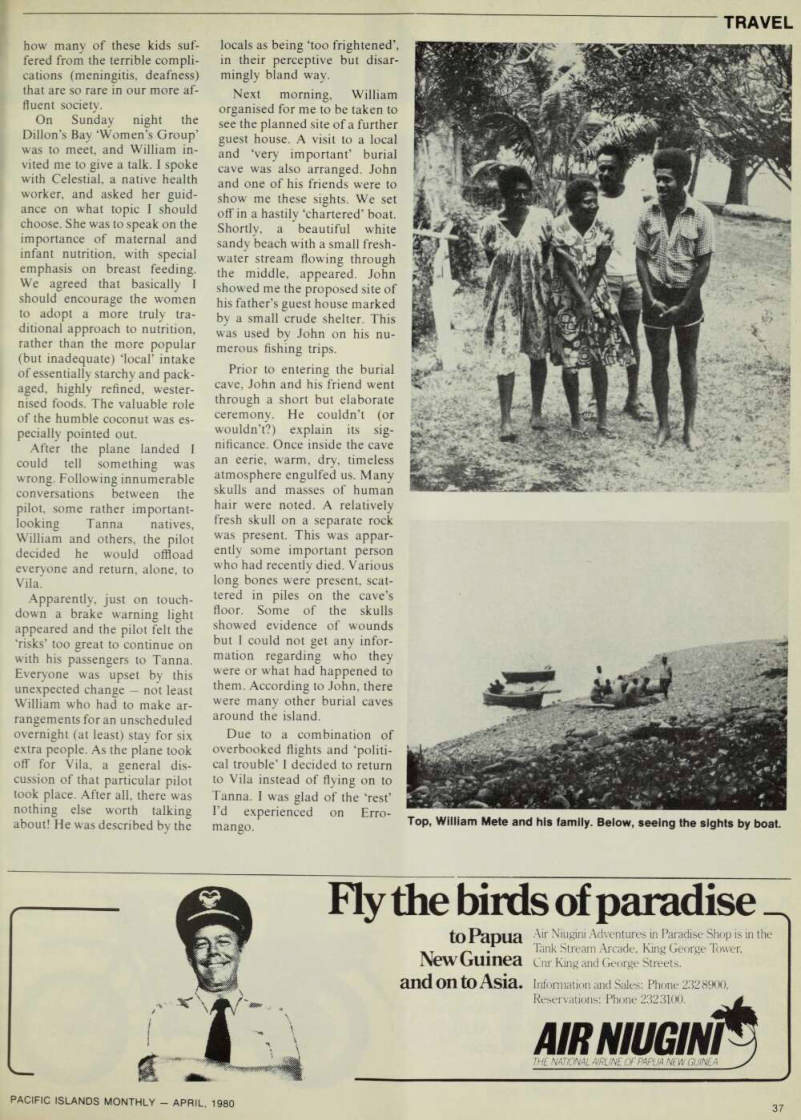
cave was also arranged. John and one of his friends were to show me these sights. We set off in a hastily ‘chartered’ boat.
Shortly, a beautiful white sandy beach with a small fresh
water stream flowing through
the middle, appeared. John showed me the proposed site of his father’s guest house marked by a small crude shelter. This was used by John on his nu
merous fishing trips.
Prior to entering the burial cave, John and his friend went through a short but elaborate ceremony. He couldn’t (or
wouldn’t?) explain its sig
nificance. Once inside the cave an eerie, warm, dry, timeless
atmosphere engulfed us. Many
skulls and masses of human hair were noted. A relatively fresh skull on a separate rock was present. This was appar
ently some important person
who had recently died. Various long bones were present, scat tered in piles on the cave’s floor. Some of the skulls showed evidence of wounds but I could not get any infor
mation regarding who they
were or what had happened to them. According to John, there were many other burial caves around the island.
Due to a combination of
overbooked flights and ‘politi
cal trouble’ I decided to return to Vila instead of flying on to Tanna. I was glad of the Test’
I’d experienced on Erro mango.
Top, William Mete and his family. Below, seeing the sights by boat.