Of Satellites
pp. 32-33 · Read in the full issue
Telecommunications
And
Human Hearts
From Sheree Upton, in Honolulu
It was not without some amuse ment that the more relaxed participants at the second annual Pacific Telecommuni cations Conference in January observed, during the forum’s peak, a freak winter storm that howled and raked its way through the Flawaiian Islands chain, knocking down, among other things, phone lines and electric wires. One feature of
the exquisitely engineered con
vention was a teleconference, carefully planned with live and
simultaneous participation
from five sophisticated main land US centres, all hooked up to Honolulu at once.
By the time the power came back on in Hawaii it was in
terrupted sporadically for sev
eral days - the mainland hookups had gone to lunch, and even reporters typing on computer terminals lost stories that were thrown forever into oblivion by the power cuts.
This incident brought home with clarity and irony the focus of Ratu Sir Kamisese Mara’s keynote speech to the 428 par ticipants from 28 different countries in anecdotes he re lated about communication problems in Fiji, even in the age of satellites PEACESAT (the experimental educational satellite relay network), and NASA’s Application Tech nology Satellite-1 (known as
Ats-1).
A week before the confer
ence began, the Fijian prime
minister was travelling on the maiden voyage of the vessel MV Katavatu, a sleek new ad dition to the government fleet, and equipped with radio tele phone, echo sounder and the latest navigational aids and
communications equipment.
New Year’s Day found the PM and entourage nearing the reef outside the village at Tuvuca Island, when news came via radio that a hurricane (traced
by satellite) was approaching
northern Fiji.
‘With shouting and hand gymnastics,’ the PM told the
rapt audience, ‘we tried to com municate this hurricane warn ing to the two small canoes of fishermen passing near the Katavatu. They misread our communication,’ Ratu Mara added with wry humour, ‘for New Year’s Greetings, and with obvious high spirits proceeded on to their fishing grounds!’
There were other signs of course, Ratu Mara learned later, that told the islanders about the hurricane, but they had nothing to do with the
sophisticated communications
equipment now operating
commercially in the Pacific.
For example, oldtimers remembered that the fish were not biting for some days before the disastrous cyclone Meli hit the Fiji islands. The point is that senses within the immediate environment and not only thousands of miles up in the sky are important. While satellite pictures can provide a detailed photographic record of impending storms and also aerial views of after-effects and damage (to trees and crops as well as buildings), it is essential to preserve and restore the fragile cultural memories of the fishermen and farmers who watched perceptively for
nature’s warning signs when
communication was still a very personal exercise and a won derful school of knowledge, lore and tradition.
Not many decry the giant steps we have taken in the tech nology of the new communi cations; perhaps it is our dependence on them that we fear. ‘The potential of the satel lite is so great that it will change the entire fabric of so ciety,’ says British scientist James Martin in his book The Wired Society. And that assess ment leaves aside all the other
paraphernalia (carefully
documented and elaborated on at the conference) cable Pay TV, videodiscs and recorders, interactive two-way home
video systems, electronic mail, home information retrieval systems ad infinitum.
It struck Mr Martin with some wonder that ‘the con tented faces are in areas where there are no electronic com munications .. .’ He writes: ‘The people are happy with their lot because they do not know of any different way of life. They know their place in the hierarchy of their village and their aspirations are to grow fat vegetables, to see their children grow up, and to be
accepted in the community.
They do not know that the United Nations classes them as “developing”. They live in well integrated communities where the patterns of life have been honed over the centuries.’
Since much of the world lives in the villages Mr Martin writes about and since it is likely that a television set may be introduced in many of them within the next decade or two it is worthwhile for us to con sider carefully the delicate question: just what is ‘appro priate communication’ for development in the Pacific?
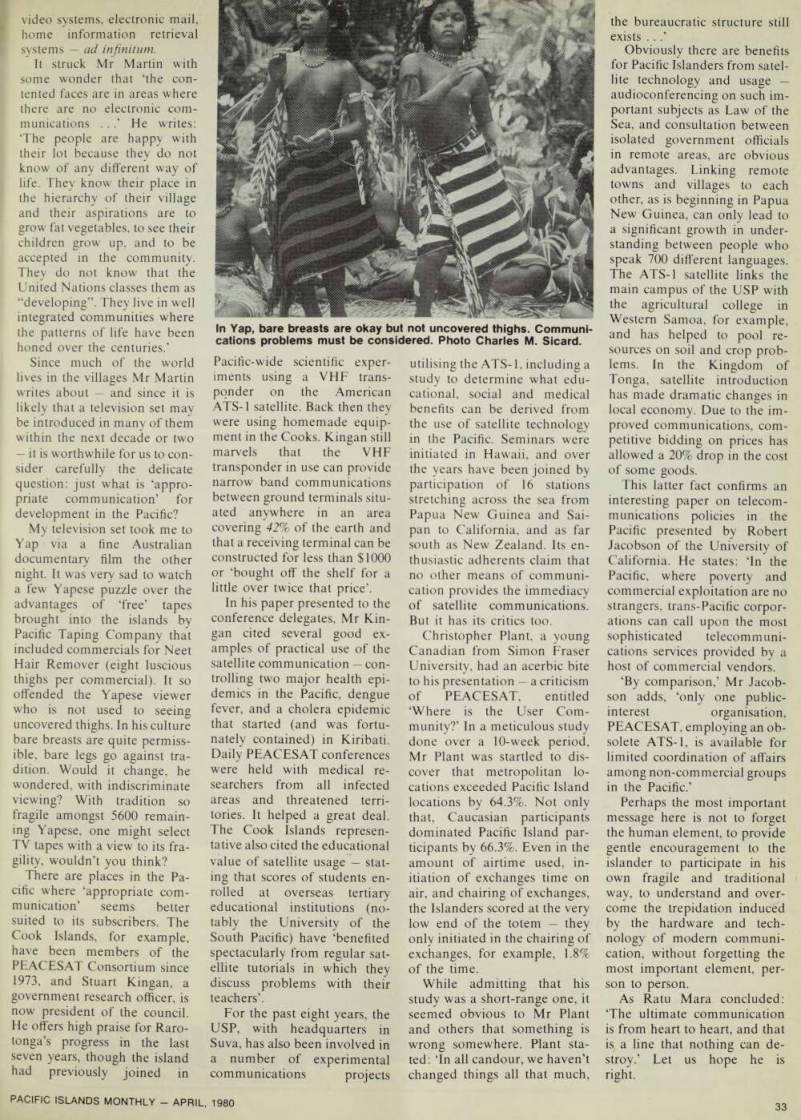
My television set took me to Yap via a fine Australian documentary film the other night. It was very sad to watch a few Yapese puzzle over the advantages of ‘free’ tapes brought into the islands by
Pacific Taping Company that
included commercials for Neet Hair Remover (eight luscious thighs per commercial). It so offended the Yapese viewer who is not used to seeing uncovered thighs. In his culture bare breasts are quite permiss ible, bare legs go against tra dition. Would it change, he wondered, with indiscriminate viewing? With tradition so fragile amongst 5600 remain
ing Yapese, one might select
TV tapes with a view to its fra gility, wouldn’t you think?
There are places in the Pa cific where ‘appropriate com munication’ seems better suited to its subscribers. The Cook Islands, for example, have been members of the PEACESAT Consortium since 1973, and Stuart Kingan, a government research officer, is now president of the council.
He offers high praise for Raro tonga’s progress in the last seven years, though the island had previously joined in
Pacific-wide scientific exper iments using a VHP trans ponder on the American ATS-1 satellite. Back then they were using homemade equip ment in the Cooks. Kingan still marvels that the VHF transponder in use can provide narrow band communications between ground terminals situ ated anywhere in an area covering 42% of the earth and that a receiving terminal can be constructed for less than $lOOO or ‘bought off the shelf for a little over twice that price’.
In his paper presented to the conference delegates, Mr Kin gan cited several good ex amples of practical use of the satellite communication con
trolling two major health epi
demics in the Pacific, dengue fever, and a cholera epidemic that started (and was fortu nately contained) in Kiribati.
Daily PEACESAT conferences were held with medical re searchers from all infected areas and threatened terri tories. It helped a great deal.
The Cook Islands represen tative also cited the educational value of satellite usage stat ing that scores of students en rolled at overseas tertiary educational institutions (no tably the University of the South Pacific) have ‘benefited
spectacularly from regular sat
ellite tutorials in which they discuss problems with their teachers’.
For the past eight years, the USP, with headquarters in Suva, has also been involved in a number of experimental
communications projects
utilising the ATS-1, including a study to determine what edu cational, social and medical benefits can be derived from the use of satellite technology in the Pacific. Seminars were initiated in Hawaii, and over the years have been joined by participation of 16 stations stretching across the sea from Papua New Guinea and Sai pan to California, and as far south as New Zealand. Its en thusiastic adherents claim that no other means of communi
cation provides the immediacy
of satellite communications.
But it has its critics too.
Christopher Plant, a young Canadian from Simon Fraser University, had an acerbic bite to his presentation a criticism of PEACESAT, entitled ‘Where is the User Com munity?’ In a meticulous study done over a 10-week period, Mr Plant was startled to dis cover that metropolitan lo cations exceeded Pacific Island locations by 64.3%. Not only that, Caucasian participants dominated Pacific Island par ticipants by 66.3%. Even in the amount of airtime used, in itiation of exchanges time on air, and chairing of exchanges, the Islanders scored at the very low end of the totem they only initiated in the chairing of exchanges, for example, 1.8% of the time.
While admitting that his study was a short-range one, it seemed obvious to Mr Plant and others that something is wrong somewhere. Plant sta ted: Tn all candour, we haven’t changed things all that much,
the bureaucratic structure still exists ..
Obviously there are benefits for Pacific Islanders from satel lite technology and usage audioconferencing on such im portant subjects as Law of the Sea, and consultation between isolated government officials in remote areas, are obvious
advantages. Linking remote
towns and villages to each other, as is beginning in Papua New Guinea, can only lead to a significant growth in under
standing between people who
speak 700 different languages.
The ATS-1 satellite links the main campus of the USP with
the agricultural college in
Western Samoa, for example, and has helped to pool re sources on soil and crop prob lems. In the Kingdom of Tonga, satellite introduction has made dramatic changes in local economy. Due to the im proved communications, com
petitive bidding on prices has
allowed a 20% drop in the cost of some goods.
This latter fact confirms an interesting paper on telecom munications policies in the Pacific presented by Robert Jacobson of the University of California. He states: Tn the Pacific, where poverty and commercial exploitation are no strangers, trans-Pacific corpor ations can call upon the most
sophisticated telecommuni
cations services provided by a host of commercial vendors.
‘By comparison,’ Mr Jacob
son adds, ‘only one public interest organisation, PEACESAT, employing an ob solete ATS-1, is available for limited coordination of affairs among non-commercial groups in the Pacific.’
Perhaps the most important
message here is not to forget the human element, to provide gentle encouragement to the islander to participate in his own fragile and traditional way, to understand and over come the trepidation induced by the hardware and tech nology of modern communi cation, without forgetting the most important element, per son to person.
As Ratu Mara concluded: ‘The ultimate communication is from heart to heart, and that is a line that nothing can de stroy.’ Let us hope he is
right.
In Yap, bare breasts are okay but not uncovered thighs. Communi cations problems must be considered. Photo Charles M. Sicard.