People
pp. 27-31 · Read in the full issue

Western Samoa’s Prime Minis ter Tupuola Efi has announced that Feesago S. Fepuleai will replace Fred Betham as the
country’s high commissioner to
New Zealand. Mr Betham has held the post since 1976.
Feesago, 43, had been serv ing as clerk of Western
Samoa’s Legislative Assembly,
a position which also involves the job of chief returning offi cer. In that capacity he has supervised seven elections.
Feesago will be no stranger to New Zealand, where he con tinued his education on a
scholarship after attending
school in Apia.
The prime minister said a re placement for Maiava lulai Toma. Western Samoa’s am bassador to the United Nations, was not being made because his term was not yet up.
Since May 1979 Stella Miria has been acting executive offi cer in Planning Economics and Marketing, a branch of Papua New Guinea’s Department of
Primary Industry.
One of the high points of her career over that time was her work as assistant co-ordinator (working with the co ordinator, lan Donald) of the assembly meetjng of the As sociation of Natural Rubber Producing Countries held in Port Moresby late last year.
Mr Donald said of her per formance: ‘Stella is totally re liable and dedicated. She has stacks of initiative and that
special ability which makes
people enjoy both working for
her and with her.’
Stella responds: ‘With the ANRPC meeting came many
complimentary comments.
Although I know I did my best for the conference, I also know that the real spirit was team work.’
A Bachelor of Arts (major in geography) from the Univer sity of Papua New Guinea,
Stella is now living apart from her husband and caring for their three children.
She sums up her experience in these terms: ‘ln my life I have been an extremely for tunate person. I am glad to be a Papua New Guinean woman, glad to be called an indepen dent professional, and also very glad to be called
Mummy.’
On a brief February visit to Sydney en route to Port Moresby to collect her diploma in journalism at the University of Papua New Guinea, Hilda Lini called at the PIM office to introduce us to the New Hebrides’ newest publication,
the weekly newsmagazine,
called in Bislama Nasiko. The
trilingual magazine King
fisher to English readers, and le Martin-pecheur to French is a non-party effort, aiming to reflect the views of all inhabi tants of the archipelago.
Hilda is the magazine’s edi tor and publisher.
She explains the name in her first editorial: ‘On my home island Nasiko is the king of the birds. It is the bird that warns of bad luck and good luck. ‘When Nasiko cries on your right side it is your good luck
and when it cries on your left, that is bad luck. ‘But also if it cries on your left and continues crying while flying to the right it means that by coincidence you will not be caught in a trap set up by nature. And it is vice versa if it goes in the other direction. ‘Sometimes Nasiko keeps crying at one particular spot.
This means that there is some thing dangerous, an owl or
something poisonous.
‘So by calling this magazine
Nasiko, I hope it acts like the king of the birds and warns everyone of the dangers ahead.
The government, the oppo sition, the businessmen, the
people and Nasiko magazine
itself.’
In a comment on some early criticisms of the Nasiko project, Hilda, who is a sister of Chief Minister Walter Lini and a
long-time Vanuaaku Party ac
tivist, Hilda writes; ‘Some people do not want to believe that (the magazine) is indepen dent and free ... In a way I don’t blame them. They associ ate me with the government because of my surname and my
previous activities. They don’t
realise that people change .. .’
High Chief Matagialalua Tavana, at 48, is probably one
of Polynesia’s wealthiest and most eccentric citizens. His rambling beachside estate in Kahala, Hawaii’s most exclusive neighbourhood, is a
gathering place for prominent
guests from all over the Pacific.
Tavana is a self-made success in every sense of the word.
His father was a Norwegian merchant. His mother was a Salmon, Amy Tuteratea Salmon, niece of Queen Marau of the Teva clan and the governess of his father’s Nor
wegian children. Illegitimate
and orphaned at an early age.
Tavana was shuffled around the Pacific and schooled in Hawaii.
Late in his teens, with youth ful energy and artisan hands itching to create and recon struct the ties to the canoe building clan of his past, he set off for Tonga to build a royal canoe as a gift for the late and revered Queen Salote. He was given a special welcome, and became firm friends with Prince Tungi (now Tonga’s King); it is a friendship that has lasted over a quarter of a cen tury.
His chiefly title is a desig nated one, introduced by Para mount Chief Leiato Tuli, and certified in the Senate Chambers of the legislature of American Samoa.
A high title like this is rarely given to a non-Samoan, but Tavana seems to enjoy a
unique relationship with
Samoans that dates back to 1952, when they backed him and helped to start the Polynesian Revue that has brought him wealth and fame.
In return Tavana has, for some years, surrounded himself with Samoan allies, and quietly con tributes more than SUS2B 000 annually to Samoan churches of various denominations, in both American and Western Samoa.
Much of Tavana’s energy is directed to his show. From a modest start as a Polynesian Pauper, he has groomed his revue to become the most cel ebrated and authentic Polynesian extravaganza in
Honolulu, performing steadily
for the last 28 years. While he seldom appears now on stage anymore, the Chief does all the choreography for the Tahitian and Rarotongan numbers, and has a cast of 75 in the revue.
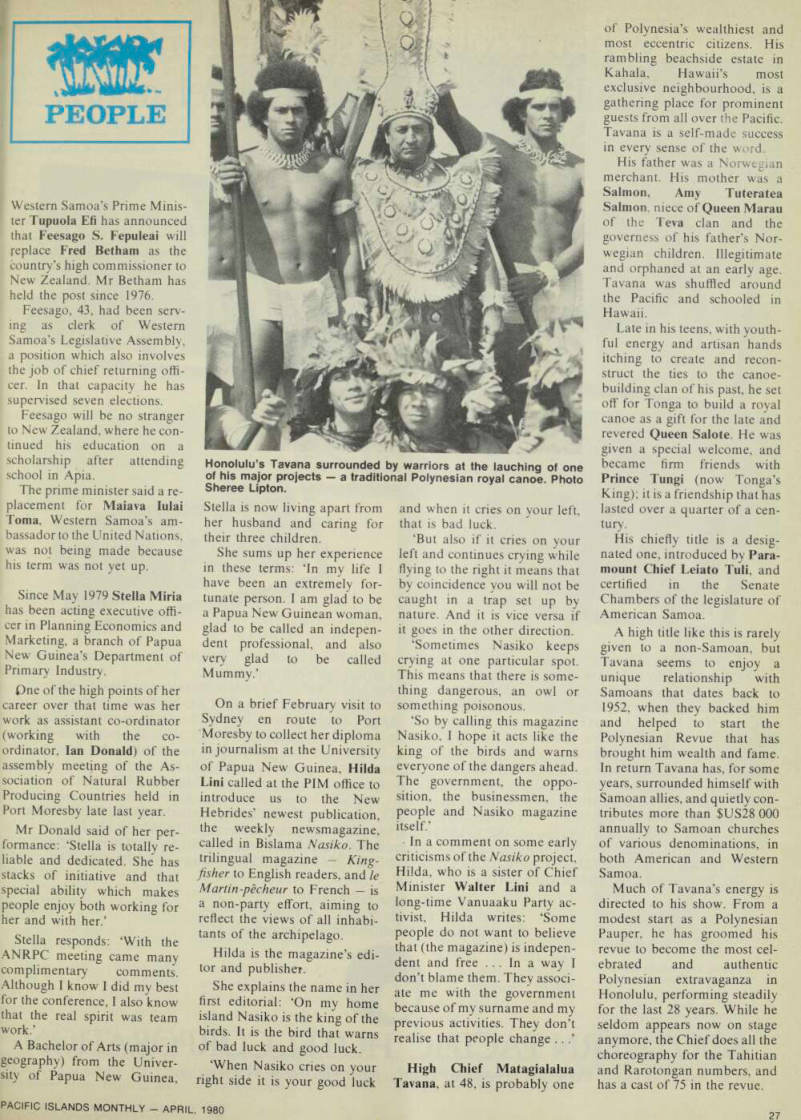
Honolulu’s Tavana surrounded by warriors at the lauchlng of one of his major projects a traditional Polynesian royal canoe. Photo Sheree Lipton.
There are two performances nightly, which means 1000 people pay $2O for dinner, two drinks and a one-hour trip into exotica. You can figure out the nightly take, but Tavana told me, without a flick of an eye lash, that he grosses approx imately $8 million a year, nets about $3 million after taxes.
He is bemused yet patient with the American tax system,
especially with just-off-the
boat Tahitian performers who love Hawaii as a ‘paradise’ but become astonished and enraged when taxes are taken
out of their wages! Payroll, by
the way, averages more than $ 1 million annually. Performers come from New Zealand (Maoris), Tahiti, Tonga,
Samoa, Rarotonga and Fiji.
They are paid according to
number of years of service, and most are sponsored by Tavana, who has given many a start on their own climb to fame in the Pacific.
Tavana returns annually to Tahiti, to recruit new and tal ented dancers and drummers, and to contribute a bit to the economy with gigantic pur chases of shells, woven coconut cord, roofing materials of pan danus and fibres for his cos tumes. He fashions textiles for the more sophisticated num bers where the boys and girls wear pareus\ most of his de
signs are originals modern
variations on ancient insignias.
Others come from dusty old plates at the Musee de Paris , with whose curators he main tains a regular correspon dence.
Tavana’s aim and search seems to be towards his own elaborate cultural renaissance in the Pacific. The show runs smoothly with his adopted son Malala McMoore at the helm, and Tavana looks forward to
spending more time ‘devoting
myself to restoring old culture’. ‘That’s my life,’ he affirms, ‘a good part of me lives in the past, and that’s the past.’
But a current project that excites him is his new palace going up on his front lawn in
Honolulu. There are already
seven houses for servants and four houses for visitors on the estate, but the palace will be the piece de resistance. It is one enormous room built in tra-
ditional Polynesian style with posts of polished coconut trunks. ‘lt will house all my ar tifacts,’ he explained, ‘and will serve as a reception room for
visiting dignitaries.’
No one doubts the palace will stand against time’s rav ages and weather Tavana’s own Polynesian Pyramid.
Sheree Lipton.
During the holiday weekend
January 25-28, almost 200 for mer expatriate residents of Western Samoa met at Wairakei, Taupo, New Zealand, for their second re union which had been organised with smooth efficiency and much hard work by Lloyd Webber former District Officer, Tokelaus and his wife Shirley.
In this weekend of splendid weather, clergy, represen tatives of commercial firms and former government officials some coming from overseas for the occasion re newed old friendships in inter vals between golf, tennis, bowls, swimming in the warm springs, and exploring the
geothermal region.
This happy occasion concluded with a Polynesian night with entertainment by a Tokelauan group. Fa’a fetai tele Lloyd, soifua!
Mrs Pat Shimmon has now joined the festival Secretariat as Programmes & Venues Offi
cer, working with William Takaku. Since arriving in PNG, Pat has been closely involved with the popular
Moresby Theatre Group, serv
ing as publicity and public re
lations officer.
Secretary to Director Mali Voi is Mrs Lyn Berryman, who before arriving in PNG in August 1979 was secretary to the Australian Gallery Direc tors’ Council, and to the NSW
State Attorney-General.
The board of the South Pa cific Festival of Arts has
appointed the distinguished in
ternational producer Stefan Haag as consultant for the Third Festival.
The newest Commissioner to the Cook Islands High Court is Dr Ngaeikura Tou, 63, who has
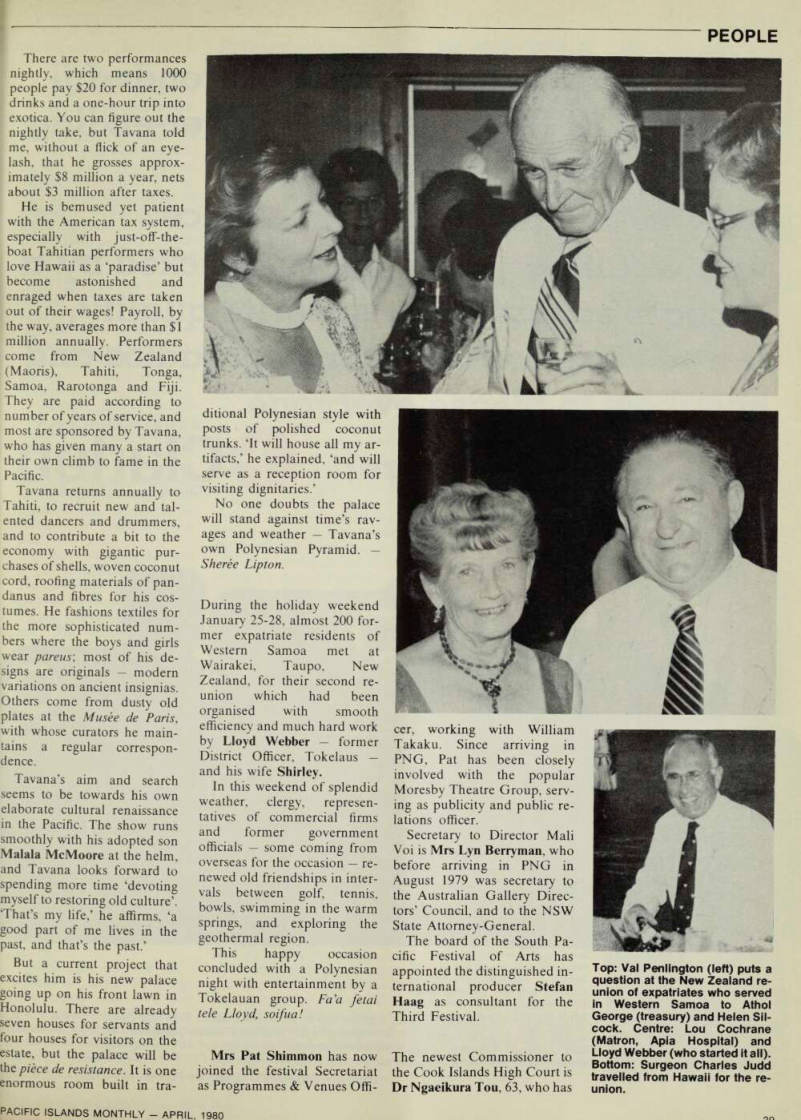
Top: Val Penlington (left) puts a question at the New Zealand re union of expatriates who served In Western Samoa to Athol George (treasury) and Helen Sil cock. Centre: Lou Cochrane (Matron, Apia Hospital) and Lloyd Webber (who started it all).
Bottom: Surgeon Charles Judd travelled from Hawaii for the re union.
been a medical practitioner in the Cooks for 37 years.
After education at a London Missionary Society School, Dr Tou became a teacher trainee and was one of the first Islands scholarshippers to attend Te Aute College in New Zealand’s Hawkes Bay. His medical training was in Fiji, with three months in a leper colony on Makogai in the Fiji group, fol lowed by stints in the outer Cook Islands and further train ing in surgery in New Zealand
and Fiji.
As Deputy Director and later Secretary of Health, Dr Ngaei, as he is known in the Cooks, represented the Cook Islands at many South Pacific Com mission and World Health Or ganisation seminars and conferences in the Pacific.
Although retired, he still helps out at the outpatient clinic on Rarotonga, and plans to write a book about his years of experience in tropical medi
cine, particularly during the
formative period of the present health system, in which the Premier, Dr Tom Davis, was also involved.
Dr Tou believes in the value of traditional Maori medicine, and says that China cannot claim all the praise for pioneer ing the ‘barefoot doctor’ sys tem. ‘The Cook Islands has always had its barefoot doctors who have worked among the people,’ he maintains.
T don’t know why they picked me,’ he says of his new appointment as Court Com missioner. ‘My training is in medicine, not in judging people ... still, I think what’s needed is just common sense.’
Karen Garner-Williams.
Aitasi Pausila. 19, is the first fe male motor mechanic to be
employed by Western Samoa’s
Public Works Department workshop at Vaitele. The PWD claims she is the first female graduate in motor mechanics from the Technical College at Vaivase.
Aitasi said she had com pleted two years at the college and, though she was now employed by the PWD, she intended to do advanced courses at the college for the next two years. ‘We’re very proud of her,’
says her workshop supervisor.
As the opening of the June- July Third South Pacific Fes tival of Arts draws closer, SPFA Director Mali Voi has announced a number of staff appointments and changes in function which will enable the festival secretariat to handle the increasing work load in volved in festival preparations during the next few months.
William Takaku has been
newly appointed Deputy
Director (Culture & Artistic), on secondment from PNG’s National Theatre Company.
William was a member of the Papua New Guinea cultural team at the 1972 SPFA in Fiji, and at the second festival in Rotorua in 1976. To take this appointment, he has had to defer a scholarship to the National Institute of Dramatic Art in Sydney. His musical drama Eberia, which will be a festival highlight, has just com pleted a successful dry run in Kieta, North Solomons Prov ince, William’s birthplace. Fes tival programming and artistic production will be his main re
sponsibilities.
Deputy Director (Finance & Administration) David Bam ford, who joined the secretariat in March 1979 on secondment from the PNG Office of Tour ism (he was then also a mem ber of the main festival committee), has now assumed
particular responsibility for
finance, administration, pub licity and marketing.
On media relations, pub licity and marketing is Ms Kerry Collins, who joined the SPFA in February 1979 as pub licity officer, following a career in PNG, the UK and Australia in advertising and public re lations.
Newly-appointed Adminis
tration Officer is John Atkins, who joins the SPFA from the personnel division of Steam ships Trading Co, and who also retires as a member of the fes tival board. His past involve ment with ceremonial includes working on Queen Elizabeth’s visit in 1977, and the Papua New Guinea Independence Celebrations in 1975. Working with David Bamford, he will be concerned with transport, ac commodation, catering, pro tocol and temporary staffing for the festival.
Father Georges Callet (right) is decorated with the rosette of France’s Legion of Honour by French Vice-Minister for Foreign Affairs Olivier Stirn during this January visit to Tonga. Fr Callet, who began his mission to Tonga 43 years ago, had a few days before been invested with the Papal decoration of the Holy Cross. The occasion was the dedication ceremony of the Basilica of St Anthony of Padua in Nukualofa.
Two new tourist industry ap pointments are those of Miss Joan Foster (right), who has joined the Fiji Mocambo Hotel as PRO/Sales Representative, han dling both local and overseas matters, and Sandy McDonald (right, top) who has been appointed Sydney representa tive of the New Caledonia Tour ist Office. Also taking on new responsibilities is lan Ingleby (centre) who has been appointed head of the newly formed export promotions/overseas invest ment advisory service of Eric White Associates, Sydney. The service is aimed primarily at the Southeast Asian and Pacific markets. On an earlier assign ment with the company Mr.
Ingleby worked for several years in Papua New Guinea.