Buying a Fiji
pp. 22-25 · Read in the full issue

Tropicalities
Good Samaritan
thrives in Tonga
You come out at the end of a bumpy side road on the north
western tip of Tongatapu
(some 16 km from Nukualofa) to find a cluster of simple
Tongan-style holiday fales
tucked among shady trees on the edge of Kolovai Lagoon.
You note an equally simple but
considerably larger edifice,
that turns out to be a res taurant. Fronted by a verandah terrace ideal for sipping drinks on as you watch a technicolour sunset over jewel-bright seas which turn to polished silver when the moon comes up.
You’ve made it to The Good Samaritan.
It’s Polynesia-on-a-platter
... it’s Everyman’s dream of Paradise-in-the-Pacific es pecially when you’re on the receiving end of a 1000-watt Friendly Isles’ smile as a wait ress flashes past you on table setting duty, with a red hibiscus in her long black hair and a provocative swing of her
supple (if usually substantial)
Tongan hips.
But (surprise, surprise) a
most un-Polynesian bonus lurks in the kitchen, where two gifted graduates of the Capucin Gourmand School of Gas tronomy in Nancy, France, work fabulous French magic
with local Tongan ingredi
ents.
How come, you ask, be mused by soupe a Voignon or
bouillabaisse, by crayfish
fiambe, mornay or Thermidor,
by succulent fish steaks, by filet
Mignon, coq au vin or boeuf Bourguignonne and their ac companiments of subtle sauces, buttery potatoes and crisp, well-dressed salads.
Well, like all good stories it began with a dash of Vamour, Vamour with Andre Leger
from Nancy meeting Alisi
Mo’ungaloa from Kolovai in the New Hebrides in ’75 and returning to Tonga with her in
’76, after a wedding in Fiji en route.
Alisi’s family had just begun
turning three hectares of their Kolovai land-holding into a
rustic holiday hideaway, so
Andre switched temporarily
from cheffery to bush-clearing
and carpentry. On October 12, ’76, the first stage of the project
was officially opened and
named by HM the King, with Andre as manager and chef and his very competent wife in charge of the bar, the bookings and the accounts.
Local and tourist reaction to the aroma of that French cook ing was so overwhelmingly en thusiastic that Andre sighed with relief when a young com patriot, Jean-Marie Robert, completing his national service in the New Hebrides in 1978, wrote to inquire about job prospects. ‘Mais oui, mon ami, come quick,’ wrote Andre; and Jean-Marie came, became involved, became engaged to a Tongan girl, and now looks set to stay.
With imported French, Ger man and Australian wines, imported herbs and olive oil, fruit and salad greens straight from the garden, fish, crays and mussels straight from the sea and the best available local meat and poultry, The Good Samaritan magicians are adding a special dimension to Tonga’s tourist amenities; and visible inches to the circum
ference of faithful customers among the expatriate popu lation of the kingdom.
How can even the most dedi cated dieter resist such temp tations? Especially in the knowledge that (oh, shades of restaurants back home!) the total charge for four or five de lectable courses will be a mere $6 or $7 per person. ‘Ze people are coming to ’ere from many countrees. Zey ’ave ’ear ze Good Samaritain ees veree good to eating,’ says Andre with justified pride, in English as French-flavoured as his sauces.
C’est vrai, M’sieu Andre the Good Samaritan is indeed
extremely good to eating and I
too (alas) have lots of extra pounds to prove it! Penny
Hodgkinson.
Buying a Fiji
island?
From time to time overseas newspapers carry advertise ments for ‘attractive’ offers of land available for sale in Fiji.
The blurbs tend to paint an
extremely rosy picture. Aware
that land ownership and leas ing in Fiji are delicate matters, PIM asked the appropriate Fiji authorities for more infor mation on these matters. We
reproduce below the reply
received from a senior officer
of the Ministry of Lands and Mineral Resources: As far as I am aware the ad vertisements that you refer to are mainly on sale of freehold properties. As you know Fiji’s land tenure system is a com plex one. Some 83% of the land is owned by Fijians in Com munal tenure, which cannot be sold, but part of it may be leased. On the other hand Crown Land, which is about 9% of the total area, can only be leased and when it becomes available applications are called for locally as the priority for consideration, in this case, is given to Fiji citizens.
The freehold land about which you are mainly con cerned is about 8% of the total area and is scattered through out the country. Land held in freehold tenure is negotiable in much the same way as is free hold land in Australia and New Zealand, where the Torrens system of land registration also applies. Sales of freehold properties are not uncommon and it is usual for owners to place their properties on the market either through firms of solicitors, land agents or news papers. The Department of Lands and Survey does not interfere with such sales of freehold properties, But, where non-residents are involved the Minister’s consent must be obtained before entering into a contract to buy or sell. The
legislation which provides for
Minister’s consent is under the
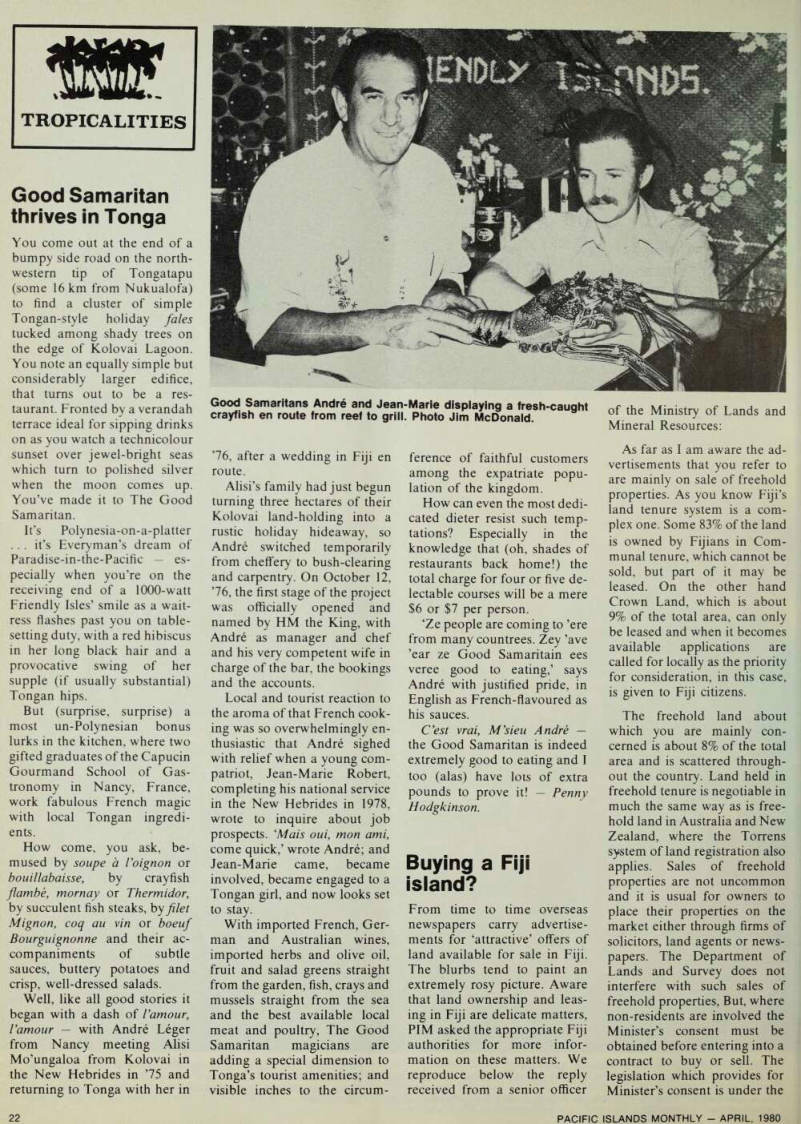
Good Samaritans Andre and Jean-Marie displaying a fresh-caught crayfish en route from reef to grill. Photo Jim McDonald.
Lands Sales Act of 1974.
The purpose of this legis lation is to have some measure of control and to watch the effect of land transactions in Fiji, particularly those of a speculative nature where non resident persons may be engaged in the dealings. In the past considerable profits appear to have been made on these transactions, and this is having the effect of rapidly increasing the price of land, and is also having a serious effect on the economy of the country. There is also provision for levying land sales tax on
capital profits derived through
sale of freehold properties.
If a person is buying either a freehold or a leasehold interest in land, he should be aware of the following facts: (a) A Sale and Purchase Agreement is not evidence of ownership of an interest in the land. To be the legal owner he must hold a Certificate of Title or a registered lease. If the land is in a recent subdivision, the vendor may not be able to give this evidence of ownership until he has satisfied the Regis trar of Titles that he has com pleted the subdivision in accordance with conditions laid down by the authority re
sponsible for its approval.
Without such evidence of own ership, he will not be permitted to start any building work on the site nor will he have an ad equate security for any mort gage on it. (b) Any subdivided block of land which one may buy or lease will be designated on the plan of subdivision for a par ticular use such as agricultural, residential, commercial, hotel purposes and so on. If one intends to change the use of the land, for example by further subdivision or by building a hotel on an agricultural hold ing, he should obtain approvals for such change of use before entering into any firm commit ment to buy or lease. Both the landlord and the local auth ority should be consulted on any proposed change of use of land. (c) Similarly if one is purchasing or leasing a build ing and intends to change its use, for example, from having
a house to being a motel or boarding house, he should obtain approvals for such change of use before entering into any firm commitment to buy or lease.
On again: Coral
Sea Air Classic
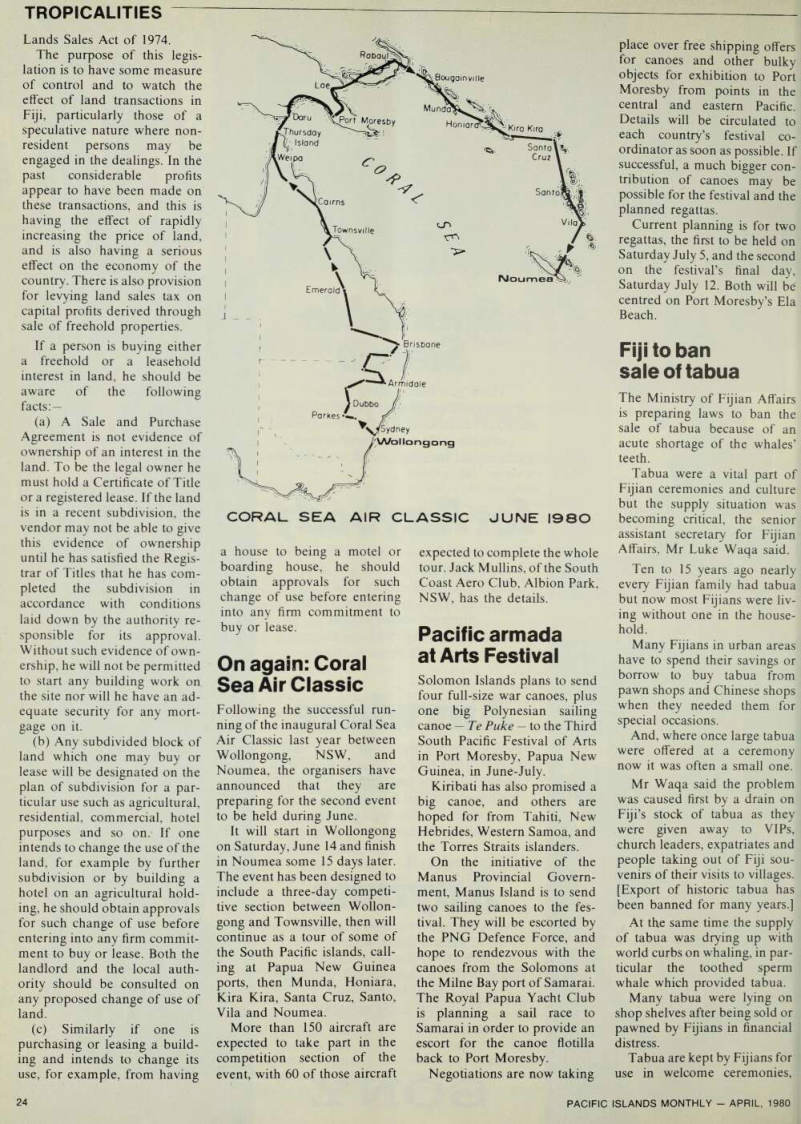
Following the successful run ning of the inaugural Coral Sea Air Classic last year between Wollongong, NSW, and Noumea, the organisers have announced that they are preparing for the second event to be held during June.
It will start in Wollongong on Saturday, June 14 and finish in Noumea some 15 days later.
The event has been designed to
include a three-day competi
tive section between Wollon gong and Townsville, then will continue as a tour of some of the South Pacific islands, call ing at Papua New Guinea ports, then Munda, Honiara, Kira Kira, Santa Cruz, Santo, Vila and Noumea.
More than 150 aircraft are expected to take part in the competition section of the event, with 60 of those aircraft
expected to complete the whole tour. Jack Mullins, of the South Coast Aero Club, Albion Park, NSW, has the details.
Pacific armada
at Arts Festival
Solomon Islands plans to send four full-size war canoes, plus
one big Polynesian sailing
canoe Te Puke to the Third South Pacific Festival of Arts in Port Moresby, Papua New Guinea, in June-July.
Kiribati has also promised a big canoe, and others are hoped for from Tahiti, New Hebrides, Western Samoa, and the Torres Straits islanders.
On the initiative of the Manus Provincial Govern ment, Manus Island is to send two sailing canoes to the fes tival. They will be escorted by the PNG Defence Force, and hope to rendezvous with the canoes from the Solomons at the Milne Bay port of Samarai.
The Royal Papua Yacht Club is planning a sail race to Samarai in order to provide an escort for the canoe flotilla back to Port Moresby.
Negotiations are now taking
place over free shipping offers for canoes and other bulky objects for exhibition to Port Moresby from points in the central and eastern Pacific.
Details will be circulated to each country’s festival co ordinator as soon as possible. If successful, a much bigger con tribution of canoes may be possible for the festival and the
planned regattas.
Current planning is for two regattas, the first to be held on Saturday July 5, and the second on the festival’s final day, Saturday July 12. Both will be centred on Port Moresby’s Ela Beach.
Fiji to ban
sale of tabua
The Ministry of Fijian Affairs is preparing laws to ban the sale of tabua because of an acute shortage of the whales’ teeth.
Tabua were a vital part of Fijian ceremonies and culture but the supply situation was becoming critical, the senior assistant secretary for Fijian Affairs, Mr Luke Waqa said.
Ten to 15 years ago nearly every Fijian family had tabua but now most Fijians were liv ing without one in the house hold.
Many Fijians in urban areas have to spend their savings or borrow to buy tabua from pawn shops and Chinese shops when they needed them for
special occasions.
And, where once large tabua were offered at a ceremony now it was often a small one.
Mr Waqa said the problem was caused first by a drain on Fiji’s stock of tabua as they were given away to VIPs, church leaders, expatriates and
people taking out of Fiji sou
venirs of their visits to villages. [Export of historic tabua has been banned for many years.] At the same time the supply of tabua was drying up with world curbs on whaling, in par ticular the toothed sperm whale which provided tabua.
Many tabua were lying on shop shelves after being sold or
pawned by Fijians in financial
distress.
Tabua are kept by Fijians for
use in welcome ceremonies,
Coral Sea Air Classic June 1980
marriages, births and reconcili ation in dispute.
Tabua cannot be replaced by yaqona or other Fijian gifts on many such special occasions.
Lae students’
Oxtrike
Under the supervision of Dr Brian Dudley, a visiting lec turer at the Papua New Guinea
University of Technology in
Lae, two final year students in the Department of Mechanical
Engineering have completed a
project of building an Oxtrike, a three-wheeled vehicle which resembles an overgrown tri cycle. The students, Pinoko Moses and Henry Pital, along with the workshop staff and Dr Dudley did all the work them selves.
The Oxtrike, intended as an economical transport vehicle for developing countries, was
originally designed by Dr
Stuart Wilson of the Inter
mediate Technology Develop
ment Unit at Oxford University. It is capable of car rying up to 150 kg of cargo, or two passengers if fitted with a seat as was the Unitech Oxtrike.
Dr Dudley said that a vehicle of this sort could be useful in a place like Lae. It is sturdy, and easy to operate and main tain. It has also been suggested the Oxtrike could be used by tourists in places like
Madang.
The Department of Mechan ical Engineering at the Univer sity is interested in improving the design of the Oxtrike and arranging for its manufacture in Papua New Guinea.
The Pasadena-
Pitcairn story
Sandra Blakeslee of the Los Angeles Times backgrounds the project by a group of students in Pasadena, California, to pre sent to Pitcairn Island the solar electricity generator they have built (PIM Mar p 7).
Writes Blakeslee: A group of Pasadena students who set out to prove that the government is ‘full of baloney’ about the cost of solar energy has succeeded in building a solar collector and generator that produces five kilowatts of electricity, a feat the government says is quite re spectable. ‘We’ve learned stuff that you could never learn without actu ally going out and doing it,’ said a Project Sunfire foreman, Neil Dipprey, 20. Most of the parts were scrounged and donated.
However, the young inven tors said they have plans to forge a solar future. They founded a company last year called the Solar Dynamo
Gang, Inc.
The company will manufac ture two-kilowatt solar gener ators for use in remote places or on rooftops in nearby Los Angeles.
Each Sun Raider, as the units are called, will sell for $5OOO.
Two kilowatts would be enough power for a single
family dwelling, they said.
Sunfire, at five kilowatts, will be enough to run the re frigerators on Pitcairn, where
people live frugally.
Solar energy is tailor-made for remote islands such as Pit cairn, Dipprey said.
Sunfire is a gift of love, the students said, from their gener ation to the past generation.
The project began five years ago. Frank Broyles, a backyard inventor and solar tinkerer, was fed up with government estimates of solar energy costs. ‘They said a collector would cost $7O 000 to $BO 000 a kilo watt,’ he recalled recently. ‘I said baloney, we can do it for less.’
Broyles enlisted the help of a physics class at nearby Cresenta Valley High School in the fall of 1974.
About the same time, Tom Christian of Pitcairn Island heard about the project on his shortwave radio. ‘Tom contacted us and asked if they could have it if it worked,” Broyles said. The
answer was yes. ‘There really wasn’t anything else to do with it,’ he added .. .
The students are worried about getting Sunfire to iso lated Pitcairn.
They are putting out feelers to the Navy in hopes of getting support .. .
PNG: Warnings
from the grave
A Papua New Guinea man who died in a drunken brawl has had his grave decorated with beer bottles. And several other men who died in road ac cidents have been buried at the roadside where every driver going past can see the graves. ‘There’s no disrespect it’s just part of a new tradition we are establishing’ clan leaders say in Mount Hagen in the Western Highlands. About eight of the new roadside graves have appeared along
sections of roadway leading
into Mount Hagen. The head stones are painted in bright colours to draw attention to them, and they are surrounded by borders of flowers and shrubs.
Villagers living near the
grave of one of the accident victims insist that all people walking or driving past must remove their hats. The grave of the man who died in a brawl is also at the roadside. It is sur rounded by a neat border of partly buried beer bottles in a
carefully-tended clearing.
(Beer bottles are commonly used to mark graves in num bers of Pacific Islands, but these ornaments have no con nection with their cause of death.) The graves belong to people of the Kilipika and Kuli clans which have a number of vil lages in the Western High lands. A Kuli man said that death on the roads or from fights which did not involve traditional tribal warfare had shocked and worried many people in the area. ‘The people are confused’ he said, ‘because our traditions of burial do not relate to deaths of this sort. The result had been the burial of some victims by the roadside instead of in tra ditional burial grounds.
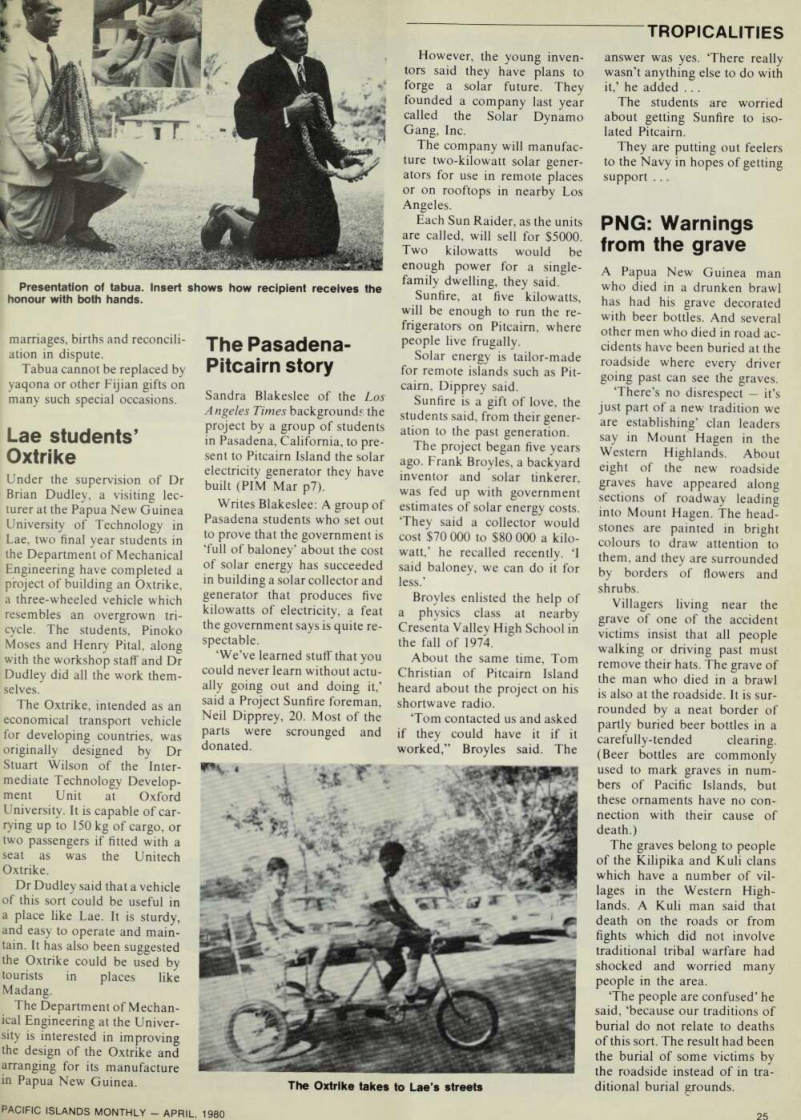
Presentation of tabua. Insert shows how recipient receives the honour with both hands.
The Oxtrike takes to Lae’s streets