New Politics
p. 19 · Read in the full issue
In W. Samoa
From Felise Va’a in Apia The year 1979 was not a happy year for Tupuola Efi’s govern ment. For the first time in the history of Samoan politics, the government in power had to fight for its existence against an organised political party using modern methods of party or ganisation and pressure tac tics.
True there had been political parties of a sort in the past, both before and after indepen dence in 1962. But these politi cal groupings were mostly loose affairs and were formed primarily for the purpose of lobbying for particular can didates for the prime minister’s job. After the 1979 general elections in February, how ever, it became only too obvious that the future of Samoan politics will be gover ned largely by formal political parties A group of parliamentarians formed themselves into the Human Rights Protection Party. At the outset, the pri-
mary aim of the party was the ousting of Tupuola Efi from the position of prime minister.
The motives were varied and to a large extent personal. Many felt that Tupuola was drifting too far left and towards a subtle
form of dictatorship. Tupuola,
for instance, was accused of
being overfriendly with Com
munist countries such as the Soviet Union and the People’s Republic of China. He was also accused of favouritism in the matter of appointments. Some of the charges have been exag erated, but others have not
been fully explained away by
government, leading many to doubt the integrity of the prime minister and members of his cabinet.
The influence of the Oppo sition was seen during 1979 when Tupuola refused to call a parliamentary session for most of the year. The first session
was finally begun on
November 13 for the purpose of discussing the $60.2 million budget for 1980. It appeared then that government was forced to hold the session only because of the budget and the Opposition did not forget it.
They made government minis ters suffer from their incessant attacks and perhaps it was no coincidence that Prime Minis ter Tupuola twice had attacks of ill-health during the budget debate. He collapsed after a game of squash, and had a re lapse in parliament during a
debate, forcing parliament to
recess for a while.
Most regrettably of all, the Minister of Lands, Hon Lesa tele Rapi, brother of Oppo sition leader Vaai Kolone,
collapsed during a budget de
bate and died shortly after. All these things occurred during a time of high tension in parlia ment.
While the imminent threat from the Opposition is waning, government still has a lot of problems to face. Chief among these is the economic problem.
Government is seeking to con trol the balance of payments
problem caused primarily by a
drop in agricultural exports
and increased energy costs. To do this, it has to curtail imports drastically. This in turn is annoying the merchants who are crying out for more allo cations. Then government is also faced by the threat of strik ing public servants who are demanding pay increases to keep up with the cost of living.
To grant these increases government will most likely re sort to more taxation, hence more dissatisfaction from the
people.
Tupuola will have to ‘pull up his socks’ and he probably re alises this. A policy of rooting out his opponents, in the public service, business or elsewhere will not help him for he cannot dismiss the social and econ omic realities. A drift towards more nationalisation will have to stop and he will have to come to terms with business and the consumers. Therefore, some relaxation in credit poli
cies will have to be allowed and business will have to be encouraged to play its part in boosting the economy. This can only be done through needed incentives.
No doubt Tupuola has the best of intentions for the country and he has many admirers for the hard work he puts in. No doubt some of the accusations made against him are exaggerated. No doubt he is knowledgeable about re
lationships with foreign coun
tries and the current world situation. But he has to come to some sort of accommodation with his critics, who are not
always wrong.
He will also have to adopt a
more open policy regarding
government public relations, an area where the Tupuola government fails miserably.
This failure explains to a great extent the unpopularity of his administration. The people will have to know more about his policies and their justifi cation. This means he will have to be more prepared to talk with the press, from which at the moment he has practically shut himself off.
Politics in Samoa in the
1980 s will be radically different
with the incoming of formal party politics. The old politics of consensus and compromise will be no more. The pro fessional politician has arrived at last, with his good points and bad. Political upheaval is in the
making.
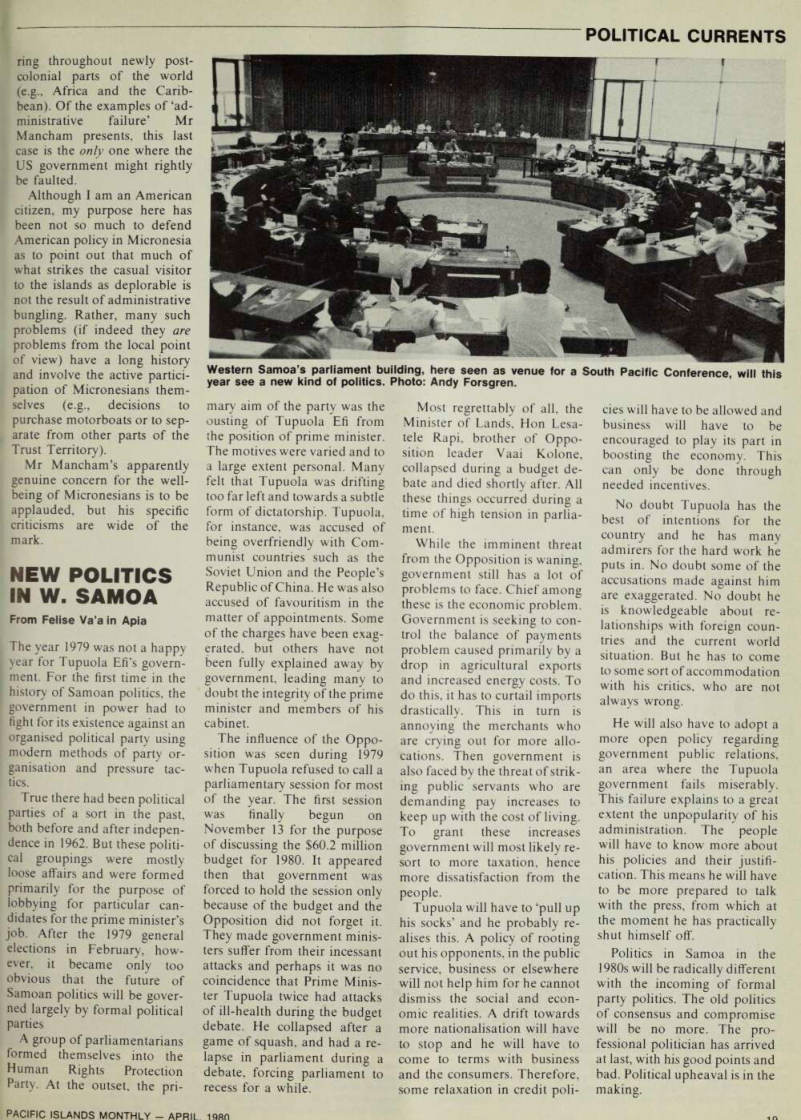
Western Samoa’s parliament building, here seen as venue for a South Pacific Conference, will this year see a new kind of politics. Photo: Andy Forsgren.