Political
pp. 17-19 · Read in the full issue
Currents
Micronesia:
Another View
Dr Mac Marshall, an American anthropologist who lived in Micronesia for almost three years, and is currently in Port Moresby as Visiting Senior Re search Fellow at the PNG Insti tute of Applied Social and Economic Research, here com ments on the letter headlined ‘ What's wrong with the U.S.
Trust Territory?’ by James R.
Mancham (PIM Feb p 5).
Mr Mancham, a former Chief Minister, Prime Minister and President of the Seychelles, re cently touched at several islands in Micronesia while aboard a cruise ship and has levelled criticism at the US Government for a variety of things he observed there which purportedly represent ‘an obvious lack of a defined, comprehensive and coordina ted policy for the islands on the part of the administering
power.’
Mr Mancham gives the
following examples in support
of this contention; the use of corrugated iron in the construc tion of churches and public buildings; the supposed lack of fishing, with ‘hundreds of empty tins of canned fish’ lying about; loss of the skills necess ary to operate traditional out rigger canoes in the face of the outboard ‘engine craze’; use of the beachfronts as ‘latrines and refuse dumps’; ‘alcoholism resulting from the indiscrimin
ating [sic] tapping and drinking
of toddy’; and political frag
mentation.
While I would concur that the US government has not always operated with a coher ent, overall policy in Micronesia, I think Mr Mancham has chosen strange examples to illustrate his point.
It is odd that Mr Mancham assumes the US government to be responsible for the use of
corrugated iron sheets in the construction of churches and
public buildings. To begin
with, the government does not construct churches; in the sec ond place, on the atolls of Micronesia corrugated iron
roofs provide an important
rain-catchment surface, which is far more important than their (admitted) aesthetic faults.
Churches and public buildings
usually are the largest struc tures in Micronesian village communities and, when roofed with corrugated iron, provide a community-wide source of water that can be collected in cisterns. Finally, in the Pacific, if not in the Indian Ocean, cor rugated iron has been readily available as a building material for at least a century and its use in Micronesia long antedates the US governmental pres ence.
That large quantities of
tinned fish are consumed in Micronesia, as elsewhere in the Pacific, is true particularly so in the port towns. That this automatically means that there is a lack of fishing in Micronesia does not follow.
Members of both of the Micronesian communities in which I have lived for extended periods one an outer island and one a suburb of the port town in Truk undertook fish
ing almost daily, even though
canned fish also was con sumed. In any event, the US government can hardly be held directly responsible for the im portation of tinned fish; it is imported and sold by private Micronesian businessmen to meet local demand.
Mr Mancham is correct that
open-ocean sailing of canoes has declined greatly in Micronesia in the past 35 years and that outboard motorboats have become increasingly popular. In contemporary Micronesia traditional naviga tional techniques survive only on a few atolls in the Central Carolines, but most young men still learn how to ‘operate’ (i.e., sail) traditional outrigger canoes, even if they do not master celestial navigation lore.
I suspect that with the tight ening of the fuel crisis world wide the canoes may begin to make a strong comeback at the expense of motorboats, but it will be a few years before this hypothesis can be tested. More importantly for this discussion, Micronesians have consciously chosen outboard motorboats because these vessels perform some jobs more rapidly and efficiently than canoes, e.g., they are faster, can carry larger loads, can be used for open ocean trolling on windless
days, etc. Again, I emphasise
that it is Micronesians them selves who have opted for motorboats; the presence of these vessels is not a con sequence of US government action.
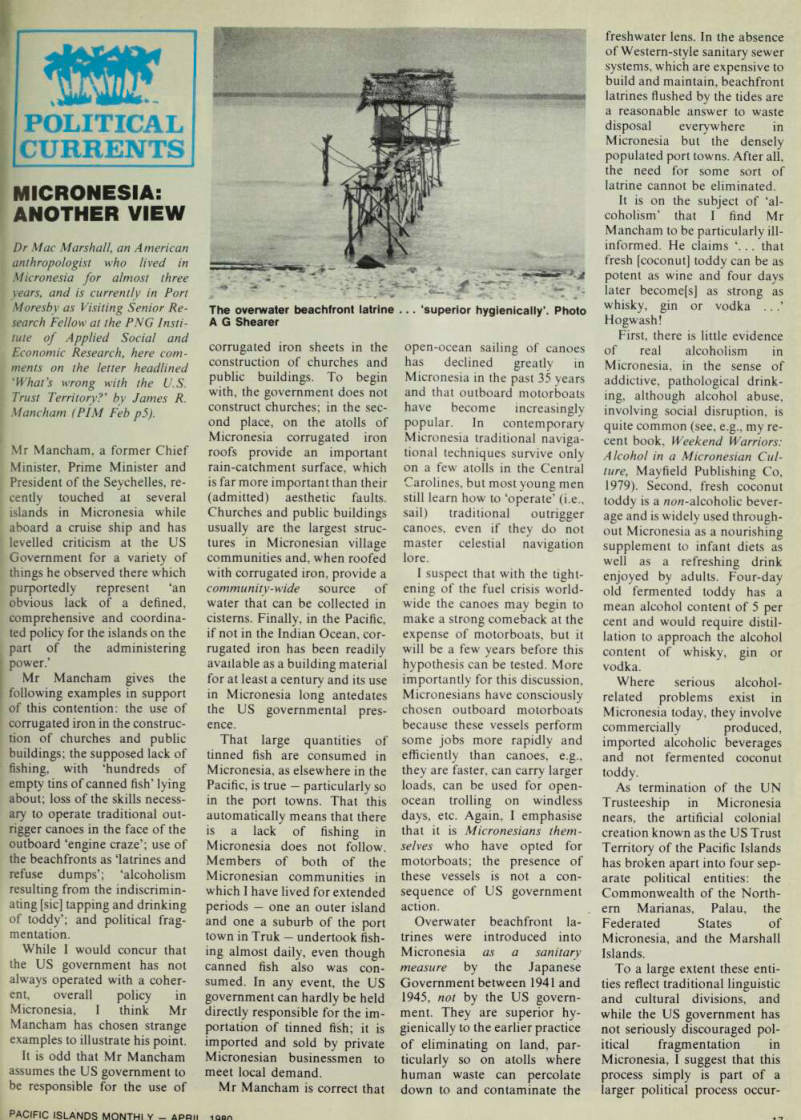
Overwater beachfront la trines were introduced into Micronesia as a sanitary measure by the Japanese Government between 1941 and 1945, not by the US govern ment. They are superior hy gienically to the earlier practice of eliminating on land, par ticularly so on atolls where human waste can percolate down to and contaminate the
freshwater lens. In the absence
of Western-style sanitary sewer
systems, which are expensive to build and maintain, beachfront latrines flushed by the tides are a reasonable answer to waste
disposal everywhere in
Micronesia but the densely populated port towns. After all, the need for some sort of latrine cannot be eliminated.
It is on the subject of ‘al coholism’ that I find Mr Mancham to be particularly ill informed. He claims ‘... that fresh [coconut] toddy can be as potent as wine and four days later become[s] as strong as
whisky, gin or vodka ..
Hogwash!
First, there is little evidence of real alcoholism in Micronesia, in the sense of addictive, pathological drink
ing, although alcohol abuse,
involving social disruption, is
quite common (see, e.g., my re cent book. Weekend Warriors: Alcohol in a Micronesian Cul
ture, Mayfield Publishing Co,
1979). Second, fresh coconut toddy is a non-alcoholic bever age and is widely used through out Micronesia as a nourishing supplement to infant diets as well as a refreshing drink
enjoyed by adults. Four-day
old fermented toddy has a mean alcohol content of 5 per cent and would require distil lation to approach the alcohol content of whisky, gin or vodka.
Where serious alcohol related problems exist in
Micronesia today, they involve
commercially produced,
imported alcoholic beverages
and not fermented coconut
toddy.
As termination of the UN Trusteeship in Micronesia nears, the artificial colonial creation known as the US Trust Territory of the Pacific Islands has broken apart into four sep arate political entities: the Commonwealth of the North ern Marianas, Palau, the Federated States of Micronesia, and the Marshall Islands.
To a large extent these enti ties reflect traditional linguistic and cultural divisions, and while the US government has
not seriously discouraged pol
itical fragmentation in Micronesia, I suggest that this process simply is part of a
larger political process occur
The overwater beachfront latrine ... ‘superior hygienically’. Photo A G Shearer
ring throughout newly post colonial parts of the world (e.g., Africa and the Carib bean). Of the examples of ‘ad ministrative failure’ Mr Mancham presents, this last case is the only one where the
US government might rightly
be faulted.
Although I am an American citizen, my purpose here has been not so much to defend American policy in Micronesia as to point out that much of what strikes the casual visitor to the islands as deplorable is not the result of administrative bungling. Rather, many such problems (if indeed they are problems from the local point of view) have a long history and involve the active partici pation of Micronesians them selves (e.g., decisions to purchase motorboats or to sep arate from other parts of the
Trust Territory).
Mr Mancham’s apparently genuine concern for the well being of Micronesians is to be
applauded, but his specific
criticisms are wide of the mark.