Offbeat Pacific Travel
pp. 40-41 · Read in the full issue
Books
From An Ex-G-G. Xz
Travel Warrant. By Bernard
Fergusson. Published by
William Collins Pty Ltd. $ A 22.50.
Bernard Fergusson (now Lord Ballantrae), is a Scot who appears to anyone who had not known too many of them as a Perfect English Gentleman. As any man with his aristocratic
background might, he drops a
lot of names, regimental and otherwise, that mean less than nothing to the antipodean un initiated. Nonetheless, in Travel Warrant he writes an
interesting and amusing book.
It concerns his travels outside the army which he had already covered in other books. Beyond the Chinwin probably being the best known.
He comes of a long line of soldiers and governors-general of various corners of what was
the British Empire, including
New Zealand. Both maternal
and paternal grandfathers ser
ved in that capacity in NZ so too did his father between 1924 and 1930. It was fitting, there fore, that young Bernard should be commissioned into the Black Watch, serve his country in many lands for 27 years and then, in the fullness of time and through his own accomplishments, himself be come governor-general of NZ between 1962-67.
Things have changed even
since 1967, and the places where an Englishman (or Scot) may become a G or a G-G are now strictly limited, most Commonwealth countries keeping that post warm for
home-grown, superannuated
politicians and other worthies.
New Zealand, however, oc casionally still does the right
thing by importing the genuine
article from ‘Home’ and may already have its eye on the Fer gusson son, now aged about 25, to carry on the tradition.
NZ was in Bernard Fergus son’s blood. Many of his rela tives had settled there, and in 1925 during his father’s term of
office he spent what he re garded as six halcyon months there as a teenager. At that time he pleaded with his parents to let him finish his education at
Wanganui or Christ’s College,
or even at Timaru Boys’ High School, which seems to have impressed him. His father ap parently considered it, but in his Scotsbyterian way did not disclose this to Bernard, simply packing him off, back to Eton.
In 1958 Bernard Fergusson resigned from the army, the idea being to augment his pen sion by writing books. Like many others he soon found that this was a chancy way of earn ing a living and he therefore induced the London Sunday Times (and later the Daily Tele graph) to employ him for three months of each year as a roving correspondent. This allowed him to visit the trouble spots of the world of which there was the usual number in late 1950s
early 19605.
One of his earliest assign
ments was to still-French
Algeria, then going through the
same sort of trauma that Rhodesia was to experience a decade later. Many members of the French services establishment had been col leagues during the war or the Suez fracas. One of these, Admiral Barjot, described to him how in November 1942 he had witnessed the Allied land
ings at Algiers and the ‘spec
tacular arrival of the
headquarters ship; HMS
Bulolo. Bulolo came alongside at 12 knots; her captain un aware that his engine-room telegraph had been severed by a near-miss from a bomb and
only a providential mudbank
by the quay brought her up all
standing and undamaged’.
Fergusson, whose travels did not involve him in Australia or Australian territories obviously did not know Bulolo's early or later connection with the Southwest Pacific.
In 1961, towards the end of
his journalistic junketing, he
visited Dutch New Guinea, at the time when Soekarno’s hys teria about that territory had reached fever pitch and the fate of DNG was already sealed.
He had intended spending a month in Indonesia, but the British Embassy at Jakarta, ap parently afraid that he would rock the boat, refused him all aid. He left for Singapore and from there finally arrived in old Hollandia. He stayed at the government hotel which he claims was ‘comfortable and well-run’, a description it hardly merited a year later when the balloon finally went up and the old pub was full of journalists from far and wide, as well as useless UN ‘ob servers’ waiting for the Dutch
to depart so they could grab
one of the better bungalows.
He describes how he met old PIM friends, Kaisiepo and
Womsiwor, leading figures in
what might be called Papuan resistance. One evening he went to Government House to hear them lay before Dr Plat ted, the governor, their request that they be granted a national flag and a national anthem. ‘They unfurled one and sang the other,’ he reports. ‘Both were hideous and I gave Dr Platted full marks for not wincing more than he did.’
Later he was to read a story datelined Jakarta on how the brutal Dutch had imposed a new flag and anthem on the
hapless Papuans and had
ordered Marines to fire on the crowds when they refused to
comply.
Fergusson’s five years in New Zealand allowed him access to the Pacific Islands the Cooks, Niue, Tonga, West Samoa, even Tahiti and interesting as it always is to see ourselves as others do, two items stand out.
In Western Samoa he felt there were the seeds of embar rassment as the ‘first 12 years of the Mandate were not happy’ a delicate way of
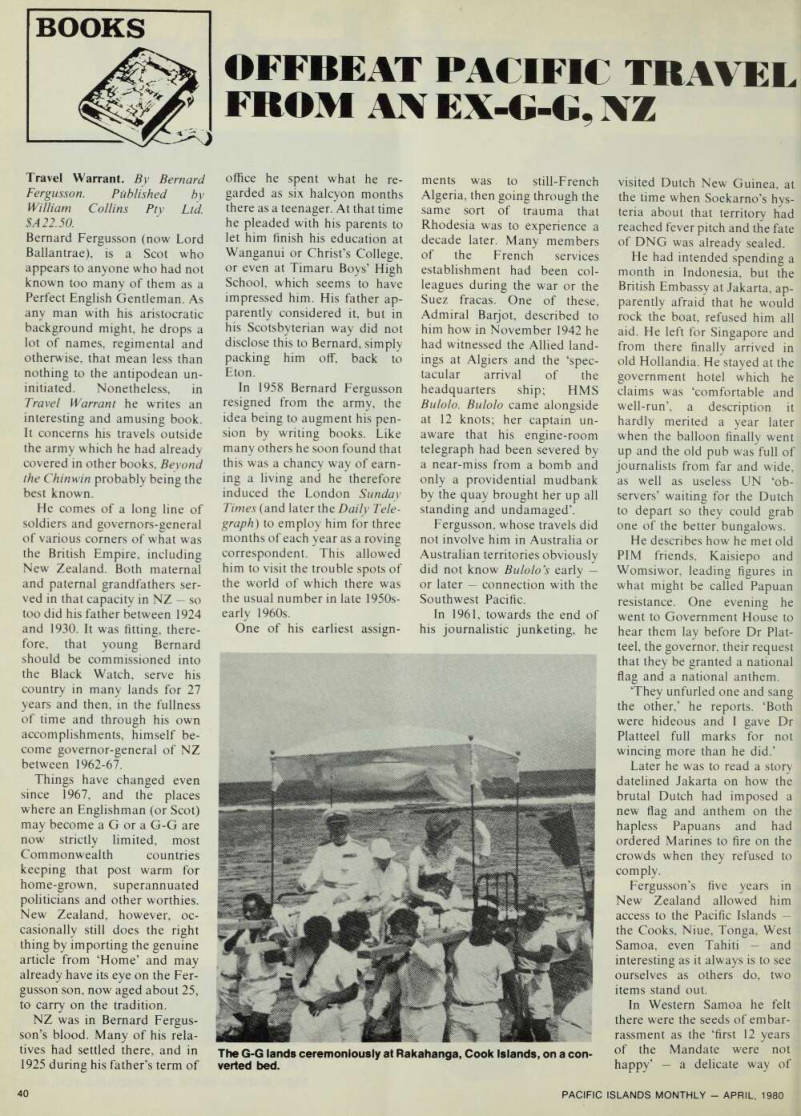
The G-G lands ceremoniously at Rakahanga, Cook Islands, on a con verted bed.
referring to the Mau troubles that went on for longer than that. His explanation of these troubled times is certainly a new slant on this period of re cent Samoan history, coloured perhaps by the fact that his father was governor-general in the late 19205, when the real trouble started, and was all for a tougher line.
To quote from Travel War rant: ‘There were ancient rivalries between the families of Tamasese, Malietoa and Mata’afa; between them and the administration; and be tween the administration and certain agitators. These last were businessmen of various
origins mostly mixed blood,
part-Samoan, part-German or Scandinavian who resented government intervention to
prevent exploitation by
middlemen of the labours of the cultivators.’
The ‘agitators’ were, of course O. F. Nelson, Judge Gurr and A. G. Smyth. Nelson was of part-Samoan ancestry but the other two were not, and
all paid dearly for what they
believed was the Samoan cause - no one, hitherto, has thrown doubts on that.
At the end of his views on the Mau, Fergusson states that the current Malietoa, who at the time of his visit was head of state, and Mata’afa, who was prime minister, agreed that the traders were the villains of the
piece. Were they just display
ing Samoan good manners; or are memories short and old rivalries really dying out in Samoa?
Malietoa’s father was cer tainly anti-Mau; High Chief
Fiame Faumuina (he received the Mata’afa title in 1939) was president of the Mau in the 19305.
Today the consensus of opinion on the Mau period is that though the Mau and its leaders were pig-headed, the NZ administration acted like ham-handed bureaucrats and had little understanding of the people it was set to govern. The Mau influence started to wane once NZ gave up sending gen erals and half-generals to the territory as administrators.
Most of the people men tioned in this book are pretty marvellous; the few that are criticised include the Marsters clan of Palmerston Island, the much-written-about descend ents of William of that ilk who settled there in 1862 with three Penrhyn wives. Fergusson says that after visiting them he saw no reason to dissent from the
warning given to his parents by
the captain of the old Tutanekai on which they had travelled, that the Marsters were an ‘avaricious and grasp
ing lot’.
On this 1964 visit the current patriarch was given two 50 lb bags of flour, 70 lb of sugar,
four pounds of cigarette
tobacco and papers to go with it, and not only did he fail to say thanks, he asked for more, including a new outboard motor.
During the vice-regal visit
the whole community got drunk on home-brew and then tried to raid the canteen on the G-G’s ship. One Marsters fell overboard and the assembled company watched him labori ously swim ashore, ‘half fear
ing and perhaps half hoping’
that a shark would get him. It didn’t.
Well, that’s what can happen to simple islanders when they become celebrities.
Not all governors-general write as well as Bernard Fer gusson, Lord Ballantrae, who, after all, can be regarded as a professional. As a result this is a book that can be enjoyed equally by old soldiers, those
intrigued by the private lives of
governors, or by those who just like an offbeat travel book full
of offbeat characters.
J. T.
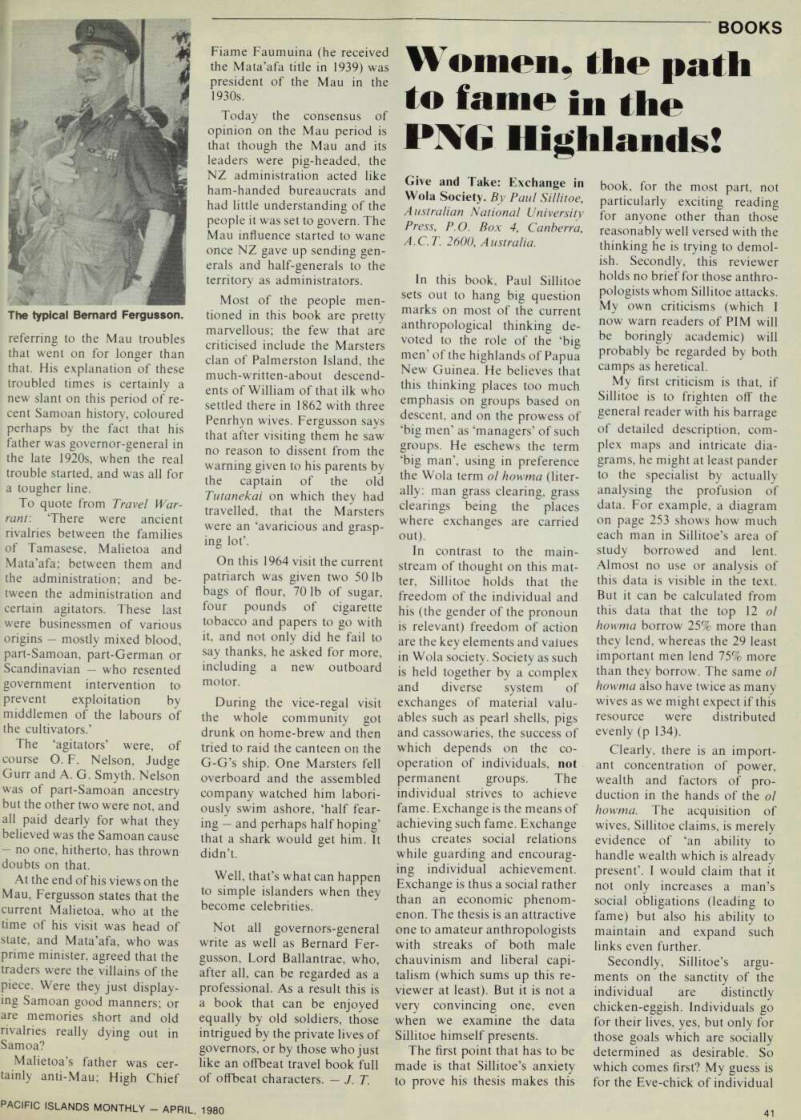
The typical Bernard Fergusson.