Auckland-Polynesian city
pp. 17-19 · Read in the full issue
[Auckland has been tagged the biggest Polynesian city in the world.
James Tally, Pacific affairs writer with The Auckland Star, looks [at some of the problems which have sprung from New Zealand's I hitherto generally relaxed immigration policy tow ard people from \ certain Island groups, mainly the Cooks, Niue, Tokelau, Western Samoa and Tonga. Things are not as bad as they were, he reports, but race relations and the need to improve the lot of the disadvan -1 (aged Island minority in New Zealand remain major problems for government and local authorities to tackle.
It is bustling, colourful, Karangahape Road which gives Auckland the feel of a big. cosmopolitan city generally lacking in this sprawling, soulless metropolis. ‘K Rd’.
Auckland s tame and tatty version of Sydney s King’s Cross, is Instant Polynesia, a focal point for Auckland’s big population of Maoris and Pacific Islanders. Especially Islanders - Tongans, Samoans, Niueans, Cook Islanders, Fijians and Tokelauans. For the many who live in the surrounding suburbs o Ponsonby, Newton, Freeman’s Bay, Grey Lynn, K Rd
is their local shopping centre, It caters for- their needs.
Fruit shops sell taro, yams and coconuts’. The fish shops carry a wide range of seafood not often served in palagi (European) homes. Fabric shops have bright printed materials for lavalavas and other island-style dress, Basketware and other island handicrafts are sold. There are travel agents who specialise in arranging trips home to the Islands, On Sunday, Island families in long skirts and picture hats, lavalavas and dark suits, bibles
in hand, stroll along K Rd to the churches which still play a big part in their lives. Some wait for buses outside the pubs, strip clubs and massage par lours that make K Rd a tawdry focus of night life.
The skyline of K Rd recently acquired an island flavour with the opening of Samoa House
which has a large fale- style
hall. The building houses the Western Samoan consulate in Auckland and Nauru’s
consulate-general.
Step away from K Rd and Ponsonby and there isn’t much to suggest that Auckland is home to more than 40 000 Islanders, even in South Auckland suburbs like Otara and Mangere which have large numbers of Islanders.
Surprisingly, there are no restaurants specialising in Island dishes. Aucklanders ap
parently prefer French, Italian,
Greek and Lebanese food. The city’s night life has little with an Island flavour apart from two dance spots popular with the Island community Tan garoa’s Hut and the Reef comber.
Visit Auckland international airport and you might see crowds of Islanders with leis and shell necklaces waiting to meet or farewell relatives and friends on flights to and from
Apia and Rarotonga.
Auckland has been tagged
the biggest Polynesian city in
the world but it doesn’t show very much.
It’s not surprising that K Rd has become identified with Auckland’s growing Pacific Island population. Over the years, migrants lured by the prospect of jobs in New Zea
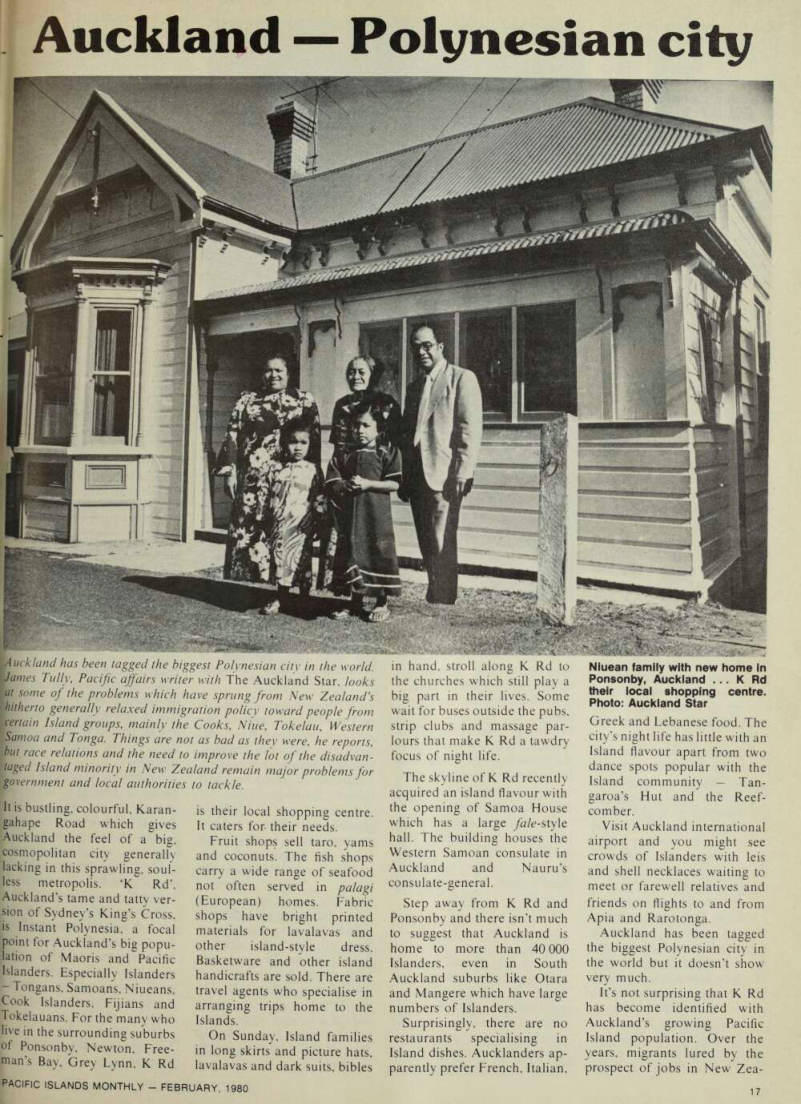
Niuean family with new home in Ponsonby, Auckland ... K Rd their local shopping centre.
Photo: Auckland Star
land factories, have tended to live in cheap housing areas.
Very often, that meant the old inner city suburbs around K Rd.
Housing is a major problem for Auckland’s Island families.
The wages for unskilled workers especially those with large families don’t stretch very far. The old wooden villas of the inner suburbs may often
provide only adequate accom
modation but rents are high.
Samoa-born Stephen
Niumata, a legal executive, who is president of the Pacific Islanders’ Housing and Wel fare Association explains: ‘Once they have obtained a place to stay the majority are faced with the problem of meeting payments of about SNZSO or $6O a week. The av erage labourer earns only $BO or $9O a week, which means they are paying out more than half their wages on rent. ‘Many try to solve this prob lem by inviting relatives or friends to live with them and thus share the burden but this is interpreted by landlords as
overcrowding.
‘lf the rental is high there can be anything up to a dozen people occupying a house. We receive many complaints of overcrowding each week and try to balance this by complain ing that rents are too high.’
Mr Niumata says bond re
quirements usually two
weeks rent create problems too. An islander may have to put up a $250 bond. Some arrive in Auckland with as little asslo. ‘Some stay at their relatives’ place for a while but this usually results in arguments.
We used to lend money but unfortunately we went broke as more often than not we were never repaid.’ The association still helps people over the Christmas period when every thing is closed.
Another problem is knowing
where to look for accommo dation. Until recently, Auckland accommodation was not advertised in the islands.
Western Samoa has taken the lead in helping prospective mi grants by running advertise ments in the Apia Press.
According to Mr Niumata, Islanders still face racial preju dice from landlords. The level.
he says, is ‘tolerable’. It used to be ‘very bad’.
In recent years Islanders have had to look increasingly to the outer suburb for accom modation. They’ve faced com petition for the old villas of Ponsonby from young pro fessional couples who realise the advantages of living close to the offices where they work.
It has become trendy to buy an old villa and restore it.
Mr Niumata says some Islanders are getting into financial difficulties because they have bought houses in outer suburbs without seeking the advice of lawyers.
Housing is just one of several
problems faced by Pacific
Islanders living in New Zealand. The picture is one of a disadvantaged minority. Im migration and its associated
socio-economic problems only
emerged as an issue when the New Zealand economy began to falter five years ago. Until then it was convenient to
'import' unskilled workers to do the dirty jobs and fill the gaps in industry. When the economic situation changed.
Islanders became a scapegoat.
Long-ignored problems came
out into the open.
Auckland was seen to have
ghettoes-in-embryo. Low
income Island families were living in overcrowded, sub standard accommodation. Mi grants faced immense problems adjusting to a new urban dollar-oriented life style for which they were largely un prepared. Too little was being done to combat the social prob lems arising from educational and other disadvantages. The disaffected young were seeking radical solutions, some form ing street gangs with names like "The Niggs’ and 'Polynesian Panthers’.
In its successful 1975 election campaign, the National Party
played on palagi bigotries and
exploited the immigration issue. A year later the word ‘overstayers’ became part ol the New Zealand vocabulary as random checks were made on Islanders to see if they had overstayed their work per mits.
The overstayers issue has died down but visit Auckland magistrate’s court and it be comes ovious that immigration officials are still busy. Cases are usually heard on Mondays
and Tuesdays.
The corridor and stairwef adjoining the courtroom arc usually crammed with relatives and friends of those defending alleged breaches of the Immi gration Act. At times there arc more than 80 cases on the list There is often confusion as tc who is who and court officers
frequently have difficult)
pronouncing names.
On a more positive note, the education department ha; extended specialist services tc schools with large numbers o] Polynesian students and re viewed the needs of Island chil dren. Closer attention is paid tc the all-important language skills needed to succeed in the education system. Two school; have ‘reception classes’ foi
newly-arrived migrant children
who are given intensive language instruction and an introduction to aspects of the palagi way of life.
Several schools have made < determined effort to foster c true multi-cultural atmosphere and make education more rele vant to the needs of then students.
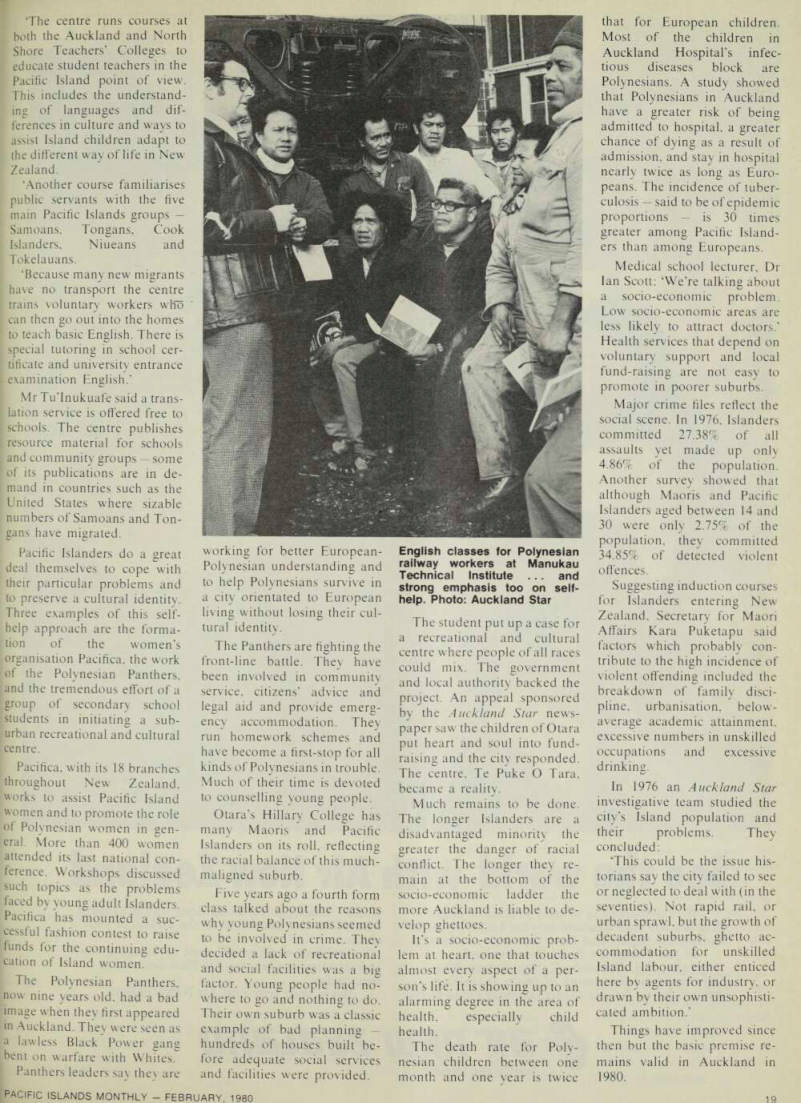
Technical institutes an taking English languag* courses ~to the factory floor
Auckland University is giving
special help to Polynesian
students, and Radio Nev Zealand has opened a Maor and Pacific Islands broadcast ing unit in Auckland.
Another welcome move ha; been the establishment of the Pacific Islands Educational Re source Centre which has a staf of 12 including tutors for all the main Island groups. An ole school in Ponsonby was refur bished as the centre’s home.
Orientation officer Edgai Tu'lnukuafe talks about some of its services:
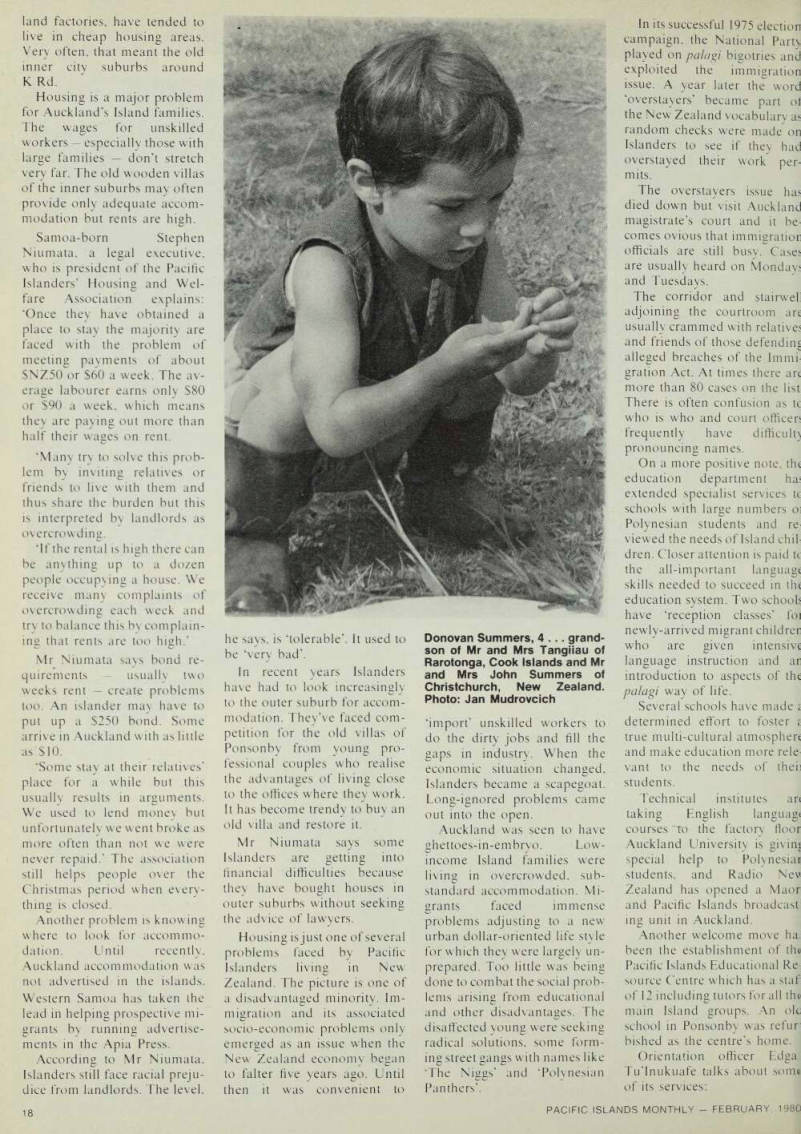
Donovan Summers, 4 . .. grand son of Mr and Mrs Tangiiau of Rarotonga, Cook Islands and Mr and Mrs John Summers of Christchurch, New Zealand.
Photo: Jan Mudrovcich
The centre runs courses at both the Auckland and North Shore Teachers’ Colleges to educate student teachers in the Pacific Island point of view.
This includes the understand ing of languages and dif ferences in culture and ways to assist Island children adapt to the different way of life in New Zealand. ‘Another course familiarises public servants with the five main Pacific Islands groups Samoans, Tongans, Cook Islanders, Niueans and Tokelauans. ‘Because many new migrants have no transport the centre trains voluntary workers who can then go out into the homes to teach basic English. There is special tutoring in school cer tificate and university entrance Lexamination English.' Mr Tu’lnukuafe said a trans lation service is offered free to j schools. The centre publishes resource material for schools and community groups some of its publications are in de mand in countries such as the I United States where sizable numbers of Samoans and Ton gans have migrated.
Pacific Islanders do a great deal themselves to cope with their particular problems and to preserve a cultural identity.
Three examples of this self help approach are the forma tion of the women’s organisation Pacifica, the work of the Polynesian Panthers, and the tremendous effort of a group of secondary school students in initiating a sub urban recreational and cultural centre.
Pacifica, with its 18 branches throughout New Zealand, works to assist Pacific Island women and to promote the role of Polynesian women in gen eral. More than 400 women attended its last national con ference. Workshops discussed such topics as the problems faced by young adult Islanders.
Pacifica has mounted a suc cessful fashion contest to raise funds for the continuing edu cation of Island women.
The Polynesian Panthers, now nine years old. had a bad image w hen they first appeared in Auckland. They w ere seen as a lawless Black Power gang bent on warfare with Whites, i Panthers leaders say they are
working for better European-
Polynesian understanding and
to help Polynesians survive in a city orientated to European living without losing their cul
tural identity.
The Panthers are fighting the front-line battle. They have been involved in community service, citizens’ advice and legal aid and provide emerg ency accommodation. They run homework schemes and have become a first-stop for all kinds of Polynesians in trouble.
Much of their time is devoted to counselling young people.
Otara’s Hillary College has
many Maoris and Pacific Islanders on its roll, reflecting the racial balance of this much
maligned suburb.
Five years ago a fourth form class talked about the reasons
why young Polynesians seemed
to be involved in crime. They decided a lack of recreational and social facilities was a big factor. Young people had no where to go and nothing to do.
Their ow n suburb was a classic example of bad planning hundreds of houses built be fore adequate social services and facilities were provided.
The student put up a case for a recreational and cultural centre where people of all races could mix. The government and local authority backed the
project. An appeal sponsored
by the Auckland Star news paper saw the children of Otara put heart and soul into fund
raising and the city responded.
The centre. Te Puke O Tara, became a reality.
Much remains to be done.
The longer Islanders are a
disadvantaged minority the
greater the danger of racial conflict. The longer they re main at the bottom of the socio-economic ladder the more Auckland is liable to de
velop ghettoes.
It’s a socio-economic prob lem at heart, one that touches almost every aspect of a per son’s life. It is showing up to an alarming degree in the area of health. especially child health.
The death rate for Poly nesian children between one month and one vear is twice
that for European children.
Most of the children in Auckland Hospital’s infec tious diseases block are
Polynesians. A study showed
that Polynesians in Auckland have a greater risk of being admitted to hospital, a greater chance of dying as a result of admission, and stay in hospital nearly twice as long as Euro peans. The incidence of tuber culosis said to be of epidemic proportions is 30 times greater among Pacific Island ers than among Europeans.
Medical school lecturer. Dr lan Scott; ‘We’re talking about a socio-economic problem.
Low socio-economic areas are less likely to attract doctors.’
Health services that depend on voluntary support and local fund-raising are not easy to promote in poorer suburbs.
Major crime files reflect the social scene. In 1976. Islanders committed 27.38% of all assaults yet made up only 4.86% of the population.
Another survey showed that although Maoris and Pacific Islanders aged between 14 and 30 were only 2.75% of the population, they committed 34.85% of detected violent offences.
Suggesting induction courses for Islanders entering New Zealand. Secretary for Maori Affairs Kara Puketapu said factors which probably con tribute to the high incidence of violent offending included the breakdown of family disci pline. urbanisation, below average academic attainment, excessive numbers in unskilled occupations and excessive
drinking.
In 1976 an Auckland Star investigative team studied the
city’s Island population and
their problems. They
concluded; ‘This could be the issue his torians say the city failed to see or neglected to deal with (in the seventies). Not rapid rail, or urban sprawl, but the growth of decadent suburbs, ghetto ac commodation for unskilled Island labour, either enticed here by agents for industry, or drawn by their own unsophisti cated ambition.’
Things have improved since
then but the basic premise re mains valid in Auckland in 1980.
English classes for Polynesian railway workers at Manukau Technical Institute .. . and strong emphasis too on self help. Photo: Auckland Star