Sydney’s Tongans
pp. 13-15 · Read in the full issue
Tropicalities
Tonga’s lively
Pacific Week
Pacific Week, an annual event on the University of the South [Pacific Suva campus since [1976, went walkabout in 1979, to fetch up in Tonga, Labasa and Solomons Extension Centres of the world’s most
[decentralised university.
I Under the banner The Weight of Tradition - Is it Worth Carrying?’ USP Tonga launched a lively programme between November 6-11 which coincided, most happily and quite fortuitously, with an equally lively Tourism Week, and produced a convincing af firmative answer to the theme
question.
The activities mix embraced a keynote address, panel dis cussion, and essay compe tition; book and photographic displays; documentary films about the Pacific region; songs and dances of the Pacific; a two-day manual arts compe tition at the Centre, with ’umu lunches for competitors; and a traditional elaborate Tongan style feast on the Friday eve ning. [ The manual arts contests, with categories for weaving, tapa 'ingatu painting, and wood carving, attracted entrants of all ages. The many visitors who watched the two-day creative workshops were clearly fasci nated with the traditional tech niques used and with the quality of the finished pro ducts.
In fact, many of the entries were sold before completion, by agreement between contest ants and fast-workers among the spectators, who chose their own No 1 favourites long be fore the official judges got a look-in.
Tonga’s traditionalists, dedi cated to preserving her ancient skills and values in the teeth of increasing external pressures and influences, have good reason to feel encouraged by the USP Pacific Week. They
can now point out that:
• A widely representative
cross-section of the Tongan people took enthusiastic part in the programme, either as par
ticipants or as eagerly appreci
ative audience members, with teenagers and young adults well to the fore on all fronts; • Tongan wood carvers were
clearly encouraged to move
away from tourist gimmickry (such as the derivative Maori tiki) towards original creative
sculpture of genuine ethnic
value: • The Pacific Week pro gramme opened a window through which visitors and the
resident expatriate community
were able to glimpse more of the Teal Tonga’ than can ever emerge from a cruise ship mar ket or a tourist floor show.
Although the small and over-extended staff at the USP Centre may pale at the thought, Pacific Week ’79 indicates a real need to establish such a programme on an annual foot
ing, preferably co-ordinated
with current planning for an annual Tourism Week.
One is tempted to suggest, too, that the prize-winning
entries from the associated handicrafts contests could form the nucleus of a National Fine Arts Collection, properly housed and permanently on display along with what rare artifacts remain from Tonga’s long and fascinating cultural past. Penny Hodgkinson.
Sydney’s Tongans
turn it on
‘A girl can’t expect to be a Ton gan beauty if she’s skinny.’ This is how, with a laugh, Mrs Fatal Slender introduced the Tongan girls who recently presented a
great evening of Polynesian
entertainment in south Sydney,
organised by the newly-formed
Tongan ladies’ charity group
Lei’ofa.
Against a huge painted tapa cloth backdrop, the evening
brought together about 200
Australians and Tongans who were welcomed with a Tongan style feast roast suckling pig surrounded by about 20 dif ferent dishes. Rich coconut cream was served with veg etables and chicken, while many Australians had their
first taste of raw fish salad marinated in coconut milk.
Preparation of this Polynesian
feast was supervised by Mrs Maa’ta Taufa and Mrs Susana Thompson, who were among the estimated 2000 Tongans
living in Sydney.
Guests included the pianist John Toutai Tupou, first cousin of the King of Tonga, and Mrs Joyce Harkness, for
merly a missionary in the king
dom.
The entertainment began with the youngest of six
dancers 18-year-old Sydney
high school student Miss
Meleane Tio. Accompanied by
three Tongan drummers, she was soon bedecked with dollar notes tucked into her necklace, her bracelets, and at the waist
by appreciative guests.
Another graceful young dancer was Miss Luseane Sikuvea, who oiled her skin so that it shone and the dollar notes clung to her bare arms and shoulders.
Fiery torches in a Raroton gan dance, castanets with their keen Hawaiian rhythms and the swirling skirts of the Tahi tian tamure soon had guests
vibrating in Polynesian mood.
These dances were performed by a skilful foursome Norma Lufe, Amalani Latu, Ofa Lowry and Fatal Slender. They were joined on stage by young
singer Miss Nancy Mataiasia
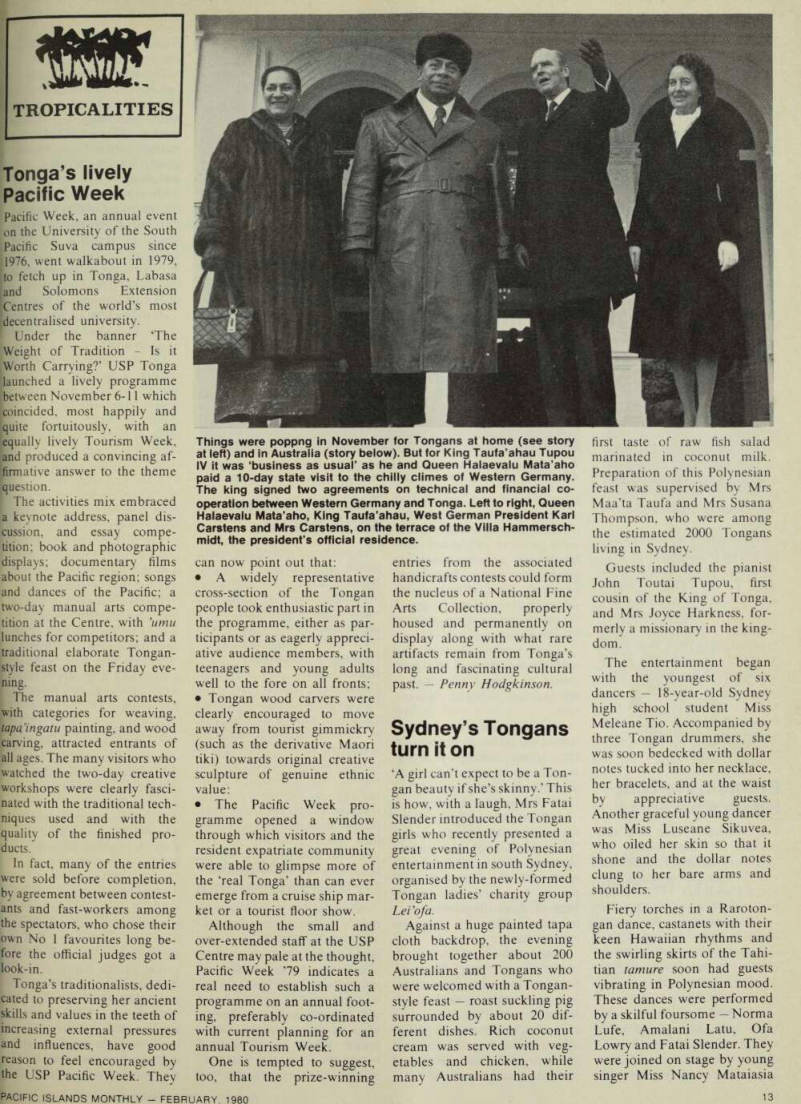
Things were poppng in November for Tongans at home (see story at left) and in Australia (story below). But for King Taufa’ahau Tupou IV it was ‘business as usual’ as he and Queen Halaevalu Mata’aho paid a 10-day state visit to the chilly climes of Western Germany.
The king signed two agreements on technical and financial co operation between Western Germany and Tonga. Left to right, Queen Halaevalu Mata’aho, King Taufa’ahau, West German President Karl Carstens and Mrs Carstens, on the terrace of the Villa Hammersch midt, the president’s official residence.
Lomu, from Nukualofa, who is studying at the Conserva torium of Music in Sydney.
This night of South Sea island treats was the first social function organised by the Ton gan ladies’ charity group LeVofa (meaning ‘current of love’). The group has been
formed by seven Tongan
women living in Sydney, who
want to help disadvantaged
families and children in the islands. As explained by Fatai Slender, who has been in Syd ney for more than 10 years, the
idea was prompted by a tragic
shipping disaster about a year ago when many families were bereaved through a voyage to the island of Niuatoputapu.
This small island, in the north of the Tongan group, is not far from Mrs Slender’s home of Tin Can Island, or Niuafo’ou, where she was known before her marriage as Fatai Moe- Manu Mounga’afi. The other six founders of LeVofa are Maa’ata and Lisita Taufa, Susana and Rosaline Thomp son, Luseane Sikuvea and Ofa
Lowry.
As the guests’ mood warmed up at the island night in Syd ney, the grand finale came from Tavake (Terry) Vaivao, who performed a daring fire dance as he tossed about two Samoan cane-knives with flames darting from both ends.
As the blazing knives lit up the darkened hall, guests were given a fiery farewell to this very successful evening
organised by Sydney’s Tongan
community - Helen Rous seau
Problems in Tom
Neale’s paradise
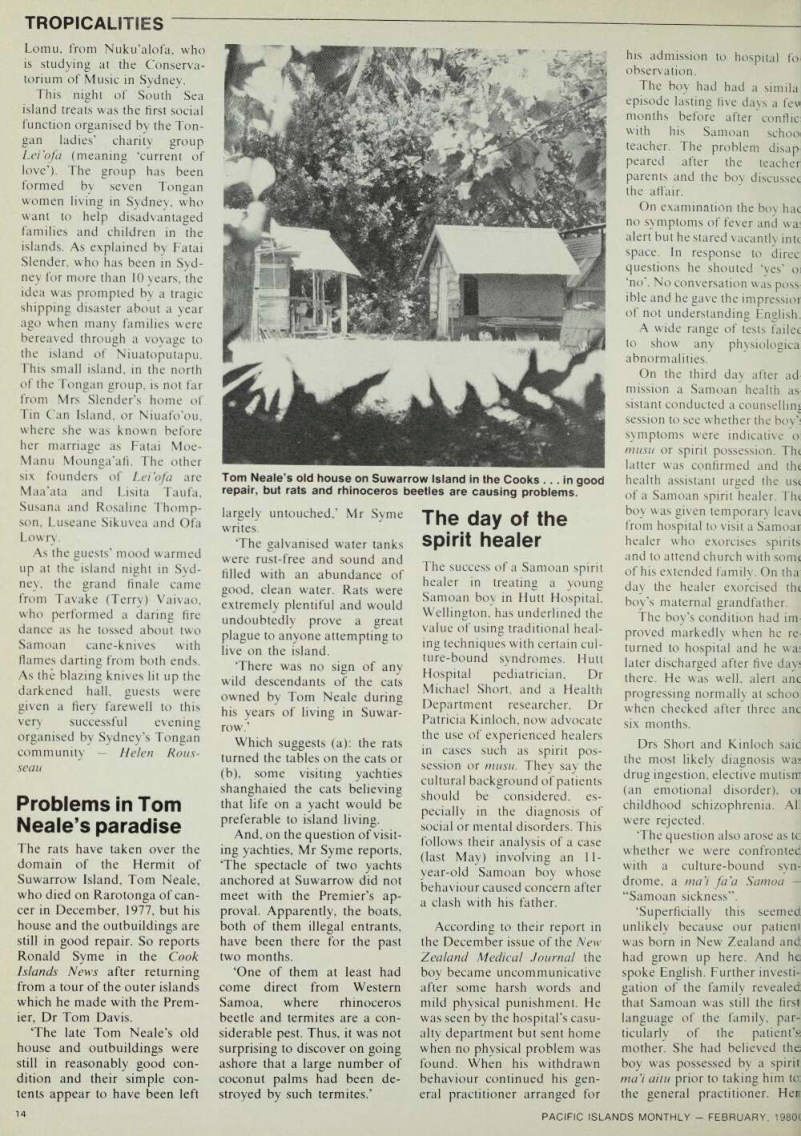
The rats have taken over the domain of the Flermit of Suwarrow Island, Tom Neale, who died on Rarotonga of can cer in December, 1977, but his house and the outbuildings are still in good repair. So reports Ronald Syme in the Cook Islands News after returning from a tour of the outer islands which he made with the Prem ier, Dr Tom Davis. ‘The late Tom Neale’s old house and outbuildings were still in reasonably good con dition and their simple con tents appear to have been left
largely untouched,’ Mr Syme
writes. ‘The galvanised water tanks were rust-free and sound and filled with an abundance of good, clean water. Rats were
extremely plentiful and would
undoubtedly prove a great plague to anyone attempting to live on the island. ‘There was no sign of any wild descendants of the cats owned by Tom Neale during his years of living in Suwar row.’
Which suggests (a): the rats turned the tables on the cats or
(b), some visiting yachties
shanghaied the cats believing
that life on a yacht would be
preferable to island living.
And, on the question of visit
ing yachties, Mr Syme reports,
‘The spectacle of two yachts anchored at Suwarrow did not meet with the Premier’s ap
proval. Apparently, the boats,
both of them illegal entrants, have been there for the past two months. ‘One of them at least had come direct from Western Samoa, where rhinoceros beetle and termites are a con siderable pest. Thus, it was not surprising to discover on going ashore that a large number of coconut palms had been de stroyed by such termites.’
The day of the
spirit healer
The success of a Samoan spirit healer in treating a young Samoan boy in Hutt Hospital.
Wellington, has underlined the value of using traditional heal ing techniques with certain cul ture-bound syndromes. Hutt
Hospital pediatrician. Dr
Michael Short, and a Health Department researcher. Dr Patricia Kinloch, now advocate the use of experienced healers in cases such as spirit pos session or musu. They say the cultural background of patients should be considered, es pecially in the diagnosis of social or mental disorders. This follows their analysis of a case (last May) involving an 11-
year-old Samoan boy whose
behaviour caused concern after a clash with his father.
According to their report in the December issue of the New Zealand Medical Journal the boy became uncommunicative after some harsh words and
mild physical punishment. He
was seen by the hospital’s casu alty department but sent home when no physical problem was found. When his withdrawn behaviour continued his gen eral practitioner arranged for
his admission to hospital fo< observation.
The boy had had a simila
episode lasting five days a few
months before after conflic: with his Samoan school teacher. The problem disap' peared after the teacher parents and the boy discussec the affair.
On examination the boy hac no symptoms of fever and wa: alert but he stared vacantly into space. In response to direc questions he shouted ‘yes’ 01 ‘no’. No conversation was poss ible and he gave the impressior
of not understanding English.
A wide range of tests failec to show any physiologica abnormalities.
On the third day after ad mission a Samoan health as sistant conducted a counselling session to see whether the boy’: symptoms were indicative o: musu or spirit possession. The latter was confirmed and the health assistant urged the use of a Samoan spirit healer. The boy was given temporary leave from hospital to visit a Samoar healer who exorcises spirits; and to attend church with some of his extended family. On tha day the healer exorcised the boy’s maternal grandfather.
The boy’s condition had im proved markedly when he re turned to hospital and he waj later discharged after five days there. He was well, alert anc
progressing normally at school
when checked after three anc six months.
Drs Short and Kinloch saic the most likely diagnosis was
drug ingestion, elective mutism
(an emotional disorder), oi childhood schizophrenia. All
were rejected.
The question also arose as tc whether we were confronted with a culture-bound syn drome, a ma’i fa’a Samoa “Samoan sickness”. ‘Superficially this seemed
unlikely because our patient
was born in New Zealand and had grown up here. And he
spoke English. Further investi
gation of the family revealed that Samoan was still the first language of the family, par ticularly of the patient’s mother. She had believed the
boy was possessed by a spirit
ma’i aitu prior to taking him to: the general practitioner. Heit
Tom Neale’s old house on Suwarrow Island In the Cooks ... in good repair, but rats and rhinoceros beetles are causing problems.
husband, however, had dismis sed this idea and insisted on I Western medical treatment for his son. That the mother was prepared to consider the possi bility of spirit possession made it possible for her son to have manifested it. The relations be tween husband and wife were found to be very strained and their tensions were often “worked out” through their re lationship with the boy. ‘lt was possible that the
patient’s response, a culturally
accepted one in the face of »great anxiety, enhanced his im fportance in the family and made possible the control of i his parents. Therefore, with some scepticism we enter tained two additional diag noses; musu and spirit
■possession.’
I Drs Short and Kinloch say the symptoms of musu and spirit possession are similar to one another and also to child-
Hiood schizophrenia.
I ‘Since we were dealing with ; a Samoan patient whose symp toms characterised a “Samoan sickness” it was decided to pur sue this before coming to the favoured diagnosis of child hood schizophrenia. The scep ticism with which the possible diagnosis of musu or spirit pos session were received was ameliorated by the “matter-of |fact” manner of the Samoan health assistant in her counsell ing session and in her obvious concern to do the right thing for the patient.’ \ Drs Short and Kinloch say dhe acceptance of her recom mendations was an experiment in treating patients from other
cultures by recognising their
cultural heritage and in using the healing skills within the patient’s own cultural group. ‘Since the Samoan spirit healer’s treatment was success ful we have concluded that our patient was possessed. He had no recollection of the time dur ing which he was possessed or of the treatment ritual of exor cism.’
They say it is useful to recog nise musu and spirit possession as culture-bound syndromes and recommend the use of healers with the skills to treat
such conditions.
James
fully.
Love from
Luganville
PlM’s Department of Heart Affairs has received a puzzling letter from the New Hebrides, and with the letter a gilt neck lace. Somewhere, it seems, there’s a young lady who may have aroused the ardour of Robin Maki, of Luganville (Santo). She might be on a PIM cover or on a photograph inside the magazine, but the letter was addressed to a Miss Reader, at PIM. Mr Makin im plied that a young lady had written to him ‘I find your nice letter’, he wrote. And added, ‘Well, well darling, here is my best love’.
Enclosed with the letter was the necklace, a gilt chain we don’t think it’s 18 carat from which was suspended a heart
shaped pendant of glittering
something or other.
The thought was as nice as the generosity, so it’s all here at PlM’s office waiting for its owner to whom Mr Makin sends his ‘best love’, if she will
kindly identify herself.
The golden
mothers of PNG
The mothers of Papua New Guinea are saving the country’s families about $2O million a year, an academic has discovered.
And how they do it is by breast-feeding their babies instead of putting them on the bottle, which estimates Dr Barry Shaw, of the Australian
National University’s Develop
ment Studies Centre, could
cost families as much as $2O million a year.
As PIM reported (July, 1976, Pl 3) Dr Cam Bowie, the Provincial Medical Officer at Goroka, led a campaign to ban bottle feeding because it was a health hazard, resulting in sick ness and semi-starvation as well as being unhygienic if bottles were not cleansed suf ficiently. He estimated the cost of bottle feeding at about KlO million a year.
Dr Shaw, who has been working on the economics of human milk production in Papua New Guinea, as part of a much larger study on food supplies and nutrition in PNG, has found that about 2.5% of total food consumed in PNG is in the form of human milk.
This amounts to about 67 million litres a year.
A reduction in the practice of breast-feeding could also cost the government dearly and raise the birth-rate!
‘Any significant reduction in
either the practice of breast feeding or its duration will re sult in increases in government expenditure, a decline in human welfare and an increase in food imports,’ Dr Shaw be lieves. ‘Any increase in child illness or mortality would increase health costs and reduce the ca pacity of the health system.
There was growing evidence that poor feeding very early in life could impair later learning
ability.
‘PNG women traditionally breast-fed their babies for the first three to five years, and this often acted as a birth-spacing
mechanism as breast-feeding resulted in a much slower return of ovulation after birth.
A reduction in breast-feeding could result in an increased birth rate which would require
increased spending on family
planning programmes.
‘Any marked reduction in breast-feeding would have adverse budgetary, balance of payment, welfare and demo
graphic effects.
‘A high-income country could cope with these changes, but for Papua New Guinea with a per capita income of around $5OO a year, it would be far more serious, especially in the long term.’
A Highlands’
Helen of Troy
of a clan in the Papua New Guinea Western
Highlands kidnapped a girl
belonging to another clan. As a result, there was a battle involving 800 tribesmen. Three died, shot to death by arrows.
More than 100 ha of crops were
destroyed. Eight hundred
houses were burned down.
Police were rushed to the area and restored order.
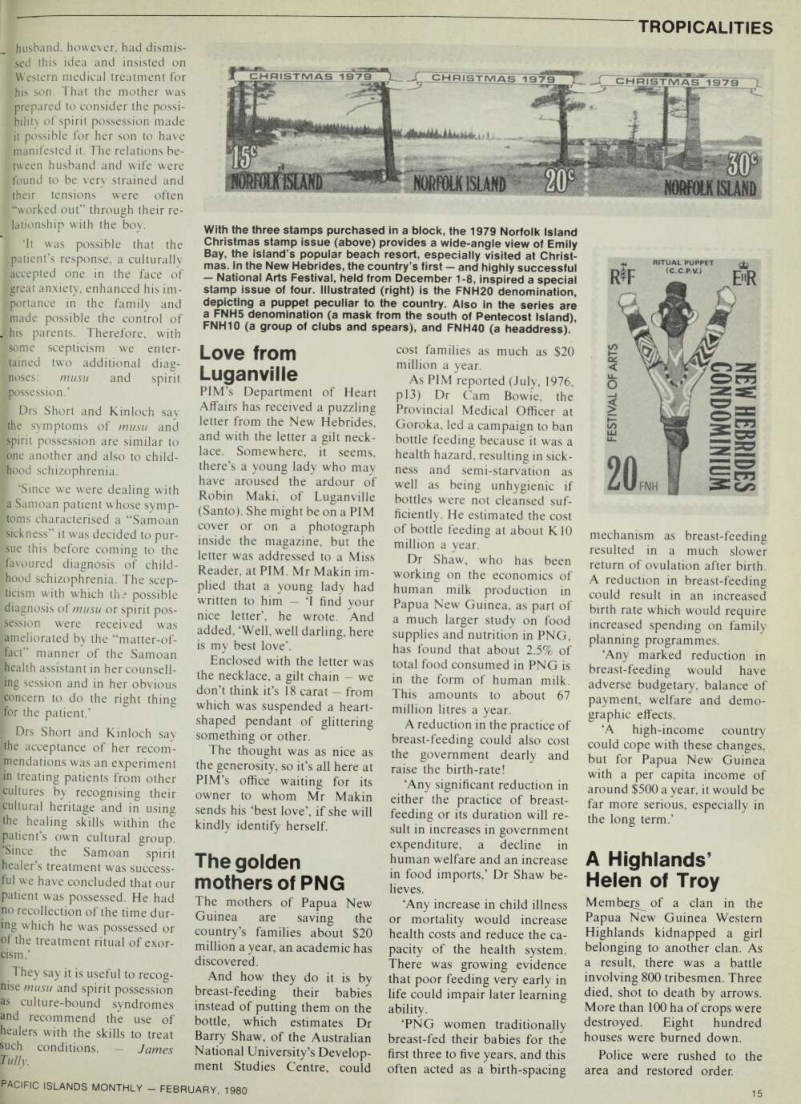
With the three stamps purchased in a block, the 1979 Norfolk Island Christmas stamp issue (above) provides a wide-angle view of Emily Bay, the island’s popular beach resort, especially visited at Christ mas. In the New Hebrides, the country’s first and highly successful National Arts Festival, held from December 1-8, inspired a special stamp issue of four. Illustrated (right) is the FNH2O denomination, depicting a puppet peculiar to the country. Also in the series are a FNHS denomination (a mask from the south of Pentecost Island), FNHIO (a group of clubs and spears), and FNH4O (a headdress).