chances of Tonga
p. 37 · Read in the full issue
Neiafu, and the chances of Tonga
By Ralph Jon Naranjo
Cultural change seems to be technology’s silent partner at least that is the emerging re ality in Oceania. The old way of life has been dealt a lethal blow by the West’s plastic Pan dora’s Box of chrome-plated hardware. But regardless of one’s opinion, there are a few indisputable realities. The cost of fossil fuel technology is increasing at a staggering rate and its future is anything but clear. In an age likely to be marked by massive fuel short ages, a self-sufficient lifestyle could become a priceless asset.
At Neiafu, Vavau, Tonga’s fiord-like harbour, one senses that today’s Tonga represents a rather positive anachronism, quite out of step with many of
its Polynesian neighbours.
Possibly it is the lack of econ omic abundance which has slowed the avalanche of Wes ternisation here. In any case, much of Tonga has so far escaped the contradictions of
overly abrupt socio-technolog
ical change. Ironically, the
archipelago’s meagre financial capacity may, in the long run, prove to be its benefactor. For Tonga and other Island cul tures sharing similar con ditions, there remain a variety of alternatives.
A closer look at the archipel ago’s contemporary culture is well worthwhile. Vavau has benefited from an amalga mation of Western and tra
ditional Polynesian lifestyles.
Years of slow transition have resulted in a compatible cul ture.
Unspoiled by surplus, outly
ing villages and the quiet city
of Neiafu co-exist, unthrea
tened by abrupt expansion.
Neiafu is nestled in an inaus picious corner of a superb South Pacific harbour. Vavau’s volcanic plateau straddles a narrow channel leading to the well protected upper harbour.
As we tacked our way across the tree-clad estuary, a fleet of locally built dories went about their daily chores. Some were returning school children to their villages, while others car ried woven baskets and other local craft works to Neiafu in preparation for the arrival of a scheduled cruise ship.
Ocean liners visit Vavau sev eral times a year and have be come a major market for
locally produced handicrafts.
The small boat fleet remains a primary mode of transpor tation in Tonga and its design apparently dates back to
European influence nearly a
century old. These locally con structed dories are ideally suited for their use. Propelled by oars or a small outboard motor they have become an
environmentally compatible
answer to transportation needs.
Each Saturday they respond
to the needs of market day.
Flocking about the small town wharf, dories deliver people and goods to the weekly event.
Livestock may arrive in one boat, bales of kava root in another, and the children of a nearby village in yet another.
Most significant, the dories
are built by Tongans utilising
native materials. The original plans and designer’s notes have been amended and passed on verbally from builder to builder. The result is a Western idea well adapted to its Polynesian environment. On Sunday most of the fleet rolls passively at anchor. Their crews are involved in a typical Tongan Sunday, a day com posed of church and rest.
Although this institution can easily be accredited to Western influence, it too has become
distinctly ‘Tonganised’.
If change follows the same paths in Tonga as in other areas it will be directly proportional to economic affluence. If and when the citizens of Vavau be come more involved as world material consumers, what will their purchases be?
Are the material wants and new lifestyles apparent in American Samoa today des tined to be repeated in Tonga?
These questions and an array of others deserve consider ation. How they are answered will help to decide the role Tonga is to play in a rapidly
changing Polynesia.
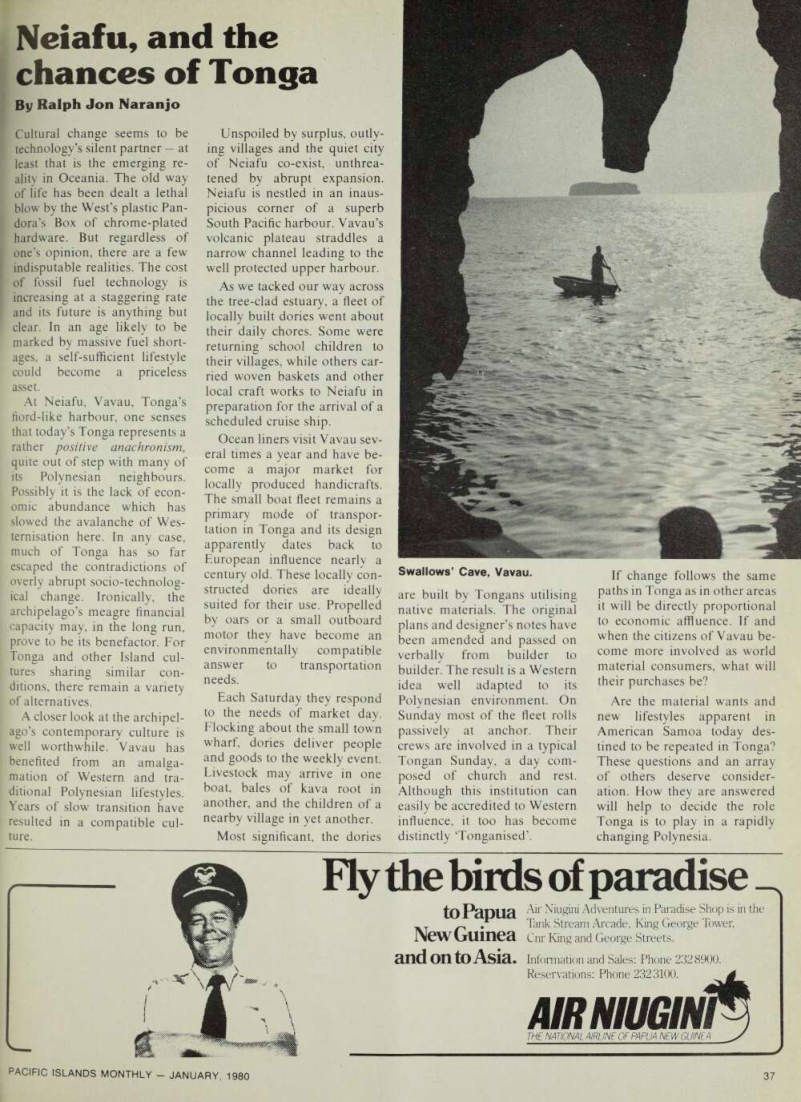
Swallows’ Cave, Vavau.