backstreet
pp. 35-36 · Read in the full issue
Travel
Polynesian oasis in backstreet Vancouver
It's been my privilege to number among my friends the legendary schooner skipper, the late Captain A ndy Thomson, writes Dr Bill Coppell. I cherish the memory of sitting w ith him at the long table in his house at Rutaki, Rarotonga, and listening to his yarns of the sea and of Pacific characters yarns which spanned nearly three-quarters of the twentieth century. On several occasions, after a couple of glasses had been downed, he talked to me of his friend Leeteg, giving him the supreme Thomson accolade: ‘What a man he was!' In Captain Andy's tales of escapades along the Papeete waterfront, Leeteg, like as not, would be the central figure.
Edgar William Leeteg, an American of German descent who was bom in 1904, achieved considerable fame for his mas tery of the art of airbrush paint ing on black velvet. This fame was due at least in part to Leeteg’s habit of ritualising his weekly drunken orgies in and around Papeete’s waterfront bars in order to build a repu tation for outrageous behav iour which would, in turn, attract buyers for his works, Andy’s stories about him would follow their course until there came the inevitable mo ment when, with genuine grief, he would tell how Leeteg met his end in a motor-cycle acci dent in 1953. After a pause, Andy would rise from the table, return with a map con tainer, and then roll out two of
Leeteg’s black velvet paintings,
which he’d acquired for a trifle many years before.
Captain Andy’s conver
sations infected me and my wife Merle with an abiding interest in Leeteg an interest which came alive with a ven geance for us a few months ago in, of all places, Vancouver, British Columbia. Canada.
Merle was browsing in a sec ondhand bookshop in Van couver when she happened to mention to the owner that we were interested in books on the South Pacific. As the conver
sation developed, Leeteg’s
name was mentioned, and Merle, to her great surprise, was told that there was a collec tion of Leeteg’s black velvet paintings in a hotel called the
Astoria along Hastings Street,
Vancouver.
So, on a cold, wet Saturday,
we set off along Hastings Street from the central shopping area into a wilderness of junk shops,
cheap cafes, rooming houses
and sleazy saloons. Reaching
the Astoria, we gazed at two entrances, one marked ‘Men Only’ and the other ‘Ladies and Escorts Only’. In through the latter we went to find ourselves
in a large saloon bar, with small groups of sad, silent men sip ping at draught beer. On the walls there was one adornment only: a grimy, poor-quality re production of a Velasquez painting. Certainly no Leetegs here.
The barman was puzzled by my inquiries about black velvet
paintings. Then a chord was struck in his memory and it be came clear that our bookseller had been confused. What we had to do was to walk a further seven blocks to the Waldorf. ‘Waldorf, ‘Astoria’ an understandable mix-up on the bookseller’s part.
As we walked on. the area became even more depressing, and the rain and wind com bined to wipe from our minds any thought of tropical para dises. Then 12 (not seven) blocks further on we found ourselves in the lobby of the Waldorf, in a building rather more imposing than the neigh bourhood seemed to merit.
The receptionist told us that there were indeed some paint ings somewhere in the hotel, and that we might start by looking in the coffee shop.
Here we saw our first Leeteg which, alone, made our day’s efforts worthwhile.
But soon we were on the trail of still better things. We were directed to the cocktail lounge.
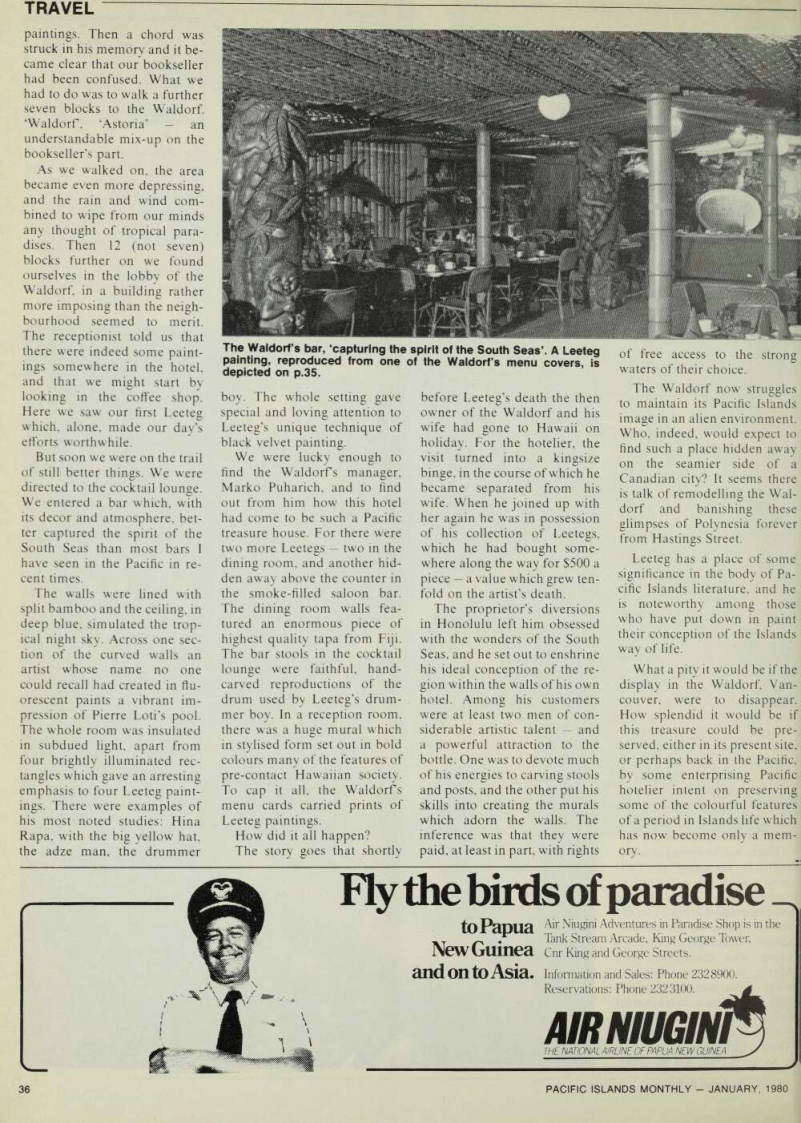
We entered a bar which, with its decor and atmosphere, bet ter captured the spirit of the South Seas than most bars I have seen in the Pacific in re cent times.
The walls were lined with split bamboo and the ceiling, in deep blue, simulated the trop ical night sky. Across one sec tion of the curved walls an artist whose name no one could recall had created in flu orescent paints a vibrant im pression of Pierre Loti’s pool.
The whole room was insulated in subdued light, apart from four brightly illuminated rec tangles which gave an arresting
emphasis to four Leeteg paint
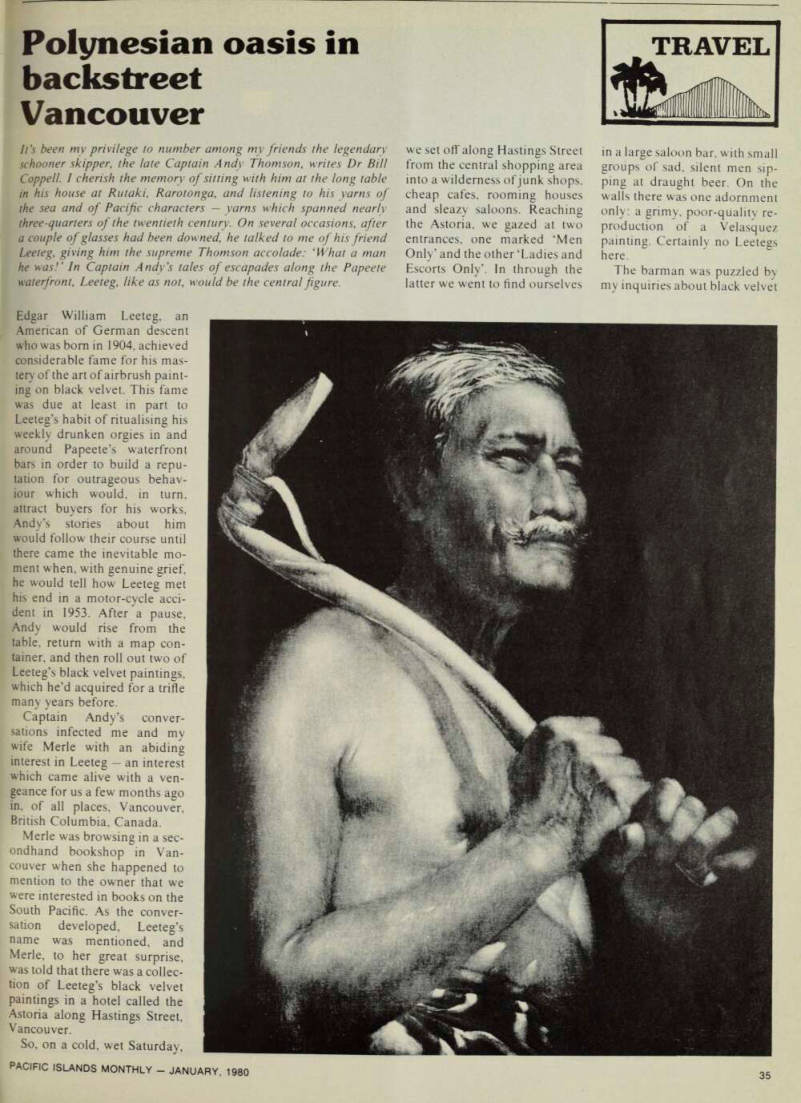
ings. There were examples of his most noted studies: Hina
Rapa, with the big yellow hat,
the adze man, the drummer
boy. The whole setting gave special and loving attention to
Leeteg’s unique technique of
black velvet painting.
We were lucky enough to find the Waldorfs manager.
Marko Puharich, and to find out from him how this hotel had come to be such a Pacific treasure house. For there were two more Leetegs two in the dining room, and another hid den away above the counter in the smoke-filled saloon bar.
The dining room walls fea tured an enormous piece of
highest quality tapa from Fiji.
The bar stools in the cocktail lounge were faithful, hand carved reproductions of the drum used by Leeteg’s drum mer boy. In a reception room, there was a huge mural which in stylised form set out in bold colours many of the features of pre-contact Hawaiian society.
To cap it all. the Waldorf’s menu cards carried prints of
Leeteg paintings.
How did it all happen?
The story goes that shortly
before Leeteg’s death the then owner of the Waldorf and his wife had gone to Hawaii on holiday. For the hotelier, the visit turned into a kingsize binge, in the course of which he became separated from his wife. When he joined up with her again he was in possession of his collection of Leetegs, which he had bought some where along the way for $5OO a piece a value which grew ten fold on the artist’s death.
The proprietor’s diversions in Honolulu left him obsessed with the wonders of the South Seas, and he set out to enshrine his ideal conception of the re gion within the walls of his own hotel. Among his customers were at least two men of con siderable artistic talent and a powerful attraction to the bottle. One was to devote much of his energies to carving stools and posts, and the other put his skills into creating the murals which adorn the walls. The inference was that they were paid, at least in part, with rights
of free access to the strong waters of their choice.
The Waldorf now struggles to maintain its Pacific Islands image in an alien environment.
Who, indeed, would expect to find such a place hidden away on the seamier side of a Canadian city? It seems there is talk of remodelling the Wal dorf and banishing these
glimpses of Polynesia forever
from Hastings Street.
Leeteg has a place of some significance in the body of Pa cific Islands literature, and he is noteworthy among those who have put down in paint their conception of the Islands way of life.
What a pity it would be if the display in the Waldorf, Van couver, were to disappear.
How splendid it would be if this treasure could be pre served, either in its present site, or perhaps back in the Pacific,
by some enterprising Pacific
hotelier intent on preserving some of the colourful features of a period in Islands life which has now become only a mem orv.
The Waldorf’s bar, ‘capturing the spirit of the South Seas’. A Leeteg painting, reproduced from one of the Waldorf’s menu covers, is depicted on p. 35.