Tonga’s king
pp. 32-33 · Read in the full issue
I Ropicalities
wows Chathams
The King of Tonga Taufa’ahau Tupou IV had an unexpected bit of advice for New Zealanders when he visited them in October. develop trade with the ‘Mongolian’ people of Indonesia, Malaysia, Thailand, the Philippines and China.
Somehow New Zealanders lived with the illusion that they floated in the North Sea, he said. ‘Let me assure you it is an
illusion.’ By comparison, the
tiny kingdom ot Tonga, with its
100 000 people, was ‘well
adjusted to its geographical
situation’.
The unheralded message
came during the king’s epoch
making visit to the Chatham Islands, a group of 10 dots that are home for about 600 people some 650 km off the east coast of the South Island of New Zealand.
Royalty is a rarity on these islands where the people live off farming and fishing, includ
ing large succulent crayfish
that caught the King’s eye. Up
to that point his visit to New Zealand to look and learn
about agricultural develop
ments such as deer-farming had been humdrum and according to plan.
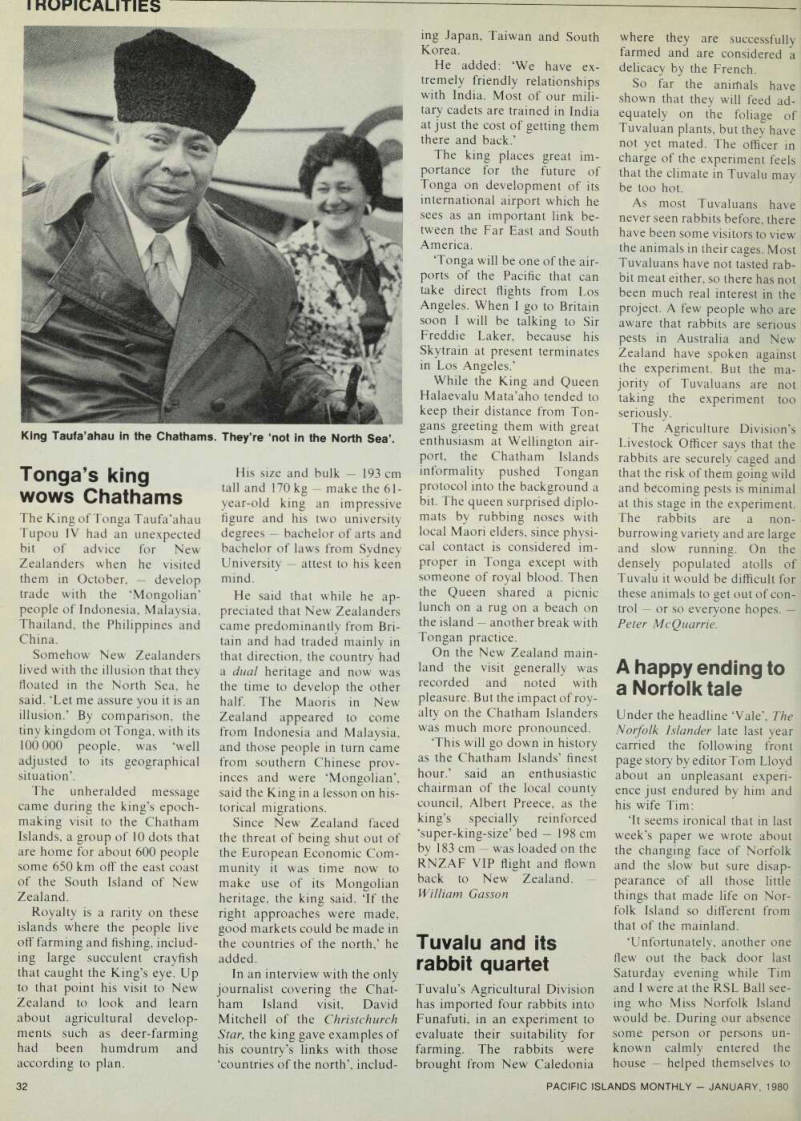
His size and bulk 193 cm tall and 170 kg make the 61-
year-old king an impressive
figure and his two university degrees bachelor of arts and bachelor of laws from Sydney University attest to his keen mind.
He said that while he ap preciated that New Zealanders came predominantly from Bri tain and had traded mainly in that direction, the country had a dual heritage and now was the time to develop the other half. The Maoris in New Zealand appeared to come from Indonesia and Malaysia, and those people in turn came from southern Chinese prov inces and were ‘Mongolian’, said the King in a lesson on his
torical migrations.
Since New Zealand faced the threat of being shut out of the European Economic Com munity it was time now to make use of its Mongolian heritage, the king said. ‘lf the right approaches were made, good markets could be made in the countries of the north,’ he added.
In an interview with the only
journalist covering the Chat
ham Island visit, David Mitchell of the Christchurch Star, the king gave examples of his country’s links with those ‘countries of the north’, includ
ing Japan, Taiwan and South Korea.
He added; ‘We have ex
tremely friendly relationships
with India. Most of our mili tary cadets are trained in India at just the cost of getting them there and back.’
The king places great im portance for the future of Tonga on development of its international airport which he sees as an important link be tween the Far East and South America. ‘Tonga will be one of the air ports of the Pacific that can take direct flights from Los Angeles. When I go to Britain soon I will be talking to Sir Freddie Laker, because his Skytrain at present terminates in Los Angeles.’
While the King and Queen Halaevalu Mata’aho tended to keep their distance from Ton gans greeting them with great enthusiasm at Wellington air port, the Chatham Islands
informality pushed Tongan
protocol into the background a bit. The queen surprised diplo mats by rubbing noses with local Maori elders, since physi cal contact is considered im proper in Tonga except with someone of royal blood. Then the Queen shared a picnic lunch on a rug on a beach on the island another break with
Tongan practice.
On the New Zealand main land the visit generally was recorded and noted with pleasure. But the impact of roy alty on the Chatham Islanders was much more pronounced. ‘This will go down in history as the Chatham Islands’ finest hour.’ said an enthusiastic chairman of the local county council, Albert Preece, as the
king’s specially reinforced
‘super-king-size’ bed 198 cm by 183 cm was loaded on the RNZAF VIP flight and flown back to New Zealand.
William Gasson
Tuvalu and its
rabbit quartet
Tuvalu’s Agricultural Division has imported four rabbits into Funafuti, in an experiment to evaluate their suitability for farming. The rabbits were brought from New Caledonia
where they are successfully
farmed and are considered a
delicacy by the French.
So far the animals have shown that they will feed ad equately on the foliage of Tuvaluan plants, but they have not yet mated. The officer in charge of the experiment feels that the climate in Tuvalu may be too hot.
As most Tuvaluans have never seen rabbits before, there have been some visitors to view the animals in their cages. Most Tuvaluans have not tasted rab bit meat either, so there has not been much real interest in the project. A few people who are aware that rabbits are serious pests in Australia and New
Zealand have spoken against
the experiment. But the ma jority of Tuvaluans are not
taking the experiment too
seriously.
The Agriculture Division’s Livestock Officer says that the rabbits are securely caged and that the risk of them going wild and becoming pests is minimal at this stage in the experiment.
The rabbits are a non
burrowing variety and are large
and slow running. On the
densely populated atolls of
Tuvalu it would be difficult for these animals to get out of con trol or so everyone hopes.
Peter McQuarrie.
A happy ending to
a Norfolk tale
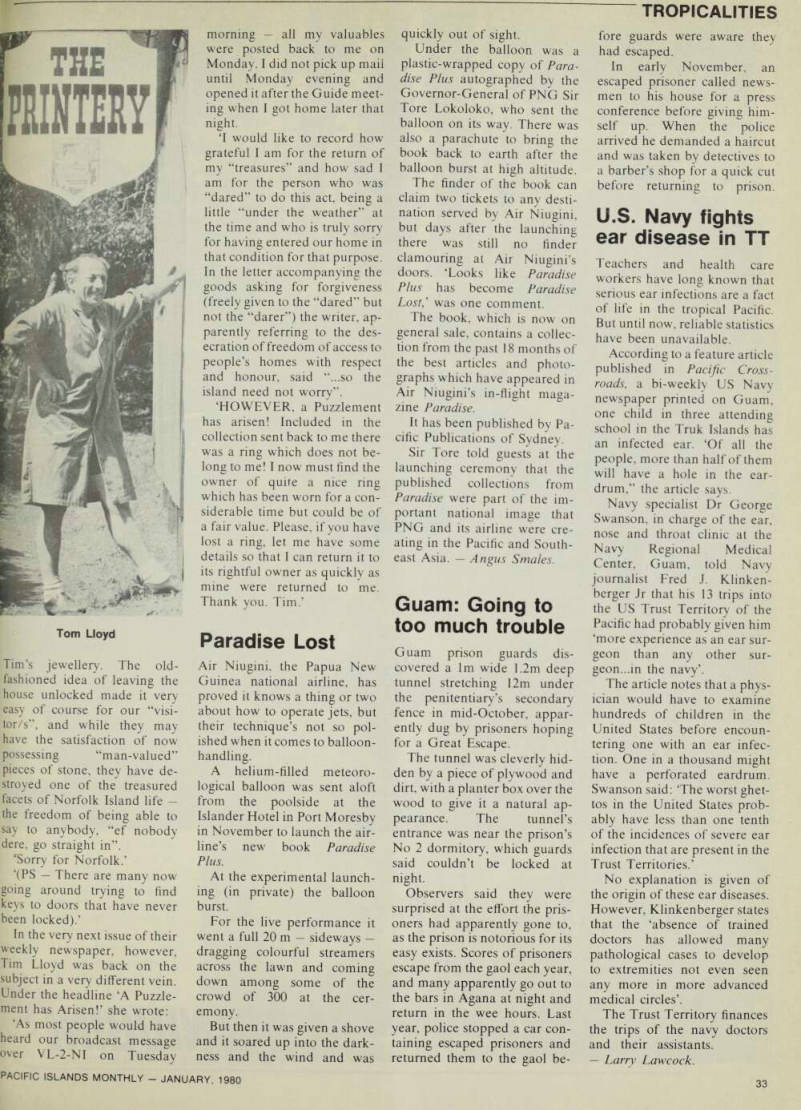
Under the headline ‘Vale’, The Norfolk Islander late last year carried the following front page story by editor Tom Lloyd about an unpleasant experi ence just endured by him and his wife Tim: ‘lt seems ironical that in last week’s paper we wrote about the changing face of Norfolk and the slow but sure disap pearance of all those little things that made life on Nor folk Island so different from that of the mainland. ‘Unfortunately, another one flew out the back door last Saturday evening while Tim and I were at the RSL Ball see ing who Miss Norfolk Island would be. During our absence some person or persons un known calmly entered the house helped themselves to
King Taufa’ahau in the Chathams. They’re ‘not In the North Sea’.
Tim’s jewellery. The old fashioned idea of leaving the house unlocked made it very easy of course for our “visi tor/s”. and while they may have the satisfaction of now
possessing “man-valued”
Pieces of stone, they have de stroyed one of the treasured facets of Norfolk Island life the freedom of being able to say to anybody, “ef nobody dere, go straight in”.
Sorry for Norfolk.’ ‘(PS There are many now going around trying to find keys to doors that have never been locked).’
In the very next issue of their weekly newspaper, however, Tim Lloyd was back on the subject in a very different vein.
Under the headline ‘A Puzzle ment has Arisen!’ she wrote: As most people would have heard our broadcast message
over VL-2-NI on Tuesday
morning all my valuables were posted back to me on Monday. I did not pick up mail until Monday evening and opened it after the Guide meet ing when I got home later that
night.
‘I would like to record how grateful I am for the return of my “treasures” and how sad I am for the person who was “dared” to do this act, being a little “under the weather” at the time and who is truly sorry for having entered our home in that condition for that purpose.
In the letter accompanying the
goods asking for forgiveness
(freely given to the “dared” but not the “darer”) the writer, ap parently referring to the des ecration of freedom of access to people’s homes with respect and honour, said “...so the island need not worry”. ‘HOWEVER, a Puzzlement has arisen! Included in the collection sent back to me there was a ring which does not be long to me! I now must find the owner of quite a nice ring which has been worn for a con siderable time but could be of a fair value. Please, if you have lost a ring, let me have some details so that I can return it to its rightful owner as quickly as mine were returned to me.
Thank you. Tim.’
Paradise Lost
Air Niugini, the Papua New Guinea national airline, has proved it knows a thing or two about how to operate jets, but their technique’s not so pol ished when it comes to balloon
handling.
A helium-filled meteoro logical balloon was sent aloft from the poolside at the Islander Hotel in Port Moresby in November to launch the air line’s new book Paradise Plus.
At the experimental launch ing (in private) the balloon burst.
For the live performance it went a full 20 m sideways dragging colourful streamers across the lawn and coming down among some of the crowd of 300 at the cer emony.
But then it was given a shove and it soared up into the dark ness and the wind and was
quickly out of sight.
Under the balloon was a plastic-wrapped copy of Para dise Plus autographed by the Governor-General of PNG Sir Tore Lokoloko, who sent the balloon on its way. There was also a parachute to bring the book back to earth after the balloon burst at high altitude.
The finder of the book can claim two tickets to any desti nation served by Air Niugini, but days after the launching there was still no finder
clamouring at Air Niugini’s
doors. ‘Looks like Paradise Plus has become Paradise Lost ,’ was one comment.
The book, which is now on general sale, contains a collec tion from the past 18 months of the best articles and photo graphs which have appeared in
Air Niugini’s in-flight maga
zine Paradise.
It has been published by Pa cific Publications of Sydney.
Sir Tore told guests at the launching ceremony that the published collections from Paradise were part of the im portant national image that PNG and its airline were cre ating in the Pacific and South east Asia. Angus Smales.
Guam: Going to
too much trouble
Guam prison guards dis covered a 1m wide 1.2 m deep tunnel stretching 12m under
the penitentiary’s secondary
fence in mid-October, appar
ently dug by prisoners hoping
for a Great Escape.
The tunnel was cleverly hid den by a piece of plywood and dirt, with a planter box over the wood to give it a natural ap pearance. The tunnel’s entrance was near the prison’s No 2 dormitory, which guards said couldn’t be locked at
night.
Observers said they were surprised at the effort the pris oners had apparently gone to, as the prison is notorious for its easy exists. Scores of prisoners escape from the gaol each year, and many apparently go out to the bars in Agana at night and return in the wee hours. Last year, police stopped a car con
taining escaped prisoners and
returned them to the gaol be
fore guards were aware they had escaped.
In early November, an escaped prisoner called news men to his house for a press conference before giving him self up. When the police arrived he demanded a haircut and was taken by detectives to a barber’s shop for a quick cut
before returning to prison.
U.S. Navy fights
ear disease in TT
Teachers and health care workers have long known that serious ear infections are a fact of life in the tropical Pacific.
But until now, reliable statistics have been unavailable.
According to a feature article
published in Pacific Cross
roads, a bi-weekly US Navy newspaper printed on Guam, one child in three attending school in the Truk Islands has an infected ear. ‘Of all the people, more than half of them will have a hole in the ear drum,” the article says.
Navy specialist Dr George
Swanson, in charge of the ear, nose and throat clinic at the
Navy Regional Medical
Center, Guam, told Navy journalist Fred J. Klinken berger Jr that his 13 trips into the US Trust Territory of the Pacific had probably given him ‘more experience as an ear sur geon than any other sur geon...in the navy’.
The article notes that a phys ician would have to examine hundreds of children in the United States before encoun tering one with an ear infec tion. One in a thousand might have a perforated eardrum.
Swanson said: ‘The worst ghet tos in the United States prob ably have less than one tenth of the incidences of severe ear infection that are present in the Trust Territories.’
No explanation is given of the origin of these ear diseases.
However, Klinkenberger states that the ‘absence of trained doctors has allowed many
pathological cases to develop
to extremities not even seen any more in more advanced medical circles’.
The Trust Territory finances the trips of the navy doctors and their assistants.
Larry Lawcock.
Tom Lloyd