pre-schoolers
pp. 29-30 · Read in the full issue
Target: A better food deal for Fiji pre-schoolers
All familiar with the custom and etiquette associated with the traditional Pacific meal are
aware that protocol required
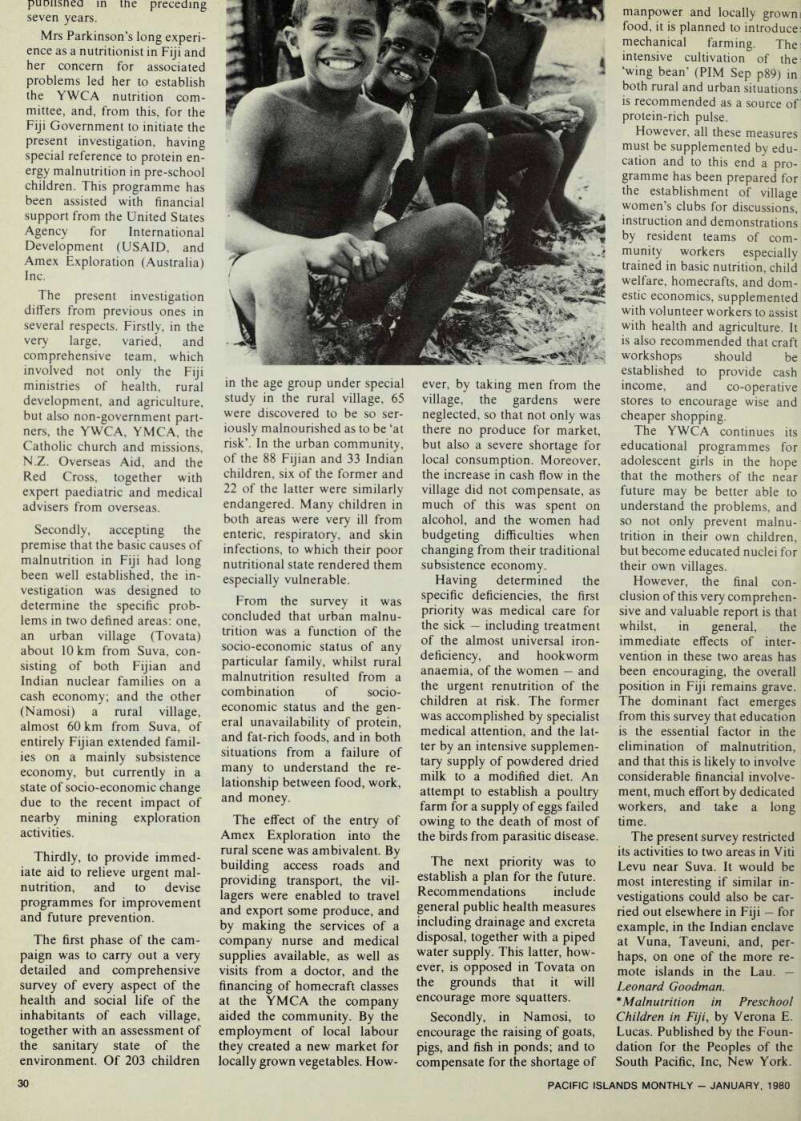
adult males and guests to be served first, the women next, and all others later, so that from the time that a child is weaned until it is old enough to compete effectively with other children it is the first to suffer deprivation, and it is to this group that investigations into malnutrition are first directed. The problem, however, is also compounded by other factors, especially those
associated with tabu, poverty,
and ignorance,
Fiji has a long history of
active interest in nutritional
problems, and especially so
since the establishment of the Nuffield Department of Social and Preventive Medicine in 1959, and the associated department of nutrition and dietetics, under the direction of Mrs Susan Parkinson provided by the Freedom from Hunger
Campaign in 1966. Many
papers have since been written on the subject the present
monograph* lists eight such
puonsneo m me preceding seven years.
Mrs Parkinson’s long experi ence as a nutritionist in Fiji and her concern for associated problems led her to establish the YWCA nutrition com mittee, and, from this, for the Fiji Government to initiate the
present investigation, having
special reference to protein en ergy malnutrition in pre-school children. This programme has been assisted with financial support from the United States Agency for International Development (USAID, and Amex Exploration (Australia) Inc.
The present investigation differs from previous ones in several respects. Firstly, in the very large, varied, and comprehensive team, which involved not only the Fiji ministries of health, rural development, and agriculture, but also non-government part ners, the YWCA, YMCA, the Catholic church and missions, N.Z. Overseas Aid, and the Red Cross, together with expert paediatric and medical advisers from overseas.
Secondly, accepting the premise that the basic causes of malnutrition in Fiji had long been well established, the in
vestigation was designed to
determine the specific prob lems in two defined areas: one, an urban village (Tovata) about 10 km from Suva, con sisting of both Fijian and Indian nuclear families on a cash economy; and the other (Namosi) a rural village, almost 60 km from Suva, of
entirely Fijian extended famil
ies on a mainly subsistence economy, but currently in a state of socio-economic change due to the recent impact of
nearby mining exploration
activities.
Thirdly, to provide immed iate aid to relieve urgent mal nutrition, and to devise programmes for improvement and future prevention.
The first phase of the cam paign was to carry out a very detailed and comprehensive survey of every aspect of the health and social life of the inhabitants of each village, together with an assessment of the sanitary state of the environment. Of 203 children
in the age group under special study in the rural village, 65 were discovered to be so ser iously malnourished as to be ‘at risk’. In the urban community, of the 88 Fijian and 33 Indian children, six of the former and 22 of the latter were similarly
endangered. Many children in
both areas were very ill from enteric, respiratory, and skin infections, to which their poor nutritional state rendered them
especially vulnerable.
From the survey it was concluded that urban malnu trition was a function of the socio-economic status of any
particular family, whilst rural
malnutrition resulted from a combination of socio economic status and the gen
eral unavailability of protein,
and fat-rich foods, and in both situations from a failure of many to understand the re lationship between food, work, and money.
The effect of the entry of Amex Exploration into the rural scene was ambivalent. By building access roads and providing transport, the vil lagers were enabled to travel and export some produce, and by making the services of a company nurse and medical supplies available, as well as visits from a doctor, and the financing of homecraft classes at the YMCA the company aided the community. By the employment of local labour they created a new market for
locally grown vegetables. How
ever, by taking men from the
village, the gardens were
neglected, so that not only was there no produce for market, but also a severe shortage for local consumption. Moreover, the increase in cash flow in the village did not compensate, as much of this was spent on alcohol, and the women had budgeting difficulties when changing from their traditional subsistence economy.
Having determined the specific deficiencies, the first priority was medical care for the sick including treatment of the almost universal iron deficiency, and hookworm anaemia, of the women and the urgent renutrition of the children at risk. The former
was accomplished by specialist
medical attention, and the lat ter by an intensive supplemen tary supply of powdered dried milk to a modified diet. An attempt to establish a poultry farm for a supply of eggs failed owing to the death of most of the birds from parasitic disease.
The next priority was to establish a plan for the future.
Recommendations include
general public health measures
including drainage and excreta
disposal, together with a piped
water supply. This latter, how ever, is opposed in Tovata on the grounds that it will encourage more squatters.
Secondly, in Namosi, to encourage the raising of goats, pigs, and fish in ponds; and to compensate for the shortage of
manpower and locally grown food, it is planned to introduce mechanical farming. The intensive cultivation of the ‘wing bean’ (PIM Sep pB9) in both rural and urban situations is recommended as a source of protein-rich pulse.
However, all these measures must be supplemented by edu cation and to this end a pro gramme has been prepared for the establishment of village women’s clubs for discussions, instruction and demonstrations by resident teams of com
munity workers especially
trained in basic nutrition, child welfare, homecrafts, and dom estic economics, supplemented with volunteer workers to assist with health and agriculture. It is also recommended that craft workshops should be established to provide cash income, and co-operative stores to encourage wise and
cheaper shopping.
The YWCA continues its educational programmes for adolescent girls in the hope that the mothers of the near future may be better able to understand the problems, and so not only prevent malnu trition in their own children, but become educated nuclei for their own villages.
However, the final con clusion of this very comprehen sive and valuable report is that whilst, in general, the immediate effects of inter vention in these two areas has been encouraging, the overall position in Fiji remains grave.
The dominant fact emerges from this survey that education is the essential factor in the elimination of malnutrition, and that this is likely to involve considerable financial involve ment, much effort by dedicated workers, and take a long time.
The present survey restricted its activities to two areas in Viti Levu near Suva. It would be most interesting if similar in vestigations could also be car ried out elsewhere in Fiji for example, in the Indian enclave at Vuna, Taveuni, and, per haps, on one of the more re mote islands in the Lau.
Leonard Goodman. * Malnutrition in Preschool Children in Fiji, by Verona E.
Lucas. Published by the Foun dation for the Peoples of the South Pacific, Inc, New York.