athletics
pp. 27-29 · Read in the full issue

‘Eating to win’ in Pacific Islands athletics
In the wake of the Sixth South Pacific Games and the furore caused in Fiji by the physical collapse during games events of a number of Fiji women athletes Suva-based nu tritionist Susan Parkinson looks at the special problems of nutrition faced by Pacific Island athletes. Mrs Parkinson wishes to acknowledge help received in preparing the follow ing article from Dr David Brown, lecturer in physiology at the Fiji School of Medicine.
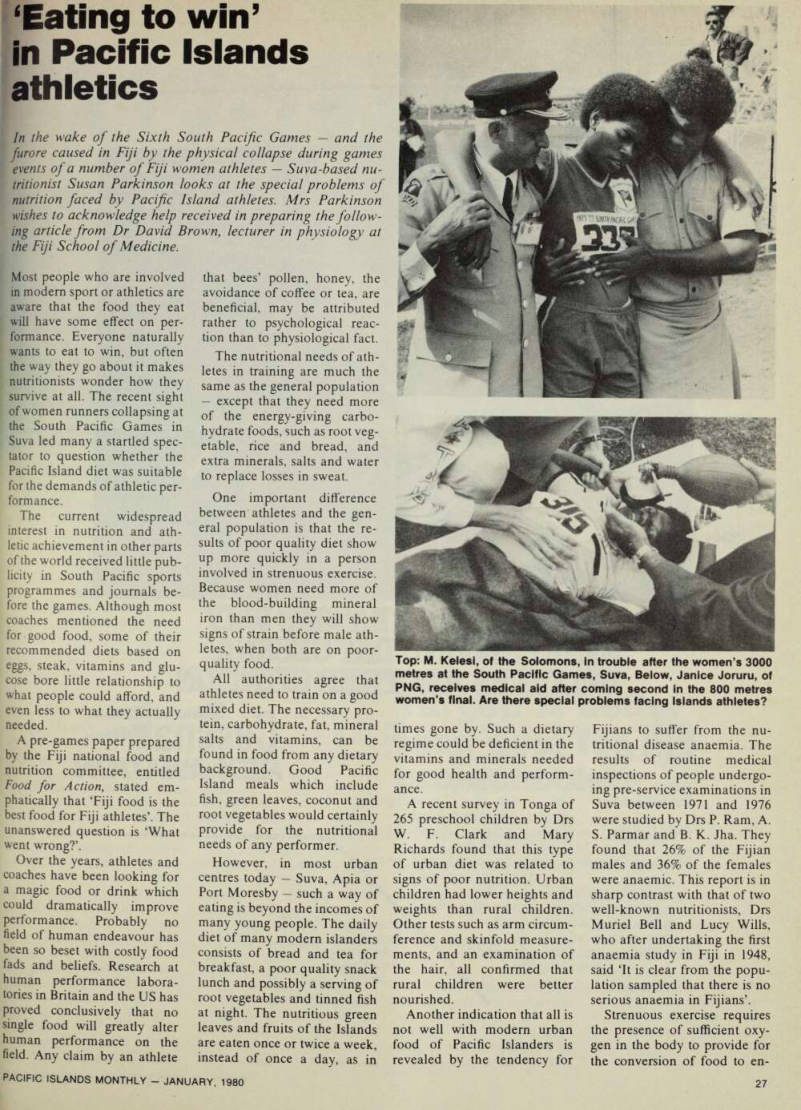
Most people who are involved in modem sport or athletics are aware that the food they eat will have some effect on per formance. Everyone naturally wants to eat to win, but often the way they go about it makes nutritionists wonder how they survive at all. The recent sight of women runners collapsing at the South Pacific Games in Suva led many a startled spec tator to question whether the Pacific Island diet was suitable for the demands of athletic per formance.
The current widespread interest in nutrition and ath letic achievement in other parts of the world received little pub licity in South Pacific sports programmes and journals be fore the games. Although most coaches mentioned the need for good food, some of their recommended diets based on eggs, steak, vitamins and glu cose bore little relationship to what people could afford, and even less to what they actually needed.
A pre-games paper prepared by the Fiji national food and nutrition committee, entitled Food for Action, stated em phatically that ‘Fiji food is the best food for Fiji athletes’. The unanswered question is ‘What
went wrong?’.
Over the years, athletes and coaches have been looking for a magic food or drink which
could dramatically improve
performance. Probably no field of human endeavour has been so beset with costly food fads and beliefs. Research at human performance labora tories in Britain and the US has proved conclusively that no single food will greatly alter human performance on the field. Any claim by an athlete
that bees’ pollen, honey, the avoidance of coffee or tea, are beneficial, may be attributed rather to psychological reac tion than to physiological fact.
The nutritional needs of ath letes in training are much the same as the general population except that they need more of the energy-giving carbo hydrate foods, such as root veg etable, rice and bread, and extra minerals, salts and water to replace losses in sweat.
One important difference between athletes and the gen eral population is that the re sults of poor quality diet show up more quickly in a person involved in strenuous exercise.
Because women need more of the blood-building mineral iron than men they will show signs of strain before male ath letes, when both are on poor quality food.
All authorities agree that athletes need to train on a good mixed diet. The necessary pro tein, carbohydrate, fat, mineral salts and vitamins, can be found in food from any dietary background. Good Pacific Island meals which include fish, green leaves, coconut and root vegetables would certainly provide for the nutritional needs of any performer.
However, in most urban centres today Suva, Apia or Port Moresby such a way of eating is beyond the incomes of many young people. The daily diet of many modern islanders consists of bread and tea for breakfast, a poor quality snack lunch and possibly a serving of root vegetables and tinned fish at night. The nutritious green leaves and fruits of the Islands are eaten once or twice a week, instead of once a day, as in
times gone by. Such a dietary regime could be deficient in the vitamins and minerals needed for good health and perform ance.
A recent survey in Tonga of 265 preschool children by Drs W. F. Clark and Mary Richards found that this type of urban diet was related to signs of poor nutrition. Urban children had lower heights and weights than rural children.
Other tests such as arm circum ference and skinfold measure ments, and an examination of the hair, all confirmed that rural children were better nourished.
Another indication that all is not well with modem urban food of Pacific Islanders is revealed by the tendency for
Fijians to suffer from the nu tritional disease anaemia. The results of routine medical
inspections of people undergo
ing pre-service examinations in
Suva between 1971 and 1976 were studied by Drs P. Ram, A.
S. Parmar and B. K. Jha. They found that 26% of the Fijian males and 36% of the females were anaemic. This report is in sharp contrast with that of two well-known nutritionists, Drs Muriel Bell and Lucy Wills, who after undertaking the first anaemia study in Fiji in 1948, said ‘lt is clear from the popu lation sampled that there is no serious anaemia in Fijians’.
Strenuous exercise requires the presence of sufficient oxy gen in the body to provide for the conversion of food to en-
Top: M. Kelesi, of the Solomons, in trouble after the women’s 3000 metres at the South Pacific Games, Suva, Below, Janice Joruru, of PNG, receives medical aid after coming second in the 800 metres women’s final. Are there special problems facing Islands athletes?
ergy. The B group of vitamins, found in root vegetables and wholegrain cereals, are also needed for this process. A lack of the mineral iron, together with a lower protein and vitamin intake, will eventually cause anaemia. Even a mild degree of this disease can seriously affect the amount of oxygen carried round the body, and thus impair the rate at which food is converted into energy.
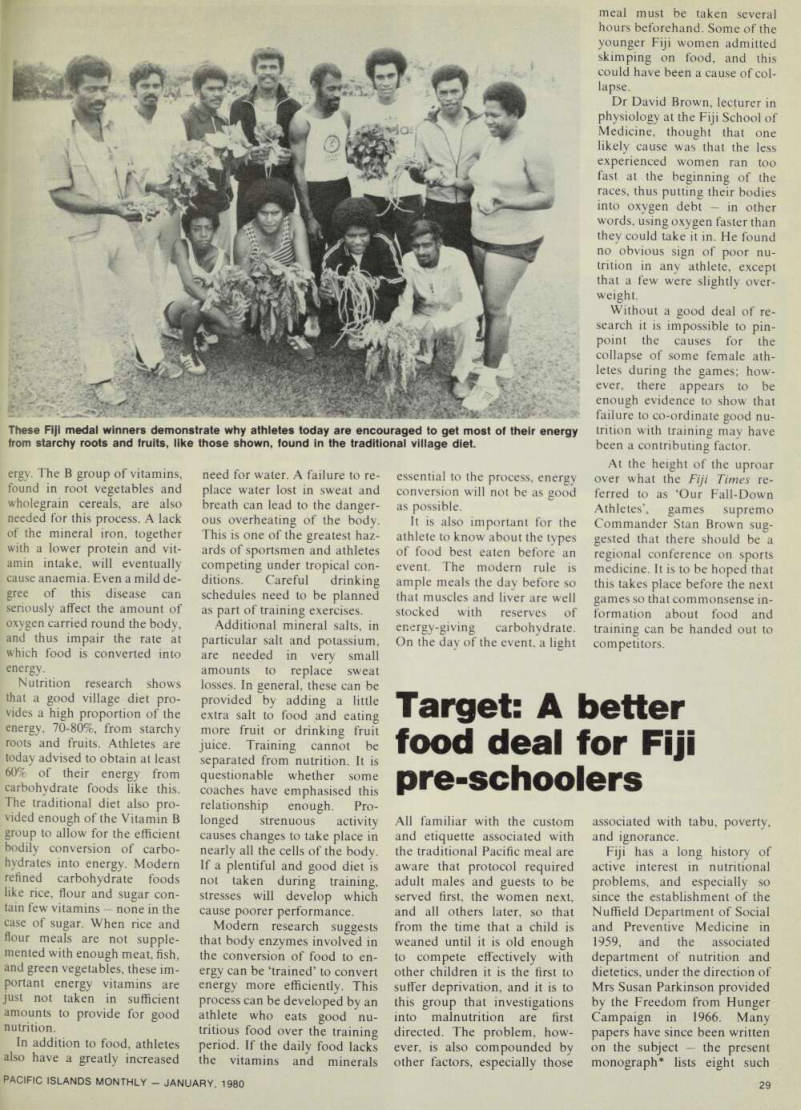
Nutrition research shows that a good village diet provides a high proportion of the energy, 70-80%, from starchy roots and fruits. Athletes are today advised to obtain at least 60% of their energy from carbohydrate foods like this.
The traditional diet also provided enough of the Vitamin B group to allow for the efficient bodily conversion of carbohydrates into energy. Modern refined carbohydrate foods like rice, flour and sugar contain few vitamins none in the case of sugar. When rice and flour meals are not supplemented with enough meat, fish, and green vegetables, these important energy vitamins are just not taken in sufficient amounts to provide for good nutrition.
In addition to food, athletes also have a greatly increased
need for water. A failure to re place water lost in sweat and breath can lead to the danger ous overheating of the body, This is one of the greatest haz ards of sportsmen and athletes
competing under tropical con
ditions. Careful drinking schedules need to be planned as part of training exercises, Additional mineral salts, in
particular salt and potassium,
are needed in very small amounts to replace sweat losses. In general, these can be
provided by adding a little
extra salt to food and eating more fruit or drinking fruit
juice. Training cannot be
separated from nutrition. It is questionable whether some coaches have emphasised this
relationship enough. Pro
longed strenuous activity
causes changes to take place in nearly all the cells of the body, If a plentiful and good diet is
not taken during training,
stresses will develop which cause poorer performance, Modem research suggests that body enzymes involved in the conversion of food to en ergy can be ‘trained’ to convert energy more efficiently. This process can be developed by an athlete who eats good nu tritious food over the training period. If the daily food lacks the vitamins and minerals
essential to the process, energy conversion will not be as good
as possible.
It is also important for the athlete to know about the types of food best eaten before an event. The modern rule is ample meals the day before so that muscles and liver are well stocked with reserves of
energy-giving carbohydrate,
On the day of the event, a light
meal must be taken several hours beforehand. Some of the younger Fiji women admitted skimping on food, and this could have been a cause of col
lapse.
Dr David Brown, lecturer in physiology at the Fiji School of Medicine, thought that one likely cause was that the less experienced women ran too fast at the beginning of the races, thus putting their bodies into oxygen debt in other words, using oxygen faster than they could take it in. He found no obvious sign of poor nu trition in any athlete, except that a few were slightly over
weight.
Without a good deal of re search it is impossible to pin point the causes for the collapse of some female ath letes during the games; how ever, there appears to be enough evidence to show that failure to co-ordinate good nu trition with training may have been a contributing factor.
At the height of the uproar over what the Fiji Times re ferred to as ‘Our Fall-Down Athletes’, games supremo Commander Stan Brown sug gested that there should be a regional conference on sports medicine. It is to be hoped that this takes place before the next games so that commonsense in formation about food and training can be handed out to
competitors.
These Fiji medal winners demonstrate why athletes today are encouraged to get most of their energy from starchy roots and fruits, like those shown, found in the traditional village diet.