People
pp. 24-25 · Read in the full issue
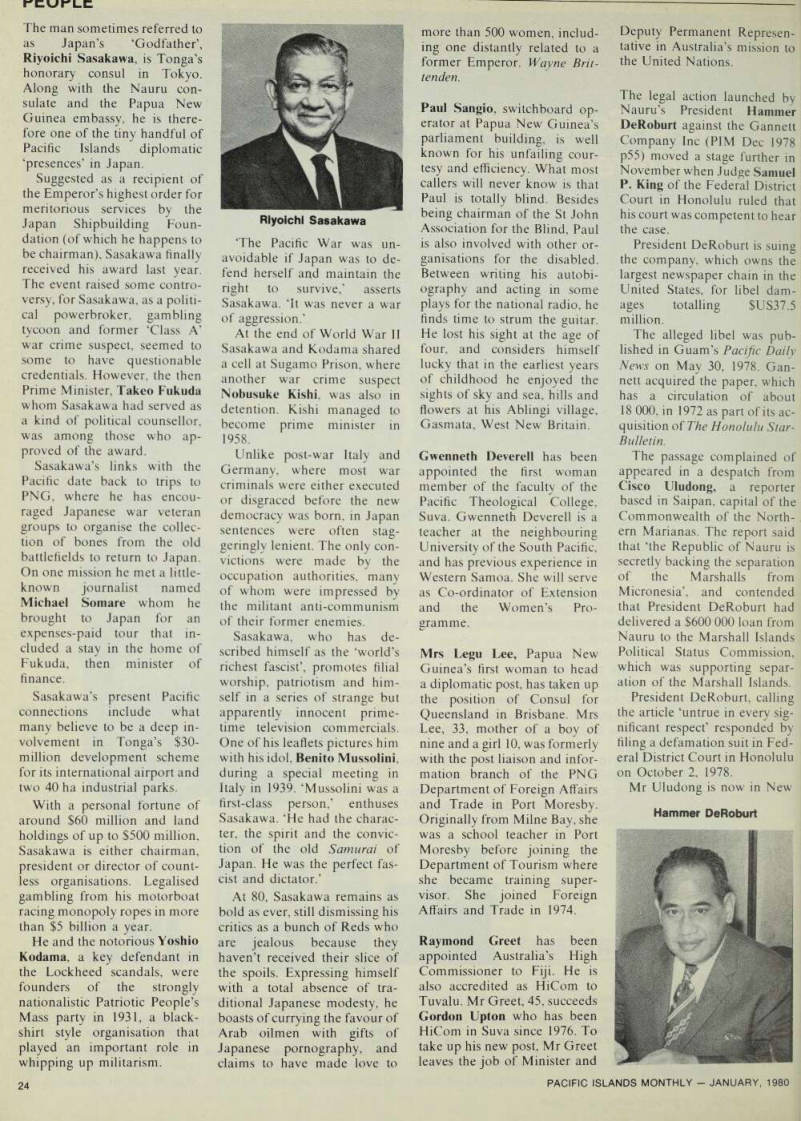
The man sometimes referred to as Japan’s ‘Godfather’, Riyoichi Sasakawa, is Tonga’s
honorary consul in Tokyo.
Along with the Nauru con sulate and the Papua New Guinea embassy, he is there fore one of the tiny handful of Pacific Islands diplomatic ‘presences’ in Japan.
Suggested as a recipient of the Emperor’s highest order for meritorious services by the
Japan Shipbuilding Foun
dation (of which he happens to be chairman), Sasakawa finally received his award last year.
The event raised some contro versy, for Sasakawa, as a politi cal powerbroker, gambling tycoon and former ‘Class A’ war crime suspect, seemed to some to have questionable credentials. However, the then Prime Minister, Takeo Fukuda whom Sasakawa had served as a kind of political counsellor, was among those who ap proved of the award.
Sasakawa’s links with the Pacific date back to trips to PNG, where he has encou
raged Japanese war veteran
groups to organise the collec tion of bones from the old battlefields to return to Japan.
On one mission he met a little known journalist named Michael Somare whom he brought to Japan for an expenses-paid tour that in cluded a stay in the home of Fukuda, then minister of finance.
Sasakawa’s present Pacific connections include what many believe to be a deep in volvement in Tonga’s $3O - development scheme for its international airport and two 40 ha industrial parks.
With a personal fortune of around $6O million and land holdings of up to $5OO million, Sasakawa is either chairman, president or director of count
less organisations. Legalised
gambling from his motorboat racing monopoly ropes in more than $5 billion a year.
He and the notorious Yoshio Kodama, a key defendant in the Lockheed scandals, were founders of the strongly nationalistic Patriotic People’s Mass party in 1931, a black
shirt style organisation that
played an important role in whipping up militarism.
‘The Pacific War was un avoidable if Japan was to de fend herself and maintain the right to survive,’ asserts Sasakawa. ‘lt was never a war
of aggression.’
At the end of World War II Sasakawa and Kodama shared a cell at Sugamo Prison, where another war crime suspect Nobusuke Kishi, was also in detention. Kishi managed to become prime minister in 1958.
Unlike post-war Italy and Germany, where most war criminals were either executed or disgraced before the new democracy was born, in Japan sentences were often stag geringly lenient. The only con victions were made by the occupation authorities, many of whom were impressed by the militant anti-communism of their former enemies.
Sasakawa, who has de scribed himself as the ‘world’s richest fascist’, promotes filial
worship, patriotism and him
self in a series of strange but
apparently innocent prime
time television commercials.
One of his leaflets pictures him with his idol. Benito Mussolini,
during a special meeting in
Italy in 1939. ‘Mussolini was a first-class person,’ enthuses Sasakawa. ‘He had the charac ter. the spirit and the convic tion of the old Samurai of Japan. He was the perfect fas cist and dictator.’
At 80, Sasakawa remains as bold as ever, still dismissing his critics as a bunch of Reds who
are jealous because they
haven’t received their slice of
the spoils. Expressing himself
with a total absence of tra ditional Japanese modesty, he boasts of currying the favour of Arab oilmen with gifts of
Japanese pornography, and
claims to have made love to
more than 500 women, includ ing one distantly related to a former Emperor. Wayne Brit tenden.
Paul Sangio, switchboard op erator at Papua New Guinea’s
parliament building, is well
known for his unfailing cour tesy and efficiency. What most callers will never know is that Paul is totally blind. Besides being chairman of the St John Association for the Blind, Paul is also involved with other or ganisations for the disabled.
Between writing his autobi ography and acting in some plays for the national radio, he finds time to strum the guitar.
He lost his sight at the age of four, and considers himself lucky that in the earliest years of childhood he enjoyed the sights of sky and sea, hills and flowers at his Ablingi village, Gasmata, West New Britain.
Gwenneth Deverell has been appointed the first woman member of the faculty of the
Pacific Theological College,
Suva. Gwenneth Deverell is a teacher at the neighbouring University of the South Pacific, and has previous experience in Western Samoa. She will serve as Co-ordinator of Extension and the Women’s Pro gramme.
Mrs Legu Lee, Papua New Guinea’s first woman to head a diplomatic post, has taken up the position of Consul for Queensland in Brisbane. Mrs Lee, 33, mother of a boy of nine and a girl 10, was formerly with the post liaison and infor mation branch of the PNG
Department of Foreign Affairs
and Trade in Port Moresby.
Originally from Milne Bay, she was a school teacher in Port
Moresby before joining the
Department of Tourism where she became training super
visor. She joined Foreign
Affairs and Trade in 1974.
Raymond Greet has been
appointed Australia’s High
Commissioner to Fiji. He is also accredited as HiCom to Tuvalu. Mr Greet, 45, succeeds Gordon Upton who has been HiCom in Suva since 1976. To take up his new post, Mr Greet leaves the job of Minister and
Deputy Permanent Represen tative in Australia’s mission to the United Nations.
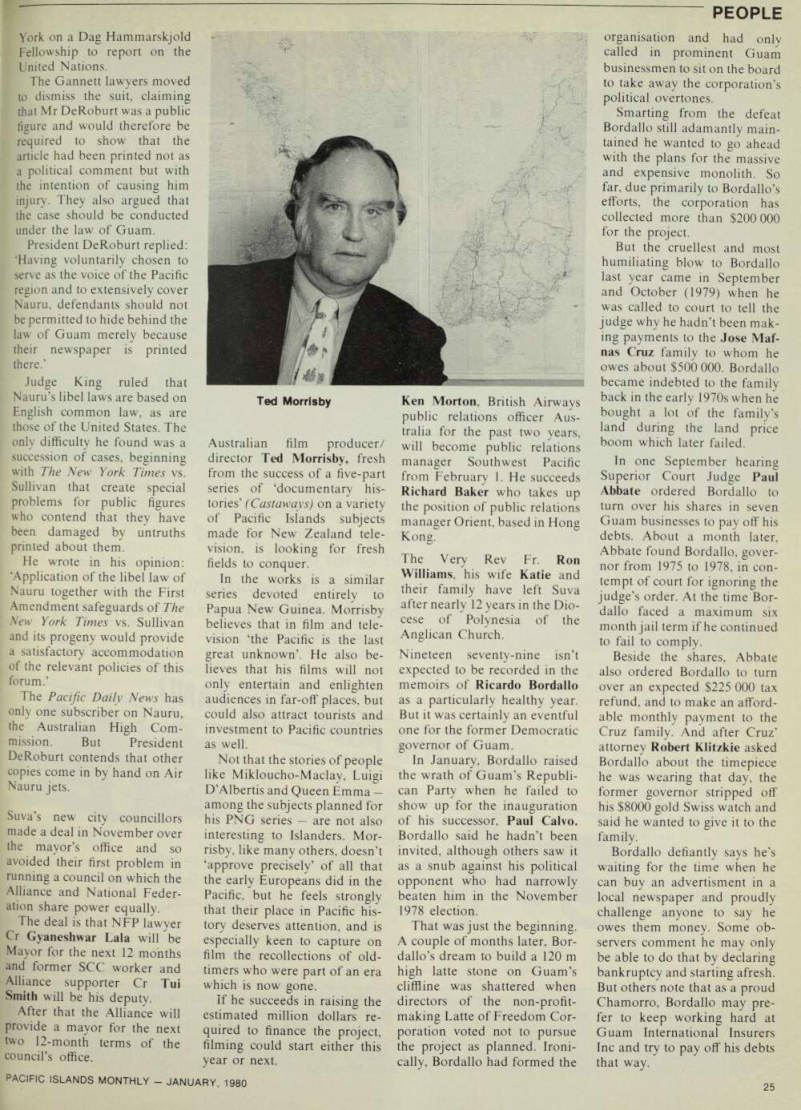
The legal action launched by Nauru’s President Hammer Deßoburt against the Gannett Company Inc (PIM Dec 1978 p 55) moved a stage further in November when Judge Samuel P. King of the Federal District Court in Honolulu ruled that his court was competent to hear the case.
President Deßoburt is suing the company, which owns the largest newspaper chain in the United States, for libel dam ages totalling $U537.5 million.
The alleged libel was pub lished in Guam’s Pacific Daily News on May 30, 1978. Gan nett acquired the paper, which has a circulation of about 18 000, in 1972 as part of its ac quisition of The Honolulu Star- Bulletin.
The passage complained of appeared in a despatch from Cisco Uludong, a reporter based in Saipan, capital of the Commonwealth of the North ern Marianas. The report said that ‘the Republic of Nauru is
secretly backing the separation
of the Marshalls from Micronesia’, and contended that President Deßoburt had delivered a $6OO 000 loan from Nauru to the Marshall Islands Political Status Commission, which was supporting separ ation of the Marshall Islands.
President Deßoburt, calling the article ‘untrue in every sig
nificant respect’ responded by
filing a defamation suit in Fed eral District Court in Honolulu on October 2, 1978.
Mr Uludong is now in New
Riyoichi Sasakawa
Hammer DeRoburt
York on a Dag Hammarskjold Fellowship to report on the United Nations.
The Gannett lawyers moved to dismiss the suit, claiming that Mr Deßoburt was a public figure and would therefore be required to show that the article had been printed not as a political comment but with the intention of causing him injury. They also argued that the case should be conducted under the law of Guam.
President Deßoburt replied:
‘Having voluntarily chosen to
serve as the voice of the Pacific region and to extensively cover Nauru, defendants should not be permitted to hide behind the law of Guam merely because their newspaper is printed there.’
Judge King ruled that
Nauru’s libel laws are based on English common law, as are those of the United States. The only difficulty he found was a succession of cases, beginning with The New York Times vs.
Sullivan that create special
problems for public figures
who contend that they have
been damaged by untruths
printed about them.
He wrote in his opinion: ‘Application of the libel law of Nauru together with the First Amendment safeguards of The New York Times vs. Sullivan and its progeny would provide a satisfactory accommodation of the relevant policies of this forum.’
The Pacific Daily News has only one subscriber on Nauru, the Australian High Com mission. But President Deßoburt contends that other copies come in by hand on Air
Nauru jets.
Suva’s new city councillors made a deal in November over the mayor’s office and so avoided their first problem in running a council on which the Alliance and National Feder ation share power equally.
The deal is that NFP lawyer Cr Gyaneshwar Lala will be Mayor for the next 12 months and former SCC worker and Alliance supporter Cr Tui Smith will be his deputy.
After that the Alliance will provide a mayor for the next two 12-month terms of the council’s office.
Australian film producer/ director Ted Morrisby, fresh from the success of a five-part series of ‘documentary his tories’ ( Castaways) on a variety of Pacific Islands subjects made for New Zealand tele vision, is looking for fresh fields to conquer.
In the works is a similar series devoted entirely to
Papua New Guinea. Morrisby
believes that in film and tele vision ‘the Pacific is the last great unknown’. He also be lieves that his films will not
only entertain and enlighten
audiences in far-off places, but could also attract tourists and investment to Pacific countries as well.
Not that the stories of people
like Mikloucho-Maclay, Luigi
D’Albertis and Queen Emma among the subjects planned for his PNG series are not also interesting to Islanders. Mor risby, like many others, doesn’t ‘approve precisely’ of all that the early Europeans did in the Pacific, but he feels strongly that their place in Pacific his tory deserves attention, and is especially keen to capture on film the recollections of old timers who were part of an era which is now gone.
If he succeeds in raising the estimated million dollars re quired to finance the project, filming could start either this year or next.
Ken Morton, British Airways public relations officer Aus tralia for the past two years, will become public relations manager Southwest Pacific from February 1. He succeeds Richard Baker who takes up the position of public relations manager Orient, based in Hong
Kong.
The Very Rev Fr. Ron Williams, his wife Katie and their family have left Suva after nearly 12 years in the Dio cese of Polynesia of the
Anglican Church.
Nineteen seventy-nine isn’t expected to be recorded in the memoirs of Ricardo Bordallo as a particularly healthy year.
But it was certainly an eventful one for the former Democratic governor of Guam.
In January, Bordallo raised the wrath of Guam’s Republi can Party when he failed to show up for the inauguration of his successor. Paul Calvo.
Bordallo said he hadn’t been invited, although others saw it as a snub against his political opponent who had narrowly beaten him in the November 1978 election.
That was just the beginning.
A couple of months later, Bor dallo’s dream to build a 120 m high latte stone on Guam’s cliffline was shattered when directors of the non-profit making Latte of Freedom Cor poration voted not to pursue the project as planned. Ironi cally, Bordallo had formed the
organisation and had only called in prominent Guam businessmen to sit on the board to take away the corporation’s
political overtones.
Smarting from the defeat Bordallo still adamantly main tained he wanted to go ahead with the plans for the massive and expensive monolith. So far, due primarily to Bordallo’s efforts, the corporation has collected more than $2OO 000 for the project.
But the cruellest and most humiliating blow to Bordallo last year came in September and October (1979) when he was called to court to tell the judge why he hadn’t been mak ing payments to the Jose Maf nas Cruz family to whom he owes about $5OO 000. Bordallo became indebted to the family back in the early 1970 s when he bought a lot of the family’s land during the land price boom which later failed.
In one September hearing
Superior Court Judge Paul
Abbate ordered Bordallo to turn over his shares in seven Guam businesses to pay off his debts. About a month later, Abbate found Bordallo, gover nor from 1975 to 1978, in con tempt of court for ignoring the judge’s order. At the time Bor dallo faced a maximum six month jail term if he continued to fail to comply.
Beside the shares, Abbate also ordered Bordallo to turn over an expected $225 000 tax refund, and to make an afford able monthly payment to the Cruz family. And after Cruz’ attorney Robert Klitzkie asked Bordallo about the timepiece he was wearing that day, the former governor stripped off his $BOOO gold Swiss watch and said he wanted to give it to the
family.
Bordallo defiantly says he’s waiting for the time when he can buy an advertisment in a local newspaper and proudly challenge anyone to say he owes them money. Some ob servers comment he may only be able to do that by declaring
bankruptcy and starting afresh.
But others note that as a proud Chamorro, Bordallo may pre fer to keep working hard at Guam International Insurers Inc and try to pay off his debts that way.
Ted Morrisby