Prescription
pp. 18-22 · Read in the full issue

Political Currents
From Africa
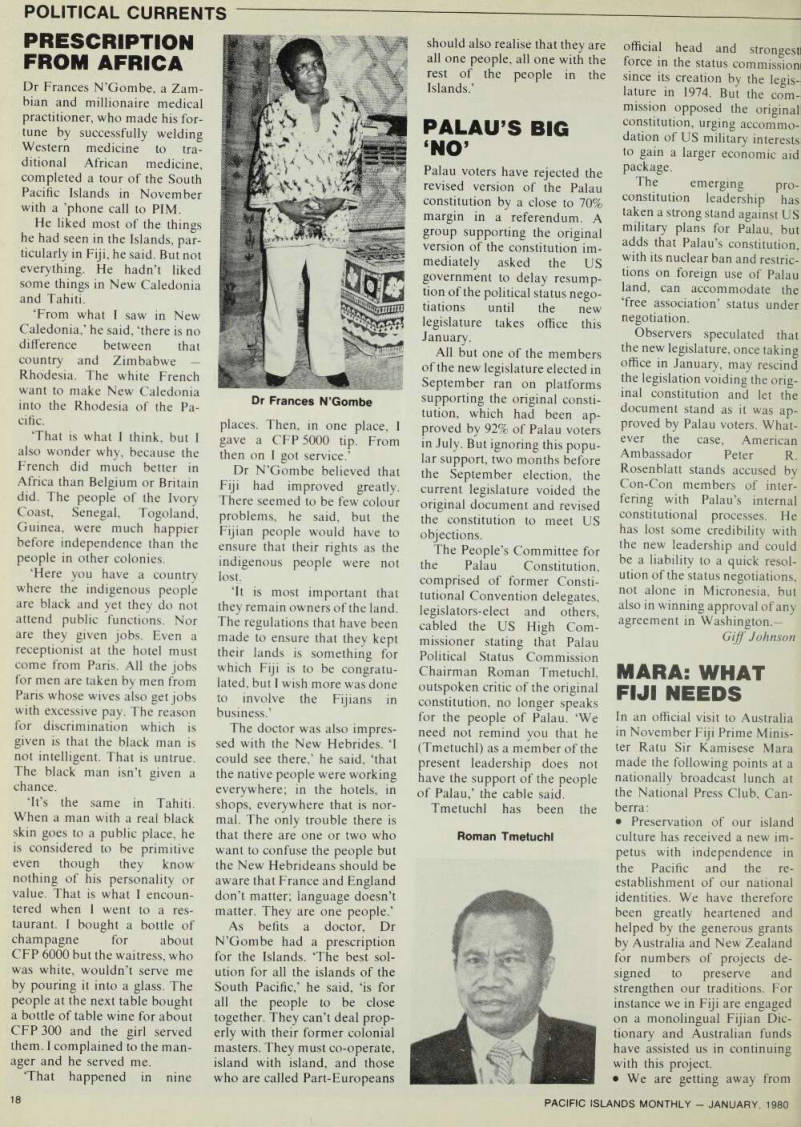
Dr Frances N’Gombe, a Zam bian and millionaire medical practitioner, who made his for
tune by successfully welding
Western medicine to tra ditional African medicine, completed a tour of the South Pacific Islands in November with a ’phone call to PIM.
He liked most of the things he had seen in the Islands, par ticularly in Fiji, he said. But not everything. He hadn’t liked some things in New Caledonia and Tahiti. ‘From what I saw in New Caledonia,’ he said, ‘there is no difference between that country and Zimbabwe - Rhodesia. The white French want to make New Caledonia into the Rhodesia of the Pa cific. ‘That is what I think, but I also wonder why, because the French did much better in Africa than Belgium or Britain did. The people of the Ivory
Coast, Senegal, Togoland,
Guinea, were much happier before independence than the people in other colonies. ‘Here you have a country
where the indigenous people
are black and yet they do not attend public functions. Nor
are they given jobs. Even a
receptionist at the hotel must come from Paris. All the jobs for men are taken by men from Paris whose wives also get jobs with excessive pay. The reason for discrimination which is given is that the black man is not intelligent. That is untrue.
The black man isn’t given a chance. ‘lt’s the same in Tahiti.
When a man with a real black skin goes to a public place, he is considered to be primitive
even though they know
nothing of his personality or value. That is what I encoun tered when I went to a res taurant. I bought a bottle of champagne for about CFP 6000 but the waitress, who was white, wouldn’t serve me by pouring it into a glass. The people at the next table bought a bottle of table wine for about CFP 300 and the girl served them. I complained to the man ager and he served me. ‘That happened in nine
places. Then, in one place, I gave a CFP 5000 tip. From then on I got service.’
Dr N’Gombe believed that
Fiji had improved greatly.
There seemed to be few colour problems, he said, but the Fijian people would have to ensure that their rights as the
indigenous people were not
lost. ‘lt is most important that they remain owners of the land.
The regulations that have been made to ensure that they kept their lands is something for which Fiji is to be congratu lated, but I wish more was done to involve the Fijians in business.’
The doctor was also impres sed with the New Hebrides. ‘I could see there,' he said, ‘that the native people were working everywhere; in the hotels, in shops, everywhere that is nor mal. The only trouble there is that there are one or two who want to confuse the people but the New Hebrideans should be aware that France and England don’t matter; language doesn’t matter. They are one people.’
As befits a doctor, Dr N’Gombe had a prescription for the Islands. ‘The best sol ution for all the islands of the South Pacific,’ he said, ‘is for all the people to be close together. They can’t deal prop erly with their former colonial masters. They must co-operate, island with island, and those who are called Part-Europeans
should also realise that they are all one people, all one with the rest of the people in the Islands.’
Palau’S Big
‘NO’
Palau voters have rejected the revised version of the Palau constitution by a close to 70% margin in a referendum. A
group supporting the original
version of the constitution im mediately asked the US government to delay resump tion of the political status nego tiations until the new legislature takes office this
January.
All but one of the members of the new legislature elected in September ran on platforms supporting the original consti tution, which had been ap proved by 92% of Palau voters in July. But ignoring this popu lar support, two months before the September election, the current legislature voided the original document and revised the constitution to meet US objections.
The People’s Committee for the Palau Constitution, comprised of former Consti tutional Convention delegates, legislators-elect and others, cabled the US High Com missioner stating that Palau Political Status Commission Chairman Roman Tmetuchl, outspoken critic of the original constitution, no longer speaks for the people of Palau. ‘We need not remind you that he (Tmetuchl) as a member of the present leadership does not have the support of the people of Palau,’ the cable said.
Tmetuchl has been the
official head and strongest force in the status commission since its creation by the legis lature in 1974. But the com mission opposed the original constitution, urging accommo dation of US military interests to gain a larger economic aid
package.
The emerging pro constitution leadership has taken a strong stand against US military plans for Palau, but adds that Palau’s constitution, with its nuclear ban and restric tions on foreign use of Palau land, can accommodate the ‘free association’ status under negotiation.
Observers speculated that the new legislature, once taking office in January, may rescind the legislation voiding the orig inal constitution and let the document stand as it was ap proved by Palau voters. What ever the case, American Ambassador Peter R.
Rosenblatt stands accused by Con-Con members of inter fering with Palau’s internal constitutional processes. He has lost some credibility with the new leadership and could be a liability to a quick resol ution of the status negotiations, not alone in Micronesia, but also in winning approval of any agreement in Washington.-
Gijf Johnson
Mara: What
Fiji Needs
In an official visit to Australia in November Fiji Prime Minis ter Ratu Sir Kamisese Mara made the following points at a nationally broadcast lunch at the National Press Club, Can berra: • Preservation of our island culture has received a new im petus with independence in the Pacific and the re establishment of our national identities. We have therefore been greatly heartened and helped by the generous grants by Australia and New Zealand for numbers of projects de signed to preserve and strengthen our traditions. For instance we in Fiji are engaged on a monolingual Fijian Dic tionary and Australian funds have assisted us in continuing with this project. • We are getting away from
Dr Frances N’Gombe
Roman Tmetuchl
simply being plantations to supply raw materials. More and more processing is going on in the islands, with the con sequent added value and the increase in our versatility and self-respect. We are doing this both in the larger scale indus trial fields and also in the smaller but no less important areas of intermediate tech nology. For example, in my own island of Lakeba we are
just establishing a factory to
make much fuller use of the coconut. We intend to make oil, coir, charcoal and coconut meal. • Quite apart from the financial benefit, we are get ting away from the situation where our people’s role in the copra industry was that of bearing heavy burdens of nuts, cutting out copra and manhan dling it into driers and on to vessels. With just a few steps upward in technology, nuts can be collected at the roadside and taken in by collectors to the centre for processing. Of course, the government in co
operation with the people’s
own effort has provided the road to make this possible, and
the factory equipment comes
under aid schemes. So this is the sort of aid which helps us to help ourselves. • Regional shipping and air lines have, I am afraid, not proved a success. However, in this we do not greatly differ from many parts of the world, and quite apart from the need
for absolutely top-class man
agement it may be that,
inherently, such regional oper
ations are almost doomed to failure because of the compet
ing interests and requirements
of the various countries. Nor is it any easier because such needs are quite legitimate and justifiable. Hence Air Pacific, where Fiji has been almost obliged to take a major
shareholding.
• On the labour front we have been sorry to see the tentacles of Australia and New Zealand metropolitan trade unionism reaching out to our islands. We are at a different stage of development, we have dif ferent problems and we have different traditional patterns of settlement. I must say the efforts to push into our indus-
trial scene received a resound ing rebuff a year or two back, when a spontaneous march of thousands of our citizens led by the women folk protested
vigorously against these
intrusions. But in any case we are now trying to handle these matters in the Pacific Way.
And that is by sitting down together in what we call the Tripartite Forum Govern ment, Employers and Trade Unions. True, we are con cerned with wage levels; and the participation of all these partners ensures that the views and positions of all are at least known to all and taken into account. • We have seen our University of the South Pacific grow so that we have an institution whose educational efforts are geared to our own require ments. But we have only been able to do this with most gener ous aid from many developed countries including Australia. • Another area where we shall, I am sure, be looking for aid is in connection with the re sources of the sea, where the new developing Law of the Sea is offering vast opportunities for exploitation. But they not only offer scope for exploi tation to us, the owners, but also to others from outside.
Surveillance will therefore be an important element in con servation. Even those of us with naval resources and airlines operating among our islands will find the task a daunting one. That is why we have wel
corned Australia’s offer to con duct a survey of all surveillance resources in the region. This will enable facilities to be measured by a common yard stick and at the same time see what supplementation is re quired in a way whereby co operation will make the most telling and economical use of resources. • The fishing resources of our countries must be vast and in seeking aid for their develop ment we are really asking you to give us an opportunity to do without aid. For once, some quite small countries have the
opportunity to develop viable
resources. By helping us, you not only enhance our economic position but also our self re spect.
Forum
Woos Asean
Initiatives have been taken to
develop a closer relationship
between the South Pacific Forum and the Association of South-East Asian Nations
(Asean).
The idea of a closer dialogue between the two regional groups was promoted at the 1979 Forum in Honiara by the
Papua New Guinea delegation.
It received strong backing from the Forum because the region’s leaders realised that their coun tries can learn a great deal from the ASEAN experience.
ASEAN was formed in 1967 to accelerate economic, social and cultural progress and has
become a viable regional force
embracing Indonesia,
Malaysia, Singapore, Thailand
and the Philippines.
The approach to ASEAN was made through the Forum secretariat, the South Pacific Bureau for Economic Co operation (SPEC). SPEC direc tor Mahe Tupouniua recently met ASEAN general secretary Datuk Ali Abdullah in Jakarta to discuss ‘appropriate areas of
co-operation.’
Mr Tupouniua describes the talks as ‘cordial.’ They focused on energy, transport, tourism and industrial co-operation.
He was impressed by the posi
tive attitude of the ASEAN and Indonesian officials to a con tinuing ASEAN-Forum dia
logue.
At Datuk Abdullah’s sugges tion he will discuss the question of SPEC representation at the next ASEAN meeting in Kuala
Lumpur (probably next July)
with the Malaysian foreign
minister.
There is obviously a degree of self-interest in seeking closer ties with ASEAN. Vulnerable Island economies face strong competition for Australian and New Zealand markets from the ASEAN countries.
Mr Tupouniua explains the
attitude of Forum nations: ‘ASEAN countries may need Australian and New Zealand aid but Pacific Island needs are greater because ASEAN coun tries are quite advanced indus trially and can guarantee more
job opportunities and higher
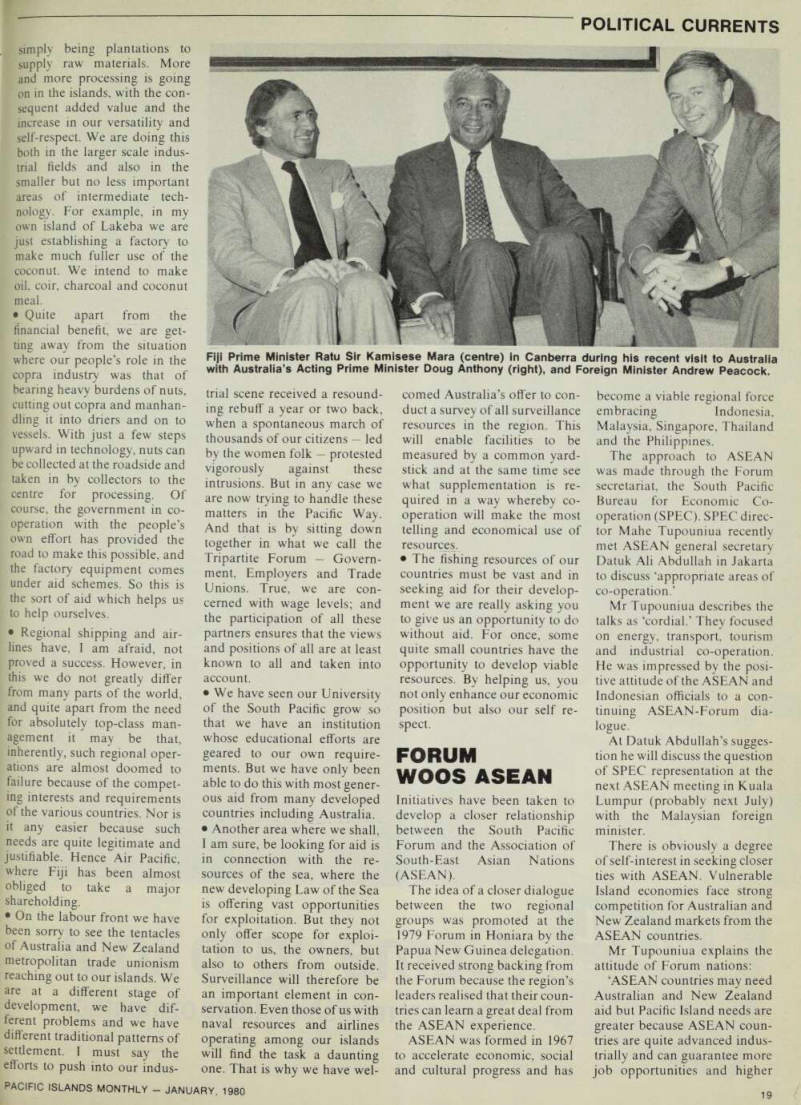
Fijl Prime Minister Ratu Sir Kamisese Mara (centre) in Canberra during his recent visit to Australia with Australia’s Acting Prime Minister Doug Anthony (right), and Foreign Minister Andrew Peacock.
incomes for their people, as a result. ‘Pacific Island countries wel come Australia and New Zealand aid programmes which in money terms are sub stantial but we do not wish to vie with ASEAN for such aid.
It is not the Pacific way to be greedy but to share the little we have. ‘But on the question of trade access Pacific Island nations cannot be treated on equal terms,’ says Mr Tupouniua. ‘Special consideration will have to be given to Pacific Island countries because by Pa cific standards we are dealing with industrial giants and we will not have a show of compet ing with ASEAN.’ James
Tally.
U.S. Won’T
Dump Waste
The United States has been re assuring Pacific Island govern ments that US plans for establishing a temporary spent nuclear fuel storage facility somewhere in the Pacific Islands has been the subject ‘of considerable misinformation’ in so'me parts of the Pacific. It’s been making it clear through diplomatic channels that it has no plans to turn Palmyra, Mid way or Wake islands into
‘dumping grounds for nuclear
wastes’.
The US has found it necess ary to make these denials as a result of publicity which fol lowed a State Department an nouncement of last June 14 which said that several US government agencies were
collaborating in preliminary
studies on the feasibility of establishing somewhere in the Pacific Islands an ‘interim spent fuel storage facility to serve the needs of Western Pa cific Basin countries’. The State
Department announcement
said that preliminary evalu ations would be made of Pal myra, Wake and Midway as possible sites.
The US has since made available fuller details of its thinking, and is going to some pains to stress that it is very early days yet. This is what it is telling Islands governments about its concept:
The US Nuclear Non- Proliferation Act is designed, among other things, to dis courage reprocessing of spent nuclear fuel rods from the world’s commercial power plant reactors before the material is actually needed commercially and before there are international agreements to reduce the risk of widespread proliferation of material from the rods that could be used for weapons, such as plutonium.
Plutonium can be extracted from the fuel rods through
reprocessing techniques but
currently it is not economic to reprocess the fuel for commer cial use.
If the material is not to be
reprocessed immediately then
it has to be put in safe storage.
The US has suspended indef initely the reprocessing of any of its own spent fuel, and is storing it in the US, and will continue to do so.
Under the Non-Proliferation Act it has offered to take back limited quantities of other people’s spent fuel for storage, to help guarantee it doesn’t get into the wrong hands. It fore sees the time approaching when it might need to find a temporary storage site for spent fuel from the Western Pacific, particularly from Japan, which is going into nu clear power in a big way. It is possible that South Korea, Taiwan and the Philippines might also need this facility.
The US has been stressing
that spent fuel stored for poss
ible reprocessing has nothing
to do with the problem of the permanent disposal of nuclear wastes, and that the Pacific is not being considered for waste
disposal.
Spent fuel would probably
be stored above ground in sealed silos made of about 100 to 200 tons of reinforced con crete. Each silo would be about seven metres high and four metres in diameter with walls about one metre thick. They would be expected to have to hold the spent fuel for up to 30 years.
The spent fuel, still con tained as pellets within the sealed rods of the rigid reactor assemblies, would originally give off considerable heat but would cool after a few years.
The US thinks storage facilities would be needed in the Pacific for 10 000 tonnes.
The ideal site would be an island that was isolated, that had regular rainfall but away from the storm and hurricane belt, with stable geography (obviously not in a volcanic belt) and with a harbour fa
cility.
Preliminary surveys have indicated that Palmyra, Mid way and Wake might be suit able, in that order of importance. Wake suffers from occasional typhoons. No other islands have been looked at, and if any are, it will be an nounced, the US says.
The inquiry is only at the preliminary stage. The US has
asked Japan to join with it in a full feasibility study of the proposal, and says that ‘further consultations with interested nations and other parties will be undertaken as this evalu ation proceeds’. The US hopes
the joint study might start this
March, and says the results of the study will ‘be made avail able to everybody’, but at least five to eight years can be expected to elapse before there are any firm decisions, if then.
The US Congress would be informed at every step in the
plan, and by law Congressional
approval would be required
before it could be put into op eration.
The US Consulate in Sydney told PIM: ‘A primary consider ation in reaching a decision will be assurance that such activity on any site does not present health, safety or environmental hazards. In ad dition, the social and political aspects will be evaluated. A range of views will be solicited and given full consideration in the evaluation process. ‘The US has instructed its embassies in the region to inform South Pacific nations.
Western Pacific nations, and many other capitals of the nature of the proposed study.
We have informed Micro nesian representatives and other islands officials. Gover nors of the state of Hawaii and of all US Pacific territories have been informed. The State Department has offered to brief members of Congress as well as representatives of any governments on this activity.’
Autonomists
Hard At It
‘lmmediate independence is not what French Polynesia wants,’ says Francis Sanford, who as vice-president of the Government Council of
French Polynesia, is Poly
nesia’s chief minister. ‘What we have got is genuine self government the right to run our own internal affairs, to use our own language officially, to fly our own flag, and that is enough for now. The rest will come.’
And Mr Sanford’s views are echoed by Frantz Vanizette,
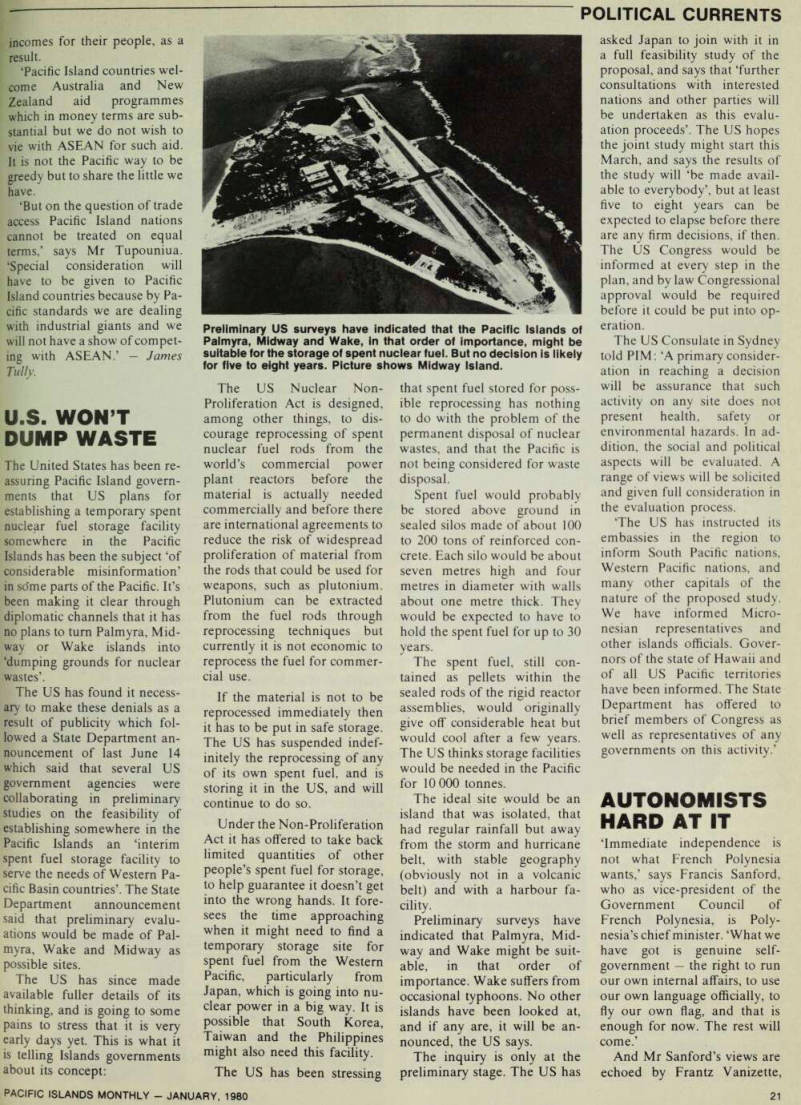
Preliminary US surveys have indicated that the Pacific Islands of Palmyra, Midway and Wake, in that order of importance, might be suitable for the storage of spent nuclear fuel. But no decision is likely for five to eight years. Picture shows Midway Island.
president of French Polynesia’s
Territorial Assembly, who says, ‘Freedom is fine, but you still have to have connections with other people. Small territories can’t survive on their own.’
The reality of self-govern-
ment has taken the heat out of the independence movement in French Polynesia. Men like Sanford who were in the vanguard of the demand for autonomy are now more busily
occupied in handling the
autonomy they’ve won And most of the population agree with their approach.
The demand for ‘independence now’ comes only from small groups with minor support, which is the reason why nobody, either in the French
establishment or the territory government, got much excited recently when PNG Deputy Prime Minister Ebia Olewale and New Hebrides Deputy Chief Minister George Kalkoa made stirring speeches at a
Papeete independence rally
(PIM Dec p 15). „,„ , . .
French Po| y nesia has been running its own affatrs, includ >"g co , nt I ro *>"S I ' s ° wn budget, since July 1977. It does it under “ ne r w constitution which both San [ ord and , Y 311126 sa y wor , ks - and whlch can and wlll evo ve ’
Mr Vanizette says the consti tution is responsible for the best relations that have ever existed between metropolitan
France and French Polynesia.
The new constitution clearly defined the State’s and Poly nesia’s responsibilities. ‘Before, there was too much ambiguity,’ he says. ‘What we got from time to time depended on who was in power in France, but not now. Power genuinely is in the hands of the Government Council for the first time. They run the
country.’
Mr Vanizette predicts that the next change will make the vice-president of the Govern ment Council into the official president of the Government Council (that title is at present held by the High Com missioner). He thinks there will also be more direct powers given the councillors who at the moment, for example, do not have the power to remove the head of a department that has to be done by the High missioner. ‘The evolution will be in the spirit of the French consti tution,’ he says, ‘which allows a local constitution to evolve with discussion.’
He believes the present con stitutional arrangement with France is more satisfactory
than complete independence,
because it enables Polynesians to discuss their needs with France ‘on a basis of equal-to
equal’.
If French Polynesia were independent today it could not possibly meet the money that was expended by France on the
development of the territory,
particularly its expenditure on
public servants, he said.
This did not mean that French Polynesia was not con scious of the need to build up its own economy. There was a time, only a few years ago, when France’s nuclear centre in French Polynesia was re sponsible for generating 60% of of the local economy. It had since been lowered to 30%, and each year French Polynesia was lowering the percentage even more, Vanizette said.
Under the constitution, France still controls French
Polynesia’s foreign affairs, citi
zenship, defence, police and
justice, and secondary edu
cation. Neither Francis San ford nor Vanizette sees the need for any of these responsi
bilities to be passed over right now, but Sanford thinks when the time does come for changes he would want to see foreign affairs passed over first be cause of its close involvement with trade.
Mr Sanford foresees a closer involvement between French Polynesia and the rest of the Pacific Islands. ‘What I woud like to see is all the groups of the South Pa cific coming together to form a kind of common market, work ing closer together on trade matters. That way we can all get stronger.’
Mr Sanford recognises the fact that some of his supporters fear he may have lost the drive drive that he once had towards full independence for French Polynesia. He doesn’t apolo gise for it; he says that once French Polynesia got the reins of government it was inevitable that it should consolidate be fore the next step.
He says: ‘Some people I know who were for indepen dence right away make visits to other places outside French Polynesia and see what is going on, and change their minds.
The fact is as long as we have the right to run our internal affairs, we are better to concen trate on developing our econ omy. That’s the big task. We have to create employment, and we are doing it’. Stuart Inder
Atmospheric nuclear tests like this one on Moruroa Atoll, French Polynesia, are a thing of the past. So are the times when the territory got as much as 60% of its budget from the nuclear testing pro gramme. According to French Polynesia’s leaders, the programme now accounts for only 30% of the budget, and this percentage will go down further.
Above: Francis Sanford; below: Frantz Vanizette.